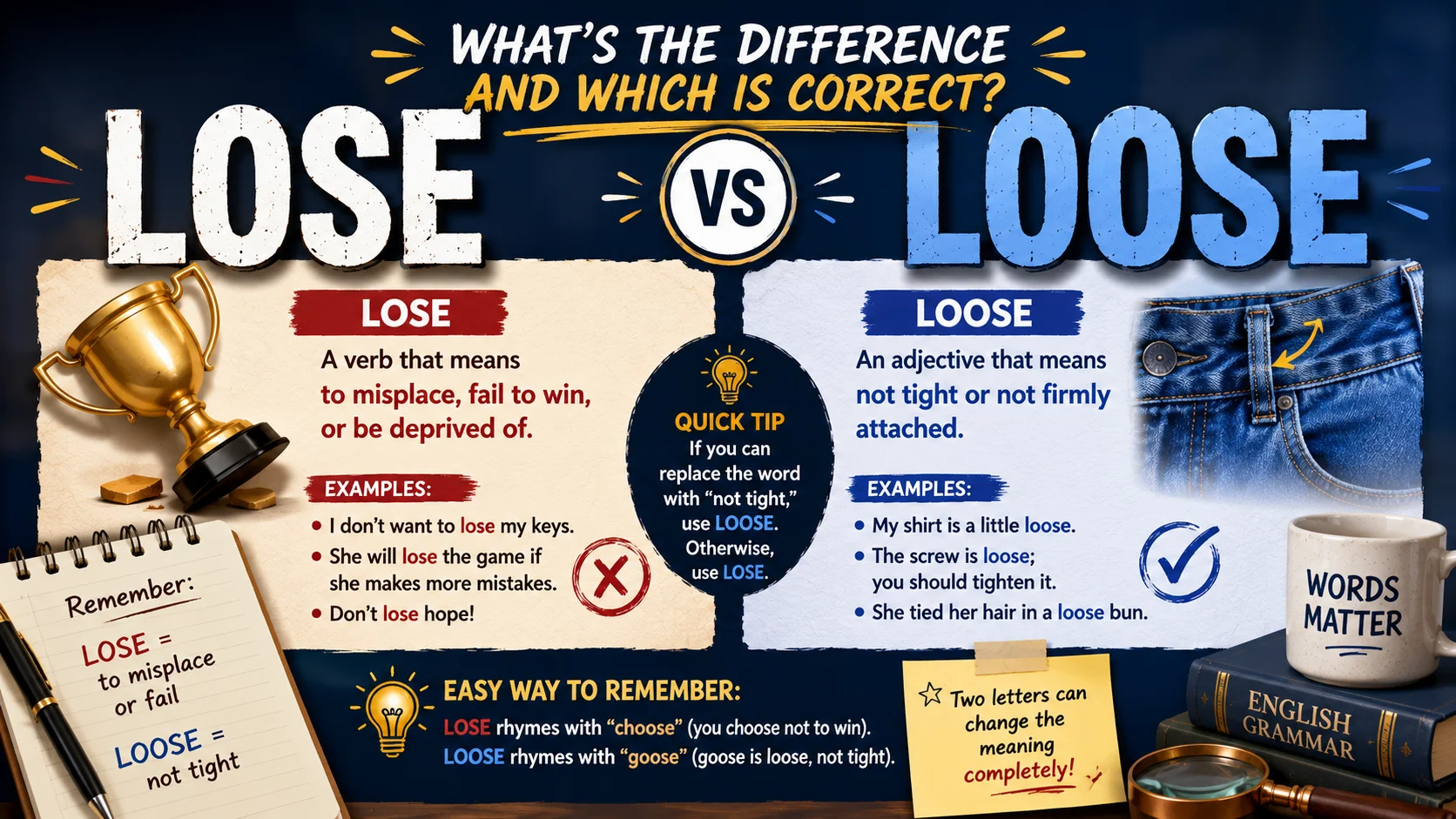
Lose and loose are two commonly confused English words. They look and sound similar, but they have completely different meanings and grammatical functions. Lose is usually a verb meaning to misplace something, fail to win, or no longer have something. Loose is usually an adjective meaning not tight, not firmly attached, or free from restraint.
For example, you might lose your keys, lose a game, or lose weight. On the other hand, your shoes might be loose, a screw might be loose, or a dog might get loose from its leash.
The extra o in loose is an easy way to remember the difference, but spelling alone isn’t enough. Understanding how each word works in a sentence will help you choose the right one every time.
Quick Answer: Lose or Loose?
Lose is a verb. It means to misplace something, fail to win, become deprived of something, or experience a reduction.
Loose is usually an adjective. It means not tight, not firmly fixed, or not securely held.
- ✅ I don’t want to lose my phone.
- ✅ These shoes are too loose.
- ❌ I don’t want to loose my phone.
- ❌ These shoes are too lose.
| Word | Part of Speech | Main Meaning | Example |
|---|---|---|---|
| Lose | Verb | Misplace, fail to win, or no longer have | Don’t lose your keys. |
| Loose | Adjective | Not tight or not firmly attached | My shirt is loose. |
What Does “Lose” Mean?
Lose is a verb with several related meanings. The exact meaning depends on the context.
Lose Something
To lose something can mean to misplace it or no longer know where it is.
I always lose my keys.
She lost her phone at the airport.
Lose a Competition
A Lose can mean to fail to win a game, contest, election, or competition.
Our team lost the game.
They don’t want to lose the championship.
Lose Weight
A Lose can also mean to experience a reduction in weight.
He wants to lose weight.
She lost five pounds last year.
Lose Time
You can also lose time, meaning that time is wasted or unavailable.
We lost an hour because of traffic.
Lose Someone
Lose can mean to stop being able to find or follow someone.
I lost my friend in the crowd.
It can also refer to experiencing someone’s death:
She lost her father when she was young.
What Does “Loose” Mean?
Loose is most commonly an adjective describing something that is not tight, not firmly attached, or not securely held.
A Loose Clothing
This jacket is too loose for me.
Loose Tooth
The child has a loose tooth.
A Loose Screw
There’s a loose screw on the chair.
A Loose Rope
The rope became loose after several hours.
The word can also describe something that is free or not restrained.
The dog got loose from its leash.
Lose vs. Loose at a Glance
| Feature | Lose | Loose |
|---|---|---|
| Part of speech | Usually verb | Usually adjective |
| Pronunciation | /luːz/ | /luːs/ |
| Main idea | Misplace, fail, or no longer have | Not tight or not secure |
| Example | I might lose my wallet. | My wallet strap is loose. |
| Past tense | Lost | — |
| Opposite | Find, win, gain | Tight, secure |
The Biggest Difference: Meaning
The easiest way to distinguish lose and loose is to focus on their meanings.
Lose = No Longer Have or Fail
Think:
Lose = something goes away from you.
Examples:
- lose your keys
- lose a game
- lose money
- lose weight
- lose your job
- lose interest
Loose = Not Tight
Think:
Loose = something isn’t firmly held.
Examples:
- loose shoes
- loose clothing
- loose hair
- loose screws
- loose rope
- loose teeth
Lose vs. Loose Pronunciation
The pronunciation is another important difference.
Lose
Lose is pronounced /luːz/.
It rhymes with words such as:
- choose
- shoes
- news
- blues
The final sound is a /z/ sound.
Loose
Loose is pronounced /luːs/.
It rhymes with:
- goose
- juice
- moose
The final sound is an /s/ sound.
| Word | IPA | Ending Sound | Rhymes With |
|---|---|---|---|
| Lose | /luːz/ | Z | Choose |
| Loose | /luːs/ | S | Goose |
This pronunciation difference can help you remember which word you’re hearing.
Why Do People Confuse Lose and Loose?
There are several reasons these words cause problems.
They Look Similar
Both words begin with loo-, and the only spelling difference is one extra o.
- lose
- loose
They Sound Similar
The vowel sound is the same, and the difference in the final consonant can be subtle for English learners.
Both Relate to Things Becoming Less Secure
There is also a conceptual connection that can make them confusing.
You can lose something because it is no longer with you, while something loose is not firmly secured.
For example:
I might lose my bracelet because the clasp is loose.
Here, both words appear naturally in the same sentence but have different meanings.
Common Mistakes
Mistake 1: “Loose” Instead of “Lose”
❌ I don’t want to loose this opportunity.
✅ I don’t want to lose this opportunity.
An opportunity can be lost, but it cannot be physically loose.
Mistake 2: “Lose” Instead of “Loose”
❌ My shoes are too lose.
✅ My shoes are too loose.
Shoes can be loose because they aren’t tight enough.
Mistake 3: “Loose Weight”
❌ I want to loose weight.
✅ I want to lose weight.
The correct phrase is always lose weight.
Mistake 4: “Lose Clothing”
❌ She prefers lose clothing.
✅ She prefers loose clothing.
Here, loose describes clothing that isn’t tight.
Lose vs. Loose in Common Expressions
Lose Weight
I’m trying to lose weight.
Not:
❌ I’m trying to loose weight.
Lose Control
The driver lost control of the car.
Lose Interest
He lost interest in the project.
Loose Clothing
She prefers loose clothing in hot weather.
Loose Change
A Loose change means small coins that are not organized or stored in a wallet or container.
I found some loose change in my car.
On the Loose
The expression on the loose means free and not captured or restrained.
The escaped animal was still on the loose.
Lose vs. Loose vs. Lost
A third word often enters the confusion: lost.
These three forms are related but serve different purposes.
| Word | Function | Example |
|---|---|---|
| Lose | Present/base verb | Don’t lose your keys. |
| Lost | Past tense/past participle | I lost my keys. |
| Loose | Usually adjective | The keys were in a loose pocket. |
Lose
I don’t want to lose my phone.
Lost
I lost my phone yesterday.
Loose
The phone fell through the loose lining of my bag.
Lose vs. Loose in Different Contexts
In School
Don’t lose your homework.
The paper is loose inside the folder.
At Work
The company could lose an important client.
There is a loose wire under the desk.
In Sports
We can’t afford to lose this game.
The player’s shoe became loose.
In Everyday Life
I don’t want to lose my wallet.
The button on my shirt is loose.
How to Remember Lose vs. Loose
A simple memory trick is:
Loose has more O’s because something has more room.
For example:
Loose shirt = more room
Loose shoes = more room
For lose, remember:
Lose = one thing is gone.
You can also associate the words with their final sounds:
- Lose → /z/ → win? No, you lose
- Loose → /s/ → softly not tight
The most reliable method, however, is to focus on meaning.
20 Natural Examples With Lose
- Don’t lose your keys.
- I don’t want to lose my phone.
- Our team might lose the game.
- She lost her wallet yesterday.
- He hopes to lose weight.
- We could lose valuable time.
- Don’t lose your confidence.
- The company may lose customers.
- I always lose track of time.
- She doesn’t want to lose her job.
- We can’t afford to lose this opportunity.
- He lost interest in the project.
- They could lose money on the deal.
- I don’t want to lose touch with my friends.
- The team lost by three points.
- She was afraid of losing her passport.
- Don’t lose hope.
- He lost his way in the city.
- The business could lose its reputation.
- I nearly lost my balance.
20 Natural Examples With Loose
- These shoes are too loose.
- My shirt feels loose.
- The screw is loose.
- The dog got loose from its leash.
- She prefers loose clothing.
- The rope became loose.
- I found some loose change in my pocket.
- The tooth is loose.
- One of the buttons is loose.
- The lid is loose.
- The wire is loose.
- His tie was loose around his neck.
- The knot came loose.
- The fence has a loose board.
- The handle feels loose.
- The dog is running loose in the yard.
- A loose thread was hanging from the shirt.
- The belt is too loose.
- The connection is loose.
- The chair has a loose leg.
Quick Test: Which Word Should You Use?
Ask yourself what you mean.
Do You Mean “Misplace” or “Fail to Keep”?
Use lose.
I don’t want to lose my passport.
Do You Mean “Not Tight”?
Use loose.
My passport holder is loose.
Do You Mean “Not Captured or Restrained”?
Use loose.
The horse got loose.
Do You Mean “Fail to Win”?
Use lose.
Our team might lose the match.
People Also Ask
What is the difference between lose and loose?
Lose is usually a verb meaning to misplace something, fail to win, or no longer have something. Loose is usually an adjective meaning not tight, not firmly attached, or free from restraint.
Is it lose weight or loose weight?
The correct phrase is lose weight.
I want to lose weight.
Loose weight is incorrect.
Is it lose clothes or loose clothes?
The correct phrase is loose clothes when you mean clothing that isn’t tight.
She prefers loose clothes.
Is lose pronounced like loose?
No. Lose ends with a /z/ sound, while loose ends with an /s/ sound.
- lose /luːz/
- loose /luːs/
What is the past tense of lose?
The past tense of lose is lost.
I lost my keys yesterday.
Is loose a verb?
Loose can also be used as a verb, although this use is less common. As a verb, it can mean to release or set free.
They loosed the horses into the field.
In everyday English, however, loose is most commonly encountered as an adjective.
What is the opposite of lose?
Depending on the meaning, the opposite of lose can be find, win, keep, or gain.
What is the opposite of loose?
The opposite of loose is usually tight, secure, or firmly attached, depending on the context.
Frequently Asked Questions
Why is loose spelled with two o’s?
The spelling helps distinguish loose from lose. The two words have different meanings and pronunciations even though they look similar.
Is “loose” always an adjective?
No. Loose can also function as a verb, particularly when it means to release or set free. However, its adjective use is much more common.
Is “lose” always a verb?
In standard modern English, lose is primarily a verb. Its forms include loses, losing, and lost.
How do I remember lose vs. loose?
Remember: lose = something is gone, while loose = something isn’t tight. Another trick is that loose has an extra o, giving it “more room.”
Which is correct: loose change or lose change?
The correct phrase is loose change. It refers to small coins that are not stored in a wallet or container.
Which is correct: lose control or loose control?
The correct phrase is lose control.
He lost control of the car.
Which is correct: on the loose or on the lose?
The correct expression is on the loose, meaning free or not captured.
Which is correct: lose interest or loose interest?
The correct phrase is lose interest.
She lost interest in the project.
Conclusion
The difference between lose vs. loose becomes much easier once you connect each word with its meaning. Lose is mainly a verb used for misplacing something, failing to win, becoming deprived of something, or experiencing a reduction. Loose is mainly an adjective describing something that isn’t tight, firmly attached, or restrained.
Remember the basic rule:
Lose = misplace, fail, or no longer have.
Loose = not tight or not secure.
So you lose your keys, lose a game, and lose weight, but you wear loose clothing, fix a loose screw, and find loose change.
If you keep those meanings separate, you’ll rarely confuse these two commonly mixed-up words again.

Olivia Bennett is a writer and language enthusiast at Vocabsteria. She is passionate about exploring word meanings, name origins, and cultural expressions from around the world.