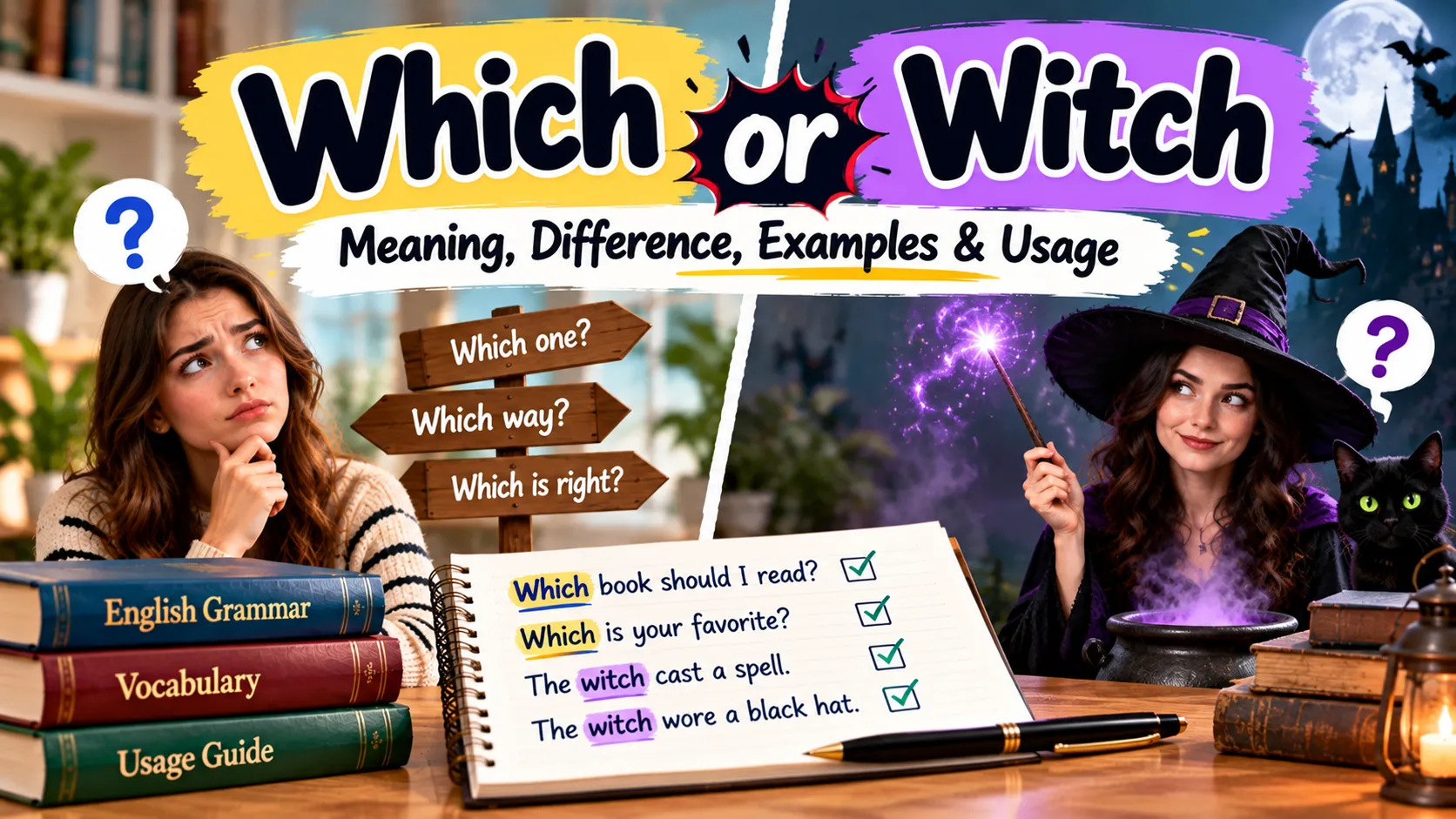
Have you ever confused two English words that sound exactly alike but have completely different meanings? Which and witch are a perfect example. One helps you ask questions and identify choices, while the other refers to a person associated with magic or witchcraft.
Although their pronunciation is identical in most English accents, their spelling and grammatical functions are different. Using the wrong word can change your sentence’s meaning or create an avoidable spelling mistake.
In this guide, you’ll learn the definitions, grammar rules, example sentences, and easy memory tricks that make these commonly confused words easier to understand.
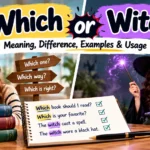
🔎 Which vs. Witch: The Main Difference
Both words sound alike, but their meanings determine how you should spell them. One is commonly used in questions, while the other names a person or character associated with witchcraft.
| Word | Meaning | Example |
|---|---|---|
| Which | Asks about a choice or identifies something | Which book do you want? |
| Witch | A person associated with witchcraft or magic | The witch lived in a forest. |
These words are called homophones because they share the same pronunciation but have different spellings and meanings.
Remember this simple rule: use which when asking about a choice, and use witch when talking about a person associated with magic.
📘 What Does Which Mean?
The word which is a pronoun or determiner used to ask questions, identify particular items, or introduce additional information about something already mentioned.
You might use it when choosing a meal, selecting a movie, or asking someone to identify an object. It helps narrow down the available options.
Examples:
- Which movie should we watch tonight?
- Which student answered correctly?
- I don’t know which road leads to the station.
- Which of these bags belongs to you?
- The house, which has a red door, belongs to my aunt.
In the final example, the word introduces extra information about the house rather than asking a direct question.
🧙 What Does Witch Mean?
A witch is a noun traditionally used for a person believed to practice witchcraft or possess supernatural powers. The word frequently appears in fairy tales, fantasy stories, folklore, and Halloween celebrations.
Fictional witches can be kind, mysterious, frightening, or powerful, depending on the story. Some people also use the term in connection with their spiritual or religious practices.
Examples:
- The witch lived in a cottage near the woods.
- The children dressed as witches for Halloween.
- A friendly witch helped the lost traveler.
- The movie featured a witch who could cast spells.
- The young witch studied magic in an ancient castle.
Unlike a question word, this noun refers to a person or character.
✍️ Examples of Both Words in Sentences
The easiest way to understand these spellings is to compare them in similar situations. Context reveals whether a sentence asks for information or describes someone connected with witchcraft.
| Sentence using which | Sentence using witch |
|---|---|
| Which dress looks better? | The witch wore a black dress. |
| Which team won the game? | The witch appeared in the story. |
| Which book is yours? | The witch opened her spellbook. |
| Which road should we take? | The witch lived beside the road. |
| Which character is your favorite? | The witch was the main character. |
Notice how the first column focuses on questions and choices, while the second describes a person or fictional character.
📝 When Should You Use Which?
Use which when asking someone to choose between options, identifying a specific item, or adding information to a sentence. It can appear in direct questions, indirect questions, and relative clauses.
To ask a question:
- Which restaurant do you prefer?
- Which answer is correct?
- Which shoes match this outfit?
Identify an option:
- Tell me which bus goes downtown.
- I cannot decide which phone to buy.
- Choose which color you like best.
To add information:
- My car, which is ten years old, still runs well.
- She visited Paris, which is famous for its landmarks.
- The test, which was difficult, took two hours.
The word’s purpose depends on the sentence. It may introduce a question or connect additional details to a noun.
🧹 When Should You Use Witch?
Use witch when referring to a person associated with witchcraft, magic, or a fictional character who uses supernatural powers. It commonly appears with articles such as a and the.
Examples:
- A witch flew across the moon in the story.
- The young witch learned how to prepare potions.
- We watched a movie about a powerful witch.
- The Halloween decoration featured a witch on a broomstick.
- The children wrote a story about a friendly witch.
You may also encounter related terms such as witchcraft and witch-hunt. These expressions have their own meanings, so consider the context when using them.
🔤 Are These Words Homophones?
Yes. Homophones are words that sound alike but have different meanings or spellings. Because pronunciation alone cannot distinguish these terms, writers must rely on context to select the correct form.
Other common examples include:
- There and their
- Flower and flour
- Pair and pear
- Sea and see
- Right and write
These pairs can cause spelling mistakes in emails, school assignments, blog posts, and messages. Proofreading for meaning is especially useful when two words share the same pronunciation.
⚠️ Common Spelling Mistakes to Avoid
Writers sometimes select the wrong spelling because they hear the word rather than consider its meaning. The following examples show how to correct common errors.
| Incorrect sentence | Correct sentence |
|---|---|
| Witch color do you prefer? | Which color do you prefer? |
| The which flew away. | The witch flew away. |
| I wonder witch movie is better. | I wonder which movie is better. |
| The which cast a spell. | The witch cast a spell. |
| Witch book belongs to you? | Which book belongs to you? |
To prevent these errors, ask yourself what the sentence communicates. If it asks about an option, use which. If it names a person associated with magic, use witch.
🧠 An Easy Memory Trick
A simple association can help you remember the correct spelling without repeatedly checking a dictionary.
- Which = choice: Think of choosing between two or more options.
- Witch = magic: Picture a witch with a pointed hat or magic wand.
- Which asks: “Which one do you want?”
- Witch is someone: “The witch performed a spell.”
You can also remember that which frequently appears in questions, while witch often follows words such as a, the, or young.
These are helpful clues rather than strict grammar rules, but they work well for everyday spelling.
🎃 Using Both Words in Halloween Writing
Halloween is a common setting for the word witch. Stories, costumes, decorations, and themed activities often feature witches, broomsticks, cauldrons, and magical spells.
Consider these examples:
- She dressed as a witch for Halloween.
- Which costume should I wear to the party?
- The witch decoration stood beside the front door.
- Which candy did you receive while trick-or-treating?
- The children told a story about a friendly witch.
Halloween sentences are useful for spelling practice because both words can appear naturally in the same paragraph. Focus on meaning rather than pronunciation to determine the correct spelling.
📚 Grammar and Word Forms
Although these words sound alike, they belong to different grammatical categories. Understanding their roles can help you avoid confusion.
| Feature | Which | Witch |
|---|---|---|
| Part of speech | Pronoun or determiner | Noun |
| Main purpose | Ask about or identify something | Name a person associated with witchcraft |
| Example | Which option is best? | The witch cast a spell. |
| Common word forms | Depends on sentence structure | Witches |
The plural of witch is witches. The word which does not have a corresponding plural form in its ordinary use as a question word or determiner.
💬 Everyday Conversation Examples
Both words appear naturally in conversation, but they serve different purposes. One helps people make decisions, while the other typically appears when discussing magic, stories, or costumes.
Examples using which:
- Which coffee would you like?
- Which route is faster?
- Do you remember which restaurant we visited?
- Which jacket matches these trousers?
Examples using witch:
- My favorite character is the witch.
- The children watched a film about a witch.
- She bought a witch costume for the party.
- The story follows a witch who protects a village.
In spoken English, listeners rely on context to understand the intended meaning. In writing, choosing the correct spelling communicates that meaning clearly.
🌟 Can Both Words Appear in One Sentence?
Yes. A sentence can use both words correctly when asking about a particular witch or identifying one character among several.
Examples include:
- Which witch cast the spell?
- Which witch appeared in the final scene?
- I cannot decide which witch is the kindest.
- Which witch would you choose for the story?
- The quiz asks which witch belongs to each fairy tale.
These examples demonstrate the difference particularly well. The first word introduces a question, while the second identifies the character being discussed.
🧩 Practice Quiz: Choose the Correct Word
Test your understanding by filling in each blank. Try answering the questions before checking the solutions.
- _____ dress should I wear to the party?
- The _____ lived in a small house near the woods.
- I don’t know _____ answer is correct.
- The story follows a young _____ who discovers her powers.
- _____ of these books belongs to you?
- The children dressed as a _____ for Halloween.
- Can you tell me _____ bus goes to the airport?
- The _____ in the movie could make things disappear.
Answers:
- Which
- Witch
- Which
- Witch
- Which
- Witch
- Which
- Witch
If you answered all eight correctly, you understand the main distinction. If you missed any, revisit the definitions and memory trick before trying again.
❓ Frequently Asked Questions
What is the difference between which and witch?
Which asks about a choice or identifies something, while witch refers to a person associated with witchcraft. Their pronunciation is the same in most English accents.
Are both spellings correct?
Yes. Both are standard English words, but they have different meanings and grammatical uses. Neither spelling replaces the other.
How do you spell the word for a person who practices witchcraft?
The spelling is witch. Its plural form is witches.
How do you use which in a sentence?
Use it to ask about a choice or identify something. For example, “Which jacket should I buy?”
Are these words pronounced the same way?
Yes. They are homophones in most English accents, meaning they sound alike despite having different spellings and meanings.
What is the plural of witch?
The plural form is witches. For example, “The witches appeared in the fairy tale.”
Can both words appear in the same sentence?
Yes. “Which witch is your favorite?” is grammatically correct. The first word asks a question, and the second refers to a character.
Why do people confuse these spellings?
Their identical pronunciation makes it difficult to distinguish them by sound alone. Remembering their meanings helps prevent mistakes.
✅ Conclusion
These two homophones become easy to distinguish when you focus on what a sentence means. Use which when asking a question, making a choice, or identifying something. Use witch when describing a person or character associated with witchcraft.
Although the words sound alike, their grammatical roles are different. Remember the simple connection: which helps you choose, while a witch is associated with magic. With this distinction in mind, you can use both words confidently in everyday writing.

Olivia Bennett is a writer and language enthusiast at Vocabsteria. She is passionate about exploring word meanings, name origins, and cultural expressions from around the world.