Verbiage or verbage—which spelling is correct? This is one of those English word choices that can make even experienced writers stop and look twice. The two forms look almost identical, but they do not have the same status in standard English.
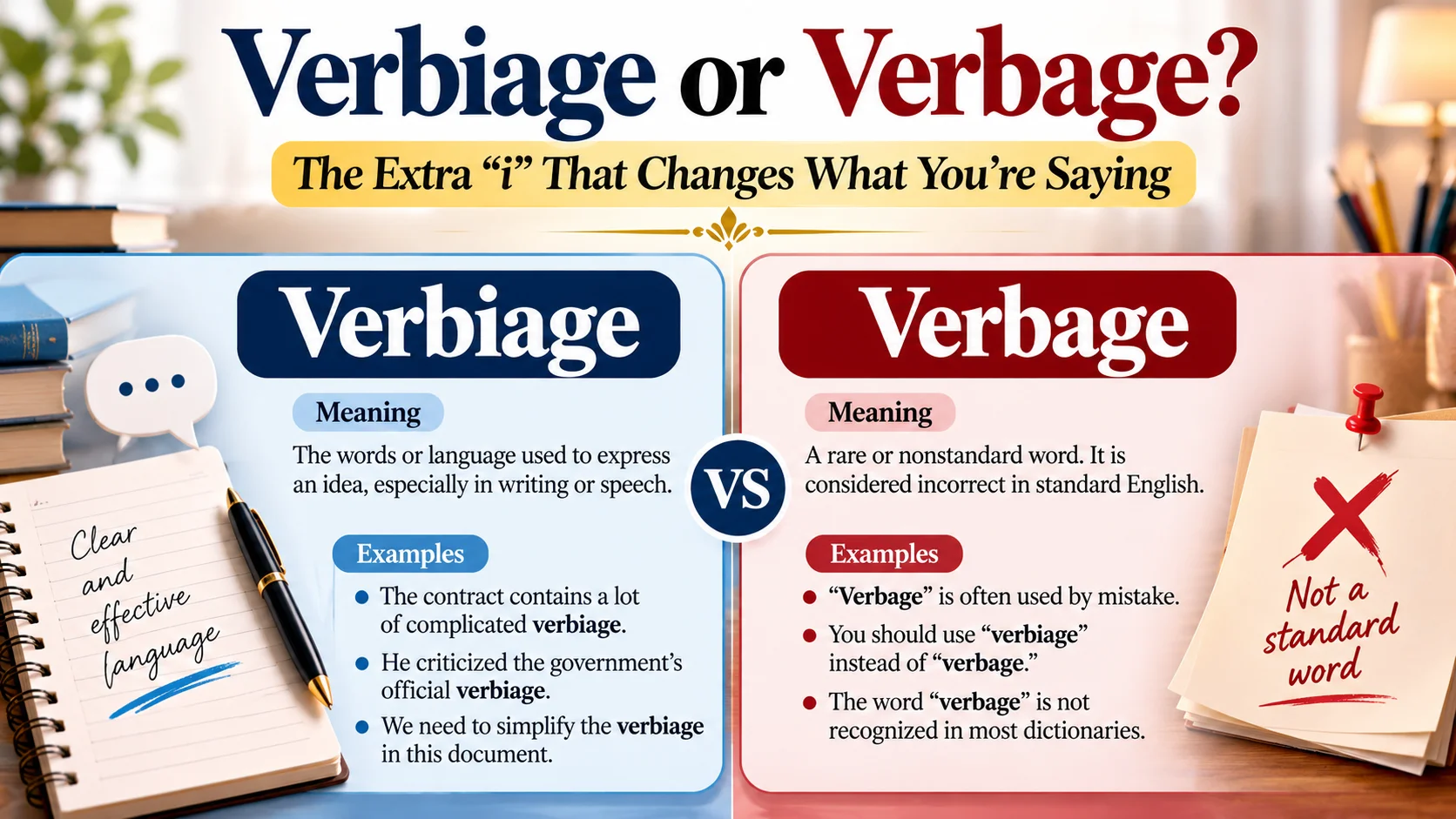
The standard word is verbiage. It generally refers to the way something is expressed in words, especially the particular wording used in a document, statement, contract, or piece of writing. Verbage is a common misspelling or nonstandard variant that appears in informal usage.
If you’re writing for school, work, publishing, websites, or professional communication, verbiage is the spelling you should normally choose.
✍️ Verbiage or Verbage? The Quick Answer
The standard spelling is verbiage, with an i after the b.
| Word | Standard English? | Meaning |
|---|---|---|
| Verbiage | ✅ Yes | Wording or expression used in speech or writing |
| Verbage | ⚠️ Nonstandard/common misspelling | Often intended to mean verbiage |
The simple rule:
Use “verbiage,” not “verbage,” in standard professional writing.
For example:
Please review the verbiage in the contract.
📖 What Does Verbiage Mean?
Verbiage refers to the words or wording used to express an idea. It can describe the language of a document, announcement, agreement, policy, email, or other communication.
Examples:
- legal verbiage
- contract verbiage
- website verbiage
- marketing verbiage
- technical verbiage
- policy verbiage
- formal verbiage
For example:
The lawyer suggested changing the verbiage of the agreement.
Here, verbiage means the specific wording used in the agreement.
🔤 Why Is Verbiage Spelled With an I?
The word verbiage comes from French verbiage, which is related to verbe, meaning “word” or “verb.”
The spelling has remained established in English as:
v-e-r-b-i-a-g-e
Because verbiage visually resembles words beginning with verb-, some writers naturally shorten or alter it to verbage.
However, the standard spelling retains the i.
⚖️ Verbiage vs Verbage at a Glance
The distinction becomes much easier when you compare the words directly.
| Feature | Verbiage | Verbage |
|---|---|---|
| Standard dictionary spelling | ✅ Yes | Usually nonstandard |
| Common in professional writing | ✅ Yes | ❌ Avoid |
| Meaning | Wording or language | Usually intended as “verbiage” |
| Correct spelling for SEO content | ✅ Yes | ❌ No |
| Used in contracts | ✅ Yes | ❌ Avoid |
| Used in academic writing | ✅ Yes | ❌ Avoid |
The safest choice in standard English is verbiage.
📝 How to Use Verbiage in a Sentence
Verbiage is often used when discussing the wording of something.
Examples:
- Please change the verbiage in the email.
- The contract contains complicated legal verbiage.
- We need clearer verbiage on the website.
- The company updated its privacy policy verbiage.
- The instructions use technical verbiage.
- I would like to simplify the verbiage.
- The advertisement uses persuasive verbiage.
- The new verbiage makes the policy easier to understand.
💼 Verbiage in Business Writing
You will often encounter verbiage in workplace communication because businesses constantly revise wording in documents, emails, contracts, policies, and marketing materials.
Common phrases include:
- change the verbiage
- revise the verbiage
- update the verbiage
- simplify the verbiage
- clarify the verbiage
- review the verbiage
- legal verbiage
- email verbiage
- contract verbiage
- website verbiage
Example:
Could you review the verbiage before we send the announcement?
Here, verbiage simply means the wording of the announcement.
⚖️ Legal Verbiage: What Does It Mean?
The phrase legal verbiage commonly refers to the particular wording used in legal documents.
For example:
The attorney reviewed the legal verbiage before the contract was signed.
Legal documents often contain specialized terminology, formal expressions, and carefully constructed sentences. Changing even a small part of the wording can sometimes affect how a provision is interpreted.
Common phrases:
- contract verbiage
- agreement verbiage
- legal document verbiage
- terms and conditions verbiage
- policy verbiage
- disclaimer verbiage
🌐 Verbiage in Website Content
Website owners and content writers also use verbiage to describe the wording displayed on a webpage.
For example:
We need to update the homepage verbiage.
This could refer to:
- headings
- descriptions
- buttons
- product copy
- service descriptions
- policy text
- calls to action
- informational content
In digital marketing, you may hear someone say:
“Let’s make the website verbiage more concise.”
That means they want the wording to be clearer or shorter.
📣 Verbiage in Marketing
Marketing teams frequently discuss verbiage when developing advertisements, campaigns, product descriptions, and promotional material.
Examples:
The marketing team changed the verbiage in the campaign.
The new ad verbiage sounds more conversational.
We need stronger verbiage for the product description.
In these contexts, verbiage refers to the actual words and phrasing used in the marketing message.
🧠 Is Verbiage Always a Good Word?
Although verbiage is a standard English word, its meaning and tone can vary depending on context.
It can simply mean wording:
I like the verbiage in this paragraph.
But it can also suggest excessive or unnecessarily complicated wording:
The report contains too much technical verbiage.
Because of this, wording can sometimes be a clearer alternative.
Compare:
Please review the verbiage.
Please review the wording.
Both can work, but wording is often simpler and more direct.
🔎 Verbiage vs Wording
These words are closely related but not always interchangeable in tone.
| Word | General Meaning |
|---|---|
| Verbiage | The words or phrasing used to express something |
| Wording | The particular way something is expressed |
| Language | Words and expressions used to communicate |
| Terminology | Specialized words used in a particular field |
| Phrasing | The way an idea is put into words |
Examples:
I don’t understand the legal terminology.
I don’t like the wording of this sentence.
The contract contains complex legal verbiage.
Each word emphasizes something slightly different.
🚫 Why Do People Write Verbage?
The spelling verbage is understandable because English contains many words beginning with verb-, and the pronunciation of verbiage may encourage people to leave out the middle vowel.
When someone hears:
VER-bee-ij
they may naturally write:
verbage
But pronunciation is not always a reliable guide to spelling.
The established spelling is:
verbiage
🧩 Common Mistake: Verbage
A frequent spelling mistake is:
❌ The contract needs clearer verbage.
The standard form is:
✅ The contract needs clearer verbiage.
Another example:
❌ Please change the website verbage.
Better:
✅ Please change the website verbiage.
If you’re writing professionally, keeping the i is important.
📚 Verbiage in Academic Writing
Academic writers may use verbiage when discussing wording, language, or the expression of an argument.
Examples:
The revised verbiage makes the research question clearer.
The author uses complex verbiage to describe the process.
The policy’s verbiage requires further clarification.
However, academic writing often benefits from precision. If you simply mean “wording,” wording may sometimes be the clearer choice.
🇺🇸 Verbiage in American English
Verbiage is an established word in American English and is widely understood in professional and everyday contexts.
You can encounter it in:
- business emails
- contracts
- legal documents
- academic writing
- marketing
- website content
- technical documentation
- policy documents
- customer communications
The spelling verbiage is the appropriate standard choice for these contexts.
🗣️ How Do You Pronounce Verbiage?
Verbiage is commonly pronounced approximately:
VER-bee-ij
The pronunciation helps explain why some people mistakenly spell it verbage.
But the spelling contains the additional i:
verbiage
Remember the sequence:
verb + i + age
This isn’t a perfect spelling rule, but it can help you remember the word.
✏️ Correct and Incorrect Examples
Here are some side-by-side examples.
Correct:
The contract contains complicated verbiage.
Incorrect in standard writing:
The contract contains complicated verbage.
Correct:
We should simplify the website verbiage.
Incorrect:
We should simplify the website verbage.
Correct:
Please review the email verbiage.
Incorrect:
Please review the email verbage.
Correct:
The new verbiage is easier to understand.
Incorrect:
The new verbage is easier to understand.
🔄 Verbiage as a Mass Noun
Verbiage is generally used as an uncountable or mass noun when it means wording or language.
You would normally say:
The verbiage is confusing.
rather than:
The verbiages are confusing.
You can refer to different pieces or examples of wording in other ways:
- phrases
- sentences
- wording
- passages
- sections
- expressions
For example:
The wording in these three sections is confusing.
🧠 Easy Memory Trick for Verbiage
Here’s a simple way to remember the spelling:
VERB + I + AGE = VERBIAGE
The important letter is I.
Think:
Verbiage has an “I” in it.
So when you’re tempted to write verbage, pause and remember:
❌ verbage
✅ verbiage
📊 Verbiage vs Verbage in Different Situations
| Situation | Recommended Word |
|---|---|
| Contract wording | verbiage |
| Legal wording | verbiage |
| Website wording | verbiage |
| Marketing copy | verbiage |
| Policy language | verbiage |
| Academic writing | verbiage |
| Professional email | verbiage |
| Informal spelling | Avoid verbage in standard writing |
🔍 When Should You Use Wording Instead?
Sometimes wording is actually a better choice than verbiage.
If your goal is maximum clarity, you can often replace verbiage with wording.
For example:
Please change the wording of this sentence.
This is simpler than:
Please change the verbiage of this sentence.
Similarly:
The wording is confusing.
is often more direct than:
The verbiage is confusing.
This does not make verbiage incorrect. It simply means that wording may be more accessible.
🛠️ How to Improve Confusing Verbiage
If someone tells you that a document has complicated verbiage, they may be asking you to make the language easier to understand.
You can improve unclear wording by:
- shortening long sentences
- removing unnecessary words
- replacing jargon
- using familiar vocabulary
- explaining technical terms
- organizing ideas clearly
- avoiding unnecessary repetition
- choosing direct verbs
- breaking large paragraphs into smaller sections
For example:
Due to the fact that the application was unable to be processed…
can often become:
Because the application could not be processed…
The second version uses simpler wording.
🎯 Quick Practice: Verbiage or Verbage?
Choose the correct spelling.
- The contract contains complicated ___.
Answer: verbiage - Please review the email ___.
Answer: verbiage - The website ___ needs to be updated.
Answer: verbiage - We should simplify the legal ___.
Answer: verbiage - The marketing team changed the ___.
Answer: verbiage - Which spelling is standard?
Answer: verbiage - Which form should you avoid in formal writing?
Answer: verbage
❓ Frequently Asked Questions About Verbiage vs Verbage
Is it verbiage or verbage?
The standard spelling is verbiage. Verbage is generally considered a nonstandard spelling or misspelling.
What does verbiage mean?
Verbiage means the words or wording used to express something. It can also refer to unnecessarily complicated or excessive language depending on context.
Is verbage a real word?
Verbage appears in informal and nonstandard usage, but verbiage is the established standard form for formal and professional writing.
Is verbiage singular or plural?
Verbiage is generally used as a mass noun rather than a countable plural noun.
Can I use verbiage in a business email?
Yes. Verbiage is commonly used in professional communication when discussing the wording of documents, emails, policies, or other materials.
Is legal verbiage correct?
Yes. Legal verbiage is a commonly used phrase referring to the wording or language of legal documents.
Is website verbiage correct?
Yes. Website verbiage can refer to the wording used throughout a website.
Is wording better than verbiage?
Not necessarily. Both can be correct. Wording is often simpler and more direct, while verbiage can emphasize the language or phrasing used in a document or communication.
How do you pronounce verbiage?
It is commonly pronounced approximately VER-bee-ij.
Why do people spell verbiage as verbage?
The pronunciation can make the word seem as though it should be spelled verbage, and its connection to “verb” may reinforce that assumption. The standard spelling, however, is verbiage.
Does verbiage mean too many words?
It can. In some contexts, verbiage refers neutrally to wording; in others, it can carry the sense of excessive or complicated language.
What is the easiest way to remember verbiage?
Remember:
VERB + I + AGE = VERBIAGE
The i is the letter commonly left out in the misspelling verbage.
🏁 Final Takeaway
When you’re deciding between verbiage or verbage, choose verbiage for standard English.
Verbiage refers to the words, wording, or language used to express something. It is especially common when discussing contracts, policies, websites, marketing material, legal documents, and professional communication.
Verbage is a common nonstandard form and should generally be avoided in polished writing.
The easiest rule is:
Correct: verbiage ✅
Avoid: verbage ❌
And if you want an even simpler alternative, wording is often a clear and natural replacement.

Olivia Bennett is a writer and language enthusiast at Vocabsteria. She is passionate about exploring word meanings, name origins, and cultural expressions from around the world.