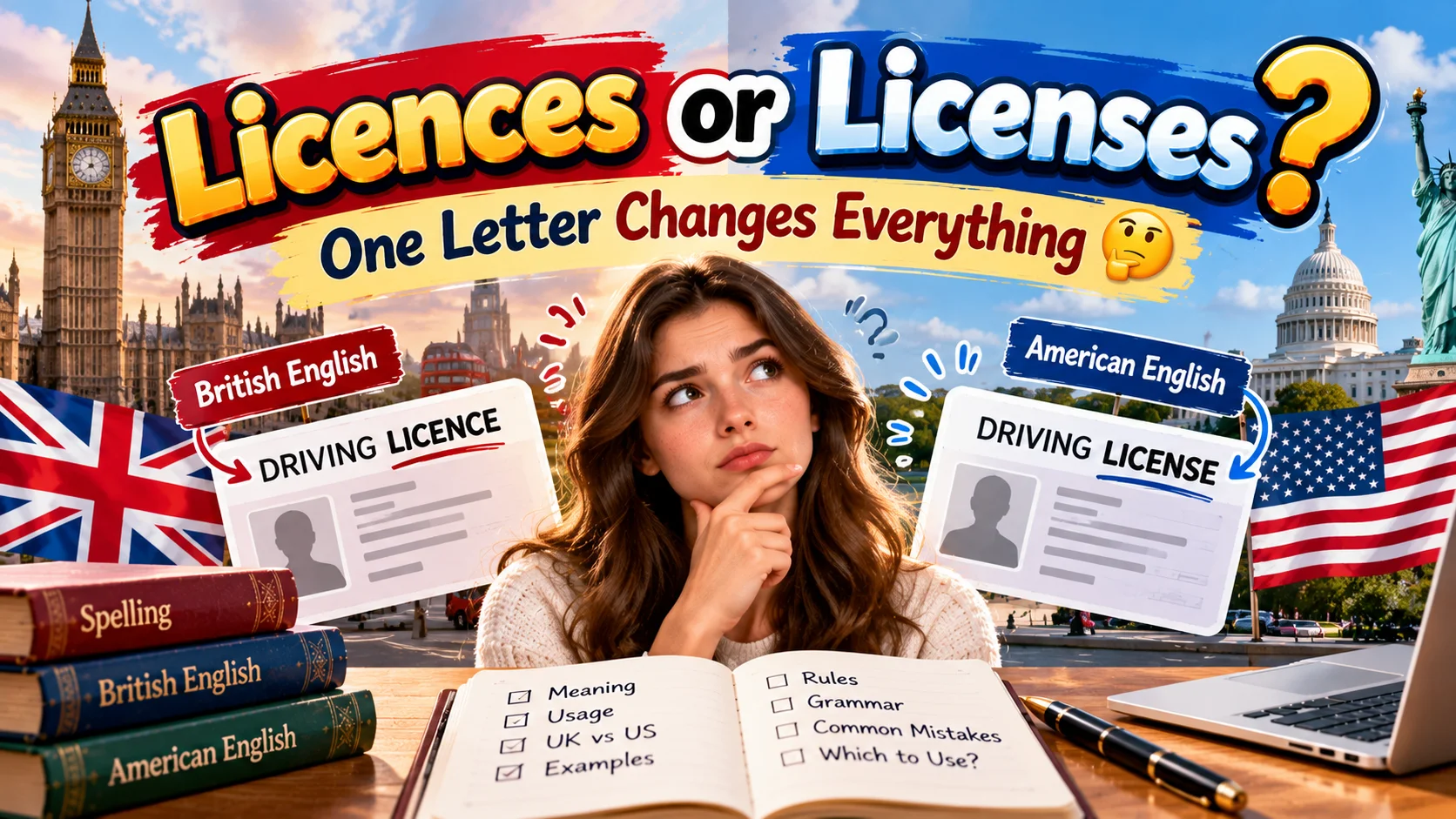
Licences or licenses—which spelling should you use? The answer depends on whether you’re writing in American or British English, making this another confusing word pair where both forms can be correct.
For a US audience, the standard spelling is licenses. In British English, licence is normally the noun, while license is traditionally used as the verb. American English generally uses license for both the noun and verb.
This small spelling difference matters when you’re writing website content, legal information, business documents, applications, or educational material for a specific English-speaking audience.
📜 Licences or Licenses? The Quick Answer
If you’re writing for American English, use licenses for the plural noun.
| Form | Variety | Use |
|---|---|---|
| licenses | American English | Plural noun or verb |
| licences | British English | Usually plural noun |
| license | American English | Singular noun and verb |
| licence | British English | Singular noun |
| licensing | Both | Standard -ing form |
Simple rule:
🇺🇸 US English → licenses
🇬🇧 British English → licences for the plural noun
📖 What Does License Mean?
A license is official permission to do something, or a document showing that permission.
Examples include:
- driver’s license
- business license
- professional license
- fishing license
- software license
- operating license
- hunting license
- marriage license
For example:
You need a valid driver’s license to operate a car.
In American English, license is the standard noun spelling.
🔤 What Does Licence Mean?
In British English, licence is traditionally used as the noun.
For example:
You need a valid driving licence.
When referring to multiple documents or permissions, the plural is:
licences
So:
one licence → two licences
This spelling is standard in British English noun usage.
⚖️ Licenses vs Licences at a Glance
| Feature | Licenses | Licences |
|---|---|---|
| American English noun | ✅ Yes | ❌ Not standard |
| British English noun | Less common | ✅ Yes |
| American English verb | ✅ Yes | ❌ No |
| British English verb | Often licenses | ❌ Usually not |
| Plural noun in US English | licenses | — |
| Plural noun in UK English | — | licences |
This is a classic American/British spelling distinction.
🇺🇸 License in American English
American English uses license for both the noun and verb.
Noun:
I renewed my driver’s license.
Verb:
The state will license the business.
The spelling remains license in both cases.
Plural noun:
The agency issued several licenses.
Verb:
The government licenses qualified providers.
This consistency makes American usage relatively straightforward.
🇬🇧 Licence in British English
British English traditionally distinguishes between the noun licence and the verb license.
Noun:
She has a driving licence.
Verb:
The authority will license the company.
Plural noun:
Several licences were issued.
This difference is important if you’re writing specifically for British readers.
🧠 Easy Memory Trick for American English
If your website targets US readers, remember:
American English uses LICENSE for the noun and verb.
Therefore:
license → licenses
The plural simply adds -s.
Examples:
- driver’s license → driver’s licenses
- business license → business licenses
- software license → software licenses
🚗 Driver’s License or Driver’s Licence?
This is one of the most common examples.
American English:
driver’s license
Plural:
driver’s licenses
British English:
driving licence
Plural:
driving licences
The terms can differ slightly beyond spelling, so always consider the intended audience.
💼 Business License or Business Licence?
For American English:
business license
Plural:
business licenses
Example:
The company must obtain the necessary business licenses before opening.
British English commonly uses:
business licence
Plural:
business licences
💻 Software Licenses or Software Licences?
Technology writing also uses these terms frequently.
American English:
The company sells software licenses.
British English:
The company sells software licences.
If your content targets American readers, software licenses is the appropriate spelling.
⚖️ Professional Licenses
Many careers require official authorization.
American English examples include:
- medical licenses
- nursing licenses
- teaching licenses
- professional licenses
- contractor licenses
- business licenses
Examples:
The board issues professional licenses.
All practitioners must maintain valid licenses.
📊 Common License Phrases
| American English | British English |
|---|---|
| driver’s license | driving licence |
| business license | business licence |
| professional license | professional licence |
| fishing license | fishing licence |
| software license | software licence |
| operating license | operating licence |
| license agreement | licence agreement |
| license holder | licence holder |
The exact terminology can vary by country and legal system, but the spelling distinction remains useful.
📝 License as a Verb
American English uses license as a verb.
Examples:
The state licenses medical professionals.
The agency will license the new facility.
The company is licensed to operate.
British English also generally uses license as the verb, even though the noun is traditionally licence.
So remember:
British noun → licence
British verb → license
🔄 License, Licenses, Licensed, Licensing
The word changes depending on grammatical form.
| Form | American English |
|---|---|
| Singular noun | license |
| Plural noun | licenses |
| Base verb | license |
| Third-person verb | licenses |
| Past tense | licensed |
| Present participle | licensing |
Examples:
The company has a license.
The company has several licenses.
The state will license the facility.
The state licenses the facility.
The company is licensed.
The agency is licensing new providers.
🔎 Why Is Licensing Not Licenscing?
The spelling can become confusing when adding suffixes.
The correct forms are:
license → licensed
license → licensing
Not:
❌ licensced
❌ licenscing
The final e is dropped before -ing:
licensing
This spelling applies in both major English varieties.
🧩 Common Mistake: Using Licences for American Readers
If you’re writing American English, avoid using licences as the plural noun.
For example:
❌ The company holds several business licences.
Preferred US spelling:
✅ The company holds several business licenses.
The British spelling is understandable, but it can look inconsistent on a US-focused website.
🧩 Common Mistake: Assuming License and Licence Are Different Meanings
They generally refer to the same concept.
The difference is primarily spelling convention and grammatical role, particularly in British English.
For example:
US: driver’s license
UK: driving licence
The underlying concept is official permission or authorization.
🌎 American vs British English
This distinction is part of a larger pattern of spelling differences.
| American | British |
|---|---|
| license | licence |
| licenses | licences |
| color | colour |
| center | centre |
| traveler | traveller |
| organize | organise |
The spelling you choose should match your intended variety of English.
📚 Licenses in Legal Writing
The word licenses frequently appears in legal, regulatory, and administrative documents.
Examples:
All required licenses must be obtained before operations begin.
The agency may revoke professional licenses for violations.
The business maintains all necessary licenses.
Because legal terminology can vary by jurisdiction, writers should follow the terminology used by the relevant government or legal authority.
🏛️ Government-Issued Licenses
Governments and regulatory agencies issue many types of licenses.
Examples include:
- driver’s licenses
- business licenses
- professional licenses
- liquor licenses
- building licenses
- occupational licenses
- fishing licenses
For US English, the plural spelling is:
licenses
For example:
The department issued hundreds of licenses this year.
💻 Software and Copyright Licenses
The word is also common in technology and intellectual property.
Examples:
The software requires individual licenses.
The company sells annual software licenses.
Users must agree to the software license before installation.
In these contexts, licenses is the standard American spelling.
✏️ Correct and Incorrect Examples
American English
✅ The state issued several licenses.
❌ The state issued several licences.
British English
✅ The authority issued several licences.
⚠️ The authority issued several licenses.
The second British example may be encountered, particularly where license is being used as the verb or under a particular style, but licences is the traditional noun spelling.
🧠 Quick Comparison: Noun vs Verb
This is especially useful for British English.
American English:
The company needs a license.
The agency will license the company.
British English:
The company needs a licence.
The agency will license the company.
Notice that the verb remains license in the British convention.
🎯 Quick Practice: Licenses or Licences?
Choose the standard American English form.
- The company needs several business ___.
Answer: licenses - She renewed her driver’s ___.
Answer: license - The agency issues professional ___.
Answer: licenses - The software requires multiple ___.
Answer: licenses - The state ___ medical providers.
Answer: licenses - Which spelling is the traditional British plural noun?
Answer: licences - Which spelling should a US-focused website normally use?
Answer: licenses
📝 Which Form Should You Use on a US Website?
If your content is specifically aimed at Americans, consistency matters.
Use:
license
for the singular noun.
Use:
licenses
for the plural noun.
Use:
license
as the verb.
This gives you a simple American English pattern:
license → licenses → licensed → licensing
🔍 How to Choose the Right Spelling
Before publishing, ask:
1. Who is my audience?
If you’re targeting the United States, choose license/licenses.
2. Am I using the word as a noun?
In British English, this matters because the noun is traditionally licence.
3. Am I using the word as a verb?
Use license in both American English and traditional British usage.
4. Does my style guide specify a variety?
Follow the required style consistently.
❓ Frequently Asked Questions About Licenses vs Licences
Is it licenses or licences?
Both spellings are used, but licenses is the standard American English plural noun, while licences is the traditional British English plural noun.
Is licenses correct in American English?
Yes. Licenses is the standard American English plural of license.
Is licences wrong?
No. Licences is the traditional British English plural noun.
What is the American spelling of licence?
American English uses license for the noun.
What is the British spelling of license?
For the noun, British English traditionally uses licence. The verb is license.
Is driver’s license American or British?
Driver’s license is standard American English. British English commonly uses driving licence.
Is software license or software licence correct?
Both can be correct depending on the English variety. American English uses software license, while British English commonly uses software licence.
Is license a noun or a verb?
In American English, license can be both a noun and a verb.
What is the plural of license?
In American English, the plural is licenses.
What is the plural of licence?
In British English, the traditional plural noun is licences.
Should I use licenses or licences for a US audience?
Use licenses for a US audience.
Does the pronunciation differ?
The noun forms are generally pronounced similarly. The main difference is spelling and, in British English, the distinction between the noun licence and verb license.
🏁 Final Takeaway
The difference between licences and licenses mainly comes down to English variety.
For American English:
license = singular noun
licenses = plural noun
license = verb
For traditional British English:
licence = singular noun
licences = plural noun
license = verb
If you’re writing for a US audience, the rule is simple:
Use “licenses.” 🇺🇸
Whether you’re discussing driver’s licenses, business licenses, professional licenses, or software licenses, licenses is the standard American spelling.

Olivia Bennett is a writer and language enthusiast at Vocabsteria. She is passionate about exploring word meanings, name origins, and cultural expressions from around the world.