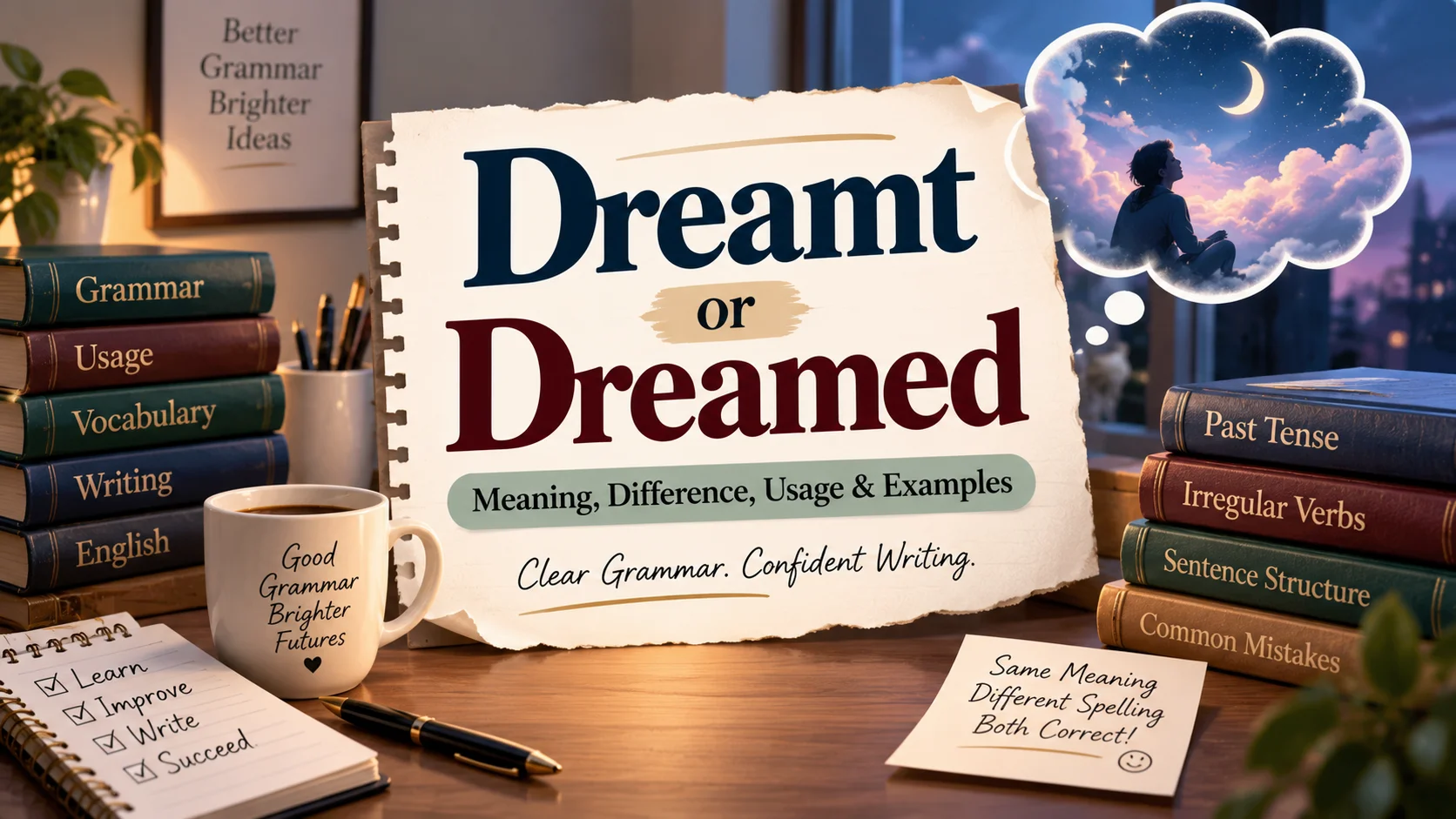
Both dreamt and dreamed are correct past-tense forms of the verb dream. The main difference is not meaning but usage and regional preference. Dreamed is especially common in American English, while dreamt is more frequently found in British English and some other varieties of English.
For most everyday situations, either form can be grammatically correct. The choice often depends on the type of English being used, the audience, and personal writing style.
Understanding the difference is useful because English contains many verbs with more than one accepted past-tense form. Learning when and how to use each version can make your writing more natural and consistent.
📖 What Does Dream Mean?
The verb dream refers to experiencing thoughts, images, emotions, or stories while sleeping. It can also describe imagining something, hoping for a particular future, or thinking about an ambitious possibility.
For example:
- I dream about traveling around the world.
- She dreams of becoming a writer.
- He dreamed about his childhood.
- They dream of building a successful business.
The word can therefore describe both sleeping experiences and waking ambitions.
Dream as a verb
The basic forms are:
| Verb Form | Example |
|---|---|
| Base form | dream |
| Present | dream / dreams |
| Past | dreamed / dreamt |
| Present participle | dreaming |
| Past participle | dreamed / dreamt |
Both past forms are standard English.
⚖️ Dreamt vs. Dreamed at a Glance
The difference can be summarized very simply.
| Feature | Dreamed | Dreamt |
|---|---|---|
| Basic meaning | Past form of dream | Past form of dream |
| Grammar | Correct | Correct |
| American English | Very common | Less common |
| British English | Common | Very common |
| Pronunciation | Usually two syllables | Usually one syllable |
| Meaning | Same | Same |
| Writing style | Neutral and widely familiar | More traditional or British-sounding |
Neither form is inherently more correct than the other.
The most important thing is to use the form consistently with the variety of English you are writing for.
🇺🇸 When Should You Use Dreamed?
Dreamed is the more familiar choice in American English and is widely understood internationally.
Use it when writing for a primarily American audience, particularly in:
- Websites
- Blogs
- School assignments
- Business writing
- General communication
- American publications
- Informal messages
Examples:
- I dreamed about flying last night.
- She dreamed of becoming a doctor.
- We dreamed about opening our own restaurant.
- He dreamed that he was walking through a forest.
- They dreamed of a better future.
For an American English website, dreamed will usually sound natural and familiar.
🇬🇧 When Should You Use Dreamt?
Dreamt is particularly common in British English and can also appear in Australian, Irish, and other varieties of English.
It is often preferred when the writer wants a concise or traditional form.
Examples:
- I dreamt about the ocean last night.
- She dreamt of becoming a singer.
- He dreamt that he was back at school.
- We dreamt about our old home.
- They dreamt of traveling across Europe.
There is no change in meaning. The difference is primarily regional and stylistic.
🧠 Why Are There Two Past Forms?
English has many verbs that developed alternative past-tense forms over time. Some use a regular -ed ending, while others retain older forms.
For dream, both patterns are accepted:
- dream → dreamed
- dream → dreamt
The -ed form follows a familiar regular pattern, while dreamt belongs to a group of verbs that use a shorter -t ending.
Similar examples include:
| Base Verb | -ed Form | -t Form |
|---|---|---|
| dream | dreamed | dreamt |
| learn | learned | learnt |
| burn | burned | burnt |
| spell | spelled | spelt |
| smell | smelled | smelt |
| spoil | spoiled | spoilt |
These alternatives do not always have exactly the same regional distribution, but the pattern helps explain why both forms exist.
🔤 Is Dreamt or Dreamed More Correct?
Neither is grammatically incorrect.
The choice depends mainly on regional English and style.
If you are writing American English, dreamed is generally the safer and more familiar option.
If you are writing British English, dreamt is completely natural and often preferred.
The important point is not to treat one as correct and the other as wrong.
🗣️ Dreamed and Dreamt in Everyday Sentences
Both forms can describe the same event.
Dreamed
- I dreamed about you last night.
- She dreamed of living near the sea.
- He dreamed that he won the competition.
- We dreamed about our future.
- They dreamed of becoming famous.
Dreamt
- I dreamt about you last night.
- She dreamt of living near the sea.
- He dreamt that he won the competition.
- We dreamt about our future.
- They dreamt of becoming famous.
The meaning remains essentially unchanged.
🌙 Dreamed vs. Dreamt for Sleeping Experiences
When referring to something experienced during sleep, either form works.
For example:
- I dreamed about a strange house.
- I dreamt about a strange house.
Both sentences mean that the speaker experienced a dream involving a strange house.
Another example:
- She dreamed that she was flying.
- She dreamt that she was flying.
Again, the grammatical meaning is the same.
The choice is primarily a matter of regional preference.
💭 Dreamed vs. Dreamt for Ambitions
The verb dream is also commonly used to describe hopes and ambitions.
Both forms work naturally:
- He dreamed of becoming a pilot.
- He dreamt of becoming a pilot.
- She dreamed about starting a company.
- She dreamt about starting a company.
In these examples, the verb does not refer to sleeping. Instead, it describes something the person strongly hoped to achieve.
📝 Dream Of vs. Dream About
Another useful grammar distinction involves the prepositions that commonly follow dream.
Dream of
Dream of often emphasizes a desire, ambition, or imagined possibility.
Examples:
- She dreamed of becoming a musician.
- He dreamed of owning a house.
- They dreamt of traveling the world.
Dream about
Dream about is often used when discussing the subject or content of a sleeping dream.
Examples:
- I dreamed about my old school.
- She dreamt about a beautiful garden.
- He dreamed about flying.
However, the two expressions can overlap in some contexts.
For example, dream of can also describe a sleeping dream, while dream about can describe something a person thinks about or hopes for.
📊 Dream Of vs. Dream About
| Expression | Common Use | Example |
|---|---|---|
| Dream of | Hope, ambition, desire | She dreamed of becoming a writer. |
| Dream about | Subject or content of a dream | I dreamed about my childhood home. |
| Dream of | Imagined possibility | He dreamt of living by the ocean. |
| Dream about | Sleeping experience | She dreamed about flying. |
This distinction is useful for learners who want to make their sentences more precise.
❌ Common Mistakes With Dreamt and Dreamed
Because both forms are accepted, the most common mistakes usually involve incorrect verb forms or inconsistent grammar.
Incorrect:
- I dreamt about it yesterday and now I dreamed about it again yesterday.
The problem here is not that one form is wrong. The issue is unnecessary inconsistency in a context where a consistent style would be clearer.
Better:
- I dreamed about it yesterday and dreamed about it again today.
Or:
- I dreamt about it yesterday and dreamt about it again today.
Both are grammatically acceptable.
Another common mistake:
- She dream about becoming a doctor yesterday.
Correct:
- She dreamed about becoming a doctor yesterday.
- She dreamt about becoming a doctor yesterday.
The past-tense form is necessary because the sentence refers to a completed past event.
🔍 How to Choose the Right Form
Use a simple three-step method.
Step 1: Identify the tense
If you are talking about something happening now, use dream or dreams.
- I dream about traveling.
- She dreams about becoming a doctor.
If you are talking about the past, use dreamed or dreamt.
- I dreamed about traveling.
- She dreamt about becoming a doctor.
Step 2: Identify your variety of English
For American English, dreamed is generally the more familiar choice.
For British English, dreamt is especially common.
Step 3: Stay consistent
If your article or document follows American English, use dreamed consistently unless there is a specific reason to quote or reproduce another variety.
If your writing follows British English, dreamt may fit better.
🇺🇸 American English vs. 🇬🇧 British English
Regional English is one of the most useful ways to understand this difference.
American English
American writers commonly use:
- dreamed
- learned
- burned
- spelled
- smelled
British English
British writers commonly use:
- dreamt
- learnt
- burnt
- spelt
- smelt
However, British English can also use the -ed versions, and American English does not prohibit the -t forms in every context.
Language variation is not the same as grammatical error.
✍️ Which Form Should Bloggers Use?
For a website targeting American readers, dreamed will generally be the most familiar form.
For a British audience, dreamt may feel more natural.
The best approach is to identify your target audience before choosing the preferred form.
For example:
American-focused sentence
- Last night, I dreamed about a mysterious city.
British-focused sentence
- Last night, I dreamt about a mysterious city.
Both communicate exactly the same basic idea.
📚 Dreamed or Dreamt in Formal Writing
Both forms can appear in formal writing.
The important consideration is consistency.
If a document uses American English throughout, dreamed may fit the overall style better.
If the document follows British English conventions, dreamt can be appropriate.
Neither form should be avoided simply because it sounds more traditional or more modern.
🧩 More Examples
Here are additional examples showing both forms in different contexts.
Sleeping dreams
- I dreamed about an unfamiliar city.
- I dreamt about an unfamiliar city.
- She dreamed that she was swimming.
- She dreamt that she was swimming.
Ambitions
- He dreamed of becoming an author.
- He dreamt of becoming an author.
- She dreamed about opening a bakery.
- She dreamt about opening a bakery.
Memories
- We dreamed about our childhood.
- We dreamt about our childhood.
Future hopes
- They dreamed of building a better life.
- They dreamt of building a better life.
The grammatical structure remains the same; only the past-tense form changes.
🧪 Quick Practice Exercise
Choose either dreamed or dreamt in each sentence.
- I ___ about the ocean last night.
- She ___ of becoming a writer.
- We ___ about our old house.
- He ___ that he was flying.
- They ___ of traveling around Europe.
- I ___ about the strange conversation.
- She ___ of owning a small bookstore.
- He ___ about his childhood.
Answers
Both forms can be grammatically correct in all eight sentences.
For example:
- I dreamed about the ocean last night.
- She dreamt of becoming a writer.
The choice depends on the English variety and preferred style.
📌 Quick Reference Table
| Situation | American English | British English |
|---|---|---|
| Past form of dream | dreamed | dreamt |
| Sleeping experience | dreamed | dreamt |
| Future ambition in the past | dreamed | dreamt |
| Formal writing | Accepted | Accepted |
| Casual writing | Very common | Very common |
| Meaning | Same | Same |
This makes the central point clear: the difference is mainly usage and regional preference, not meaning.
🆚 Other Verbs With Similar Variations
The difference between dreamed and dreamt is not unique.
English contains several verbs with both -ed and -t past forms.
| Verb | Common -ed Form | Common -t Form |
|---|---|---|
| Dream | dreamed | dreamt |
| Learn | learned | learnt |
| Burn | burned | burnt |
| Spell | spelled | spelt |
| Smell | smelled | smelt |
| Spill | spilled | spilt |
| Kneel | kneeled | knelt |
Some of these forms vary significantly by region, while others have different levels of frequency.
This is one reason English learners may encounter apparently different past-tense forms in books, websites, films, and conversations.
🎯 Easy Memory Tip
If you are writing for an American audience, remember:
Dream → dreamed
If you are writing for a British audience, remember:
Dream → dreamt
A simple way to think about it is that dreamed follows the familiar regular -ed pattern, while dreamt is the shorter traditional form.
Neither should automatically be marked as a spelling mistake.
❓ Frequently Asked Questions
Is dreamed or dreamt correct?
Both are correct past-tense forms of dream. The choice generally depends on regional English and personal or editorial style.
Is dreamed more common in American English?
Yes. Dreamed is the more familiar past form in American English.
Is dreamt more common in British English?
Yes. Dreamt is especially common in British English, although dreamed is also understood and used.
Do dreamed and dreamt have different meanings?
No. In most contexts, they have the same basic meaning and function as the past tense or past participle of dream.
Should I use dreamed or dreamt in an American English article?
Dreamed is generally the more natural choice for an American audience.
Should I use dreamt in British English?
Dreamt is a very natural choice in British English and fits traditional British usage well.
Is dreamt a formal word?
Not necessarily. It is simply a standard past form of dream. Its frequency can make it feel more traditional or distinctly British in some contexts.
Can both forms appear in the same article?
Yes, but consistent style is usually preferable. If your article follows American English, use dreamed throughout unless context requires otherwise.
Is dreamed a regular verb form?
Dreamed follows the regular -ed pattern. Dreamt is an alternative past form with a shorter -t ending.
What is the past tense of dream?
Both dreamed and dreamt can be used as the past tense of dream.
🌟 Final Thoughts
There is no need to worry about choosing between dreamed and dreamt as though one were correct and the other incorrect. Both are established English forms with the same basic meaning.
The main difference is regional and stylistic. Dreamed is particularly common in American English, while dreamt is especially familiar in British English. Your target audience should therefore guide your choice.
For consistent writing, choose one form that matches the variety of English used throughout your article or website. Once you understand this distinction, both forms become easy to recognize and use correctly.

Olivia Bennett is a writer and language enthusiast at Vocabsteria. She is passionate about exploring word meanings, name origins, and cultural expressions from around the world.