Mood ring colors and meanings have fascinated people for decades. These unusual pieces of jewelry change their appearance throughout the day, displaying shades of blue, green, purple, yellow, and even black. Each color has a traditional interpretation connected to emotions, personality, and feelings. But what does each shade actually represent?
Mood rings became especially popular during the 1970s. People loved the idea of wearing jewelry that could supposedly reveal their emotional state. Today, these color-changing accessories remain popular among jewelry lovers, collectors, and people who enjoy symbolic fashion. Their changing shades make them interesting conversation pieces and thoughtful gifts.
However, there’s more to mood rings than their colorful appearance. Each shade has a traditional meaning, ranging from relaxation and happiness to nervousness and excitement. Blue often represents calmness, while green commonly symbolizes emotional balance. Purple is associated with passion, and black traditionally represents stress or tension.
Interestingly, mood rings don’t directly detect human emotions. Their special stones contain temperature-sensitive liquid crystals that respond to changes in your finger’s surface temperature. Therefore, your surroundings and physical condition can influence the colors you see.
In this guide, you’ll discover the meanings behind every popular mood ring color. We’ll also explore how these rings work, why their shades change, and what different color combinations traditionally represent. Whether you’re buying your first mood ring or curious about a color you’re seeing, this guide will help you understand its symbolism.
What Do Mood Ring Colors and Meanings Represent? 💍
Mood ring colors traditionally represent different emotional states, including happiness, relaxation, excitement, nervousness, passion, and stress. Each shade has a symbolic interpretation based on older mood ring color charts.
Blue commonly represents calmness and happiness. Green suggests balance, while purple symbolizes passion and excitement. Yellow and amber often indicate nervousness or mixed feelings. Darker shades, including gray and black, traditionally represent tension or emotional discomfort.
However, these interpretations aren’t scientifically proven. Mood rings respond to temperature changes rather than identifying specific emotions. Think of their color meanings as entertaining symbols rather than accurate emotional measurements.
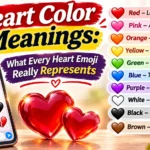
Mood Ring Colors and Meanings Chart 🌈
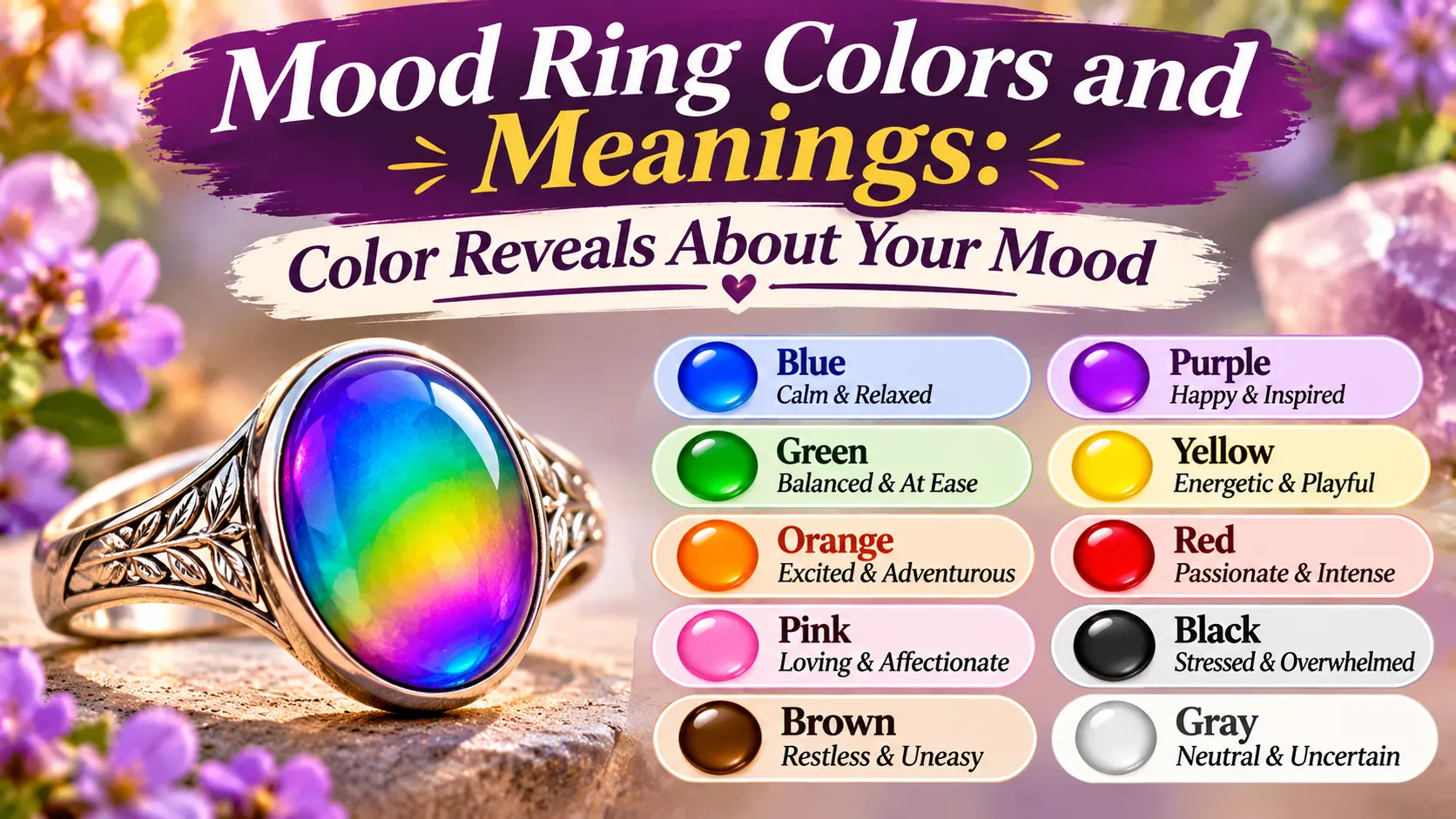
The traditional mood ring color chart provides a quick way to understand the symbolism behind different shades. Although manufacturers may use slightly different interpretations, most popular charts share several common meanings.
| Mood Ring Color | Traditional Meaning | Emotional Symbolism |
|---|---|---|
| Black | Stressed or tense | Pressure and discomfort |
| Gray | Nervous or anxious | Uncertainty and worry |
| Brown | Restless or unsettled | Mixed feelings |
| Amber | Uneasy or cautious | Emotional uncertainty |
| Yellow | Nervous or curious | Alertness and anticipation |
| Orange | Excited or adventurous | Energy and enthusiasm |
| Green | Calm and balanced | Stability and comfort |
| Blue-Green | Relaxed and peaceful | Emotional ease |
| Blue | Happy and content | Calmness and affection |
| Dark Blue | Very happy and relaxed | Deep satisfaction |
| Purple | Passionate and excited | Romance and inspiration |
| Pink | Affectionate and interested | Warmth and attraction |
| Red | Energetic and stimulated | Excitement and intensity |
| White | Varies by ring | Sometimes indicates a damaged stone |
These meanings represent common traditional interpretations rather than universal rules. Your ring’s manufacturer may provide a slightly different color guide.
Black Mood Ring Meaning: Stress and Tension 🖤
Black is traditionally associated with stress, tension, discomfort, and emotional pressure. It is one of the most recognizable colors on a traditional mood ring chart.
When your ring displays black, older interpretations suggest that you might be experiencing an uncomfortable or stressful moment. Some charts also associate this shade with frustration, exhaustion, or feeling overwhelmed.
However, black doesn’t automatically mean you’re upset. Your ring may simply be responding to cooler fingers or a colder environment.
For example, wearing your mood ring outdoors during winter can make its stone appear black. The same thing can happen when you remove the ring and leave it on a cool surface.
Traditional symbolism: Stress, tension, frustration, and discomfort.
Gray Mood Ring Meaning: Nervousness and Uncertainty 🌫️
Gray traditionally represents nervousness, anxiety, uncertainty, and emotional uneasiness. It often appears between black and warmer colors on traditional mood ring charts.
This shade is commonly connected with moments when someone feels uncomfortable or uncertain. For example, you might associate gray with the nervous excitement of an important interview or an unfamiliar situation.
It can also symbolize hesitation and mixed feelings. However, the actual color change reflects temperature rather than a confirmed emotional condition.
Gray may appear when your fingers become cooler. Room temperature, circulation, and ring fit can all influence this reading.
Traditional symbolism: Nervousness, worry, uncertainty, and uneasiness.
Brown Mood Ring Meaning: Restlessness and Mixed Feelings 🤎
Brown is often associated with restlessness, uncertainty, worry, and unsettled emotions. Its earthy appearance gives it a different interpretation from brighter mood ring colors.
Some traditional charts connect brown with feeling impatient or mentally distracted. Others associate it with anticipation and emotional confusion.
For instance, someone waiting for important news might interpret a brown mood ring as a symbol of uncertainty. Similarly, it can represent a restless moment when several thoughts compete for attention.
Brown isn’t included on every mood ring. Some manufacturers use amber or gray instead, so the exact interpretation depends on the ring.
Traditional symbolism: Restlessness, uncertainty, worry, and mixed feelings.
Amber Mood Ring Meaning: Caution and Uneasiness 🧡
Amber is traditionally associated with nervousness, caution, mixed emotions, and uncertainty. Its warm golden appearance places it between yellow and darker shades on many color charts.
This color can symbolize anticipation before an important event. It may also represent a moment when you’re curious but slightly uncomfortable about what comes next.
Amber is sometimes interpreted as a sign of emotional sensitivity. It can reflect the symbolic idea of feeling alert or uncertain rather than completely relaxed.
Some mood rings display amber instead of yellow. Others combine both shades into a single color category.
Traditional symbolism: Caution, anticipation, nervousness, and mixed feelings.
Yellow Mood Ring Meaning: Curiosity and Nervous Energy 💛
Yellow represents curiosity, alertness, nervous energy, and anticipation in several traditional mood ring charts. Its bright appearance gives it a lively and noticeable personality.
This shade is sometimes associated with situations that create excitement mixed with uncertainty. You might connect yellow with waiting for an important message or preparing for something unfamiliar.
Yellow can also symbolize mental activity and curiosity. It represents a moment when your thoughts are active and your attention is focused.
However, some manufacturers interpret yellow differently. Always check the chart supplied with your jewelry.
Traditional symbolism: Curiosity, nervousness, anticipation, and alertness.
Orange Mood Ring Meaning: Excitement and Adventure 🧡
Orange is commonly associated with excitement, enthusiasm, creativity, and adventurous energy. Its bright appearance symbolizes an active and expressive emotional state.
Traditional interpretations connect orange with curiosity about new experiences. It can represent the excitement of starting a project, meeting new people, or exploring an unfamiliar opportunity.
Orange also carries associations with confidence and enthusiasm. Its warm appearance makes it one of the most energetic shades on expanded mood ring charts.
Not every mood ring displays orange. Some designs move directly from yellow or amber toward green.
Traditional symbolism: Enthusiasm, creativity, excitement, and adventure.
Green Mood Ring Meaning: Balance and Emotional Stability 💚
Green is commonly considered the neutral or balanced color on traditional mood ring charts. It represents calmness, comfort, stability, and an emotionally steady state.
When your ring displays green, traditional interpretations suggest that you’re feeling relaxed and comfortable. It symbolizes a moment without overwhelming tension or extreme excitement.
Green also has broader associations with renewal, growth, and harmony. These meanings make it one of the most recognizable shades in mood ring symbolism.
Many classic mood rings use green as their baseline color. It often appears when the stone reaches its designed middle temperature range.
Traditional symbolism: Balance, comfort, calmness, and emotional stability.
Blue-Green Mood Ring Meaning: Peace and Relaxation 🩵
Blue-green represents relaxation, peacefulness, contentment, and emotional ease. It combines the calming symbolism of blue with the balanced associations of green.
Some traditional charts describe this shade as a sign of gradually increasing relaxation. It can symbolize feeling comfortable with your surroundings and enjoying a peaceful moment.
Blue-green is also associated with harmony and emotional openness. Its cool, refreshing appearance makes it a popular shade in modern mood ring designs.
Different manufacturers may classify this color as turquoise, teal, or aquamarine.
Traditional symbolism: Peace, relaxation, harmony, and contentment.
Blue Mood Ring Meaning: Happiness and Calmness 💙
Blue is one of the most recognizable mood ring colors. It traditionally represents happiness, relaxation, affection, and emotional comfort.
When a mood ring displays blue, its symbolic interpretation suggests that you’re feeling peaceful and content. It can represent a comfortable moment when everything seems to be going smoothly.
Blue also carries associations with trust, communication, and emotional stability. These qualities make it a popular color in jewelry and other symbolic designs.
On many traditional charts, blue appears toward the warmer end of the ring’s temperature scale. However, the exact shade depends on the manufacturer’s crystal calibration.
Traditional symbolism: Happiness, affection, relaxation, and contentment.
Dark Blue Mood Ring Meaning: Deep Happiness and Affection 💙
Dark blue is commonly associated with deep relaxation, happiness, affection, and emotional satisfaction. It usually represents a warmer reading than standard blue on traditional mood ring charts.
This shade symbolizes feeling comfortable, peaceful, and emotionally connected. Some interpretations also associate it with romance and positive relationships.
Dark blue can appear when you’re enjoying a relaxing moment or spending time with someone special. Its rich color gives it a strong association with emotional comfort.
Remember that the ring measures finger temperature. Dark blue doesn’t prove that you’re happy or romantically interested in someone.
Traditional symbolism: Deep happiness, affection, relaxation, and emotional satisfaction.
Purple Mood Ring Meaning: Passion and Romance 💜
Purple is traditionally associated with passion, romance, excitement, inspiration, and intense positive feelings. Its rich appearance makes it one of the most interesting colors on traditional mood ring charts.
When your ring displays purple, its symbolic meaning often suggests strong affection or romantic excitement. It can represent attraction, enthusiasm, and emotional intensity.
Purple also has broader associations with creativity, imagination, and individuality. These qualities make it a popular color in fashion and symbolic jewelry.
Some rings display violet or lavender instead of deep purple. These shades may have slightly different interpretations depending on the manufacturer.
Traditional symbolism: Passion, romance, inspiration, and excitement.
Pink Mood Ring Meaning: Affection and Attraction 🩷
Pink traditionally symbolizes affection, tenderness, attraction, and emotional warmth. Its soft appearance gives it a gentle meaning compared with the stronger symbolism of red or purple.
Some mood ring charts associate pink with the early stages of romantic interest. It can represent curiosity about someone special or a growing emotional connection.
Pink is also connected with kindness, compassion, and appreciation. It makes a beautiful symbolic color for friendship and affectionate relationships.
Not all mood rings include pink in their temperature scale. Some display it only briefly when the stone reaches a particular temperature.
Traditional symbolism: Affection, attraction, tenderness, and warmth.
Red Mood Ring Meaning: Energy and Excitement ❤️
Red is often associated with excitement, passion, energy, and emotional intensity. Its bold appearance makes it a powerful symbol of strong feelings.
Traditional interpretations connect red with enthusiasm and heightened emotional activity. Some charts also associate it with romantic attraction and confidence.
However, red isn’t a standard color on every mood ring. Certain rings display orange-red or pink-red shades instead.
A bright red appearance may also depend on the particular liquid crystal formulation. Therefore, check your ring’s own color chart before assigning it a specific meaning.
Traditional symbolism: Energy, excitement, passion, and intensity.
White Mood Ring Meaning: Purity and Clarity 🤍
White has different interpretations across mood ring charts. Some symbolic guides associate it with clarity, openness, and peacefulness.
However, white or clear can also indicate that the ring’s temperature-sensitive material has become damaged. This is especially important when the stone remains white or transparent and no longer responds to temperature changes.
Older or poorly maintained mood rings may lose their ability to change colors. Moisture and excessive heat can damage their sensitive materials.
Therefore, don’t automatically interpret white as a particular emotional state. Check whether the stone still changes color under normal conditions.
Traditional symbolism: Clarity, openness, and peacefulness; sometimes a sign of a damaged stone.
How Do Mood Rings Work? 🔬
Mood rings use temperature-sensitive materials called thermochromic liquid crystals. These crystals respond to changes in temperature by altering the wavelengths of light they reflect.
The special material sits inside the ring’s decorative stone. A protective covering helps keep the sensitive crystals sealed inside.
When the temperature of your finger changes, the liquid crystals adjust their molecular arrangement. This change affects the color you see when light reflects from the stone.
Warmer and cooler temperatures produce different colors. That’s why your mood ring may display blue in one situation and green or black in another.
The important distinction is that mood rings measure temperature rather than emotions. Your emotional state can sometimes influence finger temperature through changes in circulation, but many other factors also affect it.
This makes mood rings interesting temperature-sensitive accessories rather than reliable emotional detectors.
Why Does Your Mood Ring Change Colors Throughout the Day? 🌡️
Your mood ring can change colors several times because your finger temperature isn’t constant. Everyday activities and environmental conditions influence the temperature of your skin.
For example, walking outdoors in cold weather may cause your fingers to cool down. Your ring might then display gray or black.
After entering a warm room, your finger temperature may increase. The stone can gradually shift toward green, blue, or purple.
Several factors can influence these changes:
Room temperature: Cold environments can make the stone display darker shades, while warmer surroundings may produce lighter or warmer-end colors.
Blood circulation: Changes in blood flow can affect the temperature of your fingers. This may happen during physical activity or stressful situations.
Physical movement: Exercise and everyday activity can change circulation and skin temperature.
Ring fit: A loose ring may not transfer heat from your finger as consistently as a properly fitted ring.
Water exposure: Moisture entering a poorly sealed stone can damage its sensitive materials.
Individual differences: People naturally have different skin temperatures, so their rings may display different colors under similar conditions.
Understanding these factors helps explain why your mood ring doesn’t always match the emotion you expect it to represent.
What Does It Mean When a Mood Ring Shows Two Colors? 🎨
A mood ring showing two colors doesn’t necessarily represent two different emotions. It usually indicates that different areas of the stone have slightly different temperatures.
This can happen when one section receives more warmth from your finger than another. Uneven contact, surrounding air, and changing temperatures can all influence the appearance.
For example, you might notice blue near one edge and green near another. This simply means the stone is responding to slightly different temperature conditions.
Some people enjoy assigning symbolic meanings to these combinations. However, there isn’t a scientifically established chart for interpreting multiple colors together.
Treat these patterns as part of the ring’s visual appeal rather than a precise emotional message.
Why Does a Mood Ring Stay Black or Stop Changing? ⚫
A mood ring that remains black may be too cold, damaged, or unable to respond properly to temperature changes.
First, allow the ring to warm naturally while wearing it. Give the stone several minutes to adjust to your finger temperature.
If it still doesn’t change, check its condition. A cracked covering or moisture damage may affect the liquid crystals.
Excessive heat and prolonged direct sunlight can also damage sensitive mood ring materials. Avoid exposing the jewelry to extreme temperatures.
If the stone remains completely unresponsive after normal warming, it may have reached the end of its useful life.
Taking proper care of your ring helps protect its color-changing feature and maintain its appearance.
How to Take Care of a Mood Ring ✨
Mood rings need gentle handling because their special stones contain temperature-sensitive materials. Proper care helps preserve their appearance and color-changing ability.
Keep your ring away from water whenever possible. Remove it before swimming, showering, washing dishes, or using cleaning products.
Store it in a dry jewelry box when you’re not wearing it. Avoid leaving it near heaters, windows with strong direct sunlight, or other sources of extreme heat.
Clean the metal parts gently with a soft, dry cloth. Avoid harsh chemicals and abrasive cleaning materials, especially around the stone.
Handle the ring carefully to prevent scratches, cracks, and damage to its protective covering.
With these simple precautions, you can enjoy your mood ring’s changing colors for longer.
Frequently Asked Questions About Mood Ring Colors and Meanings 💍
What is the most common mood ring color?
Green is commonly considered the neutral or baseline color on traditional mood ring charts. It symbolizes balance, comfort, and calmness.
However, some modern rings use blue-green or light blue as their neutral shade.
What does purple mean on a mood ring?
Purple traditionally represents passion, romance, excitement, and inspiration. Some charts also connect violet shades with strong affection and positive emotions.
Its appearance depends on the temperature range of the particular ring.
What does blue mean on a mood ring?
Blue commonly represents happiness, calmness, affection, and relaxation. Dark blue often symbolizes deeper relaxation or emotional satisfaction.
These meanings are traditional interpretations rather than scientifically confirmed emotional readings.
What does green mean on a mood ring?
Green generally represents emotional balance, comfort, and a neutral state. It is commonly considered the middle or resting color on traditional mood ring charts.
The actual stone displays green when it reaches a particular temperature range.
Why does my mood ring turn black?
Black usually appears when the stone becomes too cool for its normal color range. Cold weather, cool fingers, and low surrounding temperatures can cause this change.
If the ring remains black after warming naturally, its temperature-sensitive material may be damaged.
Can mood rings really detect emotions?
No, mood rings cannot directly identify emotions. They contain thermochromic liquid crystals that respond to temperature changes.
Although emotions can sometimes influence finger temperature, environmental conditions and circulation also affect the reading.
What does a pink mood ring mean?
Pink is traditionally associated with affection, attraction, tenderness, and emotional warmth. Some charts connect it with romantic interest or growing affection.
Not every mood ring displays this shade.
Do all mood rings have the same color chart?
No, mood ring color charts can differ between manufacturers. Some rings display only a few basic shades, while others include additional colors such as orange, pink, amber, and purple.
Always check the color guide supplied with your particular ring.
What is the rarest mood ring color?
Purple or violet is often considered one of the harder shades to reach on traditional mood ring scales. It generally appears toward the warmer end of the temperature range.
However, the rarest color depends on the ring’s crystal formulation and calibration.
Does a mood ring change color when you are in love?
A mood ring cannot confirm whether you’re in love. Purple, pink, and dark blue traditionally symbolize romance, affection, and happiness.
However, the stone responds to finger temperature rather than measuring romantic feelings.
Conclusion 🌈
Mood ring colors and meanings offer an interesting way to explore the symbolism of different emotional states. From black representing tension to green symbolizing balance and purple suggesting passion, every shade has its own traditional interpretation. Blue represents relaxation, while pink communicates affection and warmth.
However, remember that mood rings respond to temperature rather than reading emotions directly. Their colors can change because of weather, circulation, physical activity, and other environmental factors. Enjoy their beautiful color transformations as a fun part of personal style and jewelry fashion.

Olivia Bennett is a writer and language enthusiast at Vocabsteria. She is passionate about exploring word meanings, name origins, and cultural expressions from around the world.