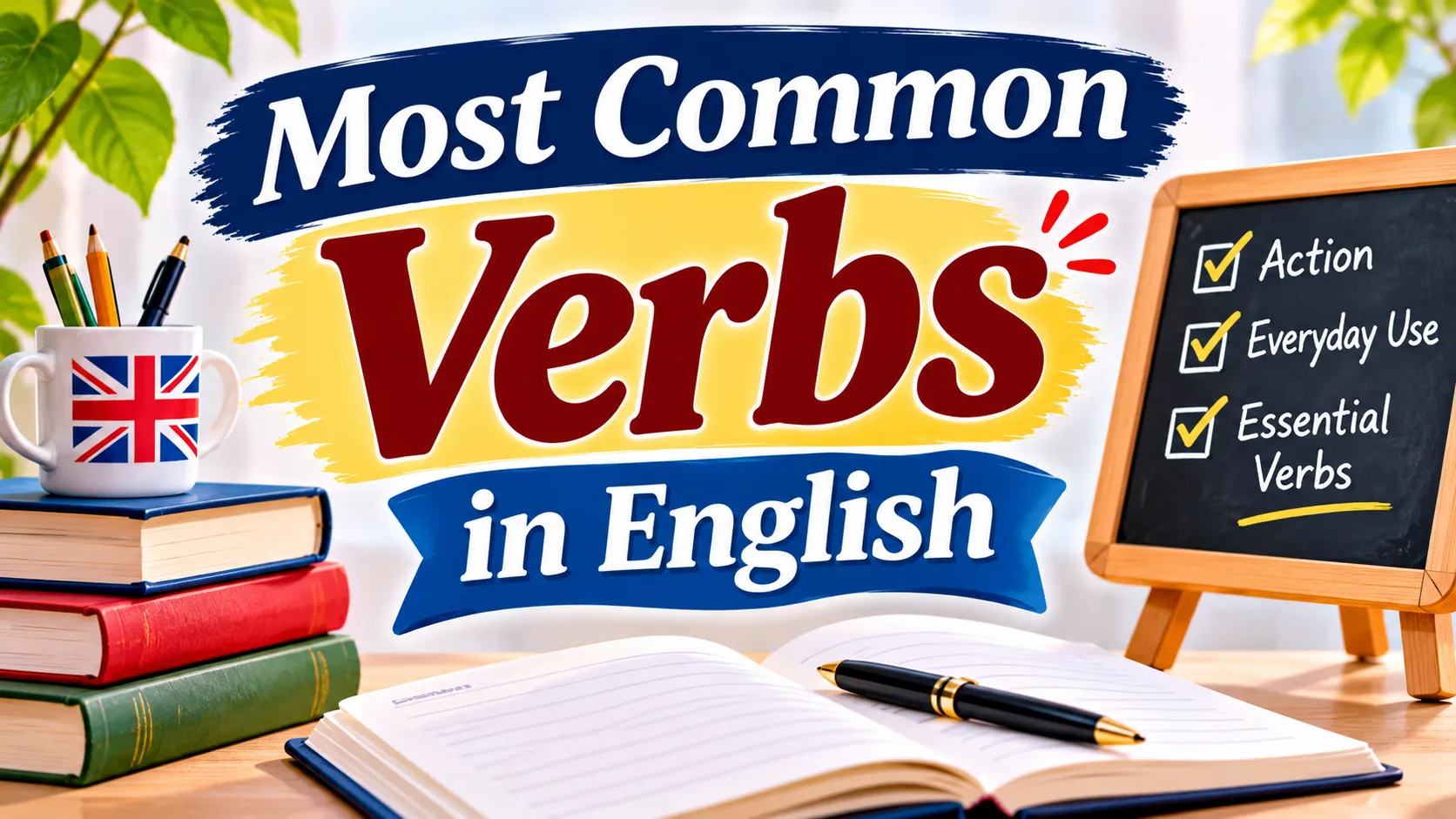
Verbs are one of the most important parts of English grammar because they tell us what someone or something does, feels, or experiences. From everyday conversations to professional writing, we use verbs to describe actions, express thoughts, explain situations, and communicate ideas. Learning the most common verbs in English can help you build stronger sentences, improve your vocabulary, and speak more confidently.
Whether you are a beginner learning English or an advanced learner looking to improve your communication skills, understanding frequently used verbs is essential. Words such as be, have, do, go, make, and get appear regularly in everyday conversations, books, emails, and online communication.
In this guide, you will discover more than 200 useful English verbs, their meanings, and practical example sentences. You will also learn about different types of verbs, common verb forms, and simple ways to use them correctly.
What Are Verbs in English? 📘
A verb is a word that describes an action, state, or occurrence. It tells readers what a person, animal, place, or thing does or what condition it is in. Without verbs, it would be difficult to create complete sentences or communicate clear ideas.
For example, in the sentence “Sarah reads a book,” the word reads is the verb because it describes Sarah’s action. In “They are happy,” the word are is a verb that connects the subject to a description.
Verbs are commonly used to express:
- Actions: run, walk, write, jump, eat.
- Thoughts: think, believe, understand, remember.
- Feelings: love, hate, enjoy, fear.
- States: be, seem, exist, belong.
- Occurrences: happen, become, grow, change.
Understanding how verbs work makes it easier to form sentences, ask questions, describe experiences, and express yourself naturally in English.
Most Common Verbs in English: Essential Verbs With Meanings ⭐
English verbs describe actions, feelings, and states. Learning frequently used verbs can improve your speaking, writing, and everyday communication. Here are some essential verbs with simple meanings and examples.
| Verb | Meaning | Example |
|---|---|---|
| Be | To exist | I want to be happy. |
| Have | To own | I have a car. |
| Do | To perform | I do my homework. |
| Say | To speak words | Say your name. |
| Go | To move somewhere | We go to school. |
| Get | To receive | I get good results. |
| Make | To create | She makes cakes. |
| Know | To understand | I know the answer. |
| Think | To form an opinion | I think you are right. |
| Take | To carry | Take your bag. |
| See | To notice | I see a bird. |
| Come | To approach | Come here, please. |
| Want | To desire | I want some water. |
| Look | To direct your eyes | Look at the sky. |
| Use | To operate something | I use a computer. |
| Find | To discover | Find your keys. |
| Give | To provide | Give me a pen. |
| Tell | To inform | Tell me the truth. |
| Work | To perform a job | She works daily. |
| Call | To contact | Call me tomorrow. |
| Try | To make an effort | Try again. |
| Ask | To question | Ask your teacher. |
| Need | To require | We need help. |
| Feel | To experience an emotion | I feel happy. |
| Become | To change into | He became a doctor. |
| Leave | To go away | They leave early. |
| Put | To place | Put it here. |
| Keep | To continue having | Keep your promise. |
| Help | To assist | Help your friend. |
| Write | To form words | Write your name. |
These verbs are useful for beginners and English learners who want to build simple, meaningful sentences.
Everyday Action Verbs You Should Know 🏃
Action verbs describe activities performed by people, animals, or things. They help you talk about daily routines, hobbies, and household tasks.
| Verb | Meaning | Example Sentence |
|---|---|---|
| Eat | To consume food | We eat dinner together. |
| Drink | To consume liquid | Drink some water. |
| Sleep | To rest | Babies sleep often. |
| Wake | To stop sleeping | I wake up early. |
| Walk | To move on foot | We walk in the park. |
| Jump | To push yourself off the ground | The child can jump high. |
| Dance | To move to music | They dance at parties. |
| Sing | To produce musical sounds | She sings beautifully. |
| Cook | To prepare food | My father cooks dinner. |
| Wash | To clean with water | Wash your hands. |
| Clean | To remove dirt | I clean my room. |
| Open | To make accessible | Open the window. |
| Close | To shut something | Close the door. |
| Drive | To operate a vehicle | He drives to work. |
| Ride | To travel on a bicycle or horse | She rides a bicycle. |
| Swim | To move through water | We swim in the pool. |
| Climb | To move upward | They climb the hill. |
| Throw | To send something through the air | Throw the ball. |
| Catch | To stop and hold something | Catch the ball. |
| Push | To apply force away from yourself | Push the button. |
| Pull | To bring something toward yourself | Pull the handle. |
| Carry | To transport something | He carries a bag. |
| Cut | To divide with a sharp tool | Cut the paper. |
| Build | To construct something | They build houses. |
| Draw | To create a picture | I draw pictures. |
| Paint | To apply color | She paints flowers. |
| Fix | To repair something | Fix my bicycle, please. |
| Break | To damage something | Do not break the glass. |
| Wear | To have clothing on | I wear a jacket. |
| Brush | To clean with a brush | Brush your teeth daily. |
Common Verbs for Communication and Speaking 🗣️
Communication verbs describe how people share information, express opinions, ask questions, and interact with others. These words are particularly important for everyday conversations, classroom discussions, meetings, and professional communication.
Using the right communication verb also helps you explain exactly how someone shared a message.
| Verb | Meaning | Example Sentence |
|---|---|---|
| Speak | To express thoughts verbally | Can you speak English? |
| Listen | To pay attention to sounds | Listen to your teacher. |
| Explain | To make something clear | Please explain the problem. |
| Describe | To give details about something | Describe your favorite place. |
| Discuss | To talk about a subject | We discuss our plans. |
| Mention | To refer to something briefly | She mentioned your name. |
| Reply | To answer someone | He did not reply to my message. |
| Answer | To respond to a question | Answer the question carefully. |
| Shout | To speak very loudly | Do not shout at your brother. |
| Whisper | To speak very quietly | She whispered a secret. |
| Announce | To make information known publicly | They announce the winner today. |
| Suggest | To offer an idea | I suggest taking a break. |
| Recommend | To advise someone about a choice | I recommend this book. |
| Promise | To say that you will do something | I promise to help you. |
| Warn | To tell someone about possible danger | They warned us about the storm. |
| Complain | To express dissatisfaction | Customers complain about delays. |
| Invite | To ask someone to attend an event | We invite our friends to dinner. |
| Greet | To welcome someone with words or actions | She greets every visitor. |
| Thank | To express gratitude | I thank you for your support. |
| Apologize | To express regret | He apologized for being late. |
Common Mental Verbs for Thoughts and Understanding 🧠
Mental verbs describe activities that happen in the mind. They help you communicate what you know, remember, imagine, understand, or believe.
These words are valuable in academic writing, personal conversations, storytelling, and professional discussions because they explain a person’s thoughts and opinions.
| Verb | Meaning | Example Sentence |
|---|---|---|
| Understand | To know the meaning of something | I understand your concern. |
| Remember | To keep something in your memory | Remember my advice. |
| Forget | To fail to remember something | Do not forget your keys. |
| Learn | To gain knowledge or a skill | Children learn quickly. |
| Study | To spend time learning a subject | She studies English every day. |
| Teach | To help someone gain knowledge | My mother teaches mathematics. |
| Imagine | To create an idea or picture in your mind | Imagine living near the beach. |
| Recognize | To identify someone or something | I recognize his voice. |
| Realize | To become aware of something | I realize my mistake. |
| Decide | To make a choice | We decide together. |
| Choose | To select one option | Choose your favorite color. |
| Consider | To think carefully about something | Consider all the options. |
| Wonder | To think about something with curiosity | I wonder what happened. |
| Guess | To form an answer without certainty | Can you guess the answer? |
| Notice | To become aware of something | Did you notice the change? |
| Expect | To think something will happen | I expect good news. |
| Prefer | To like one option more than another | I prefer coffee over tea. |
| Doubt | To feel uncertain about something | I doubt that he will come. |
| Plan | To decide what you will do | We plan our holidays early. |
| Solve | To find an answer to a problem | She can solve difficult puzzles. |
Common Verbs for Feelings and Emotions ❤️
Feeling verbs help you describe emotions, preferences, relationships, and personal experiences. They are often used in conversations about family, friendship, work, and everyday life.
Some of these verbs describe positive emotions, while others express fear, dislike, worry, or emotional reactions.
| Verb | Meaning | Example Sentence |
|---|---|---|
| Love | To feel deep affection | I love my family. |
| Hate | To strongly dislike something | She hates rude behavior. |
| Enjoy | To take pleasure in something | We enjoy spending time together. |
| Like | To have a positive feeling about something | He likes reading novels. |
| Dislike | To have a negative feeling about something | I dislike crowded places. |
| Fear | To feel afraid of something | Some people fear heights. |
| Worry | To feel anxious about something | Do not worry about the result. |
| Hope | To want something to happen | I hope you feel better. |
| Wish | To want something to be true or happen | I wish you success. |
| Care | To feel concern or interest | She cares about her friends. |
| Trust | To believe someone is reliable | I trust my best friend. |
| Appreciate | To recognize the value of something | We appreciate your kindness. |
| Admire | To respect or look up to someone | I admire her confidence. |
| Forgive | To stop feeling angry about an offense | It is important to forgive others. |
| Regret | To feel sorry about something | He regrets his decision. |
Common Verbs Used at Home and in Daily Life 🏠
Daily routine verbs make it easier to describe ordinary activities, from getting ready in the morning to completing household responsibilities. These words are especially helpful for beginners who want to talk about their everyday lives.
Practice using them in sentences about your own routine to remember them more easily.
| Verb | Meaning | Example Sentence |
|---|---|---|
| Get up | To leave your bed | I get up at six. |
| Prepare | To make something ready | She prepares breakfast. |
| Make | To create or arrange something | I make my bed every morning. |
| Serve | To provide food or assistance | They serve dinner at seven. |
| Feed | To give food to someone or an animal | He feeds the dog. |
| Sweep | To clean a floor with a broom | I sweep the kitchen floor. |
| Mop | To clean a floor with a mop | She mops the hallway. |
| Dust | To remove dust | We dust the furniture. |
| Fold | To bend something over itself | Fold your clothes neatly. |
| Iron | To remove wrinkles from clothes | He irons his shirts. |
| Shop | To buy things from stores | We shop on Saturdays. |
| Buy | To obtain something by paying money | I buy groceries weekly. |
| Sell | To exchange something for money | They sell fresh vegetables. |
| Pay | To give money for something | I pay the electricity bill. |
| Order | To request food or products | We order pizza on Fridays. |
| Store | To keep something for future use | Store the food in the refrigerator. |
| Rest | To relax after activity | You should rest for a while. |
| Relax | To become calm and comfortable | I relax after work. |
| Pack | To put things into a bag or container | Pack your clothes for the trip. |
| Unpack | To remove items from a bag or container | We unpack our suitcases. |
Common Verbs for School, Work, and Learning 🎓
School and workplace communication often requires verbs that describe responsibilities, assignments, teamwork, and progress. Knowing these expressions can help you participate in discussions and write more clearly.
The following words are useful for students, teachers, employees, managers, and anyone learning English for professional purposes.
| Verb | Meaning | Example Sentence |
|---|---|---|
| Attend | To be present at an event or class | I attend English classes. |
| Complete | To finish something | She completes her assignments on time. |
| Create | To make something new | We create a monthly report. |
| Manage | To organize or control something | He manages a small team. |
| Organize | To arrange things systematically | They organize the files. |
| Improve | To make something better | Practice can improve your writing. |
| Develop | To grow or create something further | She develops new skills. |
| Practice | To repeat an activity to improve | I practice speaking English. |
| Prepare | To get ready for something | We prepare for the meeting. |
| Review | To examine something again | Review your notes before the test. |
| Check | To examine something for accuracy | Check your answers. |
| Compare | To examine similarities and differences | Compare the two reports. |
| Measure | To find the size or amount of something | Measure the length of the table. |
| Calculate | To work out a number or amount | Calculate the total cost. |
| Research | To study a subject carefully | Students research different topics. |
| Present | To show or explain information | He presents the results. |
| Complete | To bring a task to an end | Please complete this form. |
| Achieve | To successfully reach a goal | She achieves her targets. |
| Support | To help someone or something | The manager supports the team. |
| Lead | To guide a person or group | She leads the project. |
Common Linking Verbs in English 🔗
Linking verbs connect a subject with information that describes or identifies it. Unlike action verbs, they do not necessarily show an activity. Instead, they help explain a person’s condition, appearance, identity, or state.
For example, in “The soup tastes delicious,” the verb tastes connects the subject soup with the description delicious.
| Linking Verb | Example Sentence |
|---|---|
| Be | She is a teacher. |
| Become | He became successful. |
| Seem | The task seems easy. |
| Appear | You appear confident. |
| Feel | I feel nervous. |
| Look | The sky looks cloudy. |
| Sound | That sounds interesting. |
| Smell | The flowers smell wonderful. |
| Taste | The food tastes delicious. |
| Remain | Please remain calm. |
| Stay | Stay healthy and positive. |
| Grow | The situation grows difficult. |
| Prove | The plan proved successful. |
Remember that some verbs can work as action verbs or linking verbs depending on the sentence. For example, look is a linking verb in “You look tired,” but it is an action verb in “Look at the board.”
Common Helping Verbs in English 📝
Helping verbs, also called auxiliary verbs, work with main verbs to form questions, negative sentences, different tenses, and other grammatical structures.
They are essential for building correct English sentences and understanding how actions happen over time.
| Helping Verb | Common Use | Example Sentence |
|---|---|---|
| Am | Present continuous with I | I am learning English. |
| Is | Present continuous with singular subjects | She is cooking dinner. |
| Are | Present continuous with plural subjects | They are playing football. |
| Was | Past continuous with I, he, she, or it | He was sleeping. |
| Were | Past continuous with you, we, or they | We were watching TV. |
| Have | Perfect tenses | I have finished my work. |
| Has | Present perfect with singular subjects | She has arrived. |
| Had | Past perfect | They had already left. |
| Do | Questions and negatives in the simple present | Do you like coffee? |
| Does | Questions and negatives with he, she, or it | Does he work here? |
| Did | Questions and negatives in the simple past | Did you call me? |
| Will | Future actions | I will visit tomorrow. |
| Would | Hypothetical situations and polite requests | Would you help me? |
| Can | Ability or possibility | She can swim. |
| Could | Past ability or polite requests | Could you open the door? |
| May | Permission or possibility | May I come in? |
| Might | Possibility | It might rain today. |
| Must | Necessity or strong obligation | You must wear a seat belt. |
| Should | Advice or recommendation | You should practice daily. |
| Shall | Suggestions or formal future expressions | Shall we begin? |
Regular and Irregular Verbs in English 🔤
English verbs are divided into regular and irregular verbs according to how they form their past tense and past participle.
Regular verbs generally form their past tense by adding -ed or -d to the base form. Irregular verbs follow different patterns, so their forms often need to be memorized.
Regular Verbs
| Base Form | Past Simple | Past Participle |
|---|---|---|
| Walk | Walked | Walked |
| Talk | Talked | Talked |
| Play | Played | Played |
| Work | Worked | Worked |
| Clean | Cleaned | Cleaned |
| Help | Helped | Helped |
| Open | Opened | Opened |
| Close | Closed | Closed |
| Watch | Watched | Watched |
| Visit | Visited | Visited |
| Study | Studied | Studied |
| Carry | Carried | Carried |
| Dance | Danced | Danced |
| Enjoy | Enjoyed | Enjoyed |
| Cook | Cooked | Cooked |
Irregular Verbs
| Base Form | Past Simple | Past Participle |
|---|---|---|
| Be | Was/Were | Been |
| Go | Went | Gone |
| Eat | Ate | Eaten |
| Drink | Drank | Drunk |
| Write | Wrote | Written |
| Speak | Spoke | Spoken |
| See | Saw | Seen |
| Take | Took | Taken |
| Give | Gave | Given |
| Come | Came | Come |
| Begin | Began | Begun |
| Break | Broke | Broken |
| Choose | Chose | Chosen |
| Drive | Drove | Driven |
| Fall | Fell | Fallen |
| Forget | Forgot | Forgotten |
| Know | Knew | Known |
| Ride | Rode | Ridden |
| Sing | Sang | Sung |
| Swim | Swam | Swum |
| Throw | Threw | Thrown |
| Wear | Wore | Worn |
| Win | Won | Won |
| Buy | Bought | Bought |
| Bring | Brought | Brought |
| Catch | Caught | Caught |
| Feel | Felt | Felt |
| Find | Found | Found |
| Keep | Kept | Kept |
| Leave | Left | Left |
How to Use Verbs in English Sentences ✍️
A verb usually appears after the subject in a basic English sentence. The subject tells us who or what performs the action, while the verb explains what happens.
Learning a few sentence patterns can make it easier to use new vocabulary correctly.
Subject + Verb
This simple structure expresses an action or state.
- Birds fly.
- Children laugh.
- Dogs bark.
- Flowers bloom.
Subject + Verb + Object
Some verbs need an object to complete their meaning.
- She reads a book.
- He drives a car.
- They watch movies.
- I drink water.
Subject + Helping Verb + Main Verb
Helping verbs combine with main verbs to express tense, possibility, ability, or obligation.
- She is studying.
- They have finished.
- I can swim.
- We will travel.
Subject + Linking Verb + Description
A linking verb connects the subject to a word or phrase that describes it.
- The weather is pleasant.
- He seems happy.
- The flowers smell fresh.
- The room looks clean.
Common Verb Mistakes English Learners Should Avoid ⚠️
Even familiar verbs can cause confusion when used in the wrong form or sentence structure. Paying attention to subject-verb agreement, tense, and verb patterns can help you avoid common grammar errors.
Here are some mistakes worth remembering.
| Incorrect Sentence | Correct Sentence | Explanation |
|---|---|---|
| She go to school. | She goes to school. | Use -s or -es with he, she, and it in the simple present. |
| He don’t like tea. | He doesn’t like tea. | Use doesn’t with singular third-person subjects. |
| I am agree. | I agree. | Agree is a verb and does not need am in this sentence. |
| She did not went. | She did not go. | Use the base form after did not. |
| He can sings. | He can sing. | Use the base verb after can. |
| They was happy. | They were happy. | Use were with they. |
| I have saw it. | I have seen it. | Use the past participle after have. |
| She is knowing him. | She knows him. | Know is usually a stative verb and is not normally used in the continuous form. |
Tips for Learning and Remembering Common English Verbs 💡
Memorizing a long vocabulary list is not enough to become comfortable with English. You need to understand how verbs work in real sentences and practice using them regularly.
Try these simple learning methods:
Learn verbs in groups: Organize words by topic, such as cooking, communication, emotions, school, and daily routines. This makes vocabulary easier to remember.
Practice all three forms: Learn the base form, past simple, and past participle together. For example, write, wrote, written.
Create your own sentences: Use five new verbs every day to describe your activities, plans, or experiences.
Read English regularly: Books, articles, short stories, and news reports expose you to verbs in natural contexts.
Listen to conversations: Pay attention to how native English speakers use verbs in movies, podcasts, interviews, and everyday discussions.
Practice speaking: Describe your morning routine, your work, or your favorite hobbies using simple action verbs.
Review frequently: Revisit previously learned words instead of trying to memorize hundreds of new ones in one sitting.
Frequently Asked Questions About English Verbs ❓
What are the most common verbs in English?
Some of the most frequently used English verbs include be, have, do, say, go, get, make, know, think, take, see, come, want, look, and use. These verbs appear regularly in everyday conversations and written communication.
How many verbs are there in English?
English contains thousands of verbs, and there is no single fixed number because new verbs develop over time. Many verbs also have multiple meanings and different forms. Beginners should focus on learning frequently used verbs before moving on to less common vocabulary.
What are the five most important verbs in English?
Five especially important verbs are be, have, do, go, and make. They are used in many everyday expressions, questions, statements, and grammatical structures.
What is the difference between regular and irregular verbs?
Regular verbs generally form their past tense and past participle by adding -ed or -d. For example, walk, walked, walked. Irregular verbs change in different ways, such as go, went, gone and write, wrote, written.
What is an action verb?
An action verb describes something a person, animal, or object does. Examples include run, eat, write, jump, dance, and swim. These verbs help explain physical activities and other actions.
What are helping verbs?
Helping verbs are auxiliary verbs that work with main verbs to create different tenses, questions, negative statements, and expressions of possibility or necessity. Common examples include am, is, are, was, were, have, has, do, does, can, and will.
How can I improve my English verb vocabulary?
Read regularly, practice speaking, write short sentences, and learn verb forms together. Grouping words by topic and reviewing them consistently can also help you remember and use them naturally.
Which verb forms should beginners learn first?
Beginners should start with the base form, simple past, and past participle. For example, eat, ate, eaten and go, went, gone. They should also learn how verbs change with different subjects in the simple present.
Conclusion
Learning the most common verbs in English is an important step toward better communication. These words help you describe everyday activities, share emotions, express opinions, explain ideas, and talk about past or future experiences.
Start with frequently used verbs such as be, have, do, go, make, and get. Then expand your vocabulary with action, communication, mental, linking, and helping verbs. Practice their meanings, sentence patterns, and different forms regularly. With consistent effort, you will become more confident in speaking, reading, and writing English.

Olivia Bennett is a writer and language enthusiast at Vocabsteria. She is passionate about exploring word meanings, name origins, and cultural expressions from around the world.