Have you ever paused mid-sentence, wondering whether to write “families” or “familys” when talking about more than one family? You are not alone. This common spelling dilemma has tripped up countless English learners, students, and even native speakers.
The confusion is understandable. Many English words form their plurals by simply adding an “s.” But when a word ends in a “y” preceded by a consonant, the rules change. The word “family” ends with the pattern “ily,” which means the “y” follows a consonant. This triggers a specific spelling rule that applies to hundreds of English words.
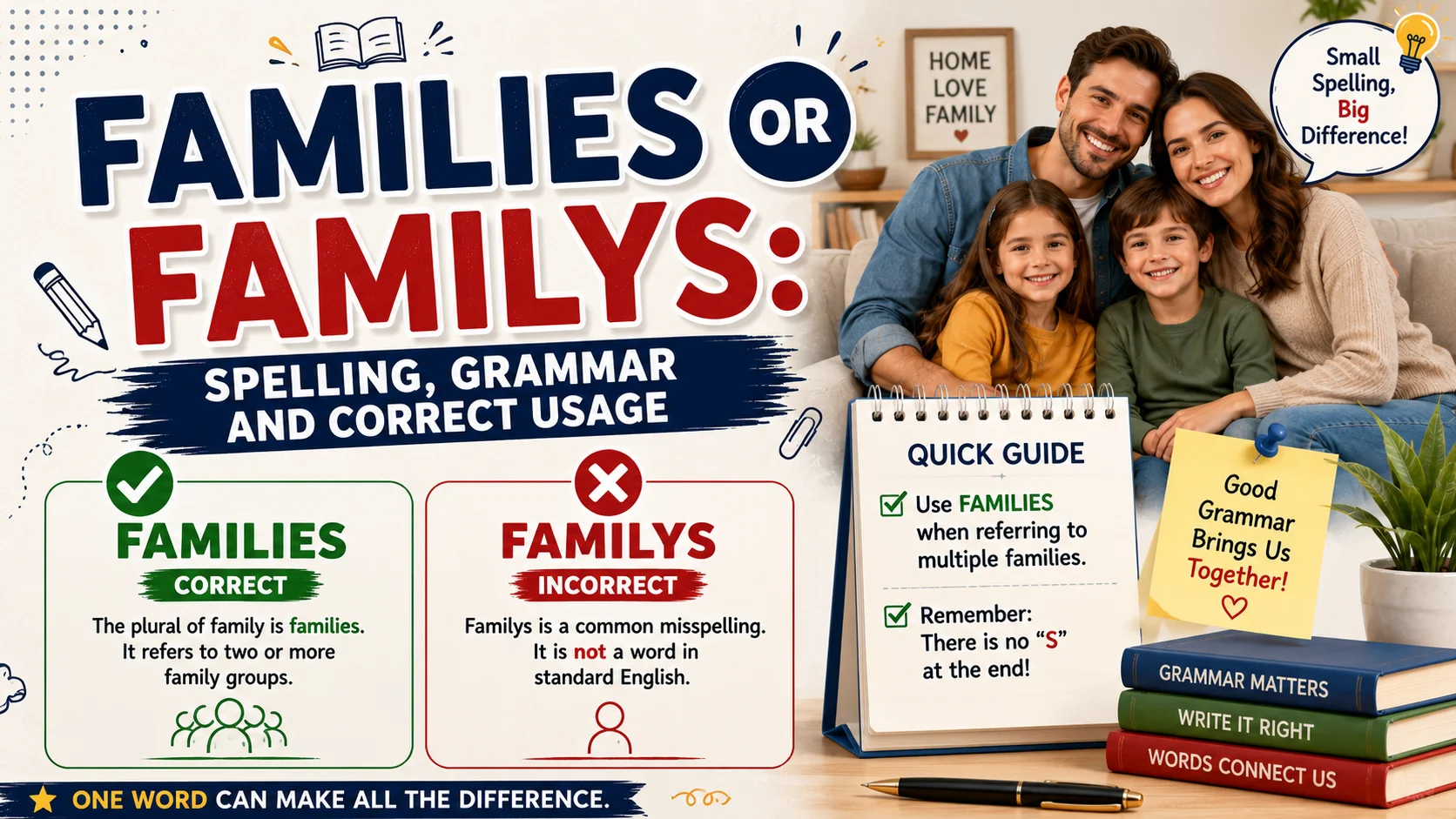
The good news is straightforward: “families” is the only correct spelling for the plural of “family.” The form “familys” is a spelling error that you should never use in your writing.
We created this comprehensive guide to help you master the plural of “family” and understand all related forms. You will learn why “families” is correct, see it in action, understand the differences between “family,” “families,” “family’s,” and “families’,” and avoid common mistakes. By the end of this guide, you will use these forms with confidence.
What Is the Correct Plural Form of Family?
“Families” is the only correct plural form of “family.” “Familys” is never correct in English. The rule is simple: when a word ends in a consonant followed by “y,” change the “y” to “i” and add “es.” Since “family” ends in “ily” (consonant + y), the correct plural is “families”.
Key points:
- Families = Correct plural form (f-a-m-i-l-i-e-s)
- Familys = Incorrect spelling (never use this)
- Rule: consonant + y → change y to i and add es
- Family’s = Singular possessive (belongs to one family)
- Families’ = Plural possessive (belongs to multiple families)
Quick Comparison Table
Main Meaning Section
Comprehensive Definition of Family
“Family” is a noun that refers to a basic social unit consisting of parents and their children, considered as a group, whether dwelling together or not. The word can also refer to:
- A group of people related by blood or marriage: “He could trace his family back over two hundred years”
- A person’s children: “He’s devoted to his wife and family”
- A group of people resembling a family: “At college, my friends became my family”
- A group of living things related to each other: “Lions and tigers are members of the cat family”
- A group of related languages: “English is part of the Germanic language family”
Complete Pronunciation Guide
Family: /ˈfæməli/ or /ˈfæmli/ (FAM-uh-lee or FAM-lee)
Families: /ˈfæməleez/ or /ˈfæmleez/ (FAM-uh-leez or FAM-leez)
Part of Speech
- Noun (primary form): “My family is coming over”
- Adjective: “We went to a family restaurant”
- Countable: Can be used in singular and plural forms
Origin and Etymology
“Family” traces its roots to the Latin word “familia,” meaning “household” or “domestic establishment.” This came from “famulus,” meaning “servant.” The word entered English through Old French and has been in use since the 14th century.
Why “Families” Is Correct and “Familys” Is Not
The Rule:
In English, when a noun ends with a consonant followed by a “y,” the plural is formed by changing the “y” to “i” and adding “es”.
Examples:
- city → cities
- baby → babies
- party → parties
- cherry → cherries
- family → families
Exception:
If the “y” is preceded by a vowel, you simply add “s”:
- day → days
- boy → boys
- key → keys
- monkey → monkeys
Applying the Rule:
“Family” ends in “ily.” The letter before the “y” is “i,” which is a consonant in this context, so the “y” changes to “i” and we add “es,” making “families”.
The spelling “familys” violates this rule. It would only be correct if “family” ended in a vowel before the “y,” which it does not. Therefore, “familys” is never correct in English.
Detailed Explanation
Literal Meaning
Literally, “families” refers to multiple groups of people who are related by blood, marriage, or adoption and typically live together or share close relationships.
Common Meaning
In everyday usage, “families” simply means more than one family unit. We use it constantly in conversation and writing when discussing groups of relatives, households, or kin.
The Three Forms Explained
1. Families (Plural)
This is the plural form of “family.” Use it when referring to more than one family unit. No apostrophe is needed because nothing is being possessed.
Examples:
- “Several families gathered for the annual picnic”
- “The neighborhood has many young families”
- “All the families on our street are friendly”
2. Family’s (Singular Possessive)
This shows that something belongs to one family. Add an apostrophe and an “s” to the singular “family”.
Examples:
- “My family’s house needs repairs”
- “The family’s dog is very friendly”
- “I have to attend my family’s reunion”
3. Families’ (Plural Possessive)
This shows that something belongs to multiple families. Add an apostrophe after the “s” of “families.” Do not add another “s”.
Examples:
- “The families’ contributions made the event a success”
- “All the families’ homes were damaged in the storm”
- “We need to consider the families’ needs”
The Incorrect Form: Familys
“Familys” has no place in modern English. It is a common misspelling that occurs when someone incorrectly adds an “s” to “family” without making the “y” to “ies” change.
A spell-check would flag “familys” as an error. No dictionary recognizes it as a valid word. If you use it, readers will assume you have made a spelling mistake.
Group Noun Verb Agreement
“Family” is a collective noun that can take either a singular or plural verb depending on whether you are thinking of the family as a single unit or as individual members:
- Singular verb (US English): “My family is coming over” – thinking of the family as one unit
- Plural verb (British English): “My family are coming over” – thinking of the individual members
Both forms are acceptable, though the singular is more common in American English.
Usage Examples
Related Terms Table
| Related Word | Meaning |
|---|---|
| Family | Singular form |
| Families | Plural form |
| Family’s | Singular possessive |
| Families’ | Plural possessive |
| Familys | Incorrect spelling |
| Family member | An individual in a family |
| Nuclear family | Parents and children only |
| Extended family | Includes grandparents, aunts, uncles, cousins |
| Single-parent family | One parent raising children |
| Blended family | Parents with children from previous relationships |
| Foster family | Family caring for unrelated children |
| Immediate family | Parents, siblings, children |
| Blood relative | Related by birth |
| Kin | Family or relatives |
| Household | People living in one home |
| Ancestors | Family members from the past |
| Descendants | Future generations of a family |
| Family tree | A chart showing family relationships |
Real-Life Usage Across Contexts
Daily Conversation
People use “families” constantly when discussing community events, school activities, holidays, and neighborhood gatherings. “Our families are getting together for dinner” is a common expression.
Social Media
Social media users discuss families in hashtags like #familytime, #families, and in posts about family events. “Families” appears in discussions about parenting, marriage, and holidays.
Business Communication
Businesses discuss “families” when talking about corporate events, employee benefits, and family-friendly policies. “The company welcomes families to our annual picnic” or “The benefit covers employees’ families.”
Academic Writing
Academics use “families” in research about sociology, anthropology, demographics, and child development. “The study examined 200 families with young children” or “Socioeconomic status affects families’ access to resources.”
Legal and Official Documents
Legal documents use precise language with “families” in zoning laws, housing regulations, and family law. “The ordinance applies to single-family dwellings” or “All families must complete the census.”
Medical Contexts
Healthcare professionals discuss “families” when talking about hereditary conditions, family medicine, and patient support. “The disease runs in families” or “We encourage families to attend the support group.”
Common Mistakes and How to Avoid Them
Semantic Keyword Section
Throughout this article, we have integrated semantic keywords that matter to you as a writer and vocabulary learner:
Primary keywords: families or familys, plural of family, families spelling, correct plural form, families vs familys
Secondary keywords: family plural, how to spell families, families pronunciation, family grammar, family’s vs families, families’ possessive
Error-related keywords: familys incorrect, common spelling mistakes, is familys a word, familys misspelling
Possessive keywords: family’s meaning, families’ meaning, family possessive, plural possessive family
Related Questions Section
Q: Is “familys” ever correct?
No. “Familys” is never correct in modern English. It is a common spelling error that violates the standard rule for words ending in consonant + y.
Q: What is the plural of “family”?
The plural of “family” is “families.” This follows the rule that words ending in consonant + y change the y to i and add es.
Q: What is the difference between “families” and “family’s”?
“Families” is plural (more than one family). “Family’s” is singular possessive (belongs to one family). For example: “Two families live here” vs. “My family’s house is big”.
Q: What is the difference between “families” and “families'”?
“Families” is plural (multiple families). “Families'” is plural possessive (belongs to multiple families). For example: “Several families attended” vs. “The families’ reunion was a success”.
Q: How do I pronounce “families”?
“Families” is pronounced /ˈfæməleez/ or /ˈfæmleez/ (FAM-uh-leez or FAM-leez), rhyming with “sneezes” or “ease”.
Q: Can “family” take a plural verb?
Yes. In British English especially, “family” can take a plural verb when thinking of the individual members: “My family are coming over” vs. “My family is coming over” in American English.
FAQ Section
1. What is the correct spelling: families or familys?
The correct spelling is “families.” “Familys” is an incorrect spelling and should never be used in English.
2. Why is “familys” wrong?
“Familys” is wrong because the plural of “family” follows the rule for words ending in consonant + y: change the y to i and add es. Since “family” ends in “ily” (consonant + y), it becomes “families”.
3. How can I remember the correct spelling?
Remember: consonant + y → ies. Think of other words that follow the same rule: baby → babies, city → cities, party → parties. If you would not write “babys” or “citys,” do not write “familys.”
4. What is the singular possessive of “family”?
The singular possessive is “family’s” (e.g., “my family’s car,” “the family’s dog”). Add an apostrophe and an “s” to the singular “family”.
5. What is the plural possessive of “families”?
The plural possessive is “families'” (e.g., “the families’ reunion,” “the families’ homes”). Add an apostrophe after the “s” of “families.” Do not add another “s”.
6. Is it “families’ ” or “families’s” for plural possessive?
The correct plural possessive is “families’.” The form “families’s” is incorrect because the extra “s” adds no value and makes the spelling awkward.
7. How do I use “families” in a sentence?
Use “families” when referring to more than one family: “Several families attended the picnic,” “The neighborhood has many families,” “All families are welcome”.
8. What does “family” mean?
“Family” refers to a group of people related by blood, marriage, or adoption, who typically live together or have a close relationship with one another.
9. Can “family” be used as an adjective?
Yes. “Family” can be used as an adjective before a noun: “family restaurant,” “family values,” “family doctor,” “family member”.
10. What are the common mistakes with “families” and “family’s”?
Common mistakes include using “family’s” when you mean plural (“Several family’s were there”), using “families” when you mean possessive (“The families house is large”), and using “familys” for plural (“Two familys came”).
11. How do I pronounce “families” correctly?
“Families” is pronounced /ˈfæməleez/ or /ˈfæmleez/ (FAM-uh-leez or FAM-leez). The emphasis is on the first syllable, which rhymes with “ham,” followed by “lee,” followed by “z”.
12. Does “family” take a singular or plural verb?
“Family” can take either a singular or plural verb depending on context. American English prefers the singular: “My family is coming.” British English sometimes uses the plural: “My family are coming.” Both are correct.
13. When should I use “families” vs. “family’s” vs. “families'”?
- “Families” = more than one family (no possession)
- “Family’s” = belongs to one family (singular possessive)
- “Families'” = belongs to multiple families (plural possessive)
14. Is “familys” found in any dictionary?
No. “Familys” is not recognized in any modern dictionary. It is a spelling error that should always be corrected.
Conclusion
We have explored the critical difference between “families” and “familys” and why this distinction matters for your writing. “Families” is the only correct plural form of “family,” following the rule that words ending in a consonant followed by “y” change the “y” to “i” and add “es.” “Familys” is a common spelling error that you should never use.
We have also covered the related forms:
- Family’s = singular possessive (one family owns something)
- Families’ = plural possessive (multiple families own something)
When you master these forms, you demonstrate attention to detail and mastery of English grammar. Your writing becomes more professional and easier to understand. Readers will appreciate the accuracy.
We encourage you to practice using “families” in your writing. Remember: “family” becomes “families,” just like “baby” becomes “babies” and “city” becomes “cities.” With this simple rule, you will never hesitate about this spelling again.

Olivia Bennett is a writer and language enthusiast at Vocabsteria. She is passionate about exploring word meanings, name origins, and cultural expressions from around the world.