Have you ever paused while typing, unsure whether to write “tier” or “teir”? You are not alone. This common spelling dilemma occurs because the “i” and “e” order can be confusing in English words.
The confusion is understandable. English has the famous “i before e except after c” rule, but there are many exceptions. Words like “friend,” “chief,” and “tier” follow the “ie” pattern, while words like “receive” and “ceiling” follow the “ei” pattern after “c” .
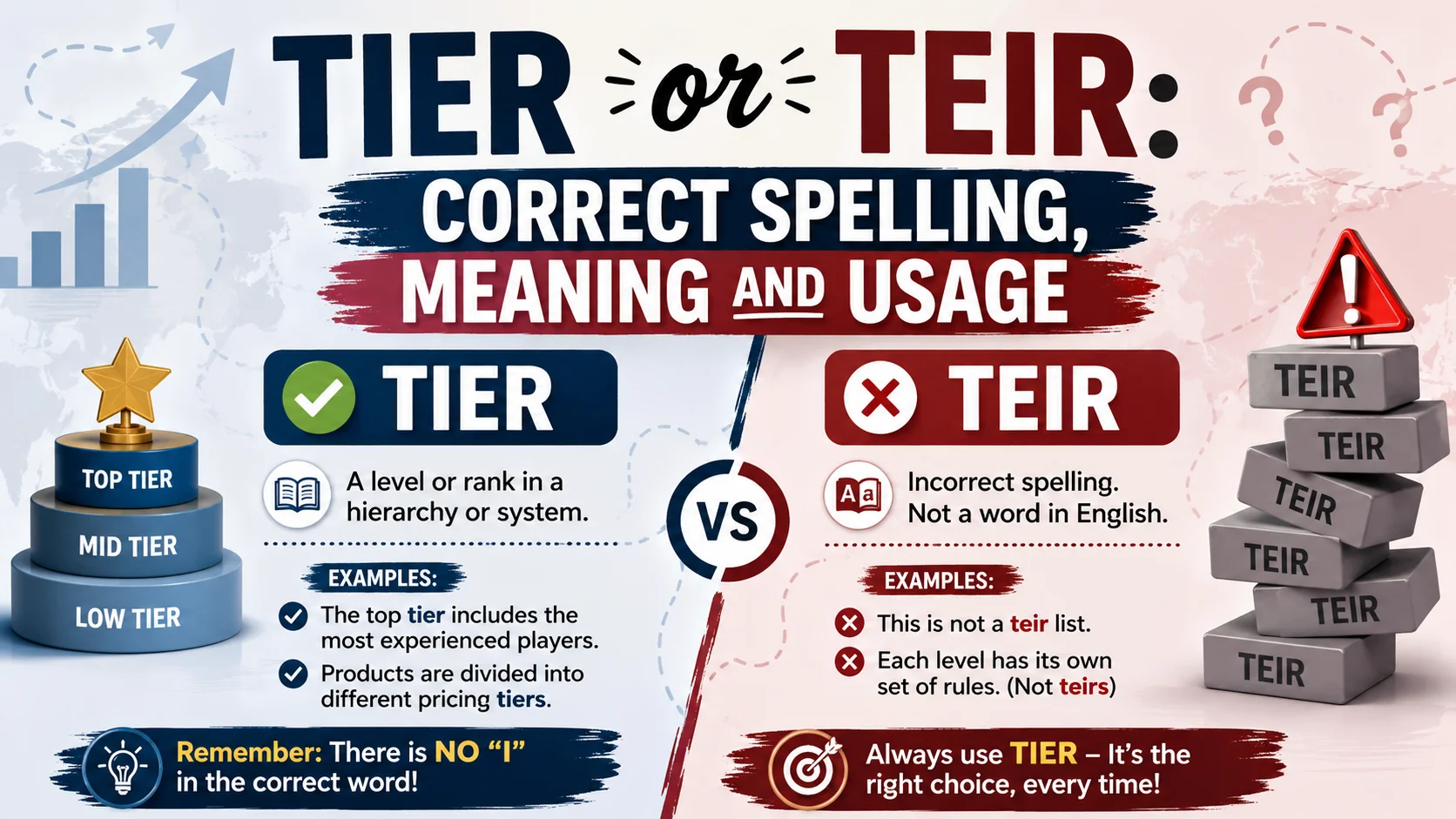
The good news is straightforward: “tier” is the only correct spelling in standard English. “Teir” is a common misspelling that you should avoid. In this comprehensive guide, you will learn the correct spelling, discover the word’s meanings, see it in action, and never confuse these two forms again.
What Is the Correct Spelling?
“Tier” is the only correct spelling in standard English. “Teir” is a common misspelling that you should never use. The word “tier” refers to one of a series of rows, layers, or levels placed one above another, such as seats in a theater, levels in an organization, or layers of a cake .
Key points:
- Tier = Correct spelling (t-i-e-r)
- Teir = Incorrect spelling (common error)
- Rule: Just like “friend” and “chief,” the “ie” order is correct
- Meaning: A row, layer, level, or rank
Quick Comparison Table
| Feature | Tier | Teir |
|---|---|---|
| Status | Correct | Incorrect |
| Spelling | t-i-e-r | t-e-i-r |
| Meaning | A row, layer, level, or rank | None (not a word) |
| Usage | “The wedding cake had six tiers” | Never used |
| Dictionary recognition | Recognized in all dictionaries | Not recognized |
| Pronunciation | /tɪr/ (teer) | /tɪr/ (if used, same pronunciation) |
Main Meaning Section
Comprehensive Definition of Tier
A “tier” is one of a series of rows, ranks, or layers placed one above another . The word describes anything arranged in levels, from physical structures to abstract hierarchies.
Key meanings include:
- Physical layers: Rows of seats rising one behind another in a theater, stadium, or amphitheater
- Structural levels: Layers of a wedding cake, shelves, or galleries in a theater
- Organizational levels: Rankings or classes within a system or organization, such as tiers of management
- Ranking systems: Classes or categories based on quality, such as “top-tier colleges”
Complete Pronunciation Guide
Tier: /tɪr/ (teer)
Key pronunciation points:
- The word rhymes with “fear,” “near,” and “dear”
- The “i” sounds like the “ee” in “see”
- The “e” is silent (it indicates the long “e” sound)
- It is a homophone with “tear” (a drop from the eye)
Part of Speech
- Noun (primary): “The seats are on the third tier”
- Verb: “The cake was tiered beautifully”
- Adjective (in compounds): “a two-tier system”
Origin and Etymology
“Tier” entered English in the 16th century (1560–1570) from Middle French tire or tiere, meaning “order, row, rank” . The French word came from Old French tirer, meaning “to draw out” or “to arrange in order.” It is of Germanic origin, related to Old English tīr meaning “glory, ornament” .
The word’s journey reflects its meaning: from arranging things in rows to describing layered structures and organizational hierarchies.
Contextual Meaning
You will encounter “tier” in various contexts:
Physical Structures:
Organizational and Ranking Systems:
- “Top tier colleges are the most prestigious”
- “The company has three tiers of management”
- “All three tiers of the firm’s management now report to one director”
Systems and Structures:
- “A two-tier system of governance”
- “The tiers of government in a federal system”
Detailed Explanation
Why “Teir” Is Incorrect
The spelling “teir” is incorrect for a simple reason: the correct spelling follows the “ie” pattern, not the “ei” pattern.
The “I Before E” Rule:
The famous mnemonic “i before e except after c” helps with many English spellings. “Tier” follows this rule because there is no “c” before the “ie” . Words like:
- Tier follows the “ie” pattern
- Friend follows the “ie” pattern
- Chief follows the “ie” pattern
- Believe follows the “ie” pattern
The spelling “teir” would require an “ei” pattern, which is only correct after “c” in words like “receive” and “ceiling” .
Common Mistakes
| Mistake | Correct Usage |
|---|---|
| Writing “teir” | Write “tier” |
| “The cake had three teirs” | “The cake had three tiers” |
| “He is in the top teir” | “He is in the top tier” |
| “Teir 1 vocabulary” | “Tier 1 vocabulary” |
Memory Tricks
- Think of “friend”: Both “friend” and “tier” have “ie” in them. If you can spell “friend,” you can spell “tier.”
- Remember the rule: “Tier” follows “i before e except after c.” There is no “c,” so the “i” comes before the “e.”
- Think of “tiered cake”: The word “cake” has “ie” in its spelling, just like “tier.”
- Think of “chief”: Both “chief” and “tier” follow the “ie” pattern.
Usage Examples
| Example Sentence | Meaning |
|---|---|
| The theater has three tiers of seating | There are three rows of seats stacked above each other |
| The wedding cake had six tiers | The cake had six layers |
| She is in the top tier of her class | She is among the highest-ranked students |
| The company has a two-tier management structure | The organization has two levels of management |
| They sat in the upper tier of the stadium | They sat in the higher section of seats |
| The government has three tiers of administration | There are three levels of government |
| The system is organized in tiers | The system has multiple levels or layers |
| This is a top-tier university | It is among the most prestigious universities |
| The shelves were arranged in tiers | The shelves were arranged in rows one above another |
| The new policy will create a new tier of management | A new level of management will be created |
Related Terms Table
| Related Word | Meaning |
|---|---|
| Layer | A single thickness of material or level |
| Level | A position on a scale or hierarchy |
| Row | A linear arrangement of things |
| Rank | A position in a hierarchy |
| Stratum | A layer or level, especially in social or geological contexts |
| Echelon | A level or rank in an organization |
| Floor | A level of a building |
| Gallery | A balcony or upper floor in a theater |
| Storey | A level of a building (also spelled “story”) |
| Grade | A level or rank |
| Class | A group or category |
| Degree | A level or stage of progression |
| Order | A rank or class |
| Series | A number of things arranged in a sequence |
| Hierarchy | A system with different levels of importance |
Real-Life Usage Across Contexts
Daily Conversation
People use “tier” when discussing seating, cakes, and levels: “We have seats on the lower tier.” “The cake has four tiers.” “She’s in a different tier of the competition.”
Business Communication
In business, “tier” describes organizational levels and rankings: “The company has three tiers of management” . “These are top-tier clients.” “The system uses a two-tier pricing structure.”
Academic Writing
Academics use “tier” in discussions of educational levels, research hierarchies, and systems: “Top-tier universities receive the most funding” . “The study examined three tiers of the education system.”
Sports and Entertainment
Sports commentators use “tier” for seating and competition levels: “The fans in the upper tier of the stadium.” “This is a top-tier league.” “The competition has multiple tiers.”
Technology and Gaming
In tech and gaming, “tier” describes performance levels, subscription plans, and rankings: “This is a tier-one provider.” “The game has four tiers of weapons.” “The subscription has three tiers.”
Education
Educators use “tier” in vocabulary instruction and academic contexts:
- Tier 1 vocabulary: Basic, everyday words used in conversation, like “talk,” “happy,” and “clock”
- Tier 2 vocabulary: Academic words that appear across subjects, like “analyze,” “classify,” and “appropriate”
- Tier 3 vocabulary: Domain-specific words for particular subjects, like terms in science or history
Semantic Keyword Section
Throughout this article, we have integrated semantic keywords that matter to you as a writer and vocabulary learner:
Primary keywords: tier or teir, tier spelling, teir misspelling, tier meaning, tier definition
Secondary keywords: correct spelling of tier, how to spell tier, tier vs teir, tier pronunciation
Related keywords: tiered, tiering, top tier, lower tier, two-tier, tier system
Error-related keywords: common spelling mistakes, teir incorrect, is teir a word
Related Questions Section
Q: Is “teir” ever correct?
No. “Teir” is never correct in standard English. It is a common misspelling of “tier” that you should avoid.
Q: Why is “tier” spelled with “ie”?
“Tier” follows the English spelling rule “i before e except after c.” Since there is no “c” before the “ie,” the “i” comes before the “e.”
Q: What does “tier” mean?
“Tier” means one of a series of rows, layers, or levels placed one above another. It can refer to physical structures, organizational levels, or ranking systems .
Q: How do you pronounce “tier”?
“Tier” is pronounced /tɪr/ (teer), rhyming with “fear” and “near” .
Q: What is a “top-tier” university?
A “top-tier” university is one of the most prestigious and highest-ranked educational institutions .
Q: What are “tiers” in vocabulary?
In education, “tiers” refer to levels of vocabulary:
- Tier 1: Basic, everyday words
- Tier 2: Academic words across subjects
- Tier 3: Domain-specific technical words
FAQ Section
1. What is the correct spelling: tier or teir?
The correct spelling is “tier.” “Teir” is a common misspelling and is never correct in standard English.
2. How can I remember the correct spelling?
Remember that “tier” follows the “i before e” pattern. Think of other “ie” words like “friend” and “chief.” If you can spell “friend,” you can spell “tier.”
3. What is the plural of “tier”?
The plural is “tiers.” For example, “The stadium has many tiers of seating.”
4. What is the verb form of “tier”?
The verb form is “tiered” (past tense) or “tiering” (present participle). For example, “The cake was beautifully tiered” .
5. What are some common collocations with “tier”?
Common collocations include “top tier,” “lower tier,” “upper tier,” “third tier,” “two-tier system,” “tier one,” and “tiered pricing” .
6. Is “tier” a homophone?
Yes. “Tier” is a homophone with “tear” (a drop from the eye) . They sound identical but have different meanings and spellings.
7. What are the three tiers in education vocabulary?
- Tier 1: Basic conversational words (e.g., talk, happy, clock)
- Tier 2: Academic words across subjects (e.g., analyze, classify, appropriate)
- Tier 3: Domain-specific technical words
8. Where did the word “tier” come from?
“Tier” came into English in the 16th century from Middle French tire or tiere, meaning “order, row, rank.” It comes from Old French tirer, meaning “to draw out” or “to arrange in order” .
Conclusion
We have explored the critical difference between “tier” and “teir” and why this distinction matters for your writing. “Tier” is the only correct spelling in standard English, following the “i before e except after c” rule. “Teir” is a common misspelling that you should never use.
“Tier” is a versatile word that describes physical layers (like seats in a theater or layers of a cake), organizational levels (like tiers of management), and ranking systems (like top-tier colleges) .
When you master this spelling, you demonstrate attention to detail and mastery of English vocabulary. Your writing becomes more professional and easier to understand.
We encourage you to practice using “tier” in your writing. Remember the simple rule: “tier” has “ie” like “friend” and “chief.” With this memory trick, you will never hesitate about this spelling again.

Olivia Bennett is a writer and language enthusiast at Vocabsteria. She is passionate about exploring word meanings, name origins, and cultural expressions from around the world.