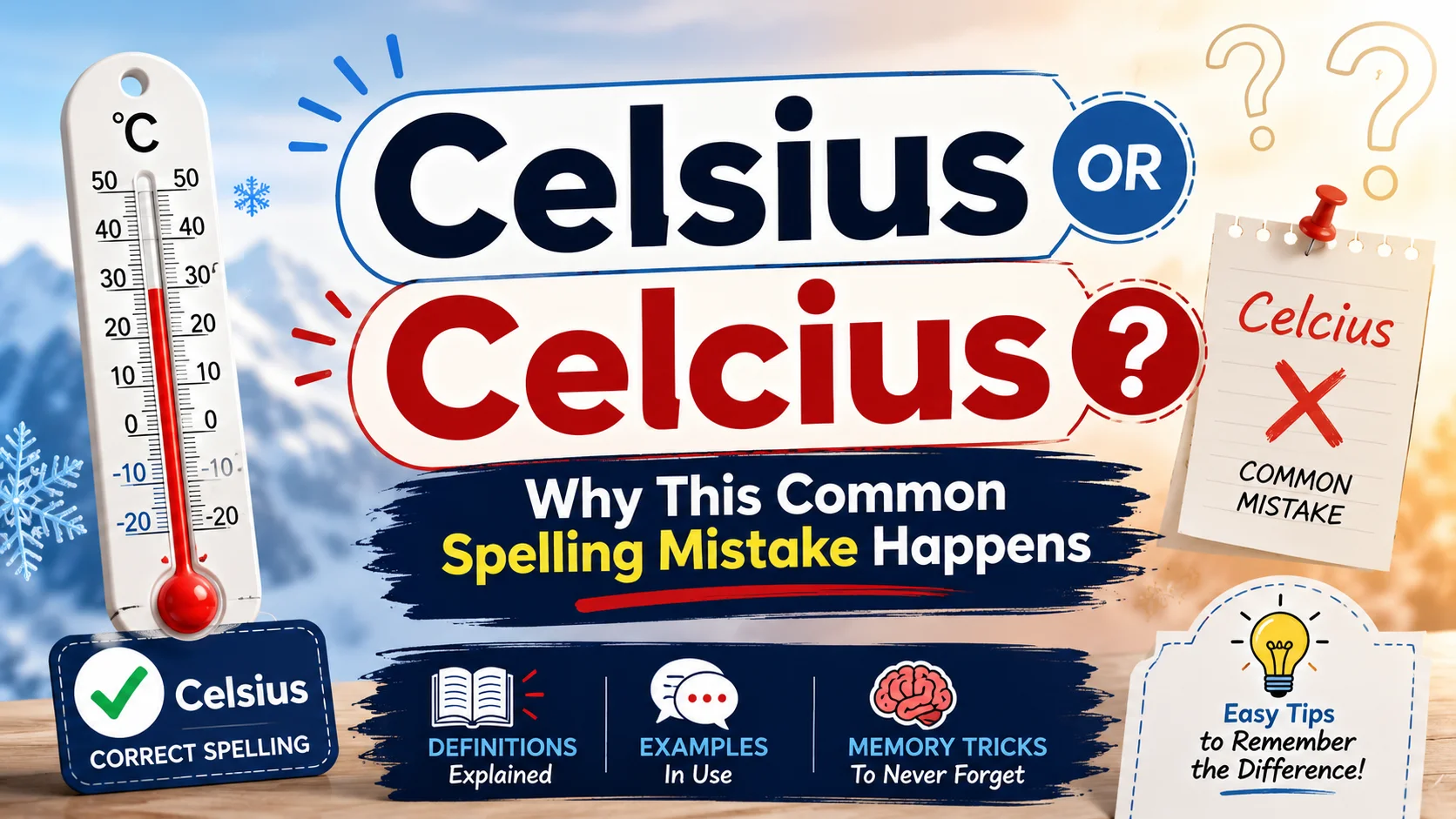
Have you ever paused before writing a temperature, wondering whether to spell it “Celsius” or “Celcius”? You are certainly not alone. This common spelling mistake plagues students, professionals, and even experienced writers. We encounter this question frequently in our work with language and science education.
The correct spelling is “Celsius,” named after the Swedish astronomer Anders Celsius (1701–1744). The misspelling “Celcius” has become remarkably widespread, appearing in approximately 61% of online searches for this term.
We created this comprehensive guide to help you master the correct spelling, understand why this confusion exists, and learn about the fascinating history of the Celsius temperature scale. You will gain confidence in your writing and never second-guess this word again.
What is the Difference Between Celsius and Celcius?
“Celsius” is the only correct spelling for the temperature scale named after the Swedish astronomer Anders Celsius. “Celcius” is a common misspelling that places the ‘c’ and ‘l’ in the wrong order. You should always use “Celsius” in all writing contexts.
Key points:
- Celsius = Correct spelling (c-e-l-s-i-u-s)
- Celcius = Incorrect spelling (c-e-l-c-i-u-s)
- Named after Anders Celsius, the Swedish astronomer who developed the temperature scale
- The spelling error occurs in about 61% of online uses
Quick Comparison Table
Main Meaning Section
Definition of Celsius
Celsius is a temperature scale on which water freezes at 0 degrees and boils at 100 degrees under standard atmospheric pressure. This scale is commonly used throughout most of the world for everyday temperature measurements and in scientific contexts.
Pronunciation
Celsius: /ˈsɛlsiəs/ (SEL-see-us)
The emphasis falls on the first syllable. The “s” is pronounced as a soft “s” sound, followed by a soft “i” sound.
Part of Speech
- Noun: The temperature scale itself (“The Celsius scale”)
- Adjective: Describing temperatures measured on this scale (“20 degrees Celsius”)
Origin and Etymology
The term “Celsius” comes from the name of the Swedish astronomer Anders Celsius (1701–1744), who developed a 100-degree temperature scale and presented it to the Swedish Academy of Sciences in 1742.
Interestingly, Celsius originally designed his scale with the boiling point of water at 0 degrees and the freezing point at 100 degrees – the reverse of what we use today. After his death in 1744, scientists reversed the scale to its current form, where 0°C represents the freezing point and 100°C represents the boiling point.
The term “centigrade” (meaning “divided into 100 degrees”) was used for many years before officially being renamed “Celsius” in the 1940s.
Contextual Meaning
You will encounter “Celsius” in several contexts:
- Daily conversation: “It is 25 degrees Celsius today”
- Science: “We measured the reaction at 100°C”
- Weather forecasts: “Temperatures will reach 30°C”
- Cooking: “Preheat the oven to 180°C”
Detailed Explanation
Literal Meaning
Literally, Celsius refers to a temperature scale based on two fixed points: the freezing point of water (0°C) and the boiling point of water (100°C) at standard atmospheric pressure. The scale is also defined by the Kelvin scale, where 0°C equals 273.15 K and a temperature change of 1°C equals a change of 1 K.
Common Meaning
In common usage, “Celsius” means the standard temperature measurement system used in most countries. You will hear it in weather reports, cooking instructions, and conversations about heat and cold.
Internet Meaning
Online, “Celsius” appears in weather apps, cooking blogs, and science websites. The misspelling “Celcius” appears frequently in web searches, social media posts, and informal writing.
Slang Meaning
Celsius has no specific slang meaning, though people sometimes use “centigrade” informally to refer to the same scale.
Texting Meaning
In texting and messaging, people often use “C” as shorthand for “Celsius” – for example, “It’s 35°C today!”
Social Media Meaning
On social media platforms, Celsius appears in weather-related posts, travel updates, and cooking content. The hashtag #celsius frequently accompanies temperature-related content.
Usage Examples
| Example Sentence | Meaning |
|---|---|
| The temperature reached 35 degrees Celsius today | The weather hit 35°C |
| Water freezes at 0 degrees Celsius | The freezing point is 0°C |
| Set the oven to 180 degrees Celsius | Preheat the oven to 180°C |
| Scientists recorded the temperature in Celsius | They used Celsius for scientific measurement |
| Most countries use Celsius for weather forecasts | Celsius is standard internationally |
| The Celsius scale is based on water’s freezing and boiling points | The scale uses 0°C and 100°C as reference points |
| Convert the temperature from Fahrenheit to Celsius | Change the measurement system |
| The Kelvin scale shares the same increments as Celsius | One Kelvin equals one degree Celsius |
| Anders Celsius invented the 100-degree scale in 1742 | The inventor introduced the scale in 1742 |
| I always check the Celsius reading on my thermometer | They check the Celsius measurement |
| The recipe calls for 200 degrees Celsius | The recipe uses Celsius |
| This thermometer shows both Celsius and Fahrenheit | The display shows both scales |
Synonyms Table
| Term | Meaning |
|---|---|
| Centigrade | The former name for Celsius, meaning “100 degrees” |
| °C | The symbol for degrees Celsius |
| Degrees Celsius | The full term for temperatures measured on this scale |
| Celsius scale | The full name of the temperature scale |
Related Terms Table
| Related Word | Meaning |
|---|---|
| Fahrenheit | A temperature scale used primarily in the United States |
| Kelvin | The SI unit of temperature, with zero at absolute zero |
| Thermometer | An instrument for measuring temperature |
| Temperature | The measure of heat or cold |
| Boiling point | The temperature at which a liquid boils (100°C for water) |
| Freezing point | The temperature at which a liquid freezes (0°C for water) |
| Absolute zero | The lowest possible temperature (-273.15°C) |
| Triple point | The temperature and pressure at which water exists as solid, liquid, and gas (0.01°C) |
| Metric system | The decimal system of measurement that includes Celsius |
| International System of Units (SI) | The modern metric system that includes Kelvin and Celsius |
| Anders Celsius | The Swedish astronomer who developed the scale |
Real-Life Usage
Daily Conversation
You will hear Celsius constantly in daily life outside the United States. People ask “What’s the temperature in Celsius?” and discuss “degrees Celsius” when talking about weather or cooking.
Social Media
On social media, you will see Celsius in hashtags like #30degreesCelsius and in posts about weather extremes.
Business Communication
In international business, Celsius appears in product specifications, shipping conditions, and manufacturing temperature requirements.
Academic Writing
Scientists and students use Celsius to report experimental data, research findings, and lab measurements.
Online Messaging
In messaging, people use “°C” shorthand to save time and characters.
Common Mistakes
| Mistake | Correct Usage |
|---|---|
| Spelling “Celcius” instead of “Celsius” | Write “Celsius” (c-e-l-s-i-u-s) |
| Confusing “centigrade” and “Celsius” | Both refer to the same scale; “Celsius” is the modern term |
| Lowercasing “celsius” incorrectly | Use uppercase when starting a sentence; lowercase elsewhere |
| Writing “degrees Celcius” | Write “degrees Celsius” |
| Saying “Celcius” aloud | Pronounce it “SEL-see-us” |
Semantic Keyword Section
Throughout this article, we have integrated semantic keywords that matter to you as a writer and language learner. These include “celsius or celcius,” “correct spelling of celsius,” “anders celsius,” “celsius vs celcius,” “celsius spelling,” “celcius misspelling,” “celsius scale,” “temperature scale,” “degrees celsius,” and “how to spell celsius.”
Related Questions Section
Q: Is Celsius or Celcius correct?
A: “Celsius” is the only correct spelling. “Celcius” is a common misspelling where the ‘c’ and ‘l’ are swapped.
Q: Why do people spell Celcius instead of Celsius?
A: “Celcius” is a phonetic misspelling that places the ‘c’ and ‘l’ in the order that matches how some people pronounce it. About 61% of misspellings of the word show this pattern.
Q: Who was Celsius named after?
A: Celsius was named after the Swedish astronomer Anders Celsius (1701–1744), who developed a 100-degree temperature scale in 1742.
Q: What is the symbol for degrees Celsius?
A: The symbol for degrees Celsius is °C. In scientific usage, “C” alone is sometimes used.
Q: Is Celsius and centigrade the same thing?
A: Yes, they refer to the same scale. “Centigrade” (meaning “divided into 100 degrees”) was the original name, but the scale was officially renamed “Celsius” in the 1940s.
FAQ Section
1. Is “Celcius” ever correct in English?
No, “Celcius” is never correct in English. The correct spelling is always “Celsius.” The Oxford English Dictionary does not record “Celcius” as a valid variant at all.
2. Why is “Celcius” such a common misspelling?
Spelling experts suggest that people spell it “Celcius” because it follows a familiar phonetic pattern: the “c” before “i” sounds like “sh” in many words, leading to the letter confusion.
3. How can I remember the correct spelling?
Think of the name of the astronomer: Anders Celsius. Remember that his name has “s” before “i” – C-E-L-S-I-U-S. The sequence “si” appears just like the word “see.”
4. What is the correct pronunciation of Celsius?
Celsius is pronounced /ˈsɛlsiəs/ (SEL-see-us). The emphasis falls on the first syllable.
5. What are the reference points of the Celsius scale?
Water freezes at 0°C and boils at 100°C at standard atmospheric pressure.
6. Is Celsius the same as centigrade?
Yes, “centigrade” was the former name for the Celsius scale. The scale was officially renamed “Celsius” in the 1940s.
7. What is the relationship between Celsius and Kelvin?
0°C equals 273.15 K, and a temperature change of 1°C equals a change of 1 K.
8. What are the alternative temperature scales?
The two other common temperature scales are Fahrenheit (used primarily in the United States) and Kelvin (used in scientific contexts).
Conclusion
We have explored the critical difference between “Celsius” and “Celcius” and why this distinction matters for your writing credibility. “Celsius” is the correct spelling, named after the Swedish astronomer Anders Celsius who developed the 100-degree temperature scale in 1742. “Celcius” is a common misspelling that appears in over 60% of online searches for this term.
When you master the correct spelling, you demonstrate attention to detail and respect for the scientific heritage of this important temperature scale. We encourage you to remember the correct order: c-e-l-s-i-u-s. The “s-i” sequence appears just like the word “see” – and that is what you will see in all proper references to this temperature scale.
Your readers and colleagues will appreciate the precision. Practice using “Celsius” in your writing, and you will build confidence and credibility. The slight effort to remember this spelling will pay off in professional, academic, and everyday communication.

Olivia Bennett is a writer and language enthusiast at Vocabsteria. She is passionate about exploring word meanings, name origins, and cultural expressions from around the world.