Have you ever written “feint” when you meant “faint”? Or wondered if someone who passed out “feinted”? You are not alone. These two words sound exactly alike, and their spellings differ by just a single letter.
The confusion is understandable. Both “faint” and “feint” share the same pronunciation (/feɪnt/), and many people encounter them in similar contexts—like describing a “faint” smell or a boxer’s “feint.” But their meanings couldn’t be more different.
We created this guide to help you distinguish these tricky homophones once and for all. You will learn their definitions, see them in action, and discover memory tricks that make choosing the right word second nature.
What is the Difference Between Faint and Feint?
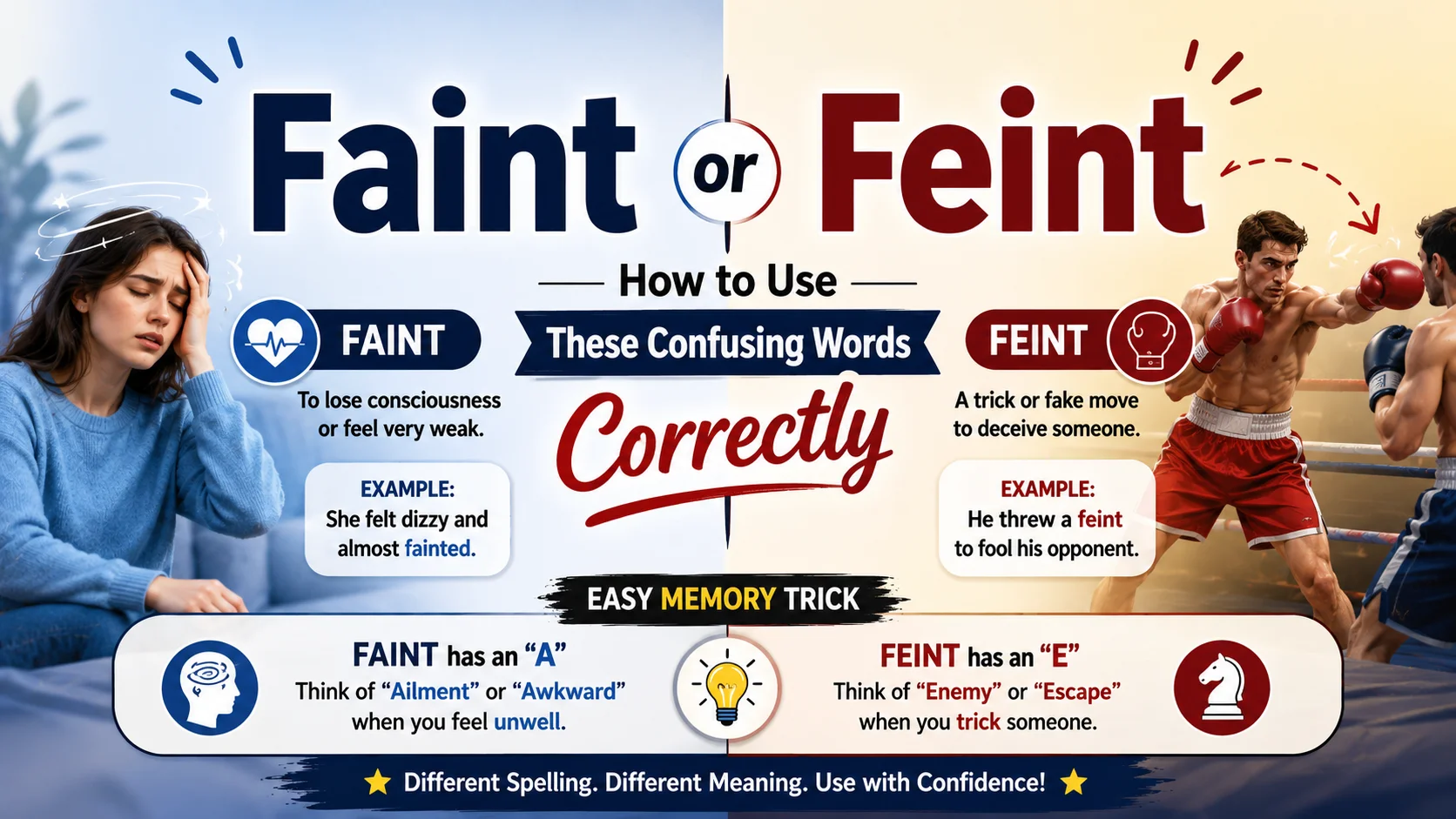
“Faint” means weak, barely perceptible, or to lose consciousness. “Feint” means a deceptive move designed to mislead an opponent, common in sports, boxing, and military tactics. They sound identical (/feɪnt/) but have completely different meanings.
Key points:
- Faint = Weak, dim, dizzy, or passing out
- Feint = A fake-out or deceptive move
- If you’re describing weakness or losing consciousness, use “faint”
- If you’re describing a trick or fake attack, use “feint”
Quick Comparison Table
Main Meaning Section
Definition of Faint
“Faint” has three main uses. As an adjective, it means weak, dim, or barely perceptible—something hard to see, hear, smell, or feel. As a verb, it means to lose consciousness temporarily. As a noun, a “faint” refers to the act of losing consciousness.
Definition of Feint
“Feint” is a noun or verb describing a deceptive move designed to distract or mislead an opponent. You will most often encounter it in sports (like boxing, fencing, or soccer), military tactics, or any situation involving strategy and deception.
Pronunciation
Both words are pronounced exactly the same way: /feɪnt/ (rhymes with “paint” or “tint”).
Part of Speech
Faint:
- Primary: Adjective (“a faint sound”)
- Primary: Verb (“to faint”)
- Secondary: Noun (“she collapsed in a faint”)
Feint:
Origin/Etymology
Faint comes from the Old French faint, meaning “feigned, false, weak,” which itself comes from the Latin fingere, meaning “to shape, invent, or pretend.”
Feint shares the exact same origin! It comes from the French feinte, meaning “a fabrication” or “pretended,” also from the Latin fingere.
Both words started from the same Latin root meaning “to pretend” or “to fashion,” but their meanings diverged over time.
Detailed Explanation
Literal Meaning
Literally, “faint” describes something that lacks strength, intensity, or clarity. A faint sound barely reaches your ears. A faint light barely illuminates. “Feint” literally describes a deceptive action—a fake punch, a pretended move, or a misleading gesture.
Common Meaning
In everyday English, we use “faint” to talk about:
- Weakness: “I feel faint” or “I need to sit down”
- Barely perceptible things: “a faint smell,” “a faint hope,” “a faint smile”
- Loss of consciousness: “He fainted from the heat”
We use “feint” to describe:
- Deceptive moves in sports: “The soccer player feinted right”
- Military strategies: “The attack was a feint”
- Any trick or bluff: “His apology was just a feint to avoid trouble”
Internet and Slang Meaning
On social media and in casual online messaging, “faint” has taken on a slang meaning. People use it to express a stunned, dramatic reaction to something impressive, shocking, or “too good to be true.” It is not literal—no one actually faints. It’s a playful exaggeration, like “I can’t even” or “I’m dead.”
Examples include:
- “Wait, you got upgraded to first class? Faint.”
- “She posted that outfit and I literally fainted in the comments.”
“Feint” does not have a slang meaning—it remains strictly tied to deceptive moves in sports, combat, and strategy.
Usage Examples
Synonyms Table
| Synonym for Faint | Meaning |
|---|---|
| Weak | Lacking strength or intensity |
| Dim | Lacking brightness |
| Barely perceptible | Almost impossible to notice |
| Indistinct | Not clear or sharply defined |
| Feeble | Lacking physical strength or vigor |
| Slight | Small in degree or amount |
| Dizzy | Feeling lightheaded or unsteady |
| Lightheaded | Feeling faint or dizzy |
| Unconscious | Not awake or aware |
| Passed out | Lost consciousness |
| Swoon | Faint or lose consciousness (archaic) |
| Vague | Not clearly expressed or perceived |
| Muted | Softened in intensity |
| Subdued | Lacking in intensity |
Related Terms Table
Real-Life Usage
Daily Conversation
You will hear “faint” frequently in everyday speech. People say “I feel faint” when they are dizzy. They describe “a faint smell” or “a faint memory.” You might say “I haven’t the faintest idea” to mean “I have no idea.”
Sports
“Feint” appears most often in sports commentary. A boxer feints to mislead an opponent. A soccer player feints left before going right. A football player uses a feint to fake out a defender.
Military and Strategy
In military contexts, a “feint” is a deliberate deceptive attack designed to draw enemy forces away from the real target. The Normandy landings, for example, involved deceptive feints to mislead the Germans.
Social Media
On social media, “faint” appears as a slang reaction word. People comment “Faint” on impressive posts to show amazement. It’s playful and exaggerated, not literal.
Academic Writing
In academic writing, “faint” appears in scientific descriptions (“a faint signal,” “faint traces”). “Feint” is less common, appearing primarily in texts about history, military strategy, or sports analysis.
Common Mistakes
Semantic Keyword Section
Throughout this article, we have integrated semantic keywords that matter to you as a writer and language learner. These include “faint or feint,” “faint meaning,” “feint meaning,” “faint vs feint,” “faint definition,” “feint definition,” “difference between faint and feint,” “faint of heart,” “feint in boxing,” “faint sound,” “feint in sports,” and “homophones.”
Related Questions Section
Q: What is the difference between faint and feint?
A: “Faint” means weak, barely perceptible, or to lose consciousness. “Feint” means a deceptive move designed to mislead an opponent. They are homophones—they sound identical but have different meanings and spellings.
Q: Is it “faint of heart” or “feint of heart”?
A: It is “faint of heart.” This phrase means lacking courage or being timid. “Feint of heart” is incorrect.
Q: How can I remember the difference?
A: Think of “faint” as having “ai” like “air”—something faint is thin as air. Think of “feint” as having “ei” like “feign”—a feint is pretending or faking something.
Q: What is a feint in boxing?
A: In boxing, a feint is a deceptive punch or movement designed to distract or mislead an opponent. A boxer might feint with a jab to create an opening for a real punch.
Q: What is the medical term for fainting?
A: The medical term for fainting is “syncope.” It occurs when there is a decrease in blood flow to the brain.
Q: Is faint used as an adjective or verb?
A: “Faint” can be both. As an adjective, it means weak or barely perceptible (“a faint sound”). As a verb, it means to lose consciousness (“he fainted”).
FAQ Section
1. What is the easiest way to remember faint vs feint?
Use the “ai” and “ei” trick. “Faint” has “ai” like “air”—something faint is thin as air. “Feint” has “ei” like “feign” (to pretend)—a feint is a fake move.
2. Can “feint” ever mean to lose consciousness?
No. “Feint” never means to lose consciousness. It always refers to a deceptive move. If someone passes out, they have “fainted,” not “feinted.”
3. What does “faint of heart” mean?
“Faint of heart” means lacking courage or being easily frightened. It appears in the phrase “not for the faint of heart,” meaning something that requires courage to face.
4. Is “feint” used outside of sports?
Yes. “Feint” is used in military strategy, business negotiations, and any context involving deception. It can describe a political tactic, a diplomatic strategy, or even a misleading apology.
5. Why do people confuse faint and feint?
People confuse them because they are homophones (they sound exactly the same) and their spellings differ by only one letter. The meanings are completely different, but the similarity in sound and spelling leads to frequent errors.
6. What is a feint in fencing?
In fencing, a feint is a deceptive attack aimed at one part of the opponent’s body to draw a defensive reaction, allowing the fencer to attack another target.
7. Can “faint” be a noun?
Yes. As a noun, a “faint” refers to an act of losing consciousness. For example, “She collapsed in a faint.”
8. What is the slang meaning of “faint” on social media?
On social media, “faint” is used as a playful exaggeration to express shock, admiration, or disbelief. For example, “Faint, that dress is incredible!” It is not literal—no one is actually losing consciousness.
Conclusion
We have explored the critical differences between “faint” and “feint” and why this distinction matters for your writing clarity. “Faint” describes weakness, dimness, or losing consciousness. “Feint” describes a deceptive move designed to mislead an opponent.
When you master these words, you avoid embarrassing errors that undermine your credibility. Remember the “ai” and “ei” trick: faint has “ai” like “air” (thin as air), and feint has “ei” like “feign” (to pretend). If you’re describing something weak or barely there, choose “faint.” If you’re describing a fake-out or trick, choose “feint.”
Your readers will appreciate the precision. With practice, choosing the right word will become second nature.

Olivia Bennett is a writer and language enthusiast at Vocabsteria. She is passionate about exploring word meanings, name origins, and cultural expressions from around the world.