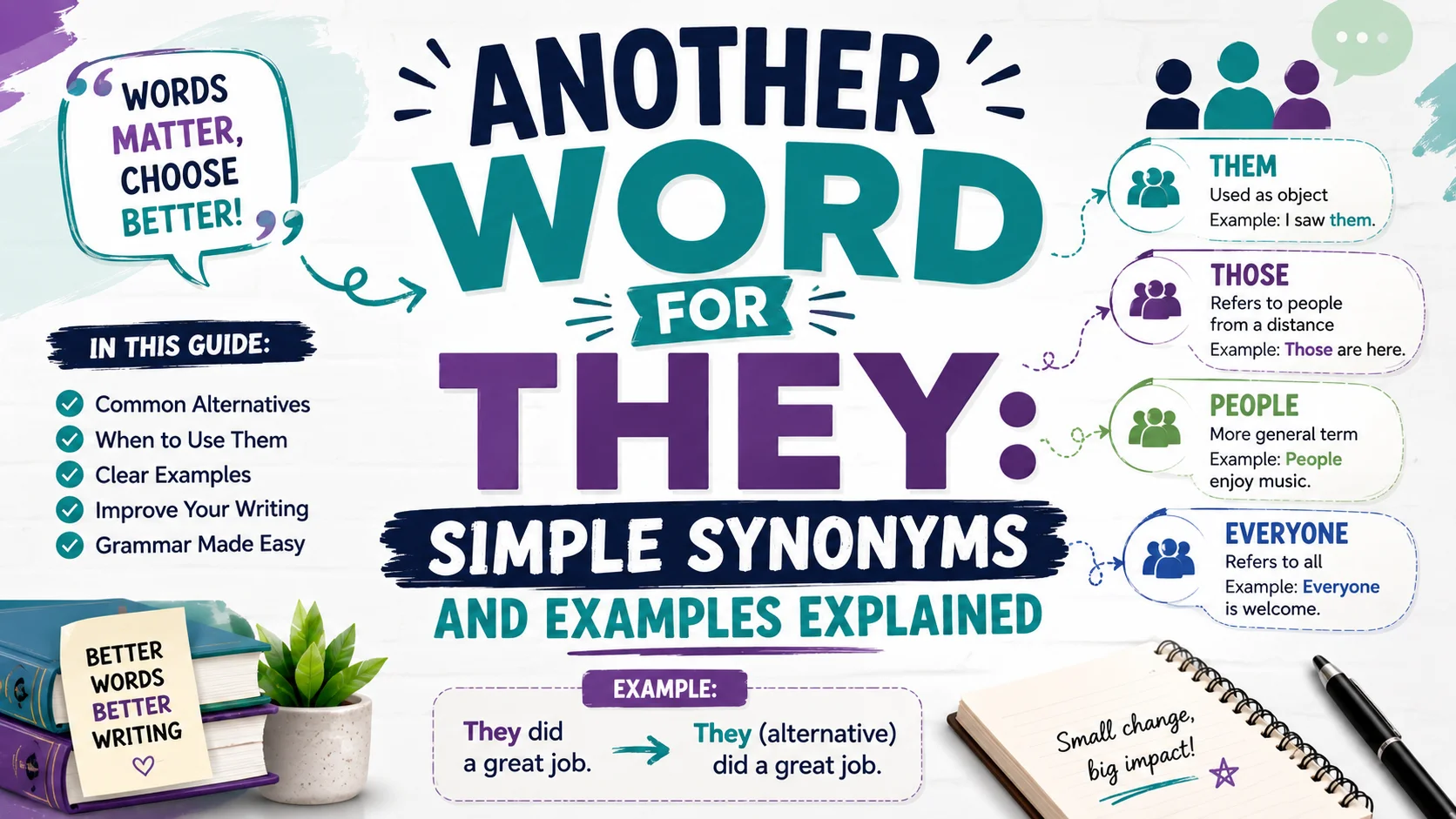
Have you ever written a sentence that repeats “they” too many times? Or wondered if there’s a better word to use? You are not alone. Finding alternatives to common pronouns can make your writing more varied, precise, and professional.
“The word “they” serves as a third-person plural pronoun used to refer to multiple people or entities” . But the English language offers many alternatives depending on your context.
We created this guide to help you choose the right replacement for “they” in any situation. You will learn practical alternatives that make your writing clearer and more engaging.
What Is Another Word for “They”?
There isn’t a single direct synonym for “they,” but you can replace it with words like “them,” “those people,” “the group,” “individuals,” or “these” depending on context. For indefinite references, “people” or “everyone” work well. In formal writing, use specific nouns like “participants,” “employees,” or “students” instead .
Key points:
- Direct pronouns: them, these, those
- General references: people, individuals, everyone
- Group names: the team, the committee, the participants
- Singular gender-neutral: them (objective form), their (possessive)
Quick Comparison Table
| Alternative | When to Use | Example |
|---|---|---|
| Them | As the object of a verb (objective case) | “I gave the books to them“ |
| Those people | To explicitly reference a specific group | “Those people are my neighbors” |
| The group | To emphasize collective identity | “The group decided to leave” |
| Individuals | To highlight separate identities | “Individuals may choose any option” |
| People | For general, indefinite references | “People say it’s haunted” |
| Participants | In research or formal contexts | “Participants completed the survey” |
Main Meaning Section
Definition of “They”
“They” is a third-person plural pronoun used to refer to two or more people or things previously mentioned or easily identified. It can also function as a singular pronoun to refer to a person whose gender is unknown or to someone who identifies as nonbinary .
Pronunciation
They: /ðeɪ/ (rhymes with “day” or “say”)
Part of Speech
- Personal pronoun (third person plural)
- Nominative/Subject form: They (“They are coming”)
- Objective form: Them (“I saw them”)
- Possessive adjective: Their (“Their house”)
- Possessive pronoun: Theirs (“The book is theirs”)
- Reflexive: Themselves (“They hurt themselves”)
Origin/Etymology
“They” comes from Old Norse þeir, meaning “those.” The Vikings introduced this word to English, gradually replacing the Old English hīe. By the 13th century, “they” had become the standard third-person plural pronoun in English .
Contextual Meaning
“They” appears in three main contexts:
- Plural groups: “Seven people made reservations, and they all showed up”
- Singular unknown gender: “If a student is absent, they must bring a note”
- Nonbinary singular: “Quinn is waiting to adopt a puppy, so they will have more time”
Detailed Explanation
Literal Meaning
Literally, “they” indicates more than one person, animal, or thing. It functions as the subject of a sentence or clause . For example, “Branches and twigs littered the lawn. They were deposited by the storm.”
Common Meaning
In everyday usage, “they” is the default pronoun for referring to groups. You will hear it constantly in conversation, whether discussing friends, colleagues, or any plural noun.
Singular “They” Meaning
Modern English accepts “they” as a singular pronoun in two situations: when the gender is unknown (“Someone left their coat”) or when referring to a specific nonbinary person (“Sam is coming; they will arrive soon”) .
Internet and Social Media Meaning
Online, “they” appears in discussions about pronouns, identity, and inclusive language. It has become widely accepted on social media platforms as a gender-neutral pronoun.
Business and Formal Context
In professional writing, “they” is increasingly used to avoid gendered language. However, some formal contexts require specific alternatives like “the candidate,” “the employee,” or “the participant” .
Usage Examples
Synonyms Table
Related Terms Table
Real-Life Usage
Daily Conversation
You will hear “they” constantly in everyday speech. People say “They are coming over” or “They told me about it.” Alternatives like “the group” or “those people” appear when referring to specific known groups.
Social Media
On social media, “they” appears in discussions about pronouns and identity. People who use they/them pronouns often specify this in their profiles.
Business Communication
Professionals use “they” in emails and reports. However, formal writing often uses specific nouns to avoid ambiguity: “The department will decide” instead of “They will decide.”
Academic Writing
Academics use “the participants,” “the subjects,” or “the respondents” when referring to research subjects . “They” appears in more general academic prose.
Online Messaging
In texting, people use “they” as the standard pronoun for groups. The singular “they” appears when discussing unknown people or in inclusive language.
Common Mistakes
Semantic Keyword Section
Throughout this article, we have integrated semantic keywords that matter to you as a writer and language learner. These include “another word for they,” “they synonyms,” “they pronoun,” “alternatives to they,” “gender-neutral pronoun,” “singular they,” “third person plural pronoun,” “they meaning,” “they definition,” “they grammar,” and “they usage.”
Related Questions Section
Q: What is another word for “they” in formal writing?
A: In formal writing, use specific nouns like “participants,” “respondents,” “employees,” “students,” “members,” or “the committee” instead of “they.”
Q: What is the singular form of “they”?
A: “They” itself serves as the singular form when referring to a person of unknown gender or a nonbinary individual. It still takes a plural verb (“they are”).
Q: What are neopronouns?
A: Neopronouns are newly created pronouns like “ze/zir,” “xe/xem,” and “ey/em” that some people use as alternatives to “they” .
Q: Is singular “they” grammatically correct?
A: Yes. Modern English widely accepts singular “they” for unknown genders, and many style guides now accept it for specific nonbinary individuals .
Q: What is the objective form of “they”?
A: The objective form is “them.” For example, “They asked me to drive them home.”
Q: Can “they” refer to just one person?
A: Yes. “They” can be singular when the person’s gender is unknown or when referring to someone who uses they/them pronouns. The verb stays plural: “They are my favorite person” .
FAQ Section
1. What is the best synonym for “they” in academic writing?
In academic writing, use specific nouns like “participants,” “subjects,” “respondents,” or “the cohort” . These provide clarity and precision that “they” sometimes lacks.
2. Can I use “they” to refer to a single person?
Yes. You can use singular “they” for people of unknown gender or for nonbinary individuals. It has been used this way since the 14th century .
3. What are some gender-neutral alternatives to “he” and “she”?
The most common is “they.” Others include “ze/zir,” “xe/xem,” and “ey/em” . “They” is the most widely understood and accepted option .
4. What is the difference between “they” and “them”?
“They” is the subject form (nominative). “Them” is the object form (objective). “They went to the store” vs. “I saw them at the store” .
5. How do I use they/them pronouns for someone?
Use “they” as the subject, “them” as the object, and “their” as the possessive. For example: “They left their book; please give it to them.”
6. What are some alternatives to “they” in casual writing?
In casual writing, you can use “people,” “those folks,” “the group,” “everyone,” or simply repeat the noun .
7. Why is singular “they” becoming more common?
Singular “they” is becoming common because it provides a gender-neutral alternative to “he” or “she.” It is less awkward than “both” and more inclusive of nonbinary individuals .
8. How can I avoid using “they” in my writing?
You can avoid “they” by using specific nouns, restructuring sentences, or using alternatives like “one,” “everyone,” or “people.” For example, instead of “They should apply,” write “Applicants should apply” .
Conclusion
We have explored the many alternatives to the word “they” and why choosing the right one matters for your writing clarity. “They” serves as a versatile pronoun for groups, unknown individuals, and nonbinary people. However, you can replace it with specific nouns like “participants,” “individuals,” “the group,” or “people” depending on your context.
When you master these alternatives, your writing becomes more precise and professional. You avoid ambiguity and demonstrate attention to detail. We encourage you to consider your audience and context when choosing alternatives to “they.” Your readers will appreciate the clarity and variety.

Olivia Bennett is a writer and language enthusiast at Vocabsteria. She is passionate about exploring word meanings, name origins, and cultural expressions from around the world.