Have you ever stared at a sentence, unsure whether to write “affect” or “effect”? You are not alone. This confusion ranks as one of the most common grammar struggles for English writers, students, and even professionals. We encounter this question constantly in our teaching and writing work.
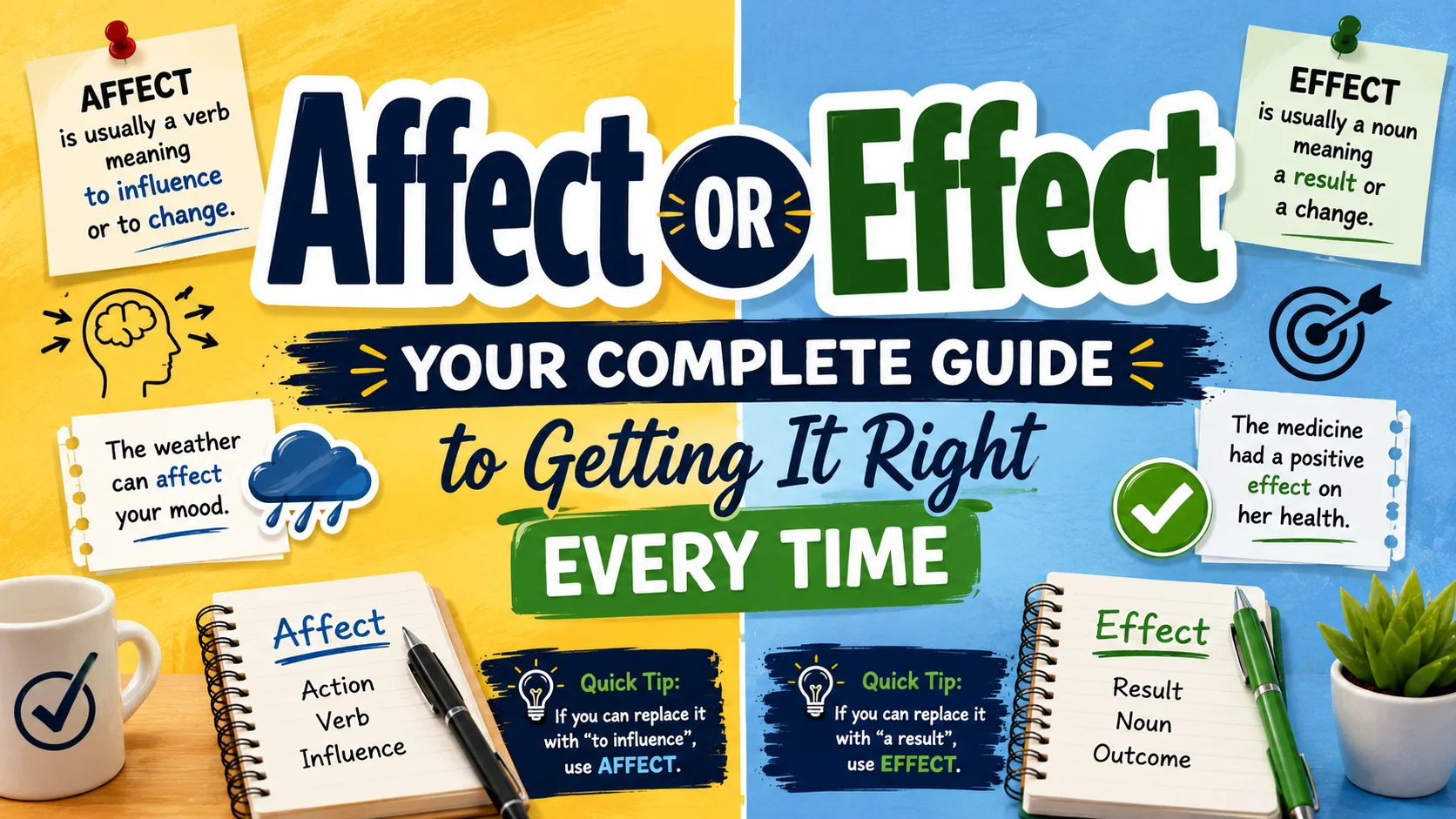
The good news? You can master this distinction with a few simple rules. Most of the time, “affect” functions as a verb (an action word), while “effect” serves as a noun (a thing or result) . When you affect something, you cause an effect. The weather can affect your mood, and that change in mood becomes the effect of the weather.
We designed this comprehensive guide to give you the confidence to use “affect” and “effect” correctly in any situation. You will learn practical tips, discover less common uses, and avoid embarrassing mistakes.
What is the Difference Between Affect and Effect? (Quick Answer)
Affect is almost always a verb that means “to influence or change something.” Effect is almost always a noun that means “the result or consequence of a change.” The simple rule: if you need an action word, choose “affect”; if you need a thing or outcome, choose “effect.”
Key points:
- Affect = Action (verb) – “The weather affected our plans”
- Effect = End result (noun) – “The weather had an effect on our plans”
- Remember RAVEN: Remember Affect Verb, Effect Noun
- A = Action (affect), E = End result (effect)
Quick Comparison Table
| Feature | Affect | Effect |
|---|---|---|
| Common Usage | Verb (action) | Noun (result) |
| Meaning | To influence, change, or act upon something | A change that results from an action or cause |
| Example | “The medicine affected her health” | “The medicine had a positive effect on her health” |
| Test | Can you replace it with “influence” or “alter”? | Can you replace it with “result” or “consequence”? |
| Part of Speech | Usually a verb | Usually a noun |
| Pronunciation | /əˈfɛkt/ (uh-FEKT) | /ɪˈfɛkt/ (ih-FEKT) |
| Origin | Latin afficere – “to do to, act on” | Latin effectus – “accomplishment, performance” |
Main Meaning Section
Definition of Affect
The verb “affect” means to act on, influence, or produce a change in someone or something . When one thing affects another, it causes that thing to alter in some way.
Definition of Effect
The noun “effect” refers to a change that results when something is done or happens . An effect is the outcome, consequence, or result of some action or cause.
Pronunciation
- Affect: /əˈfɛkt/ (uh-FEKT) – rhymes with “respect”
- Effect: /ɪˈfɛkt/ (ih-FEKT) or /əˈfɛkt/ – rhymes with “defect”
In casual American speech, people often pronounce these words almost identically, which contributes to the confusion.
Part of Speech
Affect:
- Primary: Verb
- Secondary: Noun (in psychology contexts only)
Effect:
- Primary: Noun
- Secondary: Verb (formal, meaning “to bring about”)
Origin/Etymology
Affect comes from the Latin word afficere, meaning “to do to, to act on.” The prefix *ad-* means “to” and facere means “to do” or “to make.”
Effect comes from the Latin effectus, meaning “accomplishment, performance.” It derives from *ex-* meaning “out” and facere meaning “to do.”
Both words share the same Latin root facere, which explains why they cause so much confusion.
Contextual Meaning
In everyday English, you will find “affect” in sentences describing influence or change:
- “How does stress affect your health?”
- “The new policy will affect all employees.”
You will find “effect” in sentences describing results or outcomes:
- “What effect does stress have on your health?”
- “The new policy had a significant effect on company culture.”
Detailed Explanation
Literal Meaning
Literally, “affect” describes the action of one thing influencing another. When A affects B, A actively changes or modifies B in some measurable way. “Effect” literally describes the resulting condition or state after influence occurs.
Common Meaning
In common usage, people use “affect” as a verb to talk about impact. You will hear “How does this affect me?” far more often than formal alternatives. “Effect” appears as a noun in phrases like “the effect of” or “side effects” .
Internet Meaning
Online, you will see “affect” and “effect” misused constantly. Social media posts often confuse them. You might notice people writing “this will effect me” when they mean “affect.” Grammar correction comments frequently appear under such posts.
Slang Meaning
Slang rarely uses “affect” or “effect” in specialized ways. However, you will hear “for effect” meaning “to create a particular impression” – “She wore the scarf just for effect.”
Texting Meaning
In texting, people often choose simpler alternatives to avoid confusion. Instead of “affect,” they text “impact” or “change.” Instead of “effect,” they type “result” or simply use emojis to convey meaning.
Social Media Meaning
On social media, “affect” appears in posts about current events, mental health, and lifestyle changes. “Effect” frequently appears in discussions about consequences, makeup looks (“special effects”), and viral trends.
Usage Examples
Synonyms Table
Antonyms Table
| Antonym for Affect (Verb) | Meaning |
|---|---|
| Remain unaffected | To not be influenced |
| Preserve | To keep unchanged |
| Maintain | To keep in same condition |
| Leave alone | To not interfere |
| Preserve | To protect from change |
| Antonym for Effect (Noun) | Meaning |
|---|---|
| Cause | Something that produces an effect |
| Origin | The source or starting point |
| Source | The cause or starting point |
| Beginning | The start of something |
| Antecedent | Something that comes before |
| Ineffectiveness | Lack of effect |
| Failure | Lack of success |
Related Terms Table
Real-Life Usage
Daily Conversation
You will use these words constantly in everyday conversation. “Does this affect me?” is a common question. “What effect will this have?” appears in countless discussions. People talk about side effects, the effects of weather, and how things affect their lives .
Social Media
On social media, you might post “How does this affect me?” or write “The effect of this policy surprised me.” Influencers discuss how products affect their skin. Users debate the effects of algorithms on mental health.
Business Communication
In business, you will use “effect” as a noun frequently: “The new strategy had a positive effect on sales.” You might use “effect” as a verb formally: “We need to effect changes in our workflow” . “Affect” appears when discussing how decisions affect employees, customers, or profits.
Academic Writing
Academics use both words precisely. “This study examines how socioeconomic factors affect educational outcomes.” “The effect of the intervention was statistically significant.” Researchers often discuss “cause and effect” relationships .
Online Messaging
In texts and instant messages, people might avoid these words entirely. Instead, they use “impact,” “change,” or “result.” When they do use “affect” or “effect,” autocorrect often suggests the wrong one.
Common Mistakes
Semantic Keyword Section
Throughout this article, we have integrated semantic keywords that matter to you as a writer and language learner. These include “affect vs effect,” “difference between affect and effect,” “affect meaning,” “effect meaning,” “affect definition,” “effect definition,” “affect verb,” “effect noun,” “RAVEN affect effect,” “when to use affect and effect,” “affect effect examples,” “affect effect grammar,” “side effects,” and “effect change.”
We carefully selected these terms based on what people actually search for when they need help with these words.
Related Questions Section
Q: What is the easiest way to remember affect vs effect?
A: Use the RAVEN trick: Remember Affect Verb, Effect Noun . Also, remember “A = Action” for affect and “E = End result” for effect.
Q: Is effect ever used as a verb?
A: Yes, but rarely. You can use “effect” as a verb to mean “to bring about” or “to accomplish.” For example, “The new CEO hopes to effect positive changes” .
Q: Is affect ever used as a noun?
A: In psychology, “affect” (with stress on the first syllable) means observable emotional response or facial expression . This usage is specialized and uncommon in everyday writing.
Q: When do I use “side effects” vs. “side affects”?
A: Always use “side effects.” This phrase describes additional consequences of something, especially medications. “Affects” would not make sense here .
Q: What is the difference between “effect change” and “affect change”?
A: “Effect change” means to bring about change or create it. “Affect change” would mean to influence existing change. “Effect change” is the correct formal expression .
Q: How do you test whether to use affect or effect?
A: Try replacing the word with “influence” (for affect) or “result” (for effect). If “influence” fits, use affect. If “result” fits, use effect .
FAQ Section
1. What is the basic difference between affect and effect?
The basic difference is that “affect” is usually a verb meaning “to influence,” and “effect” is usually a noun meaning “the result” . When you affect something, you cause an effect.
2. How can I remember when to use affect and effect?
Use the RAVEN method: Remember Affect Verb, Effect Noun . Another trick: “A” for Action (affect) and “E” for End result (effect).
3. Is there ever a time when affect is a noun?
Yes, in psychology, “affect” refers to an observable emotional response or facial expression. For example, “The patient showed a flat affect” . This usage is rare in everyday writing.
4. Is there ever a time when effect is a verb?
Yes, “effect” can mean “to bring about” or “to accomplish.” For example, “The organization hopes to effect change in the community” .
5. What does “side effect” mean?
A “side effect” is an unintended consequence, especially of medication. You should always spell this “side effect” – never “side affect” .
6. What are “personal effects”?
“Personal effects” means personal belongings or possessions. For example, “The police returned his personal effects” . This is always “effects,” not “affects.”
7. Why do people confuse affect and effect so often?
People confuse them because they sound similar, they have related meanings, and both have multiple parts of speech in different contexts .
8. What are common collocations with effect?
Common collocations include “take effect,” “go into effect,” “in effect,” “to that effect,” “side effect,” “after effect,” and “cause and effect” .
Conclusion
We have explored the fundamental differences between “affect” and “effect” and why this distinction matters for your writing clarity. “Affect” serves as your action word – the verb that describes influence and change. “Effect” works as your result word – the noun that describes outcomes and consequences.
When you master these words, you gain confidence in your writing. You will avoid common mistakes that undermine credibility. You will communicate precisely in business, academic, and everyday contexts.
We encourage you to practice using the RAVEN method. Think about whether you need an action (affect) or an end result (effect). Test your usage by substituting “influence” or “result.” With practice, choosing the right word will become second nature. Remember: when you want to describe influencing something, use “affect.” When you want to describe the consequence, use “effect.” Your readers will notice the difference.

Olivia Bennett is a writer and language enthusiast at Vocabsteria. She is passionate about exploring word meanings, name origins, and cultural expressions from around the world.