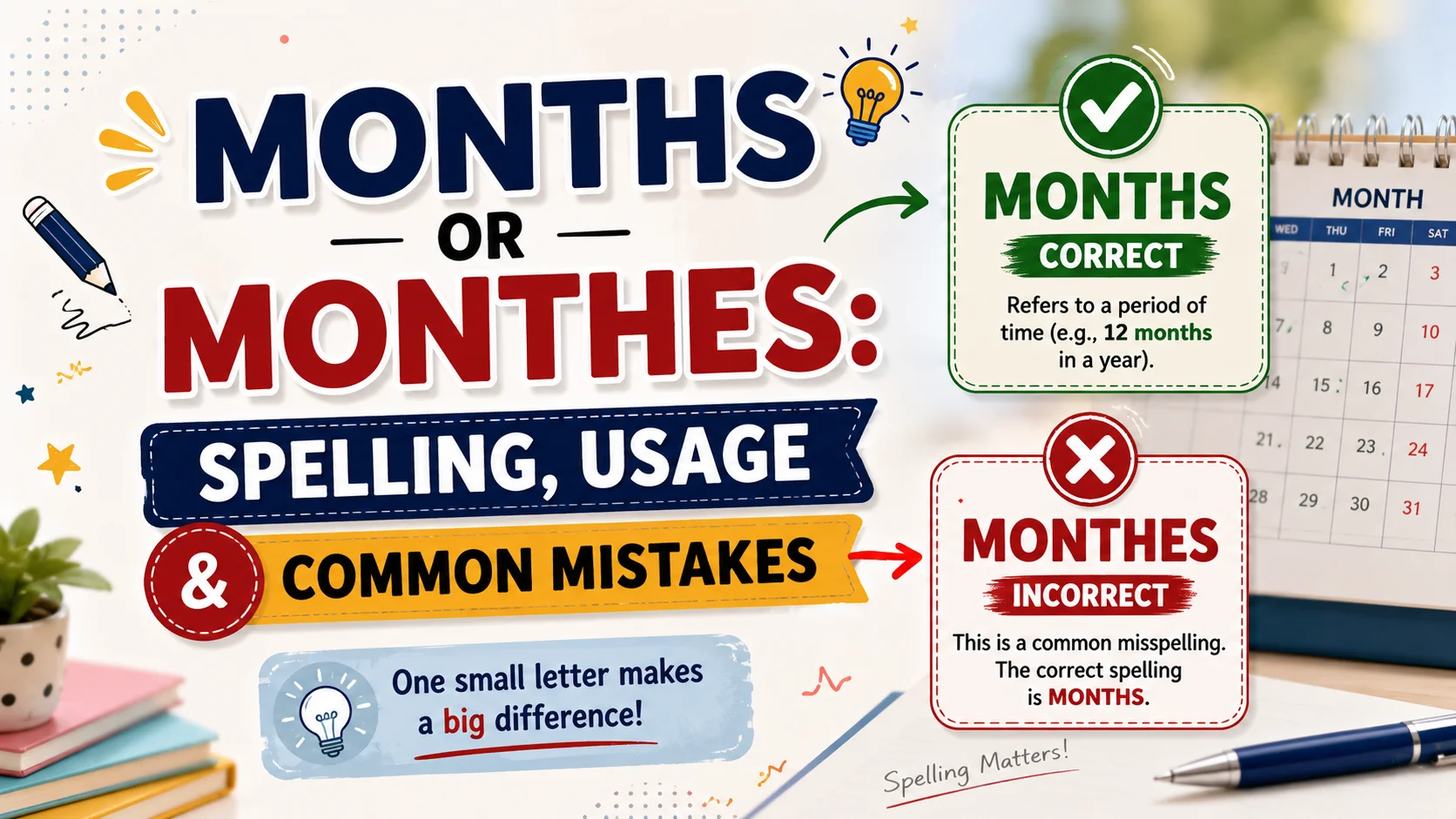
Have you ever stared at your screen, hesitating between typing “months” or “monthes”? You are not alone. This seemingly simple plural has confused countless English learners, students, and even native speakers. The confusion is understandable—English spelling rules have so many exceptions that it is easy to second-guess yourself.
The good news is straightforward: “months” is the only correct spelling in modern English. The word “monthes” does appear in historical texts from the 16th and 17th centuries, but it has been obsolete for hundreds of years. Today, using “monthes” would be considered a spelling error, and most readers would assume it is a typo.
We created this comprehensive guide to help you master the plural of “month” once and for all. You will learn why “months” is correct, explore the historical origins of the word, discover how to use it in various contexts, and avoid common mistakes. By the end of this guide, you will never hesitate again.
What Is the Correct Plural Form of Month?
“Months” is the only correct plural form of “month” in modern English. “Monthes” is an archaic spelling that was used in Early Modern English but has been obsolete for centuries. The simple rule: add -s to form the plural of “month.” Just as “path” becomes “paths” and “birth” becomes “births,” “month” becomes “months.”
Key points:
- Months = Correct plural form (m-o-n-t-h-s)
- Monthes = Incorrect spelling (archaic and obsolete)
- Rule: Add -s to form the plural, never -es
- Remember: If you can say “one month” and “two months,” you have the correct form
- Comparison: Works just like “truth” → “truths” and “youth” → “youths”
Quick Comparison Table
| Feature | Months | Monthes |
|---|---|---|
| Status | Correct and standard | Incorrect and archaic |
| Spelling | m-o-n-t-h-s | m-o-n-t-h-e-s |
| Usage | Plural form of month | Not used in modern English |
| Origin | Regular plural form | Early Modern English variant |
| Dictionary recognition | Recognized in all dictionaries | Not recognized in modern dictionaries |
| When to use | Always | Never |
| Historical usage | Used since Old English | Appeared in 16th-17th centuries |
| Grammar rule | Add -s to base form | Incorrect application of -es rule |
Main Meaning Section
Comprehensive Definition of Months
“Months” is the plural noun form of “month,” referring to more than one of the twelve named divisions of the year according to a calendar . A month is a unit of time based on the approximate period of the moon’s revolution around Earth, which takes about 29.5 days. The modern calendar defines months as having between 28 and 31 days.
Complete Pronunciation Guide
Months: /mʌnθs/ (pronounced “muhnths”)
Key pronunciation points:
- The word ends with the /θs/ sound, which can be challenging for non-native speakers
- The “t” is typically silent in casual speech, making it sound like /mʌns/ in some dialects
- The final /θs/ cluster requires placing your tongue between your teeth (for /θ/) and then moving to the /s/ sound
- In rapid speech, many speakers simplify it to /mʌnts/ or /mʌns/
Part of Speech
- Noun: Plural form of “month”
- Singular: Month
- Singular possessive: Month’s (“one month’s salary”)
- Plural possessive: Months’ (“three months’ work”)
- Adjective form: Monthly
Origin and Etymology
Old English Roots:
“Month” comes from the Old English word mōnath, which is related to the word for moon . A month was originally the period between full moons, approximately 29.5 days. The connection to the moon appears across many languages:
- Dutch: maand
- German: Monat
- Swedish: månad
- Danish: måned
- Latin: mensis (related to “moon”)
The Plural Evolution:
The plural form “months” follows the standard English pattern of adding -s to the singular. The incorrect spelling “monthes” may have arisen because some English words ending in -th take -es in the plural. However, “month” is not one of them.
Historical Usage of “Monthes”:
During the Early Modern English period (roughly 1500–1700), the spelling “monthes” occasionally appeared in texts. This was a time of great spelling variation in English before dictionaries standardized the language. Examples can be found in:
- 16th-century religious texts
- Legal documents from the Tudor period
- Early dictionaries like Thomas Blount’s Glossographia (1656)
However, by the 18th century, “monthes” had fallen out of use entirely. Today, it exists only as an archaic curiosity or a common misspelling.
Grammar Rules for Forming Plurals
The General Rule:
To form the plural of most English nouns, add -s to the singular form:
- month → months
- path → paths
- birth → births
- truth → truths
- youth → youths
When to Add -es:
You add -es to nouns that end in:
- -s: bus → buses
- -sh: brush → brushes
- -ch: church → churches
- -x: box → boxes
- -z: quiz → quizzes
Why “Month” Takes -s:
“Month” ends in -th, not in any of the endings that require -es. Therefore, it follows the standard rule and becomes “months.”
Comprehensive Contextual Meaning
You will encounter “months” in a wide range of contexts:
Everyday Time References:
- “I haven’t seen her for months”
- “The baby is six months old”
- “We’ll be there in a few months”
Weather and Seasons:
- “The winter months are the coldest”
- “The summer months are busy for tourism”
- “During the rainy months, the roads get muddy”
Project Timelines:
- “The construction will take six months”
- “We need to complete the report in two months”
- “The training program lasts nine months”
Financial Contexts:
- “You have to pay three months’ rent in advance”
- “The subscription is six months”
- “His salary was four months’ overdue”
Medical Contexts:
- “The baby reached 12 months”
- “She is three months pregnant”
- “The follow-up appointment is in six months”
Detailed Explanation
Literal Meaning
Literally, “months” refers to multiple periods of time corresponding to the cycle of the moon’s phases around Earth. Each lunar month is approximately 29.5 days, though the calendar months we use today vary between 28 and 31 days to align with the solar year.
Common Meaning
In everyday usage, “months” simply means more than one calendar month. It is one of the most common time-related words in English, appearing in countless conversations about schedules, ages, durations, and plans.
Why “Monthes” Is Incorrect
The spelling “monthes” is incorrect for several reasons:
1. It Violates the Plural Rule:
“Month” ends in -th, not in -s, -sh, -ch, -x, or -z. Therefore, it takes -s in the plural, not -es .
2. It Is Archaic:
“Monthes” was used in older forms of English but has been obsolete for centuries. Language evolves, and what was once standard becomes a spelling error .
3. No Modern Dictionary Recognizes It:
Contemporary dictionaries (Oxford, Merriam-Webster, Cambridge) list only “months” as the plural form.
4. It Confuses Readers:
If you write “monthes,” readers will assume you made a typo or lack basic spelling knowledge.
Detailed Historical Context
The evolution of the plural “months” reflects broader patterns in the English language:
Old English Period (c. 450–1150):
The word mōnath had various forms in declension, including mōnathas for the plural.
Middle English Period (c. 1150–1500):
The spelling shifted to “month” or “moneth,” with plural forms like “monethes” or “monthes” appearing.
Early Modern English (c. 1500–1700):
Spelling was highly variable, and “monthes” appeared alongside “months.” This was before dictionaries standardized English spelling.
Modern English (c. 1700–Present):
“Months” became the standard form as English spelling became more regularized. “Monthes” fell out of use.
The Psychology of Spelling Errors
Why do people spell “months” as “monthes”? Several factors contribute:
- Overgeneralization: English learners overgeneralize the rule that -th words take -es (like “truths” or “oaths”)
- Phonetic Spelling: Some people spell it the way they hear it, though “months” is actually pronounced with a /θs/ sound, not /θɛs/
- Visual Confusion: The sequence “-thes” looks familiar from words like “bathes” or “writhes”
- Autocorrect Confusion: Spell-checkers sometimes suggest incorrect forms, creating more confusion
- Lack of Exposure: Non-native speakers may not see the word frequently enough to internalize the correct spelling
Usage Examples Table
| Example Sentence | Meaning |
|---|---|
| I have been learning English for two months | A duration of 2 months has passed |
| She will return in three months | She will come back after 3 months |
| The past few months have been very challenging | The recent period was difficult |
| The project deadline is six months from today | The due date is in 6 months |
| They have been dating for several months | Their relationship has lasted multiple months |
| I haven’t seen her in months | A long time has passed since our last meeting |
| The construction lasted almost four months | The construction continued for 4 months |
| He is returning after six months in Europe | He stayed for 6 months |
| Twelve months make one year | A year contains 12 months |
| During the summer months, the weather gets very hot | The summer period is hot |
| She gave her two months’ notice at work | She informed her employer 2 months in advance |
| The baby is eighteen months old | The baby is 1.5 years old |
| We need to finish this in the next few months | The deadline is within the next several months |
| The winter months are the busiest for ski resorts | Winter brings the most tourists to ski areas |
| He spent months preparing for the exam | He prepared for a long time |
| The subscription is valid for six months | The subscription lasts 6 months |
| The report covers the last three months | The report covers the past 3 months |
| She is in her third month of pregnancy | She is 3 months pregnant |
| The rent is three months overdue | The rent has not been paid for 3 months |
| They gave him six months to complete the work | He has 6 months to finish |
Synonyms and Alternatives Table
| Term | Meaning | When to Use |
|---|---|---|
| Month | Singular form | One period of time |
| Monthly | Occurring once a month | Describing frequency |
| Bi-monthly | Occurring every two months | Describing frequency |
| Quarterly | Every three months | Business and financial contexts |
| Annual | Once a year | 12 months |
| Semester | Usually 6 months | Academic contexts |
| Trimester | 3 months | Medical (pregnancy), academic |
| Quarter | 3 months | Business, finance |
| Fortnight | 2 weeks | British English (half a month) |
| Moon | The lunar cycle | Poetic or astronomical contexts |
| Lunar month | 29.5 days (the time between full moons) | Astronomy |
| Calendar month | One of the 12 named months | General reference |
Related Terms Table
| Related Word | Meaning |
|---|---|
| Month | Singular form of the noun |
| Month’s | Singular possessive (belongs to one month) |
| Months’ | Plural possessive (belongs to multiple months) |
| Monthly | Happening once a month |
| Monthly | Payment or period occurring every 30 days |
| Bi-monthly | Occurring every two months |
| Semi-monthly | Occurring twice a month |
| Quarter | A three-month period |
| Semester | A half-year period (usually 6 months) |
| Trimester | A three-month period |
| Annual | Occurring once a year |
| Lunar | Related to the moon |
| Calendar | A system for dividing time into months and days |
| Year | 12 months or 365 days |
| Decade | 10 years or 120 months |
| Century | 100 years or 1,200 months |
| Millennium | 1,000 years or 12,000 months |
| Moonth | An obsolete variant (found in older texts) |
Real-Life Usage Across Contexts
Daily Conversation
“Months” appears constantly in everyday speech. People use it when discussing:
Age: “My baby is six months old”
Plans: “We are moving in two months”
Time passing: “It has been months since we last spoke”
Duration: “I’ve been working here for eight months”
Business Communication
In business, “months” appears in:
Project Management: “We estimate the project will take six months”
Financial Planning: “The budget covers the next twelve months”
Contracts: “The agreement is valid for three months”
Reporting: “We need the quarterly report for the last three months”
Academic Writing
Academics use “months” in:
Research Timelines: “We collected data over four months”
Study Descriptions: “The participants were followed for six months”
Historical Analysis: “The study period covers several months”
Scientific Papers: “The experiment was conducted over three months”
Online Messaging
In texting and messaging, people often shorten “months” to “mos” or use it in casual phrases:
- “I’ve been here for 6 mos”
- “It’s been months!”
- “See you in a couple of months”
Legal and Official Documents
Legal documents require precise language:
- “The defendant shall appear within thirty days (one month)”
- “The lease is for twelve months”
- “Notice must be given two months in advance”
Medical Contexts
Healthcare professionals frequently use “months”:
- “The patient is eight months pregnant”
- “The baby’s developmental milestones at six months”
- “Check back in three months for the follow-up”
Weather and Climate
Meteorologists discuss:
- “The coldest months are January and February”
- “The rainy season lasts several months”
- “Temperatures rise during the summer months”
Common Mistakes and How to Avoid Them
| Mistake | Correct Usage | Explanation |
|---|---|---|
| Writing “monthes” | Write “months” | This is an archaic spelling; always use “months” |
| Using “month’s” as a plural | Use “months” for plural | “Month’s” is singular possessive |
| Using “months” when you mean singular | Use “month” for one | “I will see you in one month,” not “months” |
| “I will see you in one months” | Say “I will see you in one month” | Singular requires “month,” not “months” |
| “Three month vacation” | Say “Three-month vacation” (hyphenated adjective) | Use hyphen when “three-month” modifies a noun |
| “The first six months of the year” (incorrect possessive) | “The first six months of the year” (no apostrophe) | Do not use an apostrophe for plural |
| “Months rent” (missing apostrophe) | “Months’ rent” (plural possessive) | Use “months'” for plural possessive |
| “Month’s of waiting” | “Months of waiting” | Do not use apostrophe for plural |
| “I haven’t seen her in month’s” | “I haven’t seen her in months” | No apostrophe for plural |
| Confusing “months” and “month’s” in writing | “Months” = plural; “month’s” = singular possessive | Learn the difference |
Semantic Keyword Section
Throughout this article, we have integrated semantic keywords that matter to you as a writer and vocabulary learner:
Primary keywords: months or monthes, plural of month, months spelling, correct plural form
Secondary keywords: months vs monthes, what is the plural of month, months pronunciation, months grammar, month plural, plural of month in English, how to spell months
Related keywords: month, months, monthly, month’s, months’, twelve months, calendar months, month spelling, plural forms, English grammar
Error-related keywords: common spelling mistakes, monthes incorrect, is monthes a word, months misspelling
Related Questions Section
Q: Is “monthes” ever correct in English?
No. “Monthes” is not correct in modern English. It is an archaic spelling that has been obsolete for centuries. You should never use it in your writing.
Q: Why do people spell it “monthes”?
People sometimes spell “month” as “monthes” because they incorrectly think words ending in -th need -es to become plural. This is a common misconception based on overgeneralizing the plural rule.
Q: What is the difference between “months” and “month’s”?
“Months” is the plural form (more than one month). “Month’s” is the singular possessive form (something belonging to one month). For example: “I have three months” (plural) vs. “I have one month’s salary” (possessive).
Q: How do you pronounce “months”?
“Months” is pronounced /mʌnθs/ or /mʌnts/ in casual speech. The “t” is often silent, and the final sound can be difficult for non-native speakers.
Q: What is the plural possessive of “month”?
The plural possessive is “months'” (with an apostrophe after the “s”). For example: “I received two months’ pay” (meaning the pay for two months).
Q: Is “month” singular or plural?
“Month” is singular (one month). “Months” is the plural form (more than one month).
Q: How many months are in a year?
There are twelve months in a year: January, February, March, April, May, June, July, August, September, October, November, and December.
Q: What are the different types of months?
There are calendar months (the 12 named months), lunar months (the period between full moons), and sidereal months (the moon’s orbit relative to stars).
Q: Why do months have different lengths?
Months have different lengths because the modern calendar is based on the solar year of about 365.24 days, divided into 12 months. Originally, months were based on the moon’s cycle (about 29.5 days), but this did not align perfectly with the solar year.
FAQ Section
1. What is the correct spelling: months or monthes?
The correct spelling is “months.” “Monthes” is an incorrect spelling and should never be used in modern English.
2. Why is “monthes” wrong?
“Monthes” is wrong because the plural of “month” follows the standard English rule of simply adding -s. The -es ending only applies to words ending in -s, -sh, -ch, -x, or -z. “Month” ends in -th, so it takes -s.
3. How can I remember the correct spelling?
Remember: “month” + “s” = “months.” You add -s, not -es. Think of other -th words like “path” → “paths,” “birth” → “births,” and “truth” → “truths.” They all follow the same rule.
4. Is “monthes” used in any English dialect?
No. No modern English dialect uses “monthes.” It is simply a spelling error that results from confusion about plural rules.
5. What is the singular possessive of “month”?
The singular possessive is “month’s” (e.g., “one month’s rent,” “one month’s salary”).
6. What is the plural possessive of “months”?
The plural possessive is “months'” (e.g., “two months’ work,” “three months’ notice”). The apostrophe comes after the “s.”
7. How do I pronounce “months” correctly?
Pronounce it /mʌnθs/ (muhnths). The “t” is silent in casual speech. The final /θs/ requires placing your tongue between your teeth for the /θ/ sound and then moving to the /s/ sound.
8. When did “monthes” stop being used?
“Monthes” was used during the Early Modern English period (1500–1700). By the 18th century, spelling had become more standardized, and “months” became the accepted form.
9. What is the adjective form of “month”?
The adjective form is “monthly” (occurring once a month). For example, “I receive a monthly salary” or “We have monthly meetings.”
10. What are the twelve months of the year?
The twelve months are January, February, March, April, May, June, July, August, September, October, November, and December.
11. Why does “month” have a silent “t” in pronunciation?
The “t” in “month” is not entirely silent in careful speech, but in casual pronunciation, the combination of “nth” can be simplified. The “t” is often not pronounced clearly, making it sound like “muhnth” or “muhns.”
12. Can I use “months” as an adjective?
“Months” is primarily a noun, but it can be used as a modifier in hyphenated phrases like “two-month-old baby” or “six-month project.” In such cases, “month” is used in its singular form before the noun.
Conclusion
We have explored the difference between “months” and “monthes” in exhaustive detail. The conclusion is clear: “months” is the only correct plural form of “month” in modern English, while “monthes” is an archaic spelling that has been obsolete for centuries.
When you write “months” correctly, you demonstrate attention to detail and mastery of English grammar. You avoid a mistake that could undermine your credibility in professional, academic, or everyday writing.
Here are our key takeaways:
- Always use “months” when writing about more than one month
- Never use “monthes” — it is incorrect in every modern context
- Remember the rule: words ending in -th add -s (month → months)
- Use “month’s” for singular possessive and “months'” for plural possessive
- Pronounce it as /mʌnθs/ with the “t” being silent in casual speech
Your readers will appreciate the accuracy. With this comprehensive guide, you will never hesitate about this spelling again.

Olivia Bennett is a writer and language enthusiast at Vocabsteria. She is passionate about exploring word meanings, name origins, and cultural expressions from around the world.