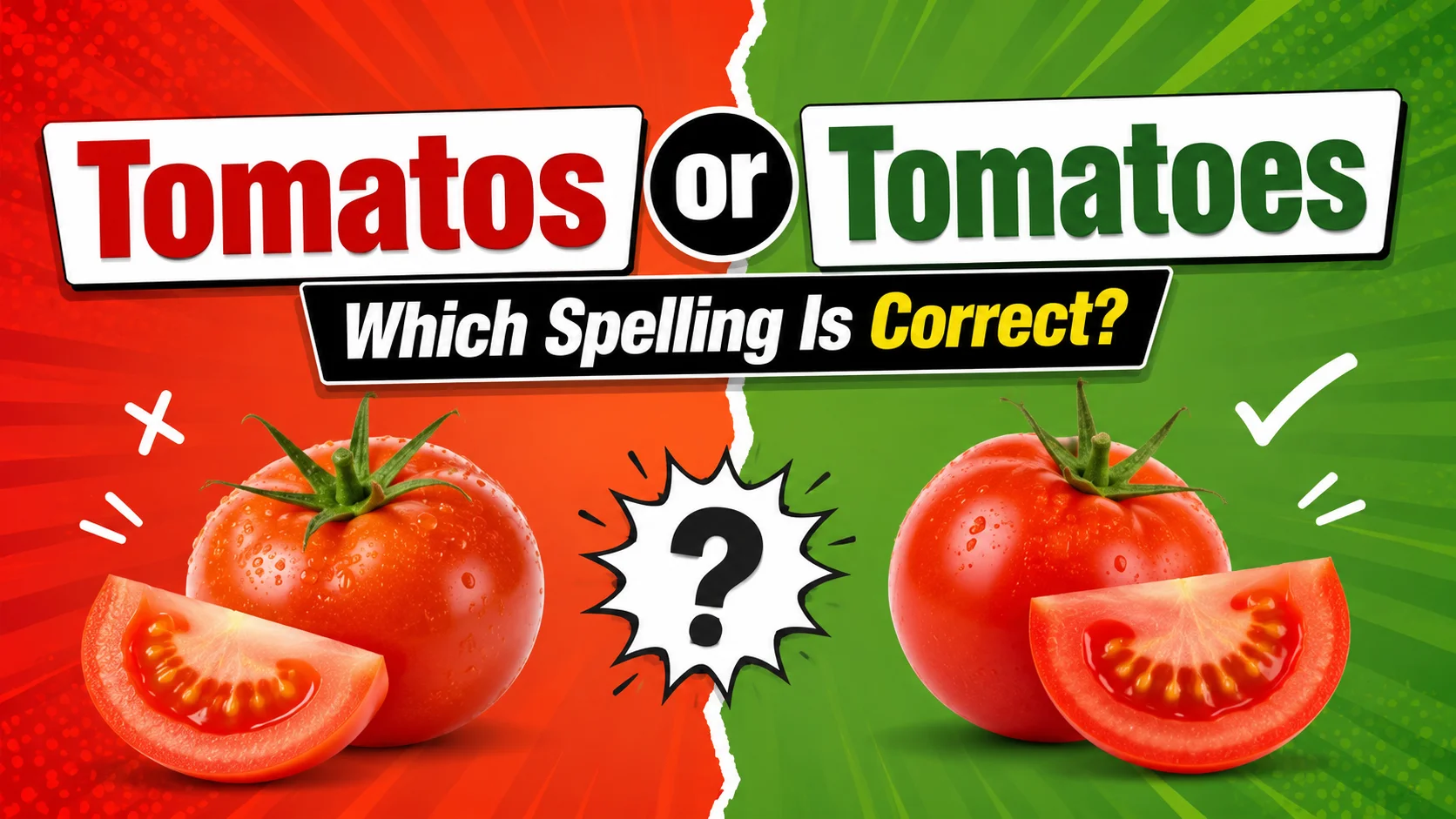
Have you ever stopped while writing and wondered whether the correct plural form is tomatos or tomatoes? You’re not alone. This is one of the most common spelling questions in English because many words ending in the letter o follow different pluralization rules.
The good news is that the answer is straightforward. Tomatoes is the correct plural form of tomato, while tomatos is considered a spelling mistake in standard English. Whether you’re writing a grocery list, recipe, school assignment, blog post, or professional document, using the correct spelling helps ensure clarity and accuracy.
Understanding why tomatoes is correct requires a basic understanding of English grammar rules for forming plurals. In this guide, you’ll learn the difference between tomatos and tomatoes, the grammar rule behind the spelling, usage examples, common mistakes, pronunciation, and answers to frequently asked questions.
Quick Answer
The correct plural form of tomato is tomatoes. The spelling tomatos is incorrect in standard English. Since tomato ends in a consonant followed by o, English grammar requires adding -es to form the plural, resulting in tomatoes.
Meaning Overview Table
| Aspect | Meaning |
|---|---|
| Definition | Plural form of tomato |
| Pronunciation | tuh-MAY-tohz |
| Part of Speech | Noun |
| Usage | Refers to more than one tomato |
| Context | Grammar, spelling, writing, vocabulary |
What Does “Tomatoes” Mean?
Definition
Tomatoes is the plural form of the noun tomato. It refers to two or more tomatoes.
Examples
- I bought five tomatoes from the market.
- Fresh tomatoes make the sauce taste better.
- The garden produced dozens of tomatoes this year.
What Does “Tomatos” Mean?
The word tomatos has no accepted meaning in standard English dictionaries.
It is simply a misspelling of tomatoes.
Incorrect Examples
❌ I bought three tomatos.
❌ The recipe requires six tomatos.
Correct Examples
✅ I bought three tomatoes.
✅ The recipe requires six tomatoes.
Why Is Tomatoes Correct?
English grammar contains a rule for many nouns ending in o after a consonant.
When forming the plural, you usually add -es instead of simply adding -s.
Singular → Plural
| Singular | Plural |
|---|---|
| Tomato | Tomatoes |
| Potato | Potatoes |
| Hero | Heroes |
| Echo | Echoes |
| Volcano | Volcanoes |
Because tomato ends with the consonant t followed by o, the correct plural becomes tomatoes.
Origin of the Word Tomato
The word tomato comes from the Spanish word tomate, which originated from the Nahuatl language word tomatl.
Tomatoes were introduced to Europe from the Americas during the 16th century and eventually became one of the world’s most popular foods.
Over time, English adopted the word and applied standard pluralization rules, creating the plural form tomatoes.
Pronunciation Guide
Tomato
Pronunciation:
tə-MAY-to
American English: /təˈmeɪtoʊ/
Tomatoes
Pronunciation:
tə-MAY-tohz
American English: /təˈmeɪtoʊz/
Is “Tomatos” Ever Correct?
No.
Modern dictionaries, grammar guides, style manuals, and educational resources recognize only tomatoes as the correct plural spelling.
Although you may occasionally see tomatos online, in social media posts, or in informal writing, it is considered a spelling error.
Common Usage of Tomatoes
The word tomatoes is commonly used in:
Cooking
- Tomato soup
- Tomato sauce
- Tomato salad
- Tomato salsa
Example:
“We need more tomatoes for the pasta sauce.”
Gardening
Gardeners frequently discuss growing tomatoes.
Example:
“The tomatoes are ready to harvest.”
Grocery Shopping
Example:
“Please buy fresh tomatoes from the store.”
Agriculture
Farmers often grow tomatoes commercially.
Example:
“The farm produced thousands of tomatoes this season.”
Examples Table
| Example | Meaning |
|---|---|
| I bought four tomatoes. | More than one tomato |
| The tomatoes are ripe. | Mature tomatoes |
| Fresh tomatoes taste better. | Quality tomatoes |
| She sliced the tomatoes. | Prepared tomatoes |
| We planted tomatoes in spring. | Growing tomatoes |
| Tomatoes are rich in nutrients. | General reference |
| The tomatoes were harvested yesterday. | Collected crop |
| He sells organic tomatoes. | Agricultural product |
| Tomatoes are used in many recipes. | Food ingredient |
| The salad contains tomatoes. | Recipe ingredient |
Related Terms Table
| Related Term | Meaning |
|---|---|
| Tomato | Singular form |
| Tomatoes | Plural form |
| Potato | Similar plural rule |
| Potatoes | Plural of potato |
| Hero | Singular noun |
| Heroes | Plural noun |
| Echo | Sound reflection |
| Echoes | Plural form |
| Vocabulary | Word knowledge |
| Grammar | Language rules |
| Spelling | Correct word formation |
| Plural | More than one |
| Singular | One item |
| Noun | Naming word |
| Pronunciation | Word sound |
Tomato vs Tomatoes
Tomato
Used when referring to one item.
Example:
“I ate a tomato.”
Tomatoes
Used when referring to more than one item.
Example:
“I ate three tomatoes.”
Other Words That Follow the Same Rule
Many English nouns ending in a consonant plus o add -es in the plural.
| Singular | Plural |
|---|---|
| Hero | Heroes |
| Potato | Potatoes |
| Echo | Echoes |
| Tomato | Tomatoes |
| Torpedo | Torpedoes |
Learning these examples makes it easier to remember the correct spelling of tomatoes.
Common Mistakes
| Mistake | Correct Usage |
|---|---|
| Tomatos | Tomatoes |
| Tomato’s | Tomatoes |
| Three tomato | Three tomatoes |
| Many tomato | Many tomatoes |
| Fresh tomatos | Fresh tomatoes |
| Red tomatos | Red tomatoes |
| Tomatoes | Tomatoes |
| Several tomato | Several tomatoes |
| Two tomato | Two tomatoes |
| Garden tomatos | Garden tomatoes |
Why People Get Confused
Several factors contribute to confusion:
1. Inconsistent English Rules
Not all words ending in o take -es.
Examples:
- Piano → Pianos
- Photo → Photos
- Radio → Radios
This inconsistency causes uncertainty.
2. Pronunciation Similarity
Both spellings sound nearly identical when spoken.
3. Internet Typos
Misspellings often spread online, leading people to think they are acceptable.
Tomatoes in Everyday Language
The word appears frequently in:
Recipes
“Add diced tomatoes to the pan.”
Restaurants
“Our burgers come with fresh tomatoes.”
Health Discussions
“Tomatoes are rich in vitamins.”
Gardening Communities
“My tomatoes grew larger this year.”
Related Questions
Is it tomatoes or tomatos?
The correct spelling is tomatoes. The spelling tomatos is incorrect.
Why does tomato become tomatoes?
Because nouns ending in a consonant followed by o often form plurals by adding -es.
Is tomato singular or plural?
Tomato is singular. Tomatoes is plural.
Is tomatos in the dictionary?
No. Standard dictionaries recognize tomatoes as the correct plural form.
How do you remember the correct spelling?
Remember that tomato follows the same pattern as potato.
Potato → Potatoes
Tomato → Tomatoes
FAQs
What is the plural of tomato?
The plural of tomato is tomatoes.
Is tomatos grammatically correct?
No. It is considered a spelling mistake.
Why do we add ES instead of S?
Because tomato ends with a consonant followed by the letter O.
Is tomatoes used in American English?
Yes. It is the standard spelling in American English.
Is tomatoes used in British English?
Yes. British English also uses tomatoes.
Can I use tomatos in informal writing?
No. Even in informal writing, tomatoes is the preferred and correct spelling.
What part of speech is tomatoes?
Tomatoes is a plural noun.
Are there other words like tomato?
Yes. Examples include potatoes, heroes, echoes, and torpedoes.
Conclusion
The debate over tomatos or tomatoes has a simple answer: tomatoes is the correct spelling, while tomatos is incorrect. The word follows a common English grammar rule in which many nouns ending in a consonant plus o form their plural by adding -es. As a result, one tomato becomes two tomatoes, not two tomatos.
Understanding this rule can improve your spelling, grammar, and overall writing confidence. Whether you’re writing recipes, school assignments, blog posts, emails, or social media captions, using tomatoes ensures your writing follows accepted English standards. By remembering similar examples such as potatoes and heroes, you’ll be able to avoid this common mistake and use the correct plural form every time.

Olivia Bennett is a writer and language enthusiast at Vocabsteria. She is passionate about exploring word meanings, name origins, and cultural expressions from around the world.