Have you ever written about “cleansing your palette” after a meal or admired an artist’s “beautiful palate of colors”? You are not alone. These two words, along with a third troublemaker “pallet,” create one of the most common spelling dilemmas in English.
The confusion is understandable. All three words sound exactly the same—/ˈpælɪt/. Their spellings differ by just a few letters, yet their meanings are worlds apart. One relates to taste and the human body, another to art and color, and the third to shipping and logistics.
We created this comprehensive guide to help you master these three homophones once and for all. You will learn their distinct meanings, see them in action, discover their fascinating origins, and never confuse them again.
What Is the Difference Between Palate and Palette?
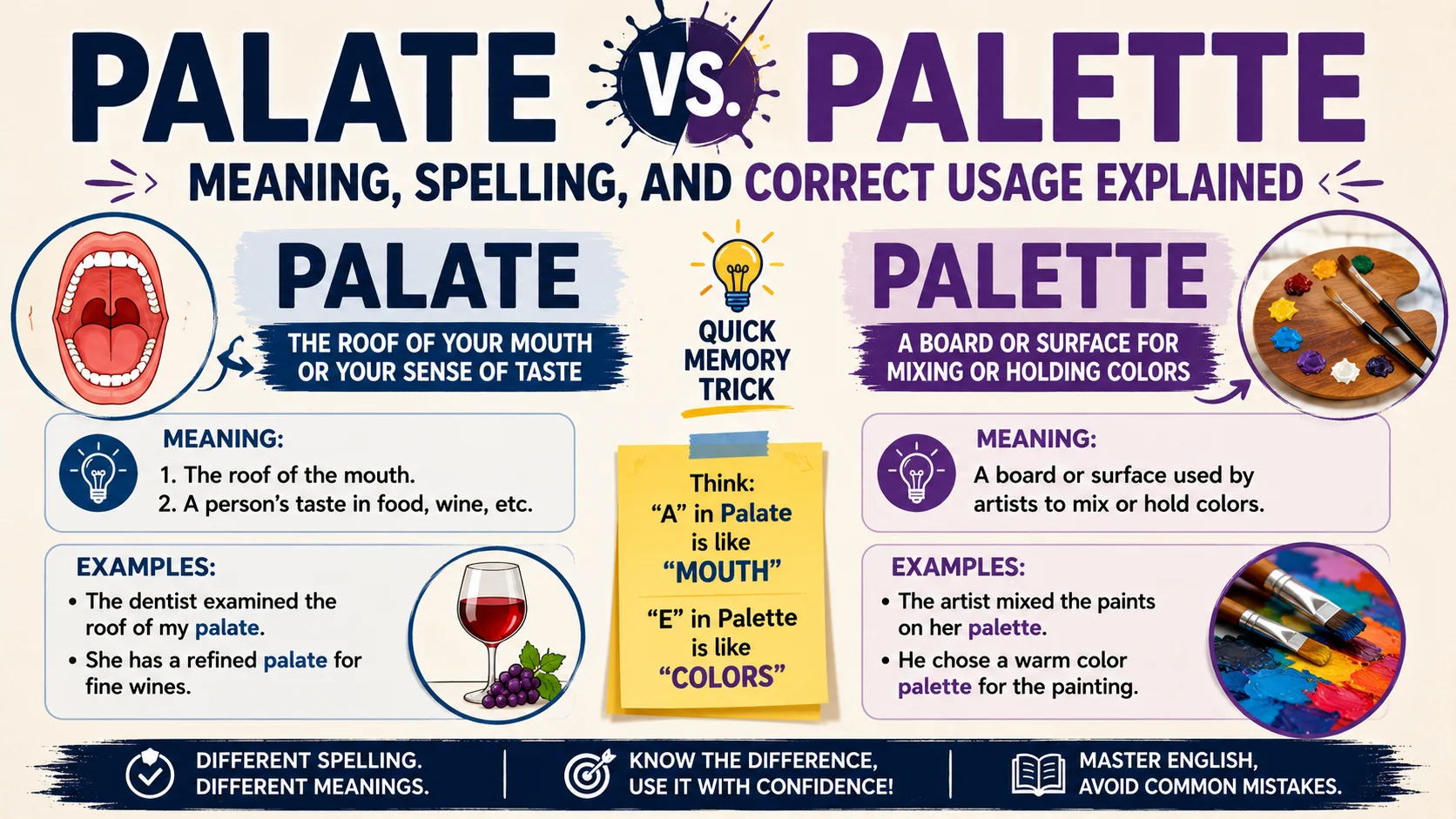
“Palate” refers to the roof of your mouth and, more commonly, your sense of taste or appreciation for food and drink. “Palette” is the flat board artists use to mix paints or any range of colors . They sound identical (/ˈpælɪt/) but have completely different meanings. A third word, “pallet” (a wooden platform for moving goods), adds to the confusion .
Key points:
- Palate = roof of the mouth + sense of taste (e.g., “a refined palate”)
- Palette = artist’s paint board + range of colors (e.g., “a limited palette”)
- Pallet = wooden platform for stacking goods (e.g., “a pallet of bricks”)
- Remember: “Palate” has “ate” at the end—you eat with your palate
Quick Comparison Table
Main Meaning Section
Palate
Definition:
“Palate” has two closely related meanings:
- Anatomical: The roof of the mouth, separating the oral and nasal cavities in vertebrates . It consists of two parts:
- Hard palate: The bony front portion
- Soft palate: The muscular rear portion (also called the velum)
- Taste-related: A person’s ability to distinguish and appreciate different flavors, or the flavor itself of food or drink .
Pronunciation: /ˈpælɪt/ (PAL-it)
Part of Speech: Noun
Origin:
“Palate” entered English in the 14th century from the Latin word palatum, meaning “roof of the mouth” . The connection between the roof of the mouth and taste dates back to when people believed that all taste sensations came from the palate. Though we now know taste buds on the tongue are responsible, both meanings have survived .
Anatomical Context:
The human palate plays several vital roles:
- It separates the oral and nasal cavities
- The soft palate moves to close off the nasal passage during swallowing
- It contributes to speech sounds, especially consonants
- The hard palate provides a bony structure for chewing
A cleft palate occurs when the two sides of the palate do not fuse properly during fetal development, causing a gap .
Palette
Definition:
“Palette” has two main meanings:
- Artistic: A thin, usually oval or oblong board or tablet with a thumb hole at one end, used by painters for holding and mixing colors .
- Color-related: The range of colors used by a particular artist, in a particular picture, or in a design context . This meaning extends to music (a range of tonal or instrumental colors) and computer graphics.
Pronunciation: /ˈpælɪt/ (PAL-it)
Part of Speech: Noun
Origin:
“Palette” came into English in the 17th century from French, where it was the diminutive of pale meaning “shovel” or “spade,” from Latin pala . The name came from the original shape of the board, which resembled a small shovel with a thumb hole.
Modern Extensions:
The word has expanded well beyond painting:
- Makeup: Eyeshadow palettes and makeup palettes
- Digital Design: Color palettes in computer graphics, also called color look-up tables (CLUTs)
- Music: A “tonal palette” describing the range of instruments or sounds a musician uses
- Branding: A company’s visual identity uses a “brand palette”
Pallet
Definition:
“Pallet” refers to:
- A flat wooden structure or platform used for storing and moving goods, typically designed to be lifted by a forklift truck or pallet jack .
- A crude or makeshift bed, often filled with straw .
- A flat wooden blade with a handle used by potters for shaping clay .
Pronunciation: /ˈpælɪt/ (PAL-it)
Part of Speech: Noun
Origin:
“Pallet” comes from Middle English through Anglo-Norman French paillete, from paille meaning “straw,” from Latin palea . This explains the connection to a straw mattress.
Detailed Explanation
Why the Confusion?
Three reasons explain why these words cause so much trouble:
- They sound identical: All three are pronounced /ˈpælɪt/
- They differ by a few letters: Palate (a), palette (e + extra t), pallet (double l)
- They appear in specialized contexts: People often see them written without knowing their distinct meanings
How to Remember
Palate = “Ate” at the end—you eat with your palate
Palette = “Ett” like “paint”—artists use a palette to mix paint
Pallet = Double “ll” like “logical”—a pallet stores goods logically
Alternatively, remember:
- “Palate” is the roof of your mouth (think of the “a” as the arch)
- “Palette” is an artist’s board (think of the “e” as easel)
- “Pallet” is a platform (think of the “ll” as the wooden slats)
Usage Examples
Common Terms with Each Word
Real-Life Usage Across Contexts
Daily Conversation
People use “palate” when discussing food preferences and taste:
- “This dish really excites my palate”
- “She has a refined palate from years of wine tasting”
They use “palette” when discussing colors in design, fashion, or home decorating:
- “I love the color palette you chose for the living room”
- “The designer’s fall palette features warm earth tones”
Social Media
On social media, “palette” appears constantly in beauty content:
- “My new eyeshadow palette arrived today!”
- “Swatching my latest makeup palette collection”
“Palate” appears in food posts and restaurant reviews:
- “A meal to delight any palate”
- “The tasting menu was a journey for the palate”
Business Communication
Business contexts use “pallet” for logistics and “palette” for design:
- “We ordered a full pallet of inventory for the warehouse”
- “The marketing team finalized the brand color palette”
Academic Writing
Academics use “palate” in anatomy and medicine:
- “The study examined children with cleft palates”
- “The hard palate separates the oral and nasal cavities”
Art historians use “palette” to describe artists’ techniques:
- “Picasso’s blue palette characterized his Blue Period”
- “The artist expanded his color palette after traveling abroad”
Legal and Medical Documents
Medical documents use “palate” in surgical contexts:
- “The patient was diagnosed with a cleft palate”
- “Palate repair surgery is scheduled for next week”
Shipping and logistics documents use “pallet”:
- “The goods are stored on wooden pallets”
- “Pallet inventory must be verified before shipping”
Common Mistakes and How to Avoid Them
| Mistake | Correct Usage |
|---|---|
| “The artist painted on a wooden palate” | “The artist painted on a wooden palette” |
| “This wine has a complex palette” | “This wine has a complex palate” |
| “Please move that palette of bricks” | “Please move that pallet of bricks” |
| “I bought a new eyeshadow palate” | “I bought a new eyeshadow palette” |
| “Sorbet cleanses the palette” | “Sorbet cleanses the palate” |
Semantic Keyword Section
Throughout this article, we have integrated semantic keywords that matter to you as a writer and vocabulary learner:
Primary keywords: palate or palette, palate vs palette, difference between palate and palette, palate definition, palette definition
Secondary keywords: palette meaning, palate meaning, palate taste, color palette, artist palette, cleft palate, pallet meaning
Error-related keywords: palate palette pallet difference, homophones examples, commonly confused words
Art keywords: paint board, mix paints, range of colors, artist’s colors, makeup palette
Taste keywords: sense of taste, roof of the mouth, food appreciation, wine tasting
Related Questions Section
Q: Is it “palate” or “palette” for food?
Use “palate.” When you talk about taste, food appreciation, or wine flavors, you are referring to the palate. “This dish pleases the palate” is correct .
Q: What is the difference between “palate,” “palette,” and “pallet”?
“Palate” is the roof of your mouth and sense of taste. “Palette” is an artist’s paint board or a range of colors. “Pallet” is a wooden platform for storing and moving goods .
Q: Is a makeup palette a “palate” or “palette”?
It is a makeup “palette.” Any collection of colors, including makeup, is referred to as a palette .
Q: What is a “cleft palate”?
A cleft palate is a congenital condition where there is a gap in the roof of the mouth because the two sides of the palate did not fuse during fetal development .
Q: What does “palate cleanser” mean?
A palate cleanser is food or drink served between courses to refresh your sense of taste, allowing you to fully appreciate the next dish .
Q: Where did the word “palette” come from?
“Palette” comes from French, as a diminutive of pale meaning “shovel” or “spade,” from Latin pala. The name comes from the original shape of the board, which looked like a small shovel .
FAQ Section
1. What is the most common mistake with palate and palette?
The most common mistake is using “palette” when describing taste (“the wine has a fruity palette”) and using “palate” when describing colors (“an artist’s palate”). Remember: taste = palate, colors = palette .
2. How can I remember the spelling of “palate”?
Remember that “palate” contains “ate” at the end. You eat with your palate, so “ate” helps you recall its connection to food and taste .
3. What is a “palette knife”?
A palette knife is a flat, blunt knife used by artists to mix and apply paint on a palette, as well as to paint directly onto the canvas .
4. Is “pallet” ever used in art?
No. In art, you use a “palette” for mixing paint. A “pallet” is strictly for shipping goods or making a bed .
5. What does “a limited palette” mean?
A limited palette refers to a restricted range of colors used in a painting or design. Some artists deliberately use limited palettes for stylistic or emotional effect .
6. What is the plural of “palate”?
The plural is “palates.” For example, “The restaurant offers dishes to suit many palates” .
7. Why do these words sound the same?
They are homophones—words that sound identical but have different meanings and spellings. They all derive from different roots but converged in pronunciation over time .
Conclusion
We have explored the critical differences between “palate” and “palette” and why this distinction matters for your writing clarity. “Palate” relates to the roof of your mouth and, more commonly, your sense of taste and appreciation for food and drink . “Palette” refers to the board artists use to mix paint or any range of colors, including makeup, digital design, and music .
A third word, “pallet” (a wooden shipping platform), adds another layer of confusion, but remembering these simple distinctions will help you avoid errors:
- Palate = taste (has “ate” at the end—you eat with it)
- Palette = paint and colors (has “ette” like a small board)
- Pallet = platform for products (has double “ll” like logs)
When you master these words, you demonstrate attention to detail and mastery of English vocabulary. Your writing becomes more precise and professional. Readers will appreciate the accuracy.

Olivia Bennett is a writer and language enthusiast at Vocabsteria. She is passionate about exploring word meanings, name origins, and cultural expressions from around the world.