Have you ever found yourself using the word “iconic” repeatedly in a single piece of writing? You are not alone. This powerful adjective appears everywhere—from fashion magazines to social media captions, from academic papers to everyday conversation. But using it too often can make your writing feel repetitive and dull.
The word “iconic” describes something widely recognized, highly regarded, and often serving as a symbol or representation of something greater . We use it to describe everything from legendary musicians and classic films to signature fashion pieces and historic landmarks. But the English language offers a treasure trove of alternatives that can make your writing more precise, varied, and engaging.
We created this comprehensive guide to help you find the perfect synonym for “iconic” in any situation. You will discover over twenty alternatives, each with distinct shades of meaning. You will learn when to use “legendary” versus “classic,” when “emblematic” fits better than “famous,” and how to choose words that convey exactly what you mean. Whether you are writing a business report, an academic paper, a social media post, or a creative piece, this guide will elevate your vocabulary.
What Is Another Word for “Iconic”? (Quick Answer)
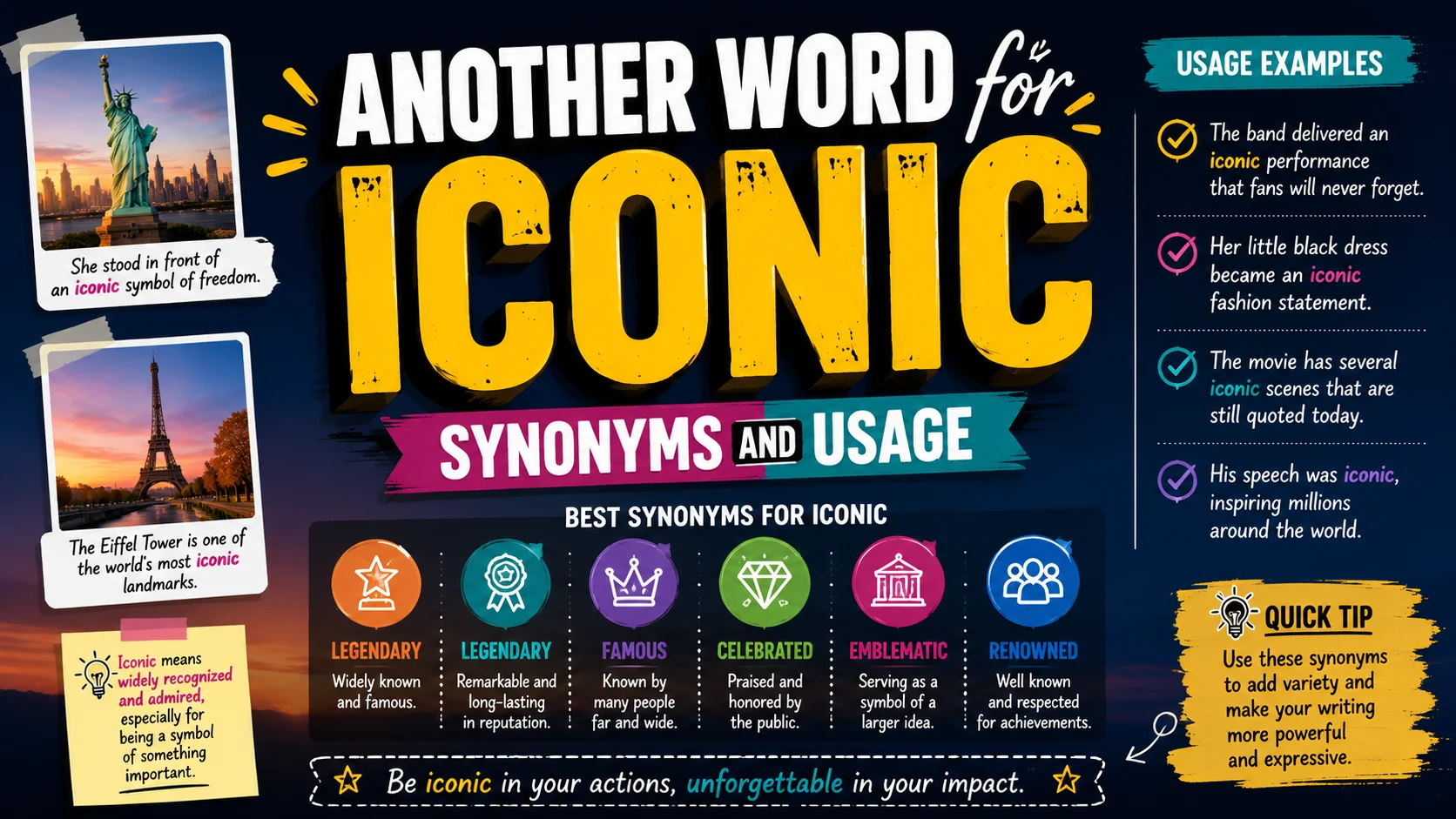
Popular synonyms for “iconic” include legendary, classic, famous, renowned, emblematic, symbolic, representative, distinguished, acclaimed, revered, celebrated, famed, well-known, signature, recognizable, and distinctive . If you want to emphasize fame, choose “legendary” or “renowned.” For symbolic meaning, pick “emblematic” or “representative.” For high regard and respect, use “revered” or “distinguished.”
Key points:
- For fame and recognition: famous, legendary, classic, well-known, famed, celebrated
- For symbolic meaning: emblematic, representative, symbolic, archetypal
- For high regard: revered, distinguished, acclaimed, venerated
- For distinctiveness: signature, recognizable, distinctive, unmistakable
- For timelessness: classic, enduring, timeless, immortal
Quick Comparison Table
| Alternative | Primary Meaning | Best Context | Example |
|---|---|---|---|
| Legendary | Remarkable enough to become famous like a legend | People, performances, careers | “The legendary musician performed for decades” |
| Classic | Of acknowledged excellence, timeless quality | Films, designs, literature | “The classic film still captivates audiences” |
| Emblematic | Serving as a visible symbol of something | Representing ideas or movements | “The emblematic monument of freedom” |
| Famous | Known about by many people | People, places, brands | “The famous restaurant draws tourists” |
| Renowned | Known and admired widely by many | People, institutions, achievements | “The renowned scientist received the award” |
| Distinguished | Very successful, authoritative, commanding respect | Careers, scholars, leaders | “The distinguished professor wrote twenty books” |
| Revered | Deeply respected and admired | Religious figures, cultural icons | “The revered leader inspired millions” |
| Signature | Distinctive and identifying | Styles, looks, works | “Her signature style influenced fashion” |
| Acclaimed | Publicly praised, widely approved | Artists, works, achievements | “The acclaimed novel won the prize” |
| Celebrated | Widely known and praised | People, events, works | “The celebrated architect designed the building” |
| Venerated | Regarded with deep respect | Historical figures, traditions | “The venerated tradition continues today” |
| Enduring | Lasting, continuing over time | Ideas, values, achievements | “His enduring legacy inspires new generations” |
| Archetypal | Representing the perfect example | Characters, patterns, ideas | “The archetypal hero’s journey” |
| Quintessential | Representing the perfect example of something | Qualities, traits, examples | “The quintessential American novel” |
| Timeless | Not affected by time | Art, music, design | “The timeless melody still moves listeners” |
| Immortal | Living forever, unforgettable | Legends, moments, achievements | “The immortal words of the speech” |
Main Meaning Section
Comprehensive Definition of “Iconic”
“Iconic” is an adjective that describes something or someone widely recognized, highly regarded, and often serving as a symbol or representation of a particular era, culture, community, or idea . The term goes beyond mere fame—it implies that the subject has achieved a special status as an enduring symbol.
Something iconic has several key characteristics:
- Widespread recognition: Most people in a given culture or community know about it
- Symbolic significance: It represents something larger than itself
- High regard: People view it with admiration and respect
- Cultural impact: It has influenced culture, fashion, art, or society
- Enduring relevance: It remains meaningful over time
Pronunciation
Iconic: /aɪˈkɒnɪk/ (eye-KON-ik)
The stress falls on the second syllable: eye-KON-ik.
Part of Speech
- Adjective (primary form)
- Adverb: iconically (“She was iconically dressed”)
- Noun: iconicity (“The iconicity of the image”)
Origin and Etymology
“Iconic” entered the English language between 1650 and 1660. It comes from the Latin word īconicus, which itself derives from the Greek word eikonikós . The Greek root eikṓn means “image,” “likeness,” or “representation.”
The word’s journey reflects its meaning: from ancient Greek religious images (eikones), to medieval Christian art, to the modern understanding of cultural symbols and icons.
Complete Contextual Meaning
You will encounter “iconic” across many domains:
Culture and Society:
- “The iconic figure of punk rock challenged conventions”
- “The Statue of Liberty is an iconic symbol of freedom”
Fashion and Design:
- “Her style became iconic, influencing generations of designers”
- “The little black dress is an iconic fashion item”
Film and Entertainment:
- “The iconic scene from the movie still resonates today”
- “The actor’s iconic performance earned him an Oscar”
Landmarks and Architecture:
- “The Eiffel Tower is an iconic landmark of Paris”
- “The iconic building defines the city’s skyline”
History and Politics:
- “The iconic speech changed the course of history”
- “The iconic photograph captured the moment”
Sports:
- “His iconic celebration became legendary”
- “The iconic athlete inspired millions”
Business and Branding:
- “The iconic logo is recognized worldwide”
- “The brand achieved iconic status in the market”
Detailed Explanation
Literal Meaning
Literally, “iconic” relates to or resembles an icon—an image, emblem, or representation. It describes something that stands for something else by resemblance or symbolism . In its original sense, an icon was a sacred image in Christian art. Today, the word has expanded to mean anything that represents larger ideas, values, or cultural touchstones.
Common Meaning
In everyday usage, “iconic” means very famous or popular, especially considered to represent particular opinions or a particular time . It describes things that have achieved a special status in the cultural imagination—the kind of things people instantly recognize and admire.
Cultural Meaning
Culturally, “iconic” refers to people, places, objects, or moments that have become symbols of broader cultural values, movements, or eras. A cultural icon transcends its original context to become a shorthand for complex ideas.
For example:
- Elvis Presley is iconic of rock and roll and youth rebellion
- The VW Beetle is iconic of 1960s counterculture
- Marilyn Monroe is iconic of Hollywood glamour
Internet and Social Media Meaning
In online and social media usage, “iconic” has evolved into a casual intensifier. People use it to mean “very special, influential, or popular” . A viral video, a celebrity outfit, or a memorable tweet can all be called “iconic” simply because they made an impression.
This usage is more casual and broader than the traditional meaning. While some language purists object to this dilution, it reflects how language naturally evolves in digital spaces.
Slang Meaning
As slang, “iconic” means exceptionally good, impressive, or noteworthy . It is often used in hyperbolic expressions of admiration:
- “That outfit is absolutely iconic!”
- “Her response was iconic”
- “This moment is pure iconic energy”
Business and Marketing Meaning
In business and marketing, “iconic” describes brands, products, or campaigns that have achieved widespread recognition and cultural significance. An iconic brand is not just well-known—it represents something deeper in the consumer’s mind:
- Coca-Cola is an iconic American brand
- The iPhone is an iconic product that defined a generation
Academic Meaning
In academic writing, “iconic” appears in discussions of symbolism, representation, and cultural studies. Scholars use “iconic” more precisely to describe objects or images that function as cultural symbols . Formal alternatives like “emblematic,” “representative,” and “symbolic” are often preferred.
Usage Examples Table
| Example Sentence | Meaning |
|---|---|
| The Eiffel Tower is an iconic landmark of Paris | It is widely recognized as a symbol of Paris |
| Her style became iconic in the fashion industry | Her style was influential and admired |
| The photograph is an iconic image of World War II | The image symbolizes the war’s impact |
| The band achieved iconic status in the 1990s | The band became widely recognized and influential |
| The cheesesteak has iconic status in Philly | The food is celebrated and revered in Philadelphia |
| She wore one of the most iconic gowns ever on the red carpet | The gown was famous and admired |
| Albert Einstein is an iconic figure in science | Einstein represents scientific genius |
| London’s iconic double-decker buses are instantly recognizable | The buses symbolize London |
| The Beatles are perhaps the most iconic band of all time | The Beatles are legendary and widely influential |
| The little black dress is iconic fashion | It is a timeless symbol of fashion |
| Martin Luther King Jr.’s speech is an iconic moment in history | The moment represents the civil rights movement |
| The Apollo 11 moon landing is an iconic achievement | It symbolizes human achievement and exploration |
| Marilyn Monroe’s white dress scene is iconic cinema | The scene is memorable and represents classic Hollywood |
| The peace sign is an iconic symbol of the anti-war movement | The symbol represents peace and protest |
| The Beatles’ Abbey Road album cover is iconic photography | The photo is widely recognized and revered |
| The Vespa scooter is iconic of Italian design | The scooter represents Italian style |
| The Coca-Cola bottle is an iconic design recognized worldwide | The bottle symbolizes the brand and American culture |
| The Sistine Chapel ceiling is Michelangelo’s iconic masterpiece | The painting represents Michelangelo’s genius |
Synonyms Table (Comprehensive)
| Synonym | Meaning | Best Used For |
|---|---|---|
| Legendary | Remarkable enough to become famous like a legend | Exceptional people, performances, careers |
| Classic | Of acknowledged excellence; timeless and enduring | Films, books, designs, art |
| Famous | Known about by many people | Broad recognition without symbolic meaning |
| Renowned | Known and admired widely by many | People, institutions, achievements |
| Emblematic | Serving as a visible symbol of something | Representing ideas, movements, concepts |
| Representative | Standing for or serving to represent something | Being a typical example |
| Symbolic | Using or serving as a symbol | Representing deeper meaning |
| Distinguished | Very successful, authoritative, commanding respect | Careers, scholars, military leaders |
| Well-known | Known by many people | General recognition |
| Acclaimed | Publicly praised or admired | Artists, works, performances |
| Revered | Deeply respected and admired | Religious figures, cultural icons |
| Famed | Extremely well-known | Broad recognition |
| Celebrated | Widely known and praised | People, events, achievements |
| Signature | Distinctive and identifying | Styles, looks, works, designs |
| Recognizable | Able to be easily identified | Distinctive features, symbols |
| Distinctive | Having a quality that makes something different | Unique qualities, features |
| Memorable | Worth remembering | Experiences, moments, performances |
| Venerated | Regarded with deep respect | Historical figures, traditions |
| Enduring | Lasting and continuing over time | Ideas, values, achievements, legacies |
| Timeless | Not affected by time; never outdated | Art, music, design, principles |
| Immortal | Living forever; unforgettable | Legends, moments, achievements |
| Archetypal | Representing the perfect example | Characters, patterns, ideas |
| Quintessential | Representing the perfect example of something | Qualities, traits, examples |
| Paradigmatic | Serving as a pattern or model | Academic examples, models |
| Definitive | The most complete or authoritative | Works, versions, performances |
| Unforgettable | So good or remarkable that it cannot be forgotten | Moments, experiences, performances |
| Celebrated | Widely known and admired | Achievements, people, events |
| Illustrious | Highly distinguished; famous | Achievements, careers, people |
Antonyms Table
| Antonym | Meaning |
|---|---|
| Obscure | Not discovered or known about |
| Unknown | Not known or familiar |
| Insignificant | Too small or unimportant to be worth consideration |
| Unrecognizable | Not able to be recognized |
| Unremarkable | Not particularly interesting or surprising |
| Mediocre | Of only average quality |
| Ordinary | Not unusual or remarkable |
| Commonplace | Not unusual; ordinary |
| Forgettable | Easily forgotten, not memorable |
| Undistinguished | Lacking distinction; ordinary |
| Inglorious | Not deserving honor or praise |
| Uncelebrated | Not publicly praised or admired |
Related Terms Table
| Related Word | Meaning |
|---|---|
| Icon | An image, emblem, or idol that represents something |
| Iconography | The visual images and symbols used in art or representational systems |
| Iconology | The study of icons and their meaning |
| Archetype | An original pattern or model from which copies are made |
| Symbol | A mark or character used as a representation of something |
| Emblem | An object or symbol that represents something else |
| Motif | A recurring theme or element |
| Trope | A recurring theme or device |
| Signifier | The form that a sign takes |
| Signified | The concept that a sign represents |
Real-Life Usage Across Contexts
Daily Conversation
You will hear “iconic” constantly in everyday conversation in informal situations. People describe movies, songs, celebrities, and moments as iconic. Alternatives like “famous,” “classic,” and “legendary” are common substitutes:
- “That movie is just so iconic” → “That movie is absolutely legendary”
- “Her outfit is iconic” → “Her outfit is unforgettable”
- “This place is iconic” → “This place is legendary”
Fashion and Design Industry
In fashion, “iconic” describes signature styles, classic designs, and trendsetters that have influenced the industry. Professionals in this field use “signature,” “classic,” and “timeless” as alternatives:
- “The iconic little black dress” → “The classic little black dress”
- “Her iconic style” → “Her signature style”
- “The iconic Chanel suit” → “The timeless Chanel suit”
Business and Marketing
Marketers use “iconic” to describe brands, logos, and campaigns that have achieved cultural significance. Business professionals use “recognizable,” “well-known,” and “trademark” as alternatives:
- “An iconic brand” → “A recognizable brand”
- “Iconic logo” → “Trademark logo”
- “Iconic campaign” → “Memorable campaign”
Academic and Scholarly Writing
Academics use “iconic” in discussions of cultural symbolism, representation, and semiotics. In formal contexts, alternatives like “emblematic,” “representative,” “symbolic,” and “paradigmatic” are preferred:
- “The iconic image of the era” → “The emblematic image of the era”
- “An iconic figure” → “A representative figure”
- “Iconic status” → “Paradigmatic status”
Social Media and Digital Content
On social media, “iconic” has become a casual intensifier. Content creators and influencers use it to describe anything impressive or culturally significant. Alternatives used online include “legendary,” “epic,” “memorable,” and “amazing”:
- “This is iconic” → “This is legendary”
- “She is iconic” → “She is everything”
- “An iconic moment” → “A moment”
Journalism and Media
Journalists and media professionals use “iconic” to describe cultural touchstones and historical moments. In reporting, “famous,” “well-known,” “renowned,” and “historic” are common alternatives:
- “The iconic photograph” → “The historic photograph”
- “An iconic figure” → “A renowned figure”
- “Iconic speech” → “Historic speech”
Entertainment Industry
In entertainment, “iconic” describes performances, characters, and works that have achieved legendary status. Entertainment writers use “legendary,” “classic,” “memorable,” and “unforgettable”:
- “The iconic performance” → “The legendary performance”
- “An iconic character” → “A memorable character”
- “Iconic scene” → “Unforgettable scene”
Sports Commentary
Sports commentators use “iconic” to describe legendary athletes, unforgettable moments, and defining plays. In sports writing, “legendary,” “historic,” “memorable,” and “unforgettable” appear frequently:
- “The iconic athlete” → “The legendary athlete”
- “An iconic moment” → “A historic moment”
- “Iconic celebration” → “Memorable celebration”
Common Mistakes and How to Avoid Them
| Mistake | Correct Usage |
|---|---|
| Using “iconic” for everything good or impressive | Reserve “iconic” for things that are truly widely recognized and revered |
| Confusing “iconic” with “famous” | “Famous” simply means known; “iconic” means recognized, revered, and symbolic |
| Overusing “iconic” in a single piece | Vary with “legendary,” “classic,” “renowned,” etc. |
| Using “iconic” when “distinctive” is better | If you mean unique or identifiable, use “distinctive” or “signature” |
| Using “iconic” when “representative” is better | If you mean typical or symbolizing, use “representative” or “emblematic” |
| Using “iconic” too casually in formal writing | In formal contexts, use “emblematic,” “representative,” or “paradigmatic” |
Semantic Keyword Section
Throughout this article, we have integrated the following semantic keywords that matter to you as a writer and vocabulary learner:
Primary keywords: another word for iconic, iconic synonyms, iconic meaning, iconic definition
Secondary synonyms: legendary synonym, famous synonym, classic synonym, renowned synonym, emblematic synonym
Related terms: iconic meaning, iconic definition, iconic status, iconic figure, iconic moment, cultural icon, fashion icon
Usage keywords: how to use iconic, when to use iconic, iconic alternatives, iconic in writing
Related Questions Section
Q: What is the most common synonym for “iconic”?
The most common synonym is “famous,” but “legendary” and “classic” are often better alternatives. “Famous” simply means known by many, while “iconic” adds symbolic significance and reverence .
Q: What is a formal synonym for “iconic”?
Formal synonyms include “emblematic,” “representative,” “symbolic,” “paradigmatic,” and “archetypal.” These are preferred in academic and professional writing .
Q: What is the difference between “iconic” and “legendary”?
“Legendary” means remarkable enough to become famous like a legend—often implying storytelling and myth. “Iconic” means recognized and symbolic. All legends are iconic, but not all iconic things are legends.
Q: What is the difference between “iconic” and “classic”?
“Classic” implies timeless quality and acknowledged excellence. “Iconic” adds symbolic significance and cultural representation. A “classic” is a classic; an “iconic” thing is a symbol.
Q: Can “iconic” describe people?
Yes. People can be iconic, especially cultural figures, celebrities, and historical personalities. An iconic person is widely recognized and symbolizes something significant .
Q: What is a slang synonym for “iconic”?
In slang, “iconic” means “very special, influential, or popular.” “Legendary” is a common slang synonym. “Epic” also appears in casual contexts.
FAQ Section
1. What is the closest synonym to “iconic”?
The closest synonym depends on context. For fame, “legendary” is closest. For symbolic meaning, “emblematic” is closest. Also For timeless quality, “classic” is closest.
2. What are formal alternatives to “iconic” in academic writing?
In academic writing, use “emblematic,” “representative,” “symbolic,” “paradigmatic,” or “archetypal.” These words convey the concept of representing something without the casual tone of “famous” or “legendary” .
3. What is the opposite of “iconic”?
Antonyms of “iconic” include “obscure,” “unknown,” “unremarkable,” “ordinary,” “forgettable,” and “undistinguished.” Something that is not iconic fails to achieve recognition, significance, or cultural status.
4. Can “iconic” be used as a noun?
No. “Iconic” is an adjective. The noun form is “icon,” and the abstract noun is “iconicity” .
5. What is the most overused synonym for “iconic”?
“Famous” is the most overused synonym. It is often used when “legendary,” “renowned,” or “celebrated” would be more precise.
6. How can I avoid overusing “iconic” in my writing?
Use specific alternatives based on what you mean: choose “legendary” for legendary status, “classic” for timeless quality, “emblematic” for symbolic representation, “renowned” for wide admiration, “signature” for distinctiveness, and “enduring” for lasting impact.
7. What is the history of the word “iconic”?
“Iconic” entered English between 1650–1660 from Latin īconicus, from Greek eikonikós, meaning “of or belonging to an image.” The word came from eikṓn, meaning “image” or “likeness.” Its modern cultural meaning expanded significantly in the 20th century .
8. How do I use “iconic” in a sentence?
Use “iconic” before a noun to describe something widely recognized and symbolic: “The icon is an iconic symbol of freedom.” You can also use it in phrases like “achieve iconic status” or “become iconic.”
9. What is the correct pronunciation of “iconic”?
“Iconic” is pronounced /aɪˈkɒnɪk/ (eye-KON-ik). The stress falls on the second syllable: eye-KON-ik. The first syllable sounds like “eye,” and the second sounds like “kon.”
10. Why is the word “iconic” so popular?
The word “iconic” is popular because it conveys a powerful combination of recognition, admiration, and symbolic meaning all in one word. In a media-saturated culture, we need words to describe what stands out, and “iconic” fills that need effectively.
Conclusion
We have explored the rich variety of synonyms and alternatives for the word “iconic” and why choosing the right one matters for your writing. “Iconic” describes something widely recognized, highly regarded, and often serving as a symbol or representation of something greater. But you have many options to convey similar meanings with different shades of nuance.
When you master these alternatives, your writing becomes more precise, varied, and engaging. You avoid overusing a single word and demonstrate a richer vocabulary. We encourage you to consider what you truly mean:
- Are you emphasizing fame? Choose “legendary,” “renowned,” or “famous”
- Are you emphasizing symbolic meaning? Choose “emblematic” or “representative”
- Are you emphasizing high regard? Choose “revered” or “distinguished”
- Are you emphasizing timeless quality? Choose “classic,” “timeless,” or “enduring”
- Are you emphasizing distinctiveness? Choose “signature” or “recognizable”
Your readers will appreciate the precision and variety. With practice, choosing the right word will become second nature.

Olivia Bennett is a writer and language enthusiast at Vocabsteria. She is passionate about exploring word meanings, name origins, and cultural expressions from around the world.