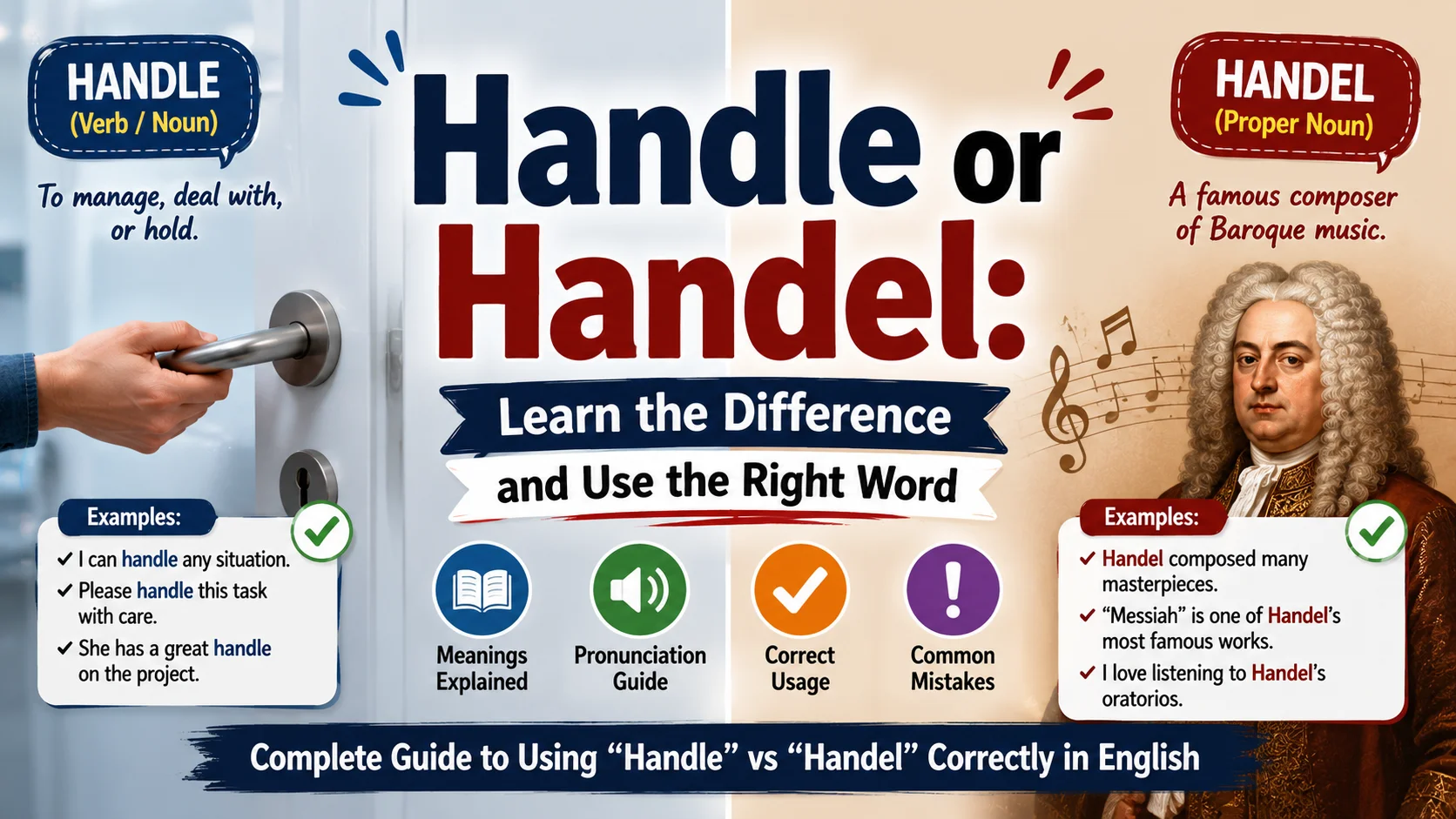
Have you ever typed “handel” instead of “handle” and wondered if you made a mistake? You are not alone. This common spelling confusion trips up countless writers, students, and professionals every day. We encounter this question frequently in our work as language educators.
“Handle” serves as one of English’s most versatile words, functioning as both a noun and a verb in everyday communication . The confusion with “handel” typically arises because the words are homophones—they sound identical when spoken but have completely different meanings and uses .
We designed this comprehensive guide to help you master “handle” usage, understand when “Handel” is appropriate, and avoid common spelling errors. You will learn the distinct meanings, proper contexts, and subtle differences between these commonly confused terms.
Quick Answer Table
Main Meaning Section
Definition
Handle functions as a noun meaning the part of an object designed to be held by the hand, or as a verb meaning to touch, manage, deal with, or control something . Handel is a proper noun referring to the famous German-British Baroque composer George Frideric Handel (1685–1759) .
Pronunciation
Both words share the same pronunciation: /ˈhændəl/ (HAN-duhl) . This identical pronunciation makes them homophones, which explains why so many people confuse them in writing .
Part of Speech
Handle:
- Noun: The part of an object you hold
- Verb: To touch, manage, deal with, or control
- Slang noun: A nickname or username
Handel:
Origin/Etymology
Handle traces its roots to Old English handlian meaning “to touch or move with the hands,” formed from the word hand with the instrumental suffix -el (like thimble from thumb) . The noun form came from Old English handle, meaning “a handle” .
Handel comes from German, where it means “trade” or “commerce” . The name was originally spelled “Händel” with an umlaut, which can mean “affairs” in German . It is also a southern German variant of “Händlein,” meaning “little hand” . The most famous bearer of this name was George Frideric Handel, who adopted this spelling when he settled in England in 1716 .
Contextual Meaning
Handle appears in various contexts:
- Physical objects: Door handles, suitcase handles, tool handles
- Management: “She handles the company’s accounts”
- Understanding: “I need to get a handle on this situation”
- Nicknames: “What’s your social media handle?”
Handel appears primarily in:
- Music history: Discussions of Baroque composers
- Classical music: Performances of oratorios like Messiah
- Surname references: People named Handel
Detailed Explanation
Literal Meaning
Literally, handle refers to the physical part of an object that you grasp with your hand to move or control it . Think of the handle on a coffee mug, a door, or a suitcase . The word literally connects to the hand itself, as its etymology suggests .
Common Meaning
In everyday usage, handle as a verb means to manage, deal with, or take care of something . You handle problems, handle responsibilities, and handle difficult situations. As a noun, it remains the grip part of any tool or object .
Internet Meaning
Online, handle has become synonymous with username or screen name . When someone asks “What’s your handle?” on social media, they are asking for your username or online identity . This usage dates back to CB radio slang from the 1870s .
Slang Meaning
Handle in slang can mean:
- A person’s name or nickname: “My handle is ‘Big Dave'”
- A way of dealing with something: “I finally got a handle on the problem”
- Love handles: Fat around the midsection (informal)
Texting Meaning
In texting, handle appears in phrases like “I can handle it” (I can manage it) or “What’s your handle?” (What’s your username?). You might also see it in abbreviated forms like “hndl.”
Social Media Meaning
On social media platforms, handle refers exclusively to your username or profile identifier . Your Twitter handle, Instagram handle, or TikTok handle identifies you on the platform. This usage has become so common that most people immediately understand “handle” to mean “online username.”
What About Handel?
Handel is NOT a misspelling of “handle” in the context of music or names. However, many people incorrectly use “handel” when they mean “handle” . Remember: if you are not referring to the composer or someone with that surname, you almost certainly mean “handle” .
Usage Examples
| Example Sentence | Meaning |
|---|---|
| Please handle the glass vase with extreme care | Touch or hold it gently |
| The door handle on my car broke yesterday | The physical grip part of the door |
| Can you handle this project while I am away? | Manage or take responsibility for it |
| What is your Twitter handle so I can follow you? | Your username on the platform |
| She handles all customer complaints professionally | Manages or deals with them |
| The suitcase handle snapped during our trip | The grip part of the luggage |
| I cannot handle this heat anymore | Cope with or tolerate it |
| He handled the negotiations skillfully | Managed or conducted them |
| The new employee handles pressure well | Copes with or manages stress |
| We need to get a handle on our expenses | Gain control or understanding of them |
| Handel’s Messiah is performed every Christmas | Referring to the composer’s work |
| That knife has a wooden handle | The physical grip part |
| The store handles returns and exchanges at the front desk | Processes or deals with them |
| The car handles beautifully on winding roads | Performs or responds when driven |
Synonyms Table
Antonyms Table
Related Terms Table
Real-Life Usage
Daily Conversation
You will hear handle constantly in everyday speech. People ask “Can you handle this?” when delegating tasks. They say “I’ve got a handle on it” to reassure others. They discuss “door handles” and “tool handles” when talking about physical objects. For example, “I’ll handle the cooking tonight” or “The handle on this frying pan gets hot.”
Social Media
On social media, handle is one of the most common terms you will encounter . Everyone knows what you mean when you ask for someone’s “Instagram handle” or “Twitter handle.” This usage has become so widespread that many younger users may not even know the word’s original physical meaning.
Business Communication
Professionals use handle to discuss management, responsibility, and customer relations. Business emails might say, “Our team will handle your account” or “We need to handle this client’s request immediately.” The word appears constantly in professional contexts.
Academic Writing
Academics use handle in discussions of methodology (“handling data”), research (“handling variables”), and historical analysis (“handling primary sources”). The term appears frequently in scholarly work.
Online Messaging
In instant messaging, handle appears when discussing usernames (“What’s your handle?”) or when expressing capability (“I can handle this”). You might see abbreviated versions like “hndl” in very informal contexts.
Common Mistakes
Semantic Keyword Section
Throughout this article, we have integrated semantic keywords that matter to you as a language learner. These include “handle,” “handel,” “difference between handle and handel,” “correct usage of handle,” “handle vs handel,” “handle definition,” “handle meaning,” “how to use handle in a sentence,” “handle examples,” “George Frideric Handel,” “composer Handel,” “handle as noun,” “handle as verb,” “handle username,” “handle nickname,” “homophones in English,” “common spelling mistakes,” and “English grammar.”
We carefully selected these terms based on what people actually search for when they have questions about this topic.
Related Questions Section
What is the difference between “handle” and “handel”?
“Handle” is a common English word meaning a grip or to manage something. “Handel” is a proper noun referring to the German composer George Frideric Handel or a surname . They are homophones, meaning they sound the same but have different meanings .
Is “handel” a word in English?
“Handel” is not a standard English word; it is a proper noun (a name) . The only accepted use is for the composer George Frideric Handel or as a surname . In German, “Handel” means “trade” or “commerce” .
Why do people confuse “handle” and “handel”?
People confuse them because they are homophones—they sound exactly the same when spoken (/ˈhændəl/) . This identical pronunciation leads to frequent spelling errors, especially for those who hear the word but have not seen it written.
What is a “handle” on social media?
On social media, a “handle” is your username or screen name . When someone asks “What’s your handle?” they are asking for your online identifier on platforms like Twitter, Instagram, or TikTok .
What is the origin of the word “handle”?
“Handle” comes from Old English handlian (verb) and handle (noun) . It is formed from the word “hand” with the instrumental suffix -el, similar to how “thimble” comes from “thumb” .
Who was George Frideric Handel?
George Frideric Handel (1685–1759) was a German-born British Baroque composer famous for his oratorio Messiah . He was born in Halle as Georg Friederich Händel and adopted the English spelling of his name in 1716 .
What are synonyms for “handle”?
Synonyms for handle as a noun include grip, hilt, knob, and haft . As a verb, synonyms include manage, deal with, control, wield, and manipulate .
How do you pronounce “handle” and “handel”?
Both are pronounced /ˈhændəl/ (HAN-duhl) . The first syllable rhymes with “hand,” and the second syllable is a soft “ul.”
FAQ Section
1. Is “handel” an acceptable spelling of “handle”?
No, “handel” is never an acceptable spelling of “handle” in English . If you mean the physical grip or the act of managing something, you must spell it “handle.” “Handel” is only correct as a proper noun referring to the composer or someone with that surname .
2. What does “handle” mean as a noun?
As a noun, “handle” means the part of an object designed to be held by the hand . Examples include door handles, suitcase handles, tool handles, and mug handles . It can also mean a nickname or username in slang .
3. What does “handle” mean as a verb?
As a verb, “handle” means to touch, manage, deal with, control, or cope with something . For example, “She handles the company’s finances” or “I can handle this situation” .
4. What is “Handel” famous for?
George Frideric Handel is famous for being one of the greatest Baroque composers . His most famous work is the oratorio Messiah, which includes the iconic “Hallelujah” chorus . He was born in Germany but became a British citizen .
5. What does “Handel” mean in German?
In German, “Handel” means “trade” or “commerce” . It is also a surname of German origin. The umlaut form “Händel” can mean “affairs” .
6. Why is my social media username called a “handle”?
The slang use of “handle” for a name originated in the 19th century . By 1870, Americans used “handle” to mean a nickname, especially in Western slang and later on CB radio . The term stuck and now applies to online usernames.
7. How can I remember the difference between “handle” and “Handel”?
Remember this: Handle has an “a” for “action” or “apparatus”—things you hold or manage. Handel has an “e” for “excellence” or “extraordinary”—like the composer! Also remember: the composer is a “proper” noun, so always capitalize it .
8. What is a “handler” and how does it relate to “handle”?
A “handler” is a person who handles something, such as a dog handler, baggage handler, or event handler . The word comes directly from “handle” with the agent suffix -er .
Conclusion
We have explored the essential differences between “handle” and “Handel” and why this distinction matters for your writing clarity. “Handle” serves as a versatile English word that helps you describe physical grips, management, and even online usernames . Its roots run deep in Old English, connecting directly to the hand . “Handel,” however, is a proper noun referring specifically to the great Baroque composer George Frideric Handel or to someone with that surname .
When you use “handle” correctly, you recognize its role as both a noun and a verb in countless contexts. You also know when to capitalize and use “Handel” for the composer. By avoiding the common confusion between these homophones, you will enhance your writing clarity and professionalism. We encourage you to practice using both words correctly in your daily communication. Remember: “handle” means a grip or to manage, “Handel” is the composer’s name!

Olivia Bennett is a writer and language enthusiast at Vocabsteria. She is passionate about exploring word meanings, name origins, and cultural expressions from around the world.