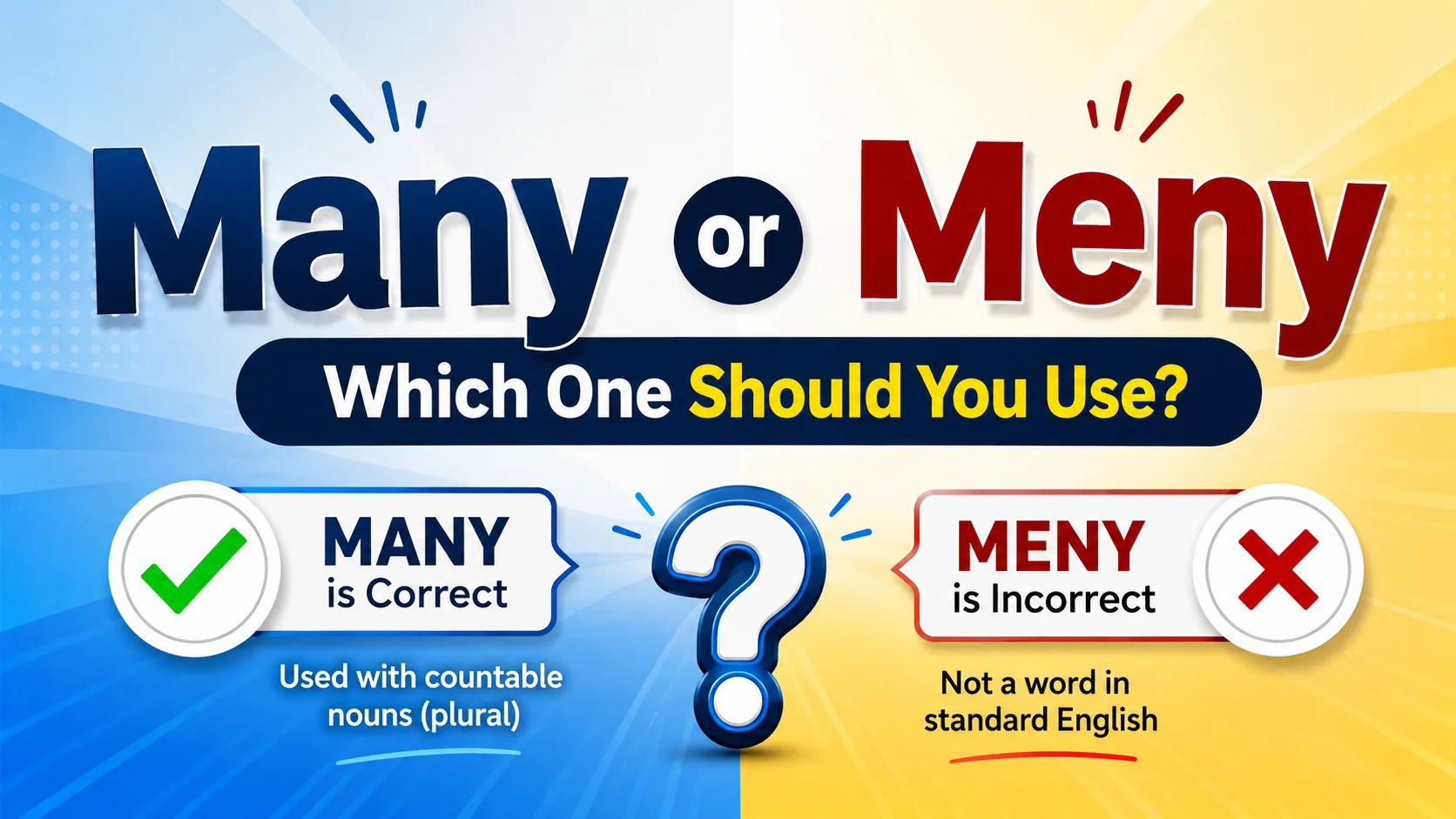
Have you ever typed “meny” instead of “many” and wondered if you made a mistake? You are not alone. This common spelling error confuses countless writers, students, and professionals every day. We encounter this question frequently in our work as language educators.
Many stands as one of English’s most essential quantifiers. We use it constantly to express quantity and countability. The confusion with “meny” typically arises from phonetic spelling errors or influence from other languages where “meny” means “menu” in Swedish and Norwegian.
We designed this comprehensive guide to help you master “many” usage, avoid the “meny” mistake, and understand subtle linguistic rules. You will learn when and how to use “many” correctly in any situation. Let us explore everything you need to know about this common English word and its misspelling.
Quick Answer Table
| Term | Meaning | Usage | Category |
|---|---|---|---|
| Many | A large but indefinite number of countable items | “Many people attended the concert” | Quantifier/Adjective |
| Meny | Common misspelling of “many” in English; also means “menu” in Swedish/Norwegian | Incorrect in English; correct in Scandinavian languages | Misspelling/Proper noun in other languages |
Main Meaning Section
Definition
Many functions as a quantifier that indicates a large but indefinite number of countable items or individuals. English grammar classifies it as a determiner, adjective, noun, and pronoun depending on your sentence structure.
Pronunciation
Pronunciation: /ˈmɛni/ (MEH-nee)
You pronounce this word like “penny” or “any.” The first syllable receives the primary stress. Many non-native speakers often mispronounce it as “may-nee,” but the correct pronunciation rhymes with “penny.”
Part of Speech
- Determiner: You place it before plural nouns to indicate a large number
- Adjective: It describes a noun as numerous
- Noun: It refers to a large number of people or things
- Pronoun: It stands in for a large number of people or things
Origin/Etymology
Many traces its roots to Old English manig or menig, which comes from the Proto-Germanic managaz. This Germanic root connects to Old Saxon manag, Old High German manag, Old Norse mangr, and Danish mange. Linguists trace the word back to the Proto-Indo-European root menegh-, meaning “many” or “much.” Some etymologists also link it to the Welsh word mynych, meaning “frequent.” This rich history explains why the word has maintained its importance in modern English.
Contextual Meaning
In modern English, we use “many” specifically with countable nouns (nouns we can count individually). You will find it in various contexts:
- Formal writing: “Many scholars have debated this theory”
- Everyday conversation: “There are many reasons for this decision”
- Questions: “How many people are coming?”
- Negative statements: “There aren’t many options available”
Detailed Explanation
Literal Meaning
Literally, “many” denotes a large number of individual items, people, or things we can count. It suggests a quantity significantly greater than “several” or “a few” but does not specify an exact number. For instance, when someone says “many cars,” they mean a substantial quantity of vehicles, not just two or three.
Common Meaning
In everyday usage, we use “many” as the standard quantifier to indicate a considerable number of plural nouns. For example, “many books” means a substantial collection of books. This represents the most common application of the word in daily communication.
Internet Meaning
Online, “many” retains its traditional meaning but frequently appears in shortened, informal contexts. You will see phrases like “so many feels” (abbreviation of “feelings”) or “many thanks” in emails and online communications. Internet users often combine “many” with emojis to emphasize quantity or emotion.
Slang Meaning
Slang usage of “many” remains relatively limited. You might hear phrases like “many a time” used informally to mean “frequently.” In some urban slang, people use “many” ironically to describe a small number, saying “many” when they mean “a few” as a form of sarcasm.
Texting Meaning
In texting, people use “many” in phrases like “too many” to express overwhelm, or “so many” for emphasis. You will occasionally see “meny” appear as a common typo. Texters often abbreviate “many” to “mny” in extremely informal contexts.
Social Media Meaning
On social media platforms, users frequently include “many” in hashtags like #manyfaces or in captions expressing quantity: “many adventures,” “many memories,” “so many options.” You will also find it in comparative statements: “many more” or “as many as.” Social media influencers often use “many” to promote products: “so many benefits” or “many reasons to try this.”
Usage Examples
| Example Sentence | Meaning |
|---|---|
| Many students passed the exam | A large number of students achieved success |
| How many apples do you need? | You are asking for the specific number of apples |
| I have too many things to do | The speaker feels overwhelmed by tasks |
| Many people believe the same thing | A large number of people share a belief |
| She has many friends from college | She maintains a large social circle from her university days |
| Many are called, but few are chosen | A large number receive invitations, but only some receive selection |
| The needs of the many outweigh the needs of the few | The majority’s interests take precedence |
| I have visited there many times | The speaker has returned to a location repeatedly |
| For many a day, it rained | The rain continued for a considerable number of days |
| We found many ways to solve this problem | Multiple solutions exist |
| Not many people can afford that | Only a limited number of people have the means |
| This approach offers many advantages | Multiple benefits exist |
| How many of you understand the lesson? | The teacher asks for a show of hands |
| We have many options available | Multiple choices exist |
| Many thanks for your assistance | The speaker expresses deep gratitude |
Synonyms Table
| Synonym | Meaning |
|---|---|
| Numerous | Existing in a large number |
| Countless | Too many to count |
| Innumerable | Beyond counting or calculation |
| Multitudinous | Consisting of many individuals or elements |
| Myriad | An extremely large number |
| Several | More than two but not many |
| Abundant | Existing in plentiful supply |
| Copious | In large quantities |
| Profuse | Very plentiful |
| Manifold | Many and various |
| Legion | Numerous; vast in number |
| Plentiful | Present in large quantities |
| Various | Different from each other; many |
| Sundry | Of various kinds; many and different |
| Unlimited | Without any limit or restriction |
Antonyms Table
| Antonym | Meaning |
|---|---|
| Few | A small number |
| Scant | Barely sufficient in quantity |
| Meager | Lacking in quantity |
| Sparse | Thinly dispersed or scattered |
| Limited | Restricted in number |
| Rare | Not occurring very often |
| Scarce | Insufficient for demand |
| Dearth | A scarcity or lack of something |
| Slight | Small in quantity |
| Deficient | Lacking in some necessary quality or quantity |
Related Terms Table
| Related Word | Meaning |
|---|---|
| Much | You use this with uncountable nouns |
| A lot of | This serves as the informal equivalent of many |
| Quantifier | This word expresses quantity |
| Plural | This form of a noun indicates more than one |
| Countable noun | You can count this type of noun |
| Uncountable noun | You cannot count this type of noun |
| Determiner | This word modifies a noun |
| Overabundance | This means an excessive amount |
| Plenty | This indicates a plentiful supply |
| Hundreds | This represents a specific large number |
| Thousands | This represents a specific large number |
| Dozens | This indicates a large, imprecise number |
| Tons | This means an enormous quantity (informal) |
| Loads | This indicates a large number (informal) |
| A great many | This means a very large number |
Real-Life Usage
Daily Conversation
You will hear “many” constantly in everyday conversation. People ask “How many?” to inquire about quantities. They state “There are many reasons” to explain situations. They express “Too many” to indicate excess. For example, “There are many things to do today.” You might also hear phrases like “many happy returns” on birthdays or “many thanks” in casual gratitude.
Social Media
You will see “many” in posts and captions to highlight quantity or intensity. Examples include “So many great memories” in photos, “Many thanks” in acknowledgments, or “Many of you asked about…” in replies. Influencers often write “many of you requested this” to engage followers.
Business Communication
Professionals use “many” to discuss numbers, markets, clients, and statistics. Business emails might say, “We found many opportunities to expand our market” or “Many clients have requested this feature.” In meetings, managers ask “How many people will attend?” and team leaders report “Many departments have contributed.”
Academic Writing
Academics use “many” to discuss research findings, literature reviews, and statistical significance. For example, “Many studies have shown the correlation between X and Y.” Researchers write “Many scholars agree that…” and “Many experiments confirm this hypothesis.”
Online Messaging
In instant messaging, people use “many” in simplified forms and emojis. You might text “2 many” or “so many” to express feeling overwhelmed. Friends message “many lols” or “many hugs” to show emotion. The word appears frequently in informal digital communication.
Common Mistakes
| Mistake | Correct Usage |
|---|---|
| Using “meny” as an English word | Use “many” as the correct spelling. “Meny” is a Swedish word meaning “menu” |
| Using “many” with uncountable nouns | Use “much” with uncountable nouns: “much water,” not “many water” |
| Using “many” with singular nouns | Use “many” before plural countable nouns: “many people” not “many person” |
| “I have many experience” | Say “I have much experience” or “I have a lot of experience” |
| Using “many” in overly formal positive statements | Use “a lot of” in everyday English: “a lot of people” instead of “many people” (though “many people” is not grammatically wrong, it sounds more formal) |
| “There is many problems” | Say “There are many problems” (match the verb to the noun) |
| Confusing “many of” and “many” | Use “many of us” vs. “many people” |
| Misusing “as many as” | “As many as 50 people attended” correctly indicates the maximum count |
| “How many much” | Use “How many” for countable nouns; use “How much” for uncountable nouns |
| Using “many a” inappropriately | Use “Many a time” only in literary/archaic contexts; use “Many times” for modern speech |
Related Questions Section
What does “meny” mean?
“Meny” means “menu” in Swedish and Norwegian. In English, “meny” has no standard definition. People frequently use it as a misspelling of “many.” The word appears in Scandinavian restaurant contexts and digital interfaces.
How do you pronounce “many”?
You pronounce “many” as /ˈmɛni/ (MEH-nee). It rhymes with “penny” or “any.” The first syllable receives the stress. Avoid pronouncing it as “may-nee” which is incorrect.
Why is “meny” wrong in English?
“Meny” is not a valid English word. It is a common spelling error that comes from mishearing or misspelling “many.” The “e” in “many” often causes this confusion. English spelling rules do not support the “meny” variant.
What is the origin of the word “many”?
“Many” comes from Old English manig or menig, which derives from the Proto-Germanic managaz. It connects to the Welsh word mynych, meaning “frequent.” The word has remained remarkably consistent across Germanic languages.
What is the difference between “many” and “much”?
You use “many” with countable nouns (e.g., many apples). You use “much” with uncountable nouns (e.g., much water). Both are quantifiers but apply to different types of nouns. Remember: “many” for things you can count, “much” for things you cannot.
What does “many a” mean?
“Many a” is a formal or literary construction you use before a singular noun to mean “many.” For example, “many a day” means “many days.” Writers use this for stylistic effect in poetry and formal prose.
What are the synonyms of “many”?
Synonyms of many include numerous, abundant, countless, innumerable, manifold, multitudinous, myriad, legion, and plentiful. Each synonym carries slightly different connotations, so choose carefully based on context.
FAQ Section
1. Is “meny” a word in English?
No, “meny” is not a recognized word in the English language. People commonly misspell “many” this way. In Scandinavian languages like Swedish and Norwegian, however, “meny” means “menu.” You should never use “meny” in English writing.
2. What is the correct spelling: many or meny?
The correct spelling is “many.” When writing in English, you should never use “meny.” Remember: it is M-A-N-Y. You can remember this by thinking “Many people spell it with an ‘a,’ not an ‘e.'”
3. How can I remember the correct spelling of “many”?
Think of this phrase: “Many people spell it with an ‘a,’ not an ‘e.'” This mnemonic helps you differentiate from the misspelling “meny.” You can also associate it with the word “any” which has a similar spelling pattern.
4. What does “many” mean?
“Many” means a large but indefinite number of countable items. It describes quantities that are more than “several” but not specified exactly. For instance, “many flowers” means a large collection of flowers.
5. What are common mistakes with “many”?
Common mistakes include misspelling it as “meny,” using it with uncountable nouns (use “much” instead), and failing to make verbs agree (“there are many” not “there is many”). You should also avoid overusing “many” in formal writing when “numerous” might sound better.
6. What is the pronunciation of “many”?
You pronounce “many” as /ˈmɛni/ (MEH-nee), with the primary stress on the first syllable. Think of the word “penny” and replace the “p” with an “m.” This will help you say it correctly.
7. How do I use “many” in sentences?
You use many before plural countable nouns: “Many students are in the library.” You also use it with “of”: “Many of the students are here. And ” You can use it in questions: “How many students are present?” and in negative statements: “Not many students arrived early.”
8. What is the difference between “many” and “a lot of”?
Both express large quantities. “Many” is more formal and you will find it more in written and formal spoken English. “A lot of” is more informal and you will hear it more in everyday speech. “A lot of” works with both countable and uncountable nouns.
9. Can I use “many” in negative sentences?
Yes, you can use “many” in negative sentences. For example: “There aren’t many people here” or “I don’t have many friends.” In negative contexts, “many” often implies “not as many as expected.”
10. Is “many” singular or plural?
“Many” is plural in meaning but functions as a determiner, pronoun, or adjective. When used as a subject, it takes a plural verb: “Many are invited” not “Many is invited.” However, “many a” takes a singular verb: “Many a student has failed.”
Conclusion
We have explored the essential differences between “many” and “meny” and why this distinction matters for your writing clarity. “Many” serves as a fundamental English word that helps you express large quantities of countable items. Its roots run deep in the Germanic languages, connecting us to centuries of linguistic history. “Meny,” however, is either a misspelling of “many” or the Swedish/Norwegian word for “menu.”
When you use “many” correctly, you recognize its role as a quantifier for plural countable nouns. You also know when to switch to “much” instead. By avoiding the common “meny” mistake, you will enhance your writing clarity and professionalism. We encourage you to practice using “many” in your daily communication. Remember: “many” means a large number, and “meny” means you have the wrong word in English! Master these rules, and your English writing will improve significantly.

Olivia Bennett is a writer and language enthusiast at Vocabsteria. She is passionate about exploring word meanings, name origins, and cultural expressions from around the world.