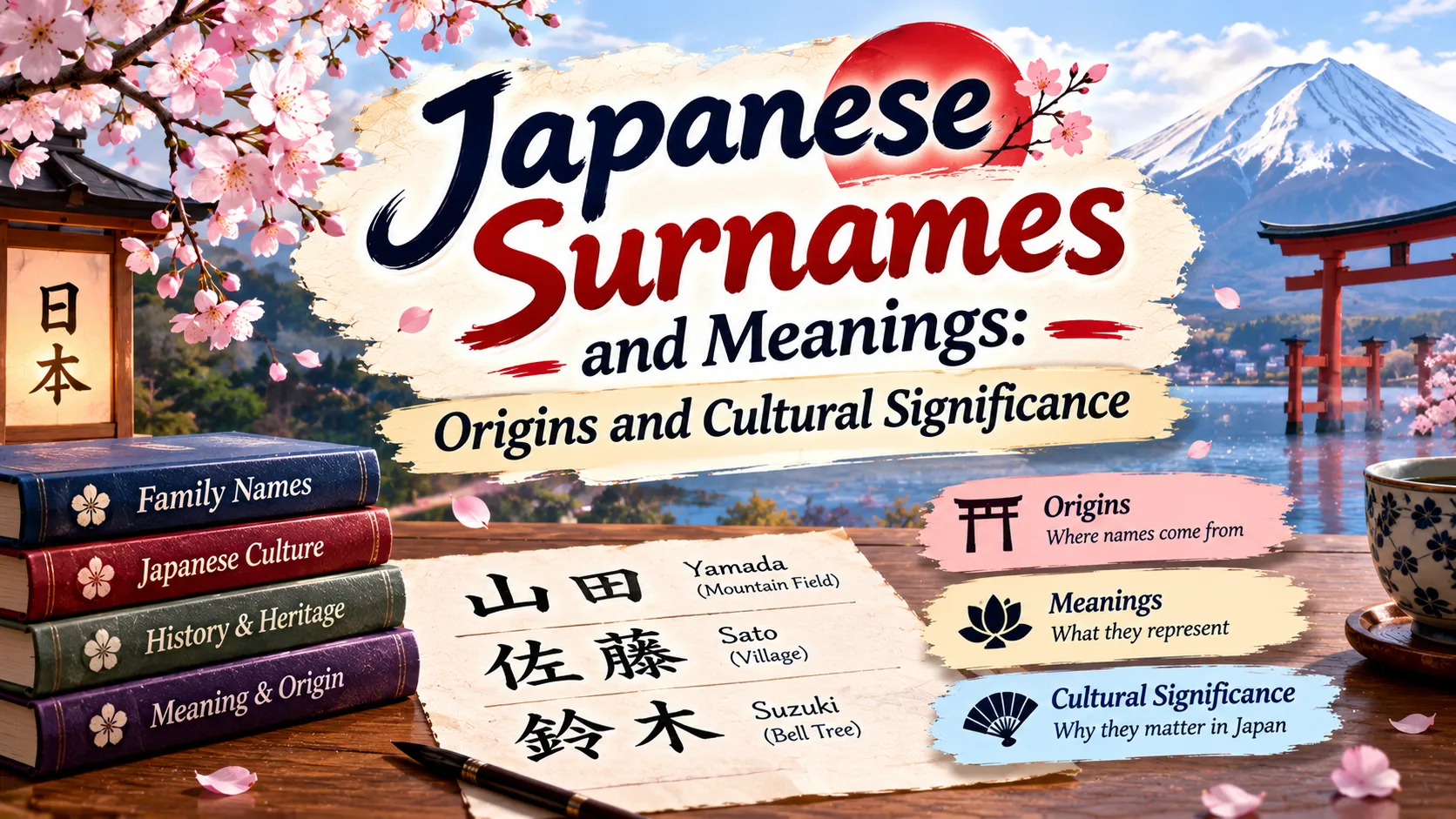
Japanese surnames carry fascinating stories about family history, geography, nature, occupations, and cultural traditions. Many Japanese last names come from words associated with mountains, rivers, forests, flowers, villages, and landscapes. Others developed from the names of ancestral locations, historical clans, and traditional occupations. Exploring Japanese surnames and meanings can help you understand Japanese naming customs while discovering beautiful and distinctive family names.
Unlike many Western naming traditions, Japanese surnames often use kanji characters, and the same surname can have different readings or interpretations depending on the characters used. For example, the surname Sato is commonly written as 佐藤, while Suzuki is commonly written as 鈴木. Each character contributes to the written meaning, although the historical origin of a surname may differ from its literal translation.
Whether you are researching Japanese family names, creating a fictional character, exploring Japanese ancestry, or simply looking for interesting last names, this guide covers popular, traditional, rare, and nature-inspired Japanese surnames with their common written forms and meanings.
Popular Japanese Surnames and Their Meanings 🌸
Popular Japanese surnames often reflect familiar natural features, historical locations, and traditional family names. Many have been used for generations and remain common throughout Japan today.
Here are some well-known Japanese last names with their common kanji spellings and approximate meanings.
| Japanese surname | Kanji | Common meaning or interpretation |
|---|---|---|
| Sato | 佐藤 | Assistant wisteria; historical surname |
| Suzuki | 鈴木 | Bell tree |
| Takahashi | 高橋 | High bridge |
| Tanaka | 田中 | In the middle of the rice fields |
| Watanabe | 渡辺 | Near the crossing or ferry |
| Ito | 伊藤 | Historical surname with wisteria kanji |
| Yamamoto | 山本 | Base of the mountain |
| Nakamura | 中村 | Central village |
| Kobayashi | 小林 | Small forest |
| Kato | 加藤 | Historical surname with wisteria kanji |
| Yoshida | 吉田 | Lucky or fortunate rice field |
| Yamada | 山田 | Mountain rice field |
| Sasaki | 佐々木 | Historical surname with tree-related characters |
| Yamaguchi | 山口 | Mountain entrance |
| Matsumoto | 松本 | Base of the pine tree |
| Inoue | 井上 | Above the well |
| Kimura | 木村 | Tree village |
| Hayashi | 林 | Forest or woods |
| Shimizu | 清水 | Clear water |
| Yamazaki | 山崎 | Mountain slope or promontory |
| Mori | 森 | Forest |
| Abe | 阿部 | Historical surname; interpretation depends on kanji |
| Ikeda | 池田 | Pond field |
| Hashimoto | 橋本 | Base of the bridge |
| Ishikawa | 石川 | Stone river |
| Maeda | 前田 | Front rice field |
| Fujita | 藤田 | Wisteria field |
| Goto | 後藤 | Historical surname with wisteria kanji |
| Okada | 岡田 | Hill rice field |
| Hasegawa | 長谷川 | Long valley river |
Japanese Surnames Inspired by Nature 🌿
Nature has played an important role in Japanese culture, art, poetry, and naming traditions. Many Japanese surnames contain kanji associated with mountains, rivers, trees, flowers, stones, and other natural features.
These family names often create beautiful visual associations and reflect Japan’s close relationship with its natural surroundings.
| Surname | Kanji | Meaning |
|---|---|---|
| Mori | 森 | Forest |
| Hayashi | 林 | Woods or forest |
| Yamamoto | 山本 | Base of the mountain |
| Ishikawa | 石川 | Stone river |
| Kawamura | 川村 | River village |
| Matsuda | 松田 | Pine field |
| Matsumoto | 松本 | Base of the pine |
| Takeuchi | 竹内 | Within the bamboo |
| Ueda | 上田 | Upper rice field |
| Okamoto | 岡本 | Base of the hill |
| Aoki | 青木 | Green or blue tree |
| Kuroki | 黒木 | Black tree |
| Shiraishi | 白石 | White stone |
| Iwasaki | 岩崎 | Rocky cape or slope |
| Ishida | 石田 | Stone field |
| Kawaguchi | 川口 | River entrance |
| Nakayama | 中山 | Middle mountain |
| Ogawa | 小川 | Small river |
| Sakurai | 桜井 | Cherry blossom well |
| Fujimoto | 藤本 | Base of the wisteria |
| Hanazawa | 花沢 | Flower marsh |
| Tsuchiya | 土屋 | Earth or soil house |
| Mizuno | 水野 | Water field |
| Kishi | 岸 | Shore or bank |
| Oshima | 大島 | Large island |
Japanese Surnames Meaning Mountain and River ⛰️
Mountains and rivers are common features in Japanese geography, so it is no surprise that they appear in many family names. These surnames often developed from locations where families lived or owned land.
Some mountain and river surnames are extremely common, while others have more distinctive regional associations.
- Yamada (山田): Mountain rice field.
- Yamashita (山下): Below the mountain.
- Yamaguchi (山口): Mountain entrance.
- Nakayama (中山): Middle mountain.
- Yamamoto (山本): Base of the mountain.
- Yamazaki (山崎): Mountain slope or promontory.
- Kawasaki (川崎): River cape or peninsula.
- Kawamura (川村): River village.
- Kawaguchi (川口): River entrance.
- Ishikawa (石川): Stone river.
- Ogawa (小川): Small river.
- Hasegawa (長谷川): Long valley river.
- Mizutani (水谷): Water valley.
- Mizuno (水野): Water field.
- Kinoshita (木下): Beneath a tree.
- Moriyama (森山): Forest mountain.
- Fujiyama (藤山): Wisteria mountain.
- Shimada (島田): Island field.
- Oshima (大島): Large island.
- Matsuyama (松山): Pine mountain.
Japanese Surnames Meaning Flower and Plants 🌺
Japanese names often incorporate plants and flowers because of their beauty, seasonal importance, and cultural symbolism. Cherry blossoms, wisteria, pine trees, bamboo, and other plants appear in traditional Japanese art and family names.
These surnames are especially appealing to people who enjoy botanical meanings and nature-inspired names.
| Surname | Kanji | Meaning |
|---|---|---|
| Sakurai | 桜井 | Cherry blossom well |
| Sakura | 桜 | Cherry blossom |
| Fujita | 藤田 | Wisteria field |
| Fujimoto | 藤本 | Base of the wisteria |
| Fujiwara | 藤原 | Wisteria plain |
| Matsuda | 松田 | Pine field |
| Matsumoto | 松本 | Base of the pine |
| Aoki | 青木 | Green or blue tree |
| Takeuchi | 竹内 | Within the bamboo |
| Takemoto | 竹本 | Base of the bamboo |
| Umehara | 梅原 | Plum blossom field |
| Umeda | 梅田 | Plum field |
| Hanazawa | 花沢 | Flower marsh |
| Hanamura | 花村 | Flower village |
| Kikuuchi | 菊池 | Chrysanthemum pond |
| Kinoshita | 木下 | Beneath a tree |
| Morita | 森田 | Forest field |
| Wakabayashi | 若林 | Young woods |
| Kusunoki | 楠木 | Camphor tree |
| Yanagi | 柳 | Willow |
Traditional Japanese Surnames and Their Meanings 🏯
Traditional Japanese surnames often have historical connections to geographical locations, family lineages, and influential clans. Some became prominent during the samurai era, while others developed from local communities and ancestral estates.
These surnames can be especially interesting for historical fiction, genealogy research, and learning about Japanese heritage.
- Fujiwara (藤原): Wisteria plain; associated with a powerful historical aristocratic clan.
- Minamoto (源): Origin or source; a prominent historical clan name.
- Taira (平): Flat or level; associated with a major historical clan.
- Tachibana (橘): Tachibana citrus or mandarin orange; an important historical clan name.
- Tokugawa (徳川): Virtue and river; associated with the Tokugawa shogunate.
- Oda (織田): Historical surname associated with the Oda clan.
- Toyotomi (豊臣): Abundant or prosperous and ministerial elements; associated with Toyotomi Hideyoshi.
- Mori (毛利): Historical clan surname, distinct from the common forest kanji 森.
- Shimazu (島津): Island and harbor or ford-related characters; associated with the Shimazu clan.
- Date (伊達): Historical samurai family surname.
- Sanada (真田): Sincere or true and rice field; associated with the Sanada clan.
- Uesugi (上杉): Upper or above and cedar; associated with the Uesugi clan.
- Akechi (明智): Bright wisdom; associated with Akechi Mitsuhide.
- Takeda (武田): Military or warrior and rice field; associated with the Takeda clan.
- Hojo (北条): Northern article or strip; associated with the Hojo clan.
The meanings above reflect the written characters or historical associations, not necessarily the exact origins of every family carrying the surname.
Japanese Surnames Meaning Beautiful and Elegant ✨
Some Japanese surnames have appealing meanings connected with beauty, brightness, nature, harmony, and positive qualities. Their written characters can create graceful impressions, although a surname’s actual origin may be geographical rather than descriptive.
Here are some examples:
- Miyazaki (宮崎): Shrine or palace cape.
- Miyamoto (宮本): Base of a shrine or palace.
- Kawabata (川端): Riverbank.
- Kobayashi (小林): Small forest.
- Shimizu (清水): Clear water.
- Aoki (青木): Green or blue tree.
- Hoshino (星野): Star field.
- Harada (原田): Plain field.
- Hirano (平野): Flat plain.
- Nishikawa (西川): Western river.
- Asano (浅野): Shallow field.
- Matsui (松井): Pine well.
- Kojima (小島): Small island.
- Yoshikawa (吉川): Fortunate river.
- Kaneko (金子): Gold child.
- Fukuda (福田): Blessed or fortunate field.
- Takahashi (高橋): High bridge.
- Hirose (広瀬): Wide rapids or shallows.
- Mizushima (水島): Water island.
- Sakaguchi (坂口): Slope entrance.
Rare and Unusual Japanese Surnames 🌙
Japan has thousands of family names, and some are much less common than the surnames found in everyday conversations. Unusual surnames can have distinctive readings, uncommon kanji combinations, or strong regional connections.
The following examples are less familiar to many international readers, although rarity varies by region and spelling.
- Kanzaki (神崎): Divine or deity cape.
- Tsukishima (月島): Moon island.
- Amamiya (雨宮): Rain shrine or palace.
- Hoshikawa (星川): Star river.
- Yukimura (雪村): Snow village.
- Kisaragi (如月): An old name for the second lunar month; used as a surname and literary name.
- Shinonome (東雲): Dawn or daybreak.
- Kurokawa (黒川): Black river.
- Akizuki (秋月): Autumn moon.
- Kagami (鏡): Mirror.
- Shirakawa (白川): White river.
- Mikazuki (三日月): Crescent moon.
- Kaminari (雷): Thunder.
- Kirisawa (霧沢): Mist marsh.
- Takamori (高森): High forest.
- Kageyama (影山): Shadow mountain.
- Asakura (朝倉): Morning storehouse.
- Fuyuki (冬木): Winter tree.
- Mizukami (水上): Above or on the water.
- Kanzawa (神沢): Divine marsh or stream.
Some of these names also appear in fiction and popular culture. Their presence in stories does not necessarily mean they are common real-world surnames.
Japanese Surnames Meaning Strong and Powerful 💪
Japanese family names can also contain characters associated with strength, leadership, military history, and important geographical features. Some are connected with historical warrior families, while others have strong-sounding kanji combinations.
- Takeda (武田): Warrior or military and rice field.
- Takeshita (竹下): Beneath the bamboo.
- Takamatsu (高松): High pine tree.
- Ishikawa (石川): Stone river.
- Iwasaki (岩崎): Rocky cape or slope.
- Kuroda (黒田): Black rice field.
- Matsuda (松田): Pine field.
- Kobayashi (小林): Small forest.
- Mori (森): Forest.
- Yamamoto (山本): Base of the mountain.
- Shibata (柴田): Brushwood field.
- Oshima (大島): Large island.
- Araki (荒木): Rough or wild tree.
- Sakuma (佐久間): Historical surname with several possible interpretations.
- Kawashima (川島): River island.
- Fukushima (福島): Fortunate island.
- Tsuchiya (土屋): Earth house.
- Kishimoto (岸本): Base of the shore.
- Ishimoto (石本): Base of the stone.
- Okamoto (岡本): Base of the hill.
Japanese Surnames Meaning Light, Moon, and Stars 🌙
The moon, stars, and light are popular themes in Japanese poetry, art, and contemporary naming inspiration. Some surnames contain kanji that directly refer to celestial objects, while others create associations with the sky or brightness.
| Surname | Kanji | Meaning |
|---|---|---|
| Hoshino | 星野 | Star field |
| Hoshikawa | 星川 | Star river |
| Tsukishima | 月島 | Moon island |
| Akizuki | 秋月 | Autumn moon |
| Mikazuki | 三日月 | Crescent moon |
| Kagayama | 輝山 | Radiant mountain |
| Terada | 寺田 | Temple field |
| Akamatsu | 赤松 | Red pine |
| Asahi | 朝日 | Morning sun |
| Hikari | 光 | Light |
| Kurotsuki | 黒月 | Black moon |
| Tsukamoto | 塚本 | Mound base |
| Shiroyama | 城山 | Castle mountain |
| Hinode | 日の出 | Sunrise |
| Hoshizaki | 星崎 | Star cape |
Some celestial-inspired examples are uncommon or depend on particular kanji readings. Always verify the spelling and reading before treating a suggested combination as an established family name.
Japanese Surnames Meaning Water and Ocean 🌊
Japan is an island country surrounded by the Pacific Ocean and other bodies of water. Rivers, coastlines, islands, and waterways have influenced the development of many Japanese family names.
Water-related surnames can have beautiful meanings and strong connections with geography.
- Mizuno (水野): Water field.
- Mizutani (水谷): Water valley.
- Mizushima (水島): Water island.
- Mizukami (水上): Above or on the water.
- Kawasaki (川崎): River cape or peninsula.
- Kawamura (川村): River village.
- Kawaguchi (川口): River entrance.
- Ishikawa (石川): Stone river.
- Nishikawa (西川): Western river.
- Shirakawa (白川): White river.
- Kurokawa (黒川): Black river.
- Ogawa (小川): Small river.
- Kojima (小島): Small island.
- Oshima (大島): Large island.
- Kawashima (川島): River island.
- Umikawa (海川): Sea and river.
- Hamamoto (浜本): Base of the beach.
- Hamaoka (浜岡): Beach hill.
- Uchida (内田): Inner field.
- Nagisa (渚): Shore or beach.
Japanese Surnames Meaning Place and Geography 🗺️
Many Japanese surnames developed from the places where families lived, worked, or owned land. These names often describe geographical features such as hills, fields, villages, bridges, valleys, and entrances.
- Tanaka (田中): In the middle of the rice fields.
- Yoshida (吉田): Fortunate rice field.
- Maeda (前田): Front rice field.
- Ikeda (池田): Pond field.
- Okada (岡田): Hill field.
- Harada (原田): Plain field.
- Nakamura (中村): Central village.
- Kawamura (川村): River village.
- Hashimoto (橋本): Base of the bridge.
- Takahashi (高橋): High bridge.
- Inoue (井上): Above the well.
- Yamaguchi (山口): Mountain entrance.
- Sakaguchi (坂口): Slope entrance.
- Hirano (平野): Flat plain.
- Morita (森田): Forest field.
- Matsuda (松田): Pine field.
- Fujita (藤田): Wisteria field.
- Nishida (西田): Western field.
- Higashida (東田): Eastern field.
- Minamida (南田): Southern field.
Japanese Surnames and Their Meanings: Short Reference Chart 📖
If you want a quick overview of popular Japanese last names, this chart brings together some familiar examples and their common interpretations.
| Surname | Kanji | Meaning |
|---|---|---|
| Sato | 佐藤 | Historical wisteria surname |
| Suzuki | 鈴木 | Bell tree |
| Takahashi | 高橋 | High bridge |
| Tanaka | 田中 | Rice field center |
| Watanabe | 渡辺 | Near a crossing |
| Yamamoto | 山本 | Mountain base |
| Nakamura | 中村 | Central village |
| Kobayashi | 小林 | Small forest |
| Yoshida | 吉田 | Fortunate field |
| Yamada | 山田 | Mountain field |
| Shimizu | 清水 | Clear water |
| Mori | 森 | Forest |
| Hayashi | 林 | Woods |
| Matsumoto | 松本 | Pine tree base |
| Inoue | 井上 | Above the well |
| Kimura | 木村 | Tree village |
| Ishikawa | 石川 | Stone river |
| Fujita | 藤田 | Wisteria field |
| Sakurai | 桜井 | Cherry blossom well |
| Hoshino | 星野 | Star field |
| Mizuno | 水野 | Water field |
| Aoki | 青木 | Green or blue tree |
| Kuroda | 黒田 | Black field |
| Okamoto | 岡本 | Hill base |
| Ogawa | 小川 | Small river |
How Japanese Surnames Work: Understanding Kanji and Readings 🈶
Japanese surnames are generally written before given names in traditional Japanese name order. For example, in the name Tanaka Haruto, Tanaka is the family name and Haruto is the given name.
Most Japanese surnames use kanji, which are characters that carry meaning. However, a surname’s written meaning does not always reveal its complete historical origin.
A single kanji can have multiple readings, and the same pronunciation can be written with different characters. This means two families with the same romanized surname may use different kanji.
For example, several Japanese surnames can be read as Saito, but they may use different combinations of characters, such as 斎藤, 斉藤, and 齋藤. Their historical spellings and family backgrounds can differ.
Why Do Japanese Surnames Have Different Meanings?
Japanese surnames developed through several historical processes. Many came from geographical features, local settlements, ancestral estates, occupations, and family lineages.
Some families adopted names connected with the land around them. A family living near a river might have a surname containing the character 川, meaning river. Another family associated with a mountain location might use 山, meaning mountain.
Other surnames became established through influential families, regional traditions, and historical events.
How Are Japanese Surnames Pronounced?
Japanese surname pronunciation can be different from what English speakers expect. Romanized spellings often represent Japanese sounds, but some surnames have multiple readings.
For example:
- Sato is commonly pronounced Sah-toh.
- Suzuki is commonly pronounced Soo-zoo-kee.
- Takahashi is commonly pronounced Tah-kah-hah-shee.
- Tanaka is commonly pronounced Tah-nah-kah.
- Yamamoto is commonly pronounced Yah-mah-moh-toh.
Pronunciation can vary slightly depending on regional speech and individual family preference.
How to Choose a Japanese Surname for a Character or Story ✍️
Japanese surnames can add cultural detail and personality to fictional characters. However, selecting a name should involve more than choosing a beautiful meaning. You should also consider whether the surname is authentic, how it sounds with the given name, and whether its cultural background suits the character.
Here are some useful tips:
- Consider the character’s background: A modern character may have a common surname such as Sato, Suzuki, or Tanaka.
- Choose meaningful kanji: Select characters that match the personality or story you want to create.
- Check pronunciation: Make sure the surname sounds natural with the character’s given name.
- Avoid treating rare names as common: Some unusual combinations may be fictional, uncommon, or regionally specific.
- Understand historical associations: Names such as Fujiwara, Minamoto, and Tokugawa carry recognizable historical connections.
- Check the kanji carefully: The same romanized spelling can represent different written names.
- Respect naming traditions: Use authentic Japanese name order when appropriate.
For a realistic contemporary character, common surnames are usually a good starting point. For historical fiction, research the period and family background before choosing a surname.
Frequently Asked Questions About Japanese Surnames and Meanings ❓
What are the most common Japanese surnames?
Some of the most common Japanese surnames include Sato, Suzuki, Takahashi, Tanaka, Watanabe, Ito, Yamamoto, Nakamura, Kobayashi, and Kato. Their popularity can vary depending on the source and year.
What is the most popular Japanese last name?
Sato (佐藤) is generally ranked among the most common Japanese surnames and is frequently listed as the most common in modern surname rankings.
What does Sato mean in Japanese?
Sato is commonly written as 佐藤. The character 藤 refers to wisteria, while 佐 has an assisting or helping meaning. However, the surname’s historical development is more complex than its literal character translation.
What does Suzuki mean?
Suzuki is commonly written as 鈴木. The characters mean bell and tree, respectively. It is one of Japan’s most recognizable family names.
What does Takahashi mean?
Takahashi is commonly written as 高橋 and means “high bridge.” The surname is associated with a geographical feature and is widely used in Japan.
What does Tanaka mean?
Tanaka is written as 田中 and commonly means “in the middle of the rice fields.” It is one of Japan’s best-known surnames.
Why do Japanese surnames have meanings?
Japanese surnames often developed from geographical locations, natural features, family histories, occupations, and historical lineages. Their kanji characters frequently preserve associations with these origins.
What Japanese surname means moon?
Tsukishima (月島) means “moon island,” while Akizuki (秋月) means “autumn moon.” Mikazuki (三日月) refers to a crescent moon. These names have distinctive kanji associations, but their frequency and readings vary.
What Japanese surname means forest?
Mori (森) means “forest,” while Hayashi (林) means “woods” or “forest.” Both are established Japanese surnames.
What Japanese surname means cherry blossom?
Sakurai (桜井) contains the character for cherry blossom and the character for well. Its common written interpretation is “cherry blossom well.”
Do Japanese people put their last names first?
Yes. Traditional Japanese name order places the family name before the given name. However, Japanese names may appear in Western order in some international settings.
Can two Japanese families have the same surname but different kanji?
Yes. Different kanji combinations can share the same pronunciation. Saito is a well-known example because several spellings exist.
Are Japanese surnames usually written in kanji?
Most traditional Japanese surnames are written in kanji. Some names may also appear in hiragana, katakana, or romanized form depending on the individual and context.
What is a rare Japanese surname?
Some less familiar surnames include Shinonome, Tsukishima, Amamiya, and Akizuki. However, rarity depends on the region, kanji spelling, and surname database used.
What Japanese surname means river?
Several Japanese surnames include the character 川, meaning river. Examples include Ishikawa (石川), Ogawa (小川), Kawamura (川村), and Shirakawa (白川).
Conclusion 🌸
Japanese surnames offer a fascinating look into Japan’s language, geography, family traditions, and history. From popular names such as Sato, Suzuki, and Takahashi to nature-inspired surnames such as Mori, Sakurai, and Hoshino, each name can reveal interesting connections through its kanji characters and historical background.
Whether you are researching Japanese ancestry, creating a fictional character, or exploring meaningful family names, understanding Japanese surnames and meanings can help you appreciate the cultural details behind each one. Remember that kanji readings and surname origins can vary, so checking the exact written characters is important when researching a particular family name.

Olivia Bennett is a writer and language enthusiast at Vocabsteria. She is passionate about exploring word meanings, name origins, and cultural expressions from around the world.