Have you ever wondered whether the correct spelling is truely or truly? This is a common spelling mistake because the adjective true ends with the letter e, and many people naturally want to keep that letter when adding -ly.
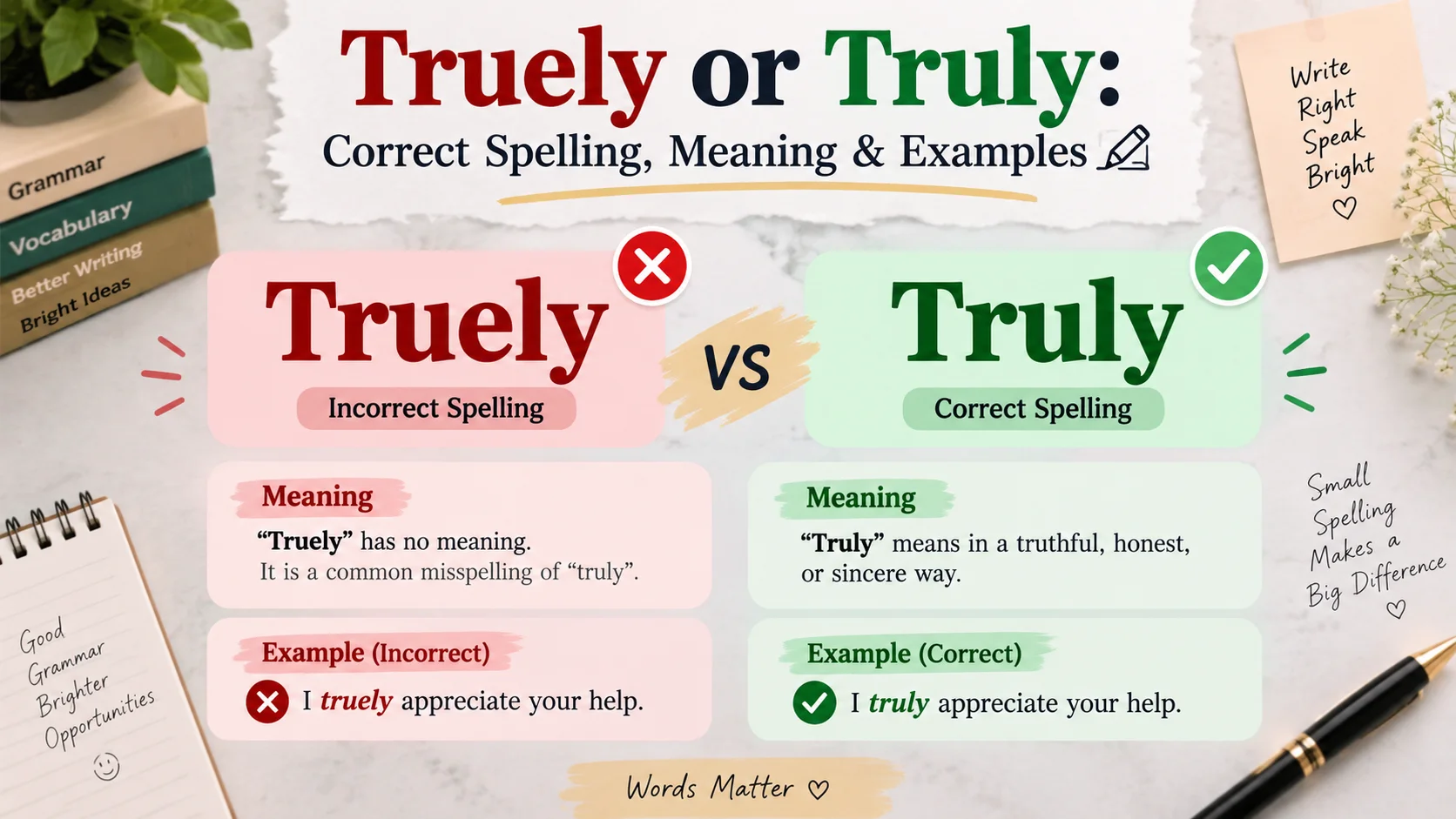
The correct spelling is truly. Truely is a misspelling and does not follow the standard spelling rule used when forming this adverb.
In this guide, you’ll learn the difference between truely or truly, why truly is correct, how to use it in a sentence, and several simple examples that make the spelling easy to remember.
✅ Truly or Truely: Quick Answer
The correct spelling is:
Truly ✅
The incorrect spelling is:
Truely ❌
Truly is an adverb that means in a genuine, sincere, real, or truthful way.
Examples
- I am truly grateful for your help.
- She was truly happy with the result.
- He truly believes in his work.
- That was a truly remarkable achievement.
📊 Truly vs. Truely Comparison Table
| Word | Correct? | Meaning | Example |
|---|---|---|---|
| Truly | ✅ Yes | Genuinely or sincerely | I am truly thankful. |
| Truely | ❌ No | Misspelling of truly | Avoid this spelling. |
So, whenever you need the adverb formed from true, use truly.
🔤 What Does Truly Mean?
Truly means in a true, genuine, sincere, or authentic way.
It can emphasize that something is real or sincere.
For example:
She is truly talented.
This means that she is genuinely talented.
Another example:
I am truly sorry.
This means:
I am genuinely or sincerely sorry.
The word can also emphasize the degree or reality of something:
It was truly beautiful.
Here, truly strengthens the adjective beautiful.
📝 Why Is Truly Correct?
The spelling truly comes from the adjective true plus the adverb-forming suffix -ly.
Although many adjectives simply add -ly, some words change their spelling when the suffix is added.
With true, the final e disappears:
true + ly → truly
Therefore:
❌ true + ly → truely
✅ true + ly → truly
This spelling can feel unusual at first, but truly is the standard English form.
🧠 Easy Trick to Remember Truly
Use this simple memory trick:
TRUE loses its E before LY.
So:
TRUE → TRULY
Not:
TRUE → TRUELY
You can remember the pattern by thinking:
true + ly = truly
The e drops before the suffix.
📚 Truly as an Adverb
Truly is an adverb.
It can modify an adjective, verb, or another part of a sentence.
Modifying an adjective
She is truly amazing.
Here, truly emphasizes amazing.
Modifying a verb
He truly understands the problem.
Here, truly describes the sincerity or reality of his understanding.
Expressing sincerity
I truly appreciate your kindness.
Here, truly emphasizes genuine appreciation.
🌟 Examples of Truly in Sentences
Here are some natural examples:
- I am truly grateful for everything you have done.
- She is truly one of a kind.
- He was truly surprised by the news.
- We are truly excited about the opportunity.
- You are truly special to me.
- It was truly an unforgettable experience.
- She truly cares about her family.
- I truly appreciate your honesty.
- That was truly impressive.
- He is truly committed to his goals.
- The view was truly breathtaking.
- I am truly sorry for the mistake.
- They were truly happy together.
- This is truly a wonderful place.
- She truly deserves the recognition.
❤️ Truly in Emotional Sentences
The word truly frequently appears in emotional messages because it emphasizes sincerity.
Examples:
- I am truly thankful for your friendship.
- You are truly important to me.
- I truly appreciate everything you do.
- You have truly made my life better.
- I am truly blessed to know you.
- Your kindness is truly unforgettable.
- I am truly grateful for your support.
In these sentences, truly adds emotional emphasis without changing the basic meaning.
💬 Truly in Everyday Conversation
Although truly can sound somewhat formal or expressive, people commonly use it in everyday English.
For example:
“I truly appreciate that.”
“Are you truly happy?”
“She truly loves that place.”
“That is truly amazing.”
It often adds sincerity or emphasis to a statement.
🎓 Truly in Formal Writing
Truly can also work well in formal and professional writing.
Examples include:
- “We are truly grateful for your continued support.”
- “The organization is truly committed to serving the community.”
- “This research represents a truly significant development.”
- “The findings are truly important for future studies.”
However, formal writing should still use truly naturally rather than adding it unnecessarily to every sentence.
🔄 Truly vs. Really
Truly and really can have similar meanings, but their tone can differ.
| Truly | Really |
|---|---|
| Often emphasizes sincerity or authenticity | Often emphasizes degree or surprise |
| Can sound more formal | Very common in everyday speech |
| I truly appreciate it. | I really appreciate it. |
| She is truly talented. | She is really talented. |
For example:
I truly appreciate your help.
This emphasizes genuine gratitude.
I really appreciate your help.
This is more conversational.
Both sentences are correct.
🔍 Truly vs. Sincerely
Truly and sincerely overlap when expressing genuine feelings, but they are not identical.
Truly can mean genuinely or really.
I truly care about you.
Sincerely emphasizes honesty and genuine feeling.
I sincerely apologize.
The word sincerely is also commonly used in formal letters and emails.
🌿 Truly vs. Honestly
Both words can emphasize sincerity, but they serve different purposes.
I truly admire her work.
This emphasizes genuine admiration.
Honestly, I don’t know the answer.
This introduces a candid or frank statement.
Therefore, truly is not always interchangeable with honestly.
✍️ Common Mistake: Truely
One of the most common spelling errors is writing:
❌ I am truely grateful.
The correct version is:
✅ I am truly grateful.
Another example:
❌ She is truely talented.
Correct:
✅ She is truly talented.
The mistake happens because people often assume that true + ly keeps the original spelling.
English spelling does not always work that way.
📖 True, Truly, Truth and Truthful
These words are related but have different grammatical roles.
| Word | Part of Speech | Meaning | Example |
|---|---|---|---|
| True | Adjective | Correct or genuine | The statement is true. |
| Truly | Adverb | Genuinely or sincerely | I truly believe you. |
| Truth | Noun | The actual facts | Tell me the truth. |
| Truthful | Adjective | Honest or accurate | She gave a truthful answer. |
Understanding the word forms can help you remember the correct spelling.
🔤 How True Changes to Truly
The spelling pattern is simple:
True → Truly
Examples:
- true → truly
- due → duly
- whole → wholly
- sole → solely
These examples show that adding -ly can sometimes change the spelling of the original adjective.
However, English has many exceptions and spelling patterns, so it is best to learn common forms individually.
📋 Truely or Truly Examples
| Incorrect | Correct |
|---|---|
| I am truely grateful. | I am truly grateful. |
| She is truely happy. | She is truly happy. |
| He truely cares. | He truly cares. |
| It was truely amazing. | It was truly amazing. |
| I truely believe you. | I truly believe you. |
| We are truely thankful. | We are truly thankful. |
| That is truely impressive. | That is truly impressive. |
| She truely understands. | She truly understands. |
The pattern remains the same: truly is the correct spelling.
🗣️ How to Use Truly Correctly
You can use truly in several common ways.
To express sincerity
I truly appreciate your help.
To emphasize an adjective
It was truly beautiful.
emphasize a belief
I truly believe that you can succeed.
To emphasize an emotion
She was truly excited.
To emphasize authenticity
This is truly an original idea.
These uses make truly a versatile adverb.
🌟 Synonyms for Truly
Depending on the context, synonyms for truly include:
- Really
- Genuinely
- Sincerely
- Honestly
- Actually
- Indeed
- Certainly
- Authentically
- Veritably
- In truth
Examples
Truly grateful
→ genuinely grateful
Truly sorry
→ sincerely sorry
Truly remarkable
→ genuinely remarkable
Truly amazing
→ really amazing
The best synonym depends on the sentence and intended tone.
📊 Truly Synonyms Table
| Synonym | Main Sense | Example |
|---|---|---|
| Really | To a high degree | It is really beautiful. |
| Genuinely | In an authentic way | She genuinely cares. |
| Sincerely | Honestly or earnestly | I sincerely apologize. |
| Honestly | Frankly | Honestly, I agree. |
| Actually | In fact | It actually happened. |
| Indeed | Certainly or really | It is indeed impressive. |
| Certainly | Definitely | She certainly deserves it. |
| Authentically | In a genuine way | The work feels authentically traditional. |
❓ Frequently Asked Questions About Truely or Truly
Is it truly or truely?
The correct spelling is truly. Truely is a common misspelling.
Why is truly spelled without an e?
When the adjective true takes the adverb-forming suffix -ly, the final e is dropped:
true + ly = truly.
Is “truely” a word?
Truely is not the standard spelling of the English adverb. The correct form is truly.
What does truly mean?
Truly means genuinely, sincerely, really, or in a true manner.
Is truly an adjective?
No. Truly is an adverb. The adjective is true.
What is the adjective form of truly?
The adjective form is true.
Example:
That is a true statement.
What is the noun form related to truly?
The related noun is truth.
Example:
She always tells the truth.
What is the difference between true and truly?
True is an adjective, while truly is an adverb.
The story is true.
I truly believe the story.
Is truly the same as really?
They can have similar meanings, especially when emphasizing something. However, truly often emphasizes sincerity or genuineness, while really is more common in casual conversation.
What is another word for truly?
Depending on the context, you can use genuinely, sincerely, really, honestly, indeed, or actually.
How do you remember the spelling of truly?
Remember:
TRUE loses E before LY.
Therefore:
TRUE → TRULY
Is “I truly love you” correct?
Yes. “I truly love you” is grammatically correct and expresses genuine or sincere love.
Is “I am truly grateful” correct?
Yes. “I am truly grateful” is a natural and correct expression of sincere appreciation.
📝 Final Thoughts
When choosing between truely or truly, remember that truly is the correct spelling. The word functions as an adverb and can mean genuinely, sincerely, really, or in a true way.
The spelling becomes easier to remember when you think of the transformation:
true + ly = truly
The final e disappears.
So, if you’re writing an email, article, social media caption, school assignment, or personal message, use truly, not truely.
Correct: I am truly grateful.
Incorrect: I am truely grateful.

Olivia Bennett is a writer and language enthusiast at Vocabsteria. She is passionate about exploring word meanings, name origins, and cultural expressions from around the world.