Have you ever wondered whether you should write past or passed? These two words sound very similar, which makes them easy to confuse. However, past and passed have different meanings and grammatical functions.
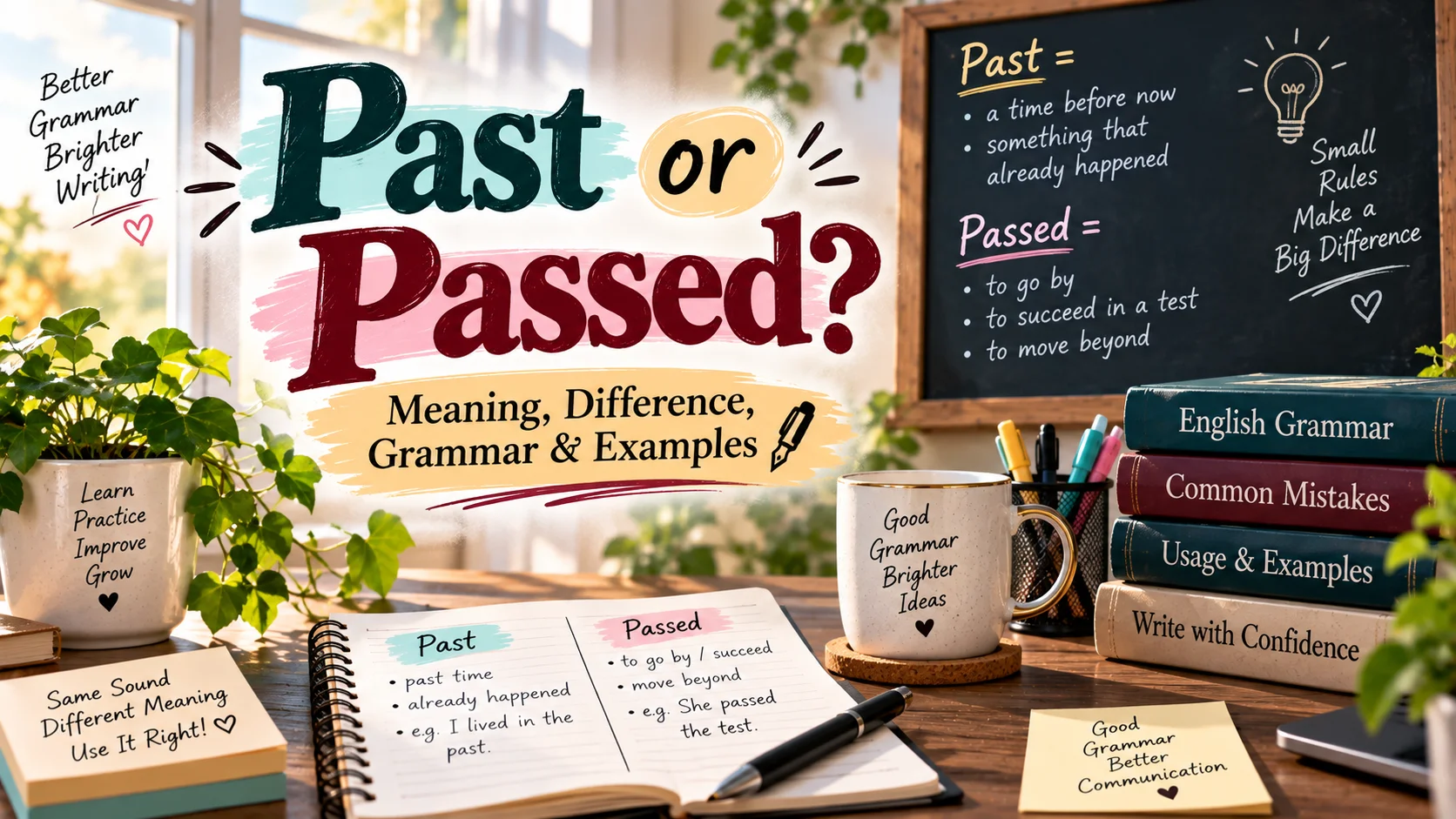
Past can refer to an earlier time, something beyond a particular point, or a period that has already happened. Passed is the past tense and past participle of the verb pass. It can mean moved beyond something, succeeded in a test, handed something to someone, or went by.
In this guide, you’ll learn the difference between past or passed, how to use each word correctly, common mistakes, comparison tables, and plenty of examples.
🔤 Past or Passed: Quick Answer
Both past and passed are correct words, but you cannot use them interchangeably.
Past
Past can function as a noun, adjective, preposition, or adverb.
Examples:
We should learn from the past.
She walked past the store.
Passed
Passed is the past tense and past participle of pass.
Examples:
She passed the store.
I passed my exam.
Time passed quickly.
Quick rule
Past = earlier time or beyond a point
Passed = an action involving “pass”
📊 Past vs. Passed Comparison Table
| Word | Grammar | Main Meaning | Example |
|---|---|---|---|
| Past | Noun | Earlier time | The past cannot be changed. |
| Past | Adjective | Former/previous | My past experiences helped me. |
| Past | Preposition | Beyond | We walked past the school. |
| Past | Adverb | Beyond a point | The car drove past. |
| Passed | Verb | Moved beyond | She passed the car. |
| Passed | Verb | Succeeded | He passed the test. |
| Passed | Verb | Handed something | She passed me the book. |
| Passed | Verb | Went by | The years passed quickly. |
⏳ What Does Past Mean?
Past generally refers to a time that has already happened.
For example:
We cannot change the past.
Here, past is a noun referring to previous events or experiences.
You can also use past as an adjective:
She talked about her past experiences.
Here, past describes experiences that happened earlier.
More examples
- He often thinks about the past.
- We learned an important lesson from the past.
- Her past mistakes helped her grow.
- The past year was challenging.
- They discussed their past relationship.
🚶 What Does Passed Mean?
Passed is the past tense of the verb pass.
The verb pass has several meanings, so passed can appear in many different situations.
Moving beyond something
The car passed the bus.
Going by
Two hours passed quickly.
Succeeding
She passed her driving test.
Giving something to someone
He passed me the salt.
Moving something from one person to another
She passed the ball to her teammate.
In each case, passed describes an action.
🚗 Past as “Beyond”
One of the most common uses of past is to describe movement beyond a particular place or point.
For example:
We walked past the library.
This means we walked beyond the library.
Other examples:
- Drive past the school.
- Walk past the restaurant.
- Go past the traffic light.
- The dog ran past me.
- She walked past the window.
Past as a Preposition
When past comes before a noun or pronoun to describe movement, it often works as a preposition.
He walked past the house.
She drove past me.
Here, past means beyond.
🚶♀️ Passed as “Moved Beyond”
Passed can also describe movement beyond something, but it functions as a verb.
Compare:
We walked past the store.
We passed the store.
Both sentences can describe movement beyond the store, but their grammar differs.
Past
Past tells us where the movement occurred in relation to something.
They walked past the building.
Passed
Passed describes the action of moving beyond something.
They passed the building.
Both forms are correct.
📍 Past or Passed a Place?
This is a particularly common source of confusion.
Use past
We drove past the school.
Here, past acts as a preposition.
Use passed
We passed the school.
Here, passed is the verb.
The meaning is similar, but the sentence structure is different.
🎓 Past or Passed an Exam?
When talking about succeeding in an examination or test, use passed.
✅ Correct:
I passed my exam.
❌ Incorrect:
I past my exam.
Why?
Because passed is the past tense of pass.
More examples
- She passed her final exam.
- He passed the driving test.
- They passed the entrance examination.
- I finally passed the certification test.
- We all passed the course.
📚 Past or Passed the Test?
The correct expression is:
I passed the test.
Here, passed means succeeded in the test.
You can also say:
I did well on the test.
But past the test is incorrect when you mean that you succeeded.
⏰ Past or Passed Time?
Both forms can appear with time, but they mean different things.
Passed time
Time passed quickly.
Here, passed is a verb. It means time went by.
Past time
Past time can refer to a previous period or earlier time, depending on context.
The events belong to the past.
Another common expression is:
It is past time to leave.
This means it is already later than the appropriate time.
🕐 “Time Passed” vs. “Past Time”
Compare these sentences:
As the years passed, she gained experience.
Here, passed means went by.
The past years taught her many lessons.
Here, past refers to previous years.
The difference becomes clear when you identify whether you’re describing an action or an earlier period.
💭 Past as a Noun
When past refers to previous events, experiences, or history, it functions as a noun.
Examples:
- The past is behind us.
- We should learn from the past.
- His past is complicated.
- She doesn’t like discussing the past.
- The past can teach us valuable lessons.
In these sentences, past refers to something that happened before the present.
📝 Past as an Adjective
Past can also describe something that happened previously.
Examples:
- my past experiences
- her past mistakes
- previous past events
- a past president
- past relationships
- past achievements
For example:
Her past experiences shaped her perspective.
Here, past describes experiences from an earlier period.
🔄 Passed as the Past Tense of Pass
The easiest way to understand passed is to remember the verb pass.
| Present | Past | Past Participle |
|---|---|---|
| Pass | Passed | Passed |
Examples:
I pass the store every day.
Yesterday, I passed the store.
I have passed the store many times.
The word changes because the verb describes different time frames.
📋 Common Expressions With Past
Here are common phrases using past:
- in the past
- from the past
- past experience
- past mistakes
- past events
- past tense
- past year
- past decade
- past few days
- past midnight
- past the point
- walk past
- drive past
- look past
- move past
Examples
We learned from our mistakes in the past.
She walked past the entrance.
The store stayed open past midnight.
📋 Common Expressions With Passed
Common phrases using passed include:
- passed the test
- passed the exam
- passed the driving test
- passed the ball
- passed the message
- passed the information
- passed the house
- passed the car
- passed away
- passed by
- time passed
- years passed
Examples
He passed the exam.
She passed the ball to her teammate.
Several years passed before they met again.
🕊️ “Passed Away” vs. “Past Away”
The correct expression is:
Passed away ✅
Passed away is a polite expression meaning died.
Example:
Her grandfather passed away last year.
Past away is incorrect.
Why?
Because passed is the past tense of pass, and the phrase passed away means that someone has died.
🚶 “Passed By” vs. “Past”
Both passed by and past can describe movement, but they work differently.
Passed by
The bus passed by my house.
Here, passed is the verb.
Past
The bus drove past my house.
Here, past describes movement beyond the house.
Both sentences can describe a similar event.
🧠 Easy Trick to Remember Past and Passed
Try this simple test:
Can you replace the word with “went by”?
Use passed.
Time passed quickly.
→ Time went by quickly.
Does it mean “earlier”?
Use past.
We learned from the past.
→ We learned from an earlier time.
Does it mean “beyond”?
Use past.
She walked past the store.
→ She walked beyond the store.
Does it mean “succeeded”?
Use passed.
I passed my exam.
→ I succeeded in my exam.
📊 Past or Passed: Examples Table
| Incorrect/Correct Choice | Correct Sentence | Reason |
|---|---|---|
| Past | We walked past the store. | Beyond the store |
| Passed | We passed the store. | Verb describing movement |
| Passed | I passed my exam. | Succeeded |
| Passed | Time passed quickly. | Time went by |
| Past | I learned from the past. | Earlier time |
| Passed | She passed me the book. | Handed the book |
| Passed | He passed away peacefully. | Euphemism for died |
| Past | It is past midnight. | Beyond a particular time |
| Past | She has a difficult past. | Earlier experiences |
| Passed | The car passed us. | Moved ahead of us |
🌙 Past Midnight or Passed Midnight?
The correct phrase is:
past midnight ✅
Example:
We stayed awake past midnight.
Here, past means later than or beyond midnight.
You would not write:
❌ We stayed awake passed midnight.
However, passed can appear in another sentence:
Midnight passed while we were talking.
Here, passed means time went by.
📅 Past Due or Passed Due?
The correct expression is:
past due ✅
It means something is late or has gone beyond its required date.
Example:
The payment is past due.
Passed due is incorrect in this expression.
However:
The deadline passed yesterday.
Here, passed is the verb describing what happened to the deadline.
🛣️ Past Me or Passed Me?
Both can be correct depending on the sentence.
Past me
She walked past me.
Here, past means beyond me.
Passed me
She passed me on the way home.
Here, passed means she moved ahead of me.
This distinction is useful because the words may appear in almost identical sentences.
📖 Past vs. Passed in Writing
When proofreading your writing, look at the function of the word.
If it describes:
- an earlier period → past
- something beyond a point → past
- previous experiences → past
- a movement/action → passed
- success in an exam → passed
- handing something over → passed
- time going by → passed
This simple approach can prevent most spelling and grammar mistakes.
⚠️ Common Mistakes With Past and Passed
Mistake 1
❌ I past my exam.
✅ I passed my exam.
Mistake 2
❌ We walked passed the store.
✅ We walked past the store.
Mistake 3
❌ She past me the phone.
✅ She passed me the phone.
Mistake 4
❌ We stayed up passed midnight.
✅ We stayed up past midnight.
Mistake 5
❌ He past away last year.
✅ He passed away last year.
These mistakes usually happen because past and passed sound similar.
🔤 Past, Passed and Pass
Understanding all three words makes the distinction easier.
| Word | Function | Example |
|---|---|---|
| Pass | Present-tense verb | I pass the store every day. |
| Passed | Past-tense verb | I passed the store yesterday. |
| Past | Noun/adjective/preposition/adverb | I walked past the store. |
Think of pass → passed as a verb change.
Past is a separate word with different grammatical functions.
📝 Past or Passed in Sentences
Here are additional examples:
- We drove past the old building.
- She passed the building without stopping.
- I remember my past clearly.
- Three months passed quickly.
- He passed his driving test.
- We stayed past our usual bedtime.
- She walked past the window.
- He passed the message to his friend.
- The deadline passed yesterday.
- The payment is past due.
- They talked about their past experiences.
- The years passed faster than expected.
- The train went past the station.
- The runner passed several competitors.
- We should not let the past control the future.
🎯 Quick Decision Guide
When you’re unsure between past and passed, ask what you mean.
Earlier time?
→ Past
She talked about the past.
Beyond something?
→ Past
Walk past the door.
Moved beyond something?
→ Passed
He passed the door.
Succeeded?
→ Passed
She passed the test.
Handed something?
→ Passed
He passed me the paper.
Time went by?
→ Passed
The years passed quickly.
Later than a specific time?
→ Past
It is past midnight.
❓ Frequently Asked Questions About Past or Passed
Is it past or passed?
Both are correct words, but they have different uses. Past refers to earlier time, something beyond a point, or previous events. Passed is the past tense of pass.
Is it “I passed the test” or “I past the test”?
The correct sentence is “I passed the test.” Passed means you succeeded in the test.
Is it “walk past” or “walk passed”?
The correct expression is “walk past.”
We walked past the house.
Here, past means beyond the house.
Is it “passed the store” or “past the store”?
Both can be correct:
We passed the store.
We walked past the store.
The first uses passed as a verb. The second uses past to describe movement beyond the store.
Is it “past midnight” or “passed midnight”?
The correct expression is “past midnight.”
We stayed up past midnight.
Is it “past due” or “passed due”?
The standard expression is “past due.”
The bill is past due.
Is it “passed away” or “past away”?
The correct expression is “passed away.”
Is “past” a verb?
Usually, past functions as a noun, adjective, preposition, or adverb. Passed is the verb form of pass in the past tense.
Is “passed” a noun?
No. Passed is generally a verb form. The noun related to the verb pass can be pass, depending on the meaning.
What is an easy way to remember past and passed?
Remember:
Past = earlier or beyond
Passed = an action
If you can replace the word with “went by” or “succeeded,” you likely need passed.
What is the difference between “past me” and “passed me”?
Past me means beyond me:
She walked past me.
Passed me means she moved ahead of me:
She passed me during the race.
Is “time passed” correct?
Yes.
Time passed quickly.
Here, passed means that time went by.
Is “past experience” correct?
Yes.
Her past experience helped her make the decision.
Here, past means previous.
🌟 Final Thoughts
The difference between past or passed becomes much easier when you remember that past and passed serve different grammatical roles.
Use past when you mean earlier, previous, or beyond:
We learned from the past.
She walked past the store.
Use passed when you describe an action related to pass:
She passed the store.
I passed my exam.
Time passed quickly.
He passed me the book.
A quick memory trick is:
Past = earlier or beyond.
Passed = an action.
Once you identify the meaning and grammatical role of the word, choosing between past and passed becomes much easier.

Olivia Bennett is a writer and language enthusiast at Vocabsteria. She is passionate about exploring word meanings, name origins, and cultural expressions from around the world.