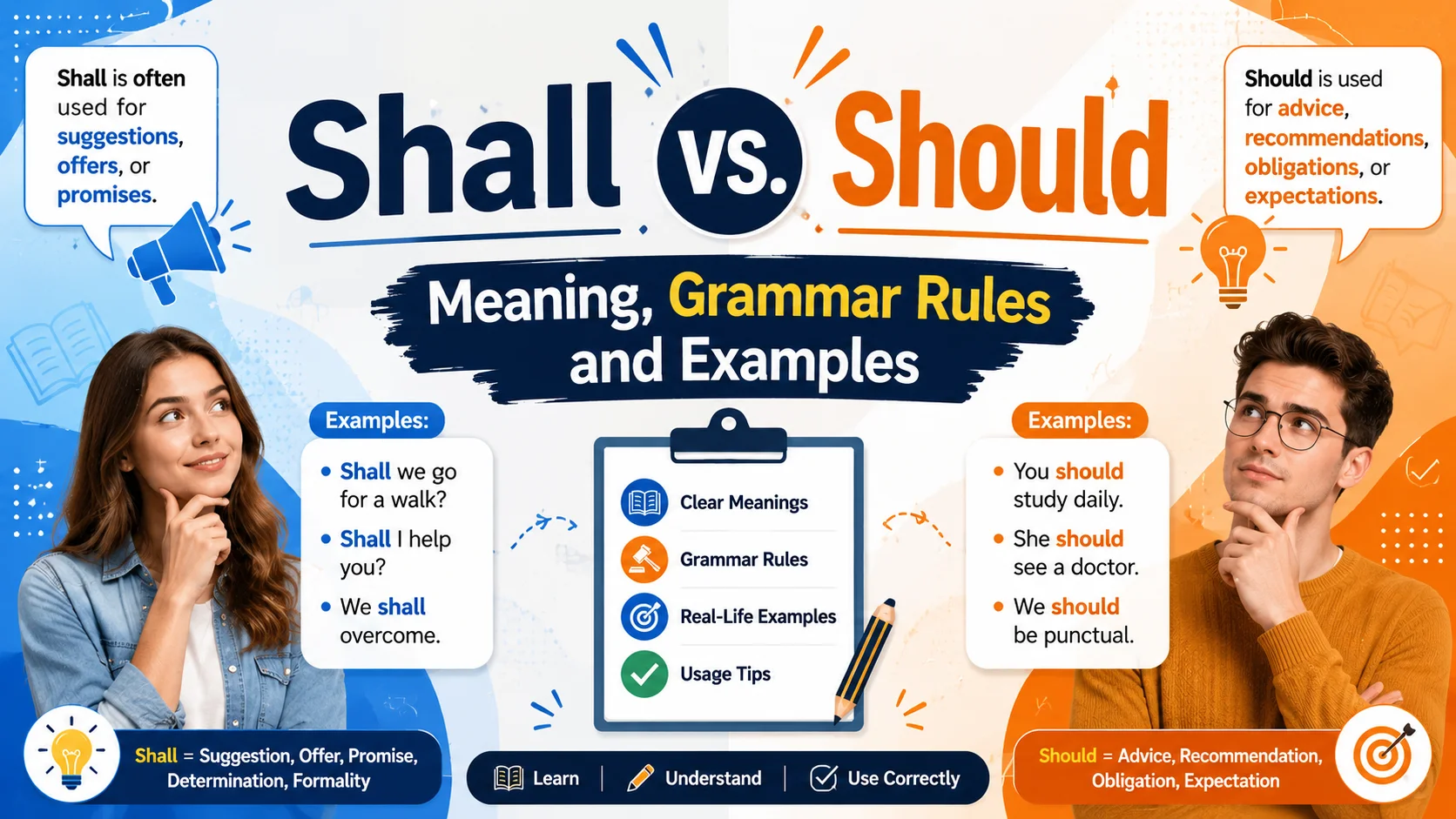
Have you ever paused mid-sentence, unsure whether to write “shall” or “should”? You are not alone. These two modal verbs confuse countless writers, students, and professionals every day.
The confusion is understandable. Both words express something about the future. Both relate to obligation and expectation. Yet they carry very different weights and meanings.
The difference is not just academic. In 2015, a single word nearly derailed the Paris Climate Agreement . Negotiators had been using “should” in Article 4.4, meaning developing countries had a goal to reduce emissions. But a last-minute change replaced “should” with “shall,” creating a legal obligation rather than a suggestion. The U.S. Secretary of State personally called the French foreign minister and said: “We cannot do this.” The French eventually changed it back to “should,” calling it a “typing mistake.”
This real-world example shows why choosing the right word matters. “Shall” makes something a binding requirement. “Should” makes it a recommendation. One word can change the legal meaning of an international treaty.
We created this comprehensive guide to help you master these two words once and for all. You will learn their distinct meanings, see them in action, understand when to use each one, and avoid embarrassing mistakes. By the end of this guide, you will use “shall” and “should” with confidence.
What Is the Difference Between Shall and Should? (Quick Answer)
“Shall” expresses certainty, strong intention, or formal obligation, often used in legal or official contexts. “Should” gives advice, recommendations, or expresses probability. Think of shall as a command or guarantee, and should as a suggestion or expectation .
Key points:
- Shall = strong intention, formal obligation, certainty, legal requirements
- Should = advice, recommendation, duty, probability, softer obligation
- Shall is more common in British English and formal documents; should is used in everyday conversation
- Should is technically the past tense of shall, but they have very different meanings today
Quick Comparison Table
Main Meaning Section
Comprehensive Definition of Shall
“Shall” is a modal auxiliary verb used to express:
- Strong intention or determination: “I shall return”
- Formal obligation or requirement: Often in legal or official documents
- Offers and suggestions: “Shall we go to the park?”
- Future action (more common in British English): “I shall see you tomorrow”
The word “shall” carries a sense of certainty and authority. When you use it, you are stating something that must happen or that you are determined to make happen .
Comprehensive Definition of Should
“Should” is a modal auxiliary verb used to express:
- Advice or recommendation: “You should exercise more”
- Duty or obligation: “We should respect our elders”
- Probability or expectation: “The train should arrive soon”
- Polite requests: “Should I call you later?”
- Retrospective advice: “I should have studied harder”
“Should” is much softer than “shall.” It suggests what is advisable or expected, but does not carry the weight of a command .
Complete Pronunciation Guide
Origin and Etymology
“Should” is technically the past tense form of “shall” . However, in modern usage, they have evolved into distinct words with different meanings.
Historical context:
- Old English: sceal (must, owe)
- The traditional rule distinguished “shall” (with I/we) from “will” (with other subjects)
- “Should” emerged as the past tense but developed its own meanings
Detailed Explanation
Why These Words Matter
The difference between “shall” and “should” is not just academic. It can have serious real-world consequences.
The Paris Climate Agreement Example:
In 2015, a single word nearly derailed the Paris climate agreement . Negotiators had been using “should” in Article 4.4, meaning developing countries had a goal to reduce emissions. But a last-minute change replaced “should” with “shall,” creating a legal obligation rather than a suggestion .
U.S. Secretary of State John Kerry personally called the French foreign minister and said: “We cannot do this.” The U.S. argued that “shall” created stronger legal requirements for developed countries. The French eventually said it was a “typing mistake” and changed it back to “should” .
The lesson? “Shall” makes something a binding requirement. “Should” makes it a recommendation .
In Legal and Formal Writing
Shall = Mandatory
In contracts and legal documents, “shall” means something is required by law:
Should = Recommended
In the same contexts, “should” indicates best practice but not legal obligation:
In Everyday Conversation
Shall is often used for:
- Offers: “Shall I open the window?”
- Suggestions: “Shall we dance?”
- Formal promises: “I shall never forget this”
Should is used for:
- Advice: “You should try the pasta”
- Expectations: “They should be here by now”
- Opinions: “I think we should leave early”
Usage Examples
Key Differences at a Glance
Strength and Certainty
| Word | Strength Level | Meaning |
|---|---|---|
| Shall | Strong | It will happen; it must happen |
| Should | Weak | It is advisable; it is expected |
Example:
- “I shall come back” = I am determined to return
- “I should come back” = There are reasons to return, but I might not
In Questions
| Word | Question Type | Implication |
|---|---|---|
| Shall | Offer/Suggestion | Confident about the correct action |
| Should | Asking for advice | Unsure about the best choice |
Example:
- “Shall I open this door?” = I believe opening it is the right thing to do
- “Should I open this door?” = I am hesitant and asking for your opinion
Formality
| Word | Formality Level | Typical Contexts |
|---|---|---|
| Shall | Very formal | Legal documents, contracts, official rules |
| Should | Informal to semi-formal | Everyday conversation, advice, opinions |
Common Mistakes
Real-Life Usage Across Contexts
Legal and Official Documents
“Shall” appears frequently in contracts, laws, and regulations:
- “The renter shall pay the landlord on the first of every month”
- “If there are objections, the individuals shall inform the judge”
“Should” in legal contexts is weaker:
Business Communication
In business writing, “shall” is used for formal commitments:
- “We shall deliver the project by the deadline” (formal promise)
- “Employees shall complete the training by Friday” (company policy)
“Should” is used for recommendations:
- “You should consider our premium service” (suggestion)
- “We should meet next week to discuss” (suggestion)
Academic Writing
Academics use “should” for advice and expectations:
- “Students should reference all sources” (recommendation)
- “The results should be reproducible” (expectation)
“Shall” appears in official academic policies:
- “All students shall adhere to the honor code” (formal requirement)
Daily Conversation
In casual conversation, “should” dominates:
- “You should try the new restaurant”
- “We should leave soon”
- “Should I bring anything?”
“Shall” appears mainly in:
British vs. American English
British English:
- “Shall” is more common in everyday speech
- Used for offers and suggestions: “Shall we go?”
- Used for future (with I/we): “I shall see you tomorrow”
American English:
- “Shall” is rarely used in casual conversation
- “Will” is used for the future
- “Should” is used for offers and advice
The “Shall” vs. “Will” Distinction
Traditionally, the rule for British English was:
- Shall with I/we for simple future: “I shall arrive tomorrow”
- Will with he/she/they for simple future: “He will arrive tomorrow”
For intention:
- Will with I/we: “I will do it” (I am determined)
- Shall with he/she/they: “He shall do it” (I will make him do it)
Today, most English speakers use “will” for all future tenses, making “shall” less common in everyday speech .
FAQ Section
1. What is the main difference between shall and should?
“Shall” expresses strong intention, certainty, or formal obligation. “Should” expresses advice, recommendation, or probability. “Shall” is stronger and more formal. “Should” is softer and more common .
2. When should I use shall instead of should?
Use “shall” for legal requirements, formal obligations, offers (“Shall I open the door?”), and suggestions (“Shall we go?”). Use “shall” when you mean something must happen .
3. When should I use should instead of shall?
Use “should” for giving advice (“You should exercise”), expressing duty (“We should help”), stating expectations (“The train should arrive soon”), and asking for advice (“Should I apply?”) .
4. Is should the past tense of shall?
Yes, grammatically, “should” is the past tense of “shall.” However, they have evolved into separate words with different meanings in modern English .
5. Can shall and should be used interchangeably?
No. They change the meaning of a sentence. “You shall go” is a command. “You should go” is advice .
6. Which is more formal: shall or should?
“Shall” is more formal. It appears in legal documents, contracts, and official rules. “Should” is more common in everyday speech and informal writing .
7. Why did “shall” almost ruin the Paris Climate Agreement?
The change from “should” to “shall” in Article 4.4 turned a recommendation into a legal obligation. The U.S. government objected because “shall” would have legally bound developed countries to specific actions .
8. Do Americans use “shall”?
Rarely. American English prefers “will” for the future and “should” for advice and offers. However, “shall” still appears in legal and formal documents in American English .
9. What is the difference between shall and will?
In simple future, British English traditionally used “shall” with I/we and “will” with other subjects. Today, most speakers use “will” for all subjects. “Shall” is now mainly used for offers, suggestions, and formal obligations .
10. How do I remember which one to use?
Think of “shall” as a command or guarantee: “This shall happen.” Think of “should” as advice or expectation: “This should happen, but it might not.” Also, “Shall” = obligation, “Should” = suggestion .
Conclusion
We have explored the crucial difference between “shall” and “should” and why using the right word matters. “Shall” expresses strong intention, formal obligation, or certainty—it is the language of contracts, laws, and promises. “Should” expresses advice, recommendations, and expectations—it is the language of everyday suggestions and opinions .
The difference is not just a grammar rule. It can change legal obligations, as the Paris Climate Agreement proved . It can change how people understand your message, whether in a legal document or a casual conversation.
Quick memory tip:
When you master these words, you communicate with clarity and precision. Your readers and listeners will understand exactly what you mean—whether you are drafting a contract, giving advice, or just making a suggestion.

Olivia Bennett is a writer and language enthusiast at Vocabsteria. She is passionate about exploring word meanings, name origins, and cultural expressions from around the world.