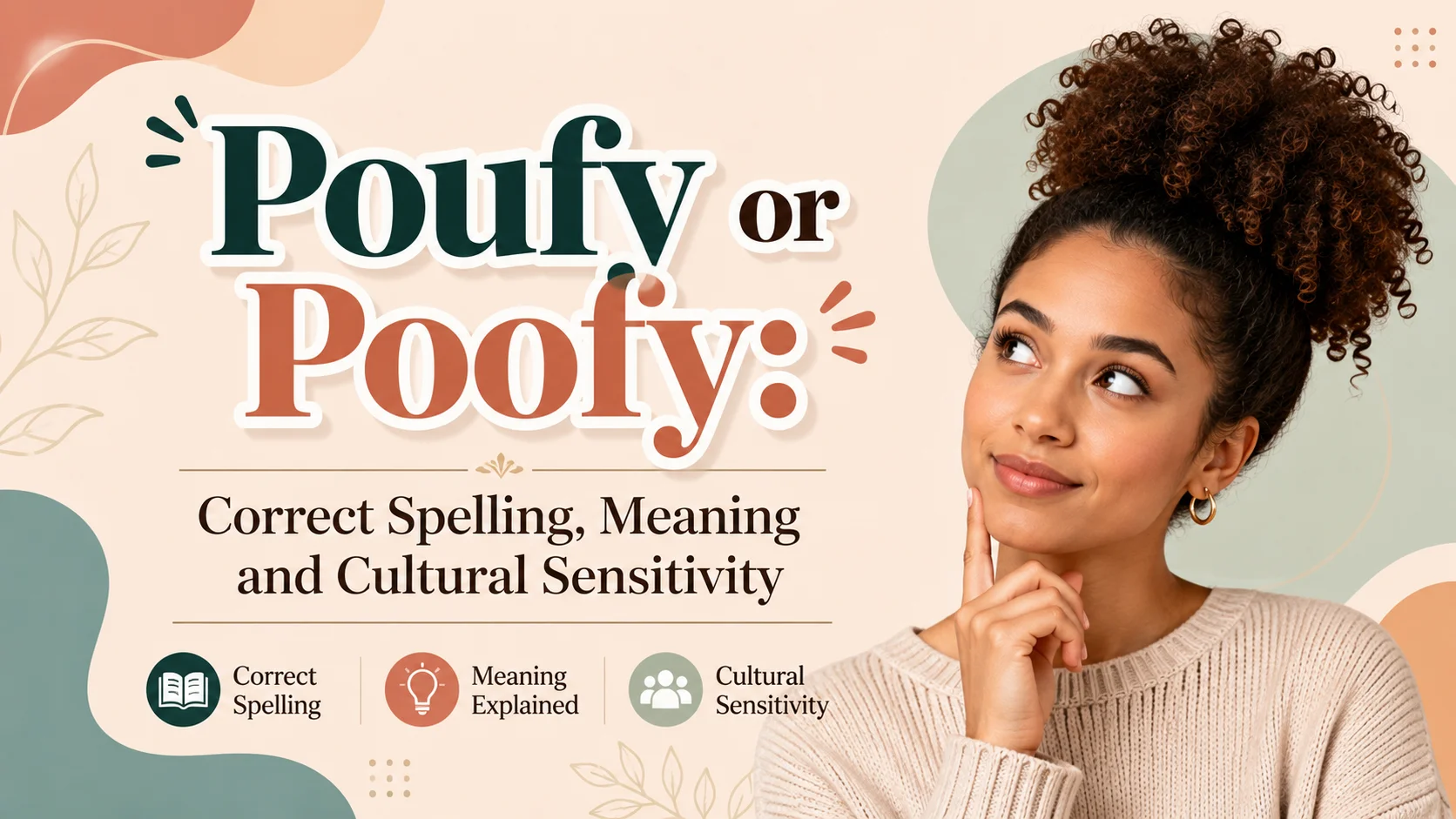
Have you ever stopped while writing because you weren’t sure whether to use “poufy” or “poofy”? You’re not alone. Although these two words sound identical and share similar meanings, one also carries a controversial secondary meaning that could unintentionally offend your readers.
The confusion is easy to understand. People commonly use both words as adjectives to describe something fluffy, puffed up, or voluminous. However, “poufy” remains a neutral term for describing hair, clothing, furniture, or pillows. In contrast, some people have used “poofy” as a derogatory slang term for gay men or effeminate behavior. Because of this history, many dictionaries and style guides recommend using “poufy” or “puffy” instead in most situations.
This comprehensive guide explains the key differences between “poufy” and “poofy.” You’ll learn what each word means, explore real-world examples, understand the controversial usage of “poofy,” and discover which spelling fits each situation with confidence.
What Is the Difference Between Poufy and Poofy?
People use both “poufy” and “poofy” as adjectives to describe something fluffy, puffed up, or voluminous, such as hair, clothing, or pillows. Many dictionaries treat them as alternate spellings. However, the most important difference lies in their secondary meanings. While “poufy” remains a neutral descriptive word, some people have used “poofy” as a derogatory slang term for gay men or effeminate behavior. Because of this history, many dictionaries and style guides recommend using “poufy” or “puffy” instead to avoid causing unintended offense.
Key points:
- Poufy = Puffed up, voluminous (hairstyles, dresses)
- Poofy = Same physical meaning, but carries a derogatory secondary meaning
- Safer choice: “Puffy” or “voluminous” avoids all confusion
Quick Comparison Table
Main Meaning Section
Comprehensive Definition of Poufy
“Poufy” is an adjective used to describe something that is voluminous, full, or fluffy in appearance . It typically refers to hair, clothing, or decorative elements that seem to have a lot of air or material, resulting in a puffed or inflated look .
In context of hair:
- A hairstyle that appears large and full of body
- Achieved through teasing, products, or natural texture
- Often describes a round, inflated appearance
context of clothing:
- Garments with significant amounts of fabric or layers
- Dresses or skirts with tulle, ruffles, or gathers
- Sleeves that are billowing or ballooning
context of decorative elements:
Comprehensive Definition of Poofy
“Poofy” shares the same primary meaning as “poufy” – it describes something puffy, light, and having great volume or fullness . You can use it for hair, clothing, or pillows .
However, “poofy” has a second, problematic meaning. It is derived from “poof,” which is a derogatory British slang term for a gay man . The adjective “poofy” can describe something as effeminate or associated with homosexual behavior .
One dictionary entry defines the two meanings as follows :
- poof·y 1: Puffy, light, and having great volume or fullness: a poofy hairstyle
- poof·y 2: Offensive Slang: Effeminate
Pronunciation
Most English speakers pronounce both words the same way: /ˈpuːfi/ or /ˈpʊfi/ (POO-fee).
Part of Speech
- Adjective (primary form for both)
- Comparative: poufier / poofier
- Superlative: poufiest / poofiest
Origin and Etymology
Origin of Poufy
The word “poufy” entered English in the early 19th century and comes from the French word pouffe, which refers to a large, soft, cushioned seat or footstool. Over time, English speakers began using “poufy” to describe something that’s fluffy, padded, full, or rounded. Today, people commonly use it for hairstyles, dresses, pillows, skirts, and other items with extra volume.
Origin of Poofy
People developed the spelling “poofy” as a variation of “poufy,” and many still use it to describe something fluffy or puffed up. However, in some English-speaking regions—especially the UK—people have also used “poofy” as a derogatory slang term for gay or effeminate men. Because of this history, many dictionaries and style guides recommend using “poufy” or “puffy” instead when describing a person or object to avoid causing unintended offense.
Detailed Explanation
The Controversy: Why Does This Matter?
The distinction matters because of the potential for offense . While both words describe puffed-up things, “poofy” carries baggage that “poufy” does not.
Consider this real example from a writer’s forum :
A fantasy author wrote: “Oh, and no poufy pants.” Several beta readers objected, saying this line could be interpreted as a comment about “gay pants.” The word “poufy” in their minds was linked to the derogatory slang.
In response, the author was told :
“Pouf” is, indeed, a derogatory term for gay men, and not a new one at all.
This illustrates how words with hidden secondary meanings can cause unintended offense.
“Poofy” or “Poufy” in British vs. American English
The issue is more pronounced in British English. “Poof” and “poofy” have long been used as derogatory slang for gay men in the UK . A forum poster noted :
“The slur for gay people has always been spelled ‘poof’ as far as I’m aware.”
“It is the very definition of poufy, but that article did not address the widespread use of the word poufy as a slur against gay men.”
However, this meaning may be less prevalent in American English. A U.S. user commented :
“Poofy over here in the US means ‘puffed out’ or ‘puffed up.'”
“Of course, I am referring to the U.S. usage which has nothing whatsoever to do with homosexuality.”
What about “Puffy”?
If you are concerned about using either word, “puffy” is a safe alternative . A writer on the forum asked :
“I would say ‘puffy’ rather than ‘poofy’ to describe something that’s puffy because that’s what puffy means and it would sound weird in my dialect to call it poofy.”
“Why not ‘no padded trousers’ then? Or ‘puffy’? These adjectives will elicit the same image in the reader’s mind as ‘poofy’ without jolting them out of the story.”
Usage Examples
| Example Sentence | Meaning |
|---|---|
| She wore a beautiful poufy wedding dress with layers of tulle | The dress had a voluminous, full skirt |
| Her hair was styled in a poufy updo for the party | Her hair was full of volume and body |
| The couch had several poufy cushions that were incredibly comfortable | The cushions were soft and plump |
| The sleeves on the Elizabethan gown were extremely poufy | The sleeves were billowing and full |
| The bride’s poofy dress made it difficult to walk down the aisle | The dress was voluminous and hard to manage |
| My dog has a poofy coat that requires regular grooming | The fur is fluffy and thick |
| She wore a poofy skirt that made it hard to squeeze through the crowded hallway | The skirt was inflated and full |
| The decorative pillows on the bed were poofy and soft | The pillows were plush and rounded |
| The 1980s hairstyle was notably poofy | The hairstyle had a large, inflated appearance |
| The birds’ feathers looked poofy and warm | The feathers were fluffed up |
Common Mistakes
Related Questions Section
Q: Which spelling should I use?
If you want to describe something as puffed up or fluffy, you can use either word. However, to avoid any possible offense, choose “poufy” (the less controversial spelling) or simply use “puffy.”
Q: Is “poofy” offensive?
“Poofy” can be considered offensive because of its association with the derogatory slang term “poof,” used against gay men . The Oxford English Dictionary notes this usage is “derogatory and offensive” .
Q: Do both words sound the same?
People pronounce both “poufy” and “poofy” the same way: /ˈpuːfi/ or /ˈpʊfi/ (POO-fee).
Q: What does “poufy” mean in fashion?
In fashion, “poufy” describes voluminous or full garments, like a dress with a full skirt or sleeves that are billowing and puffed up .
FAQ Section
1. What is the primary meaning of both “poufy” and “poofy”?
Both words describe something that is puffed up, full of volume, or fluffy . This can apply to hairstyles, clothing (like wedding dresses and sleeves), and items like pillows or animal fur .
2. Why is “poofy” consider offensive?
“Poofy” is linked to the derogatory British slang “poof,” which is a slur for a gay man . The adjective “poofy” can be used to describe something as effeminate in a derogatory way .
3. Is “poufy” also offensive?
Some people still associate “poufy” with a derogatory term, but they do so less often than with “poofy.” As a result, many writers consider “poufy” the safer choice.
4. What is a safe alternative to these words?
“Puffy” is a direct and safe synonym for both words . Other alternatives include “voluminous,” “fluffy,” or “billowing.”
5. Are “poufy” and “poofy” interchangeable?
They are often used as alternate spellings for the same physical meaning . However, the secondary offensive meaning of “poofy” makes them not entirely interchangeable in practice.
6. What is the origin of “poufy”?
“Poufy” comes from the French word “pouffe,” meaning a thick cushion . This explains its connection to soft, plush objects.
7. How do I use “poufy” in a sentence about hair?
You can say, “Her hair looked poufy and full of volume” or “The bride’s poufy updo had a romantic feel.”
Conclusion
We have explored the nuanced difference between “poufy” and “poofy.” Both describe something that is puffed up or voluminous, but “poofy” carries a secondary meaning that is a derogatory slur, a usage that you should be aware of .
To avoid any unintended offense, especially in writing that will be read by a British audience, you should choose your words carefully . “Poufy” is a safer choice, and the word “puffy” is the most straightforward and uncomplicated alternative of all . By understanding these subtleties, your writing will be both accurate and culturally sensitive.

Olivia Bennett is a writer and language enthusiast at Vocabsteria. She is passionate about exploring word meanings, name origins, and cultural expressions from around the world.