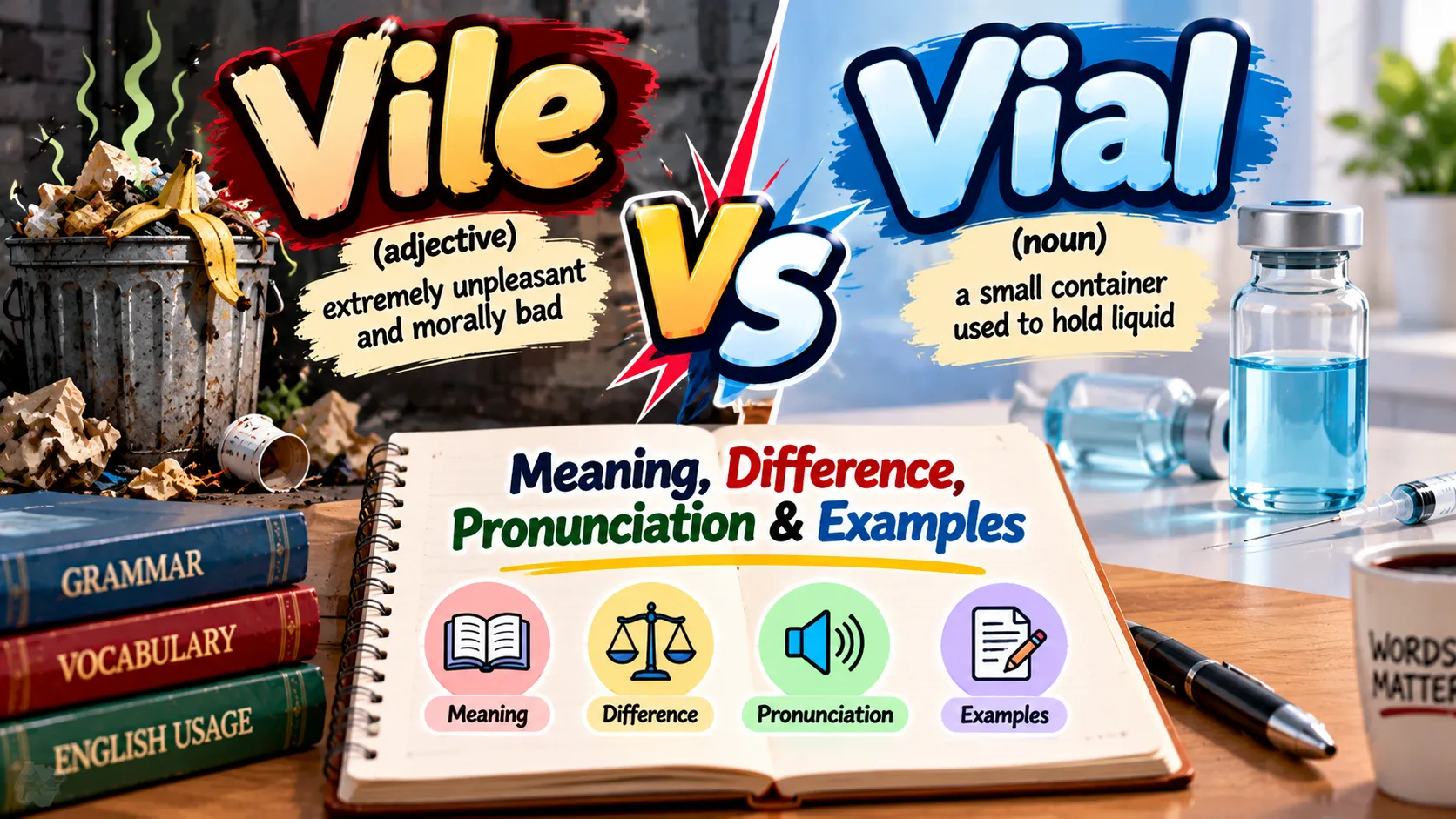
Vile and vial are two commonly confused English words because they sound similar when spoken quickly, but they have completely different meanings and grammatical roles. Vile describes something extremely unpleasant, offensive, evil, or morally bad, while a vial is a small container used to hold medicine, chemicals, liquids, or laboratory samples.
Understanding the difference between vile vs vial is useful for students, writers, English learners, and anyone who wants to avoid spelling mistakes. Although the two words look and sound somewhat alike, they cannot normally be used interchangeably.
In this guide, we will explain the meaning of vile and vial, compare their pronunciation, parts of speech, spelling, examples, common mistakes, and easy ways to remember the difference.
🔤 Vile vs Vial: Quick Difference
The easiest way to understand vile vs vial is to remember that one describes something unpleasant or morally bad, while the other refers to a physical container. Their meanings are completely different despite their similar pronunciation.
| Word | Meaning | Part of Speech | Common Use | Example |
|---|---|---|---|---|
| Vile | Extremely unpleasant, evil, or morally bad | Adjective | Behavior, actions, people, conditions | It was a vile act. |
| Vial | A small container for holding liquid or medicine | Noun | Medicine, chemicals, samples | The doctor opened a vial of medicine. |
Simple rule:
Vile = bad or disgusting
Vial = small bottle or container
📖 What Does Vile Mean?
Vile is an adjective used to describe something extremely unpleasant, offensive, disgusting, or morally wrong. It can refer to a person’s behavior, an action, language, smell, substance, or situation.
The word often carries a strong negative meaning. For example, if someone commits a cruel or morally unacceptable act, you might describe that act as vile.
Examples of “vile”
- The criminal committed a vile act.
- The room had a vile smell.
- He made a vile comment.
- The story described a vile crime.
- The food had a vile taste.
- She was shocked by his vile behavior.
Because vile is an adjective, it normally appears before a noun or after a linking verb.
🧪 What Does Vial Mean?
A vial is a small container, usually made of glass or plastic, that holds a liquid, medicine, chemical, blood sample, or another substance.
The word vial is a noun because it names a physical object. You may commonly encounter it in hospitals, pharmacies, laboratories, research facilities, and medical settings.
Examples of “vial”
- The nurse prepared a vial of medicine.
- The laboratory received a vial containing the sample.
- Keep the vial in a cool place.
- The doctor removed a small vial from the package.
- The scientist labeled each vial carefully.
- The pharmacist handed me a vial of medication.
Unlike vile, the word vial does not describe something as bad or unpleasant.
⚖️ Vile vs Vial Comparison Table
This comparison makes the difference between these confusing words easier to understand. Pay attention to their meanings, grammatical roles, and typical contexts.
| Feature | Vile | Vial |
|---|---|---|
| Word type | Adjective | Noun |
| Meaning | Extremely unpleasant, evil, or offensive | Small container |
| Describes | A quality or characteristic | A physical object |
| Common context | Behavior, actions, language, smells | Medicine, chemicals, laboratories |
| Negative meaning | Usually yes | No |
| Refers to a container? | No | Yes |
| Example | That was a vile thing to do. | The medicine is in a vial. |
| Related words | Evil, nasty, disgusting | Bottle, container, ampoule |
| Plural form | Vile does not normally have a plural form | Vials |
| Pronunciation | Usually /vaɪl/ | Usually /ˈvaɪ.əl/ |
🗣️ Vile vs Vial Pronunciation
Although vile and vial can sound similar, their pronunciation is slightly different. Vile is generally pronounced as one syllable, while vial is commonly pronounced as two syllables.
| Word | Pronunciation | Syllables |
|---|---|---|
| Vile | /vaɪl/ | 1 |
| Vial | /ˈvaɪ.əl/ | 2 |
Vile rhymes with words such as:
- file
- mile
- pile
- while
- smile
Vial sounds more like:
- “VY-uhl”
In some accents, the difference can be subtle, which is one reason English learners sometimes confuse the two words.
✍️ Vile as an Adjective
The most important grammatical point to remember is that vile is an adjective. It modifies or describes a noun.
For example:
- vile behavior
- vile language
- vile crime
- vile smell
- vile insult
- vile treatment
- vile act
- vile person
Notice that the word describes the noun rather than naming an object.
Example sentences
- The article exposed his vile behavior.
- The garbage produced a vile smell.
- Everyone condemned the vile act.
- She refused to tolerate his vile language.
🧴 Vial as a Noun
Vial is a noun because it identifies a small container. It is particularly common in medical, pharmaceutical, scientific, and laboratory contexts.
You may see phrases such as:
- a vial of medicine
- a vial of vaccine
- a vial of blood
- a vial of liquid
- a vial of chemicals
- a glass vial
- a plastic vial
- a laboratory vial
- a sterile vial
- a sealed vial
Example sentences
- The pharmacist opened a vial of medication.
- The sample was placed in a sterile vial.
- The laboratory stored the substance in a glass vial.
- The technician labeled the vial before testing it.
🆚 Vile vs Vial in Sentences
Looking at the two words side by side can make their difference much easier to remember. In each pair below, the first sentence uses vile as a description, while the second uses vial as the name of a container.
| Vile | Vial |
|---|---|
| His behavior was vile. | The medicine came in a vial. |
| That was a vile comment. | The nurse opened a vial. |
| The garbage had a vile odor. | The sample was placed in a vial. |
| They condemned the vile act. | The laboratory stored the liquid in a vial. |
| The story describes a vile crime. | The pharmacist prepared a vial of medication. |
| He used vile language. | The doctor examined the vial. |
This shows why substituting one word for the other can completely change the meaning of a sentence.
🚫 Common Mistake: Using Vile Instead of Vial
One common spelling mistake occurs when someone wants to describe a small medicine container but writes vile instead of vial.
Incorrect:
The nurse opened a vile of medicine.
Correct:
The nurse opened a vial of medicine.
Why? Because the sentence needs the name of a container. Vial is the noun that means a small container for liquids.
More examples
- ❌ Put the sample in a vile.
- ✅ Put the sample in a vial.
- ❌ The doctor gave me a vile of medicine.
- ✅ The doctor gave me a vial of medicine.
- ❌ The laboratory received three viles.
- ✅ The laboratory received three vials.
🚫 Common Mistake: Using Vial Instead of Vile
The opposite mistake happens when someone wants to describe something as extremely unpleasant or morally bad.
Incorrect:
His behavior was vial.
Correct:
His behavior was vile.
Here, the word describes behavior, so an adjective is required. Vile means extremely unpleasant, offensive, or morally bad.
More examples
- ❌ That was a vial thing to say.
- ✅ That was a vile thing to say.
- ❌ The criminal committed a vial act.
- ✅ The criminal committed a vile act.
- ❌ The food had a vial smell.
- ✅ The food had a vile smell.
🧠 Easy Trick to Remember Vile and Vial
A simple memory trick can help you distinguish these words whenever you encounter them.
Think:
VILE = Very unpleasant or evil
The E in vile can remind you of evil.
VIAL = A little container
Think of a vial as a small bottle that can hold medicine or liquid.
So:
VILE → evil, nasty, unpleasant
VIAL → medicine, liquid, container
This simple association makes the spelling difference easier to remember.
💊 Vial in Medical English
The word vial is particularly common in healthcare and pharmaceutical vocabulary. Medical professionals may use it to describe a small container holding medication or another substance.
Examples include:
- a vial of insulin
- a vial of medication
- a vial of vaccine
- a vial of injectable medicine
- a sterile vial
- a single-dose vial
- a multi-dose vial
For example:
The pharmacist checked the label on the vial before dispensing the medication.
Here, vial clearly refers to the container rather than the substance itself.
🔬 Vial in Scientific and Laboratory English
Scientists and laboratory technicians also use vial when discussing containers for samples, chemicals, solutions, and experimental materials.
Examples include:
- sample vial
- laboratory vial
- glass vial
- specimen vial
- chemical vial
- storage vial
- testing vial
Example sentences
- The scientist placed the sample in a sterile vial.
- Each vial was marked with a unique identification number.
- The chemical was transferred to a sealed vial.
- The technician stored the specimens in separate vials.
In these examples, vial is always a noun referring to a container.
😠 Vile in Everyday English
Unlike vial, which is mostly a concrete noun, vile can appear in many everyday situations. It can describe something disgusting, offensive, cruel, or morally unacceptable.
Common phrases with “vile”
- vile behavior
- vile language
- vile person
- vile crime
- vile act
- vile comment
- vile insult
- vile treatment
- vile smell
- vile taste
For example:
The manager criticized the employee’s vile language.
Here, vile expresses a strongly negative judgment about the language.
📚 Vile Synonyms
If you are looking for alternatives to vile, several words can express similar ideas. The best choice depends on whether you mean morally bad, disgusting, offensive, or unpleasant.
| Synonym | Meaning |
|---|---|
| Wicked | Morally bad or evil |
| Evil | Profoundly immoral or harmful |
| Nasty | Very unpleasant or offensive |
| Disgusting | Causing strong dislike or revulsion |
| Despicable | Extremely contemptible |
| Abhorrent | Extremely offensive or unacceptable |
| Repulsive | Causing strong dislike |
| Loathsome | Extremely unpleasant or hateful |
| Offensive | Causing anger or upset |
| Depraved | Morally corrupt or degraded |
For example, vile behavior could sometimes be replaced with despicable behavior, wicked behavior, or abhorrent behavior, depending on the intended tone.
🧴 Vial Synonyms and Related Words
There are several words related to vial, although they are not always exact synonyms. Their meaning depends on the size, shape, and purpose of the container.
| Word | Meaning |
|---|---|
| Bottle | A container with a narrow neck |
| Container | A general object used to hold something |
| Ampoule | A sealed small container, often used for medicine |
| Phial | An alternative spelling and form of vial |
| Tube | A long, hollow container |
| Jar | A wide-mouthed container |
| Flask | A container commonly used for liquids |
| Canister | A container used for storage |
Vial is especially associated with small containers for medicine, laboratory samples, and liquids.
🔤 Vial vs Phial
Another word that sometimes causes confusion is phial. A phial is an alternative spelling for a small bottle or container, although vial is much more common in modern American English.
| Word | Meaning | Usage |
|---|---|---|
| Vial | Small container for liquid | Common |
| Phial | Small bottle or container | Less common, somewhat traditional |
Example:
The laboratory placed the sample in a vial.
The word phial can express a similar meaning, but vial is generally the more familiar spelling.
🇺🇸 Vile vs Vial in American English
In American English, vile and vial remain separate words with different meanings. Vial is especially common in medical and pharmaceutical contexts, while vile appears in descriptions involving offensive, unpleasant, cruel, or morally bad things.
Examples from everyday American English include:
- “The pharmacist handed me a vial.”
- “That was a vile thing to say.”
- “The laboratory tested the vial.”
- “The article described the vile crime.”
Knowing the grammatical role of each word is usually enough to determine which spelling you need.
📝 Vile vs Vial for Students
Students often encounter these words in reading assignments, spelling exercises, vocabulary tests, and writing. The key is to focus on meaning before spelling.
If the sentence is talking about something bad, disgusting, cruel, or offensive, choose vile.
If the sentence is talking about a small container holding medicine, liquid, or a sample, choose vial.
Quick practice
- The nurse opened a ___ of medicine.
Answer: vial - The criminal committed a ___ act.
Answer: vile - The laboratory stored the sample in a ___.
Answer: vial - Everyone was shocked by his ___ behavior.
Answer: vile - The pharmacist labeled each ___.
Answer: vial - The article described a ___ crime.
Answer: vile
🎯 How to Choose Between Vile and Vial
Choosing between these two words becomes simple when you identify what the sentence is describing. Ask yourself whether you need a description or the name of a container.
Use vile when you need an adjective describing something extremely unpleasant, offensive, evil, or morally bad.
Use vial when you need a noun referring to a small container, particularly one used for medicine, chemicals, or samples.
Remember:
- Vile → describes something bad.
- Vial → holds something.
- Vile → adjective.
- Vial → noun.
- Vile → “evil” can help you remember the meaning.
- Vial → think “small bottle.”
❓ Frequently Asked Questions About Vile vs Vial
The following questions cover common spelling, grammar, pronunciation, and vocabulary concerns about vile and vial.
What is the difference between vile and vial?
Vile is an adjective meaning extremely unpleasant, offensive, evil, or morally bad. Vial is a noun meaning a small container used to hold medicine, liquids, chemicals, or samples.
Is a vial a bottle?
Yes. A vial is a small container that is often bottle-like and is commonly used for medicine, laboratory samples, and other liquids.
Is vile a bad word?
Vile is not a swear word, but it is a strongly negative adjective. It can describe something extremely unpleasant, offensive, cruel, or morally wrong.
Is vial an adjective?
No. Vial is normally a noun because it names a type of small container.
Is vile an adjective?
Yes. Vile is an adjective used to describe something extremely unpleasant, offensive, disgusting, or morally bad.
How do you remember vile vs vial?
Remember vile with evil because both can relate to something morally bad. Remember vial as a small container for medicine or liquids.
What is the plural of vial?
The plural of vial is vials.
Example:
The pharmacist prepared three vials of medication.
Can vile and vial be used interchangeably?
No. They have completely different meanings. Vile describes something negative, while vial refers to a small container.
What is another word for vial?
Depending on the context, related words include small bottle, container, phial, ampoule, and sample container. These are not always exact replacements.
What is another word for vile?
Depending on context, alternatives include evil, wicked, nasty, disgusting, despicable, abhorrent, repulsive, and loathsome.
Does vile mean disgusting?
It can. Vile may describe something extremely unpleasant or disgusting, but it can also mean morally bad, offensive, or evil.
Does vial mean medicine?
Not exactly. A vial is the container, while the medicine or liquid is what the vial holds.
🏁 Conclusion
The difference between vile vs vial is simple once you remember their meanings and grammatical roles. Vile is an adjective used for something extremely unpleasant, offensive, disgusting, or morally bad. Vial is a noun referring to a small container commonly used for medicine, chemicals, liquids, or samples.
The easiest memory trick is:
VILE = evil, bad, or unpleasant
VIAL = a small container
Whenever you are unsure, look at the surrounding sentence. If you are describing someone’s behavior or an unpleasant situation, vile is likely the correct word. If you are talking about medicine, laboratory samples, or a small liquid container, choose vial.

Olivia Bennett is a writer and language enthusiast at Vocabsteria. She is passionate about exploring word meanings, name origins, and cultural expressions from around the world.