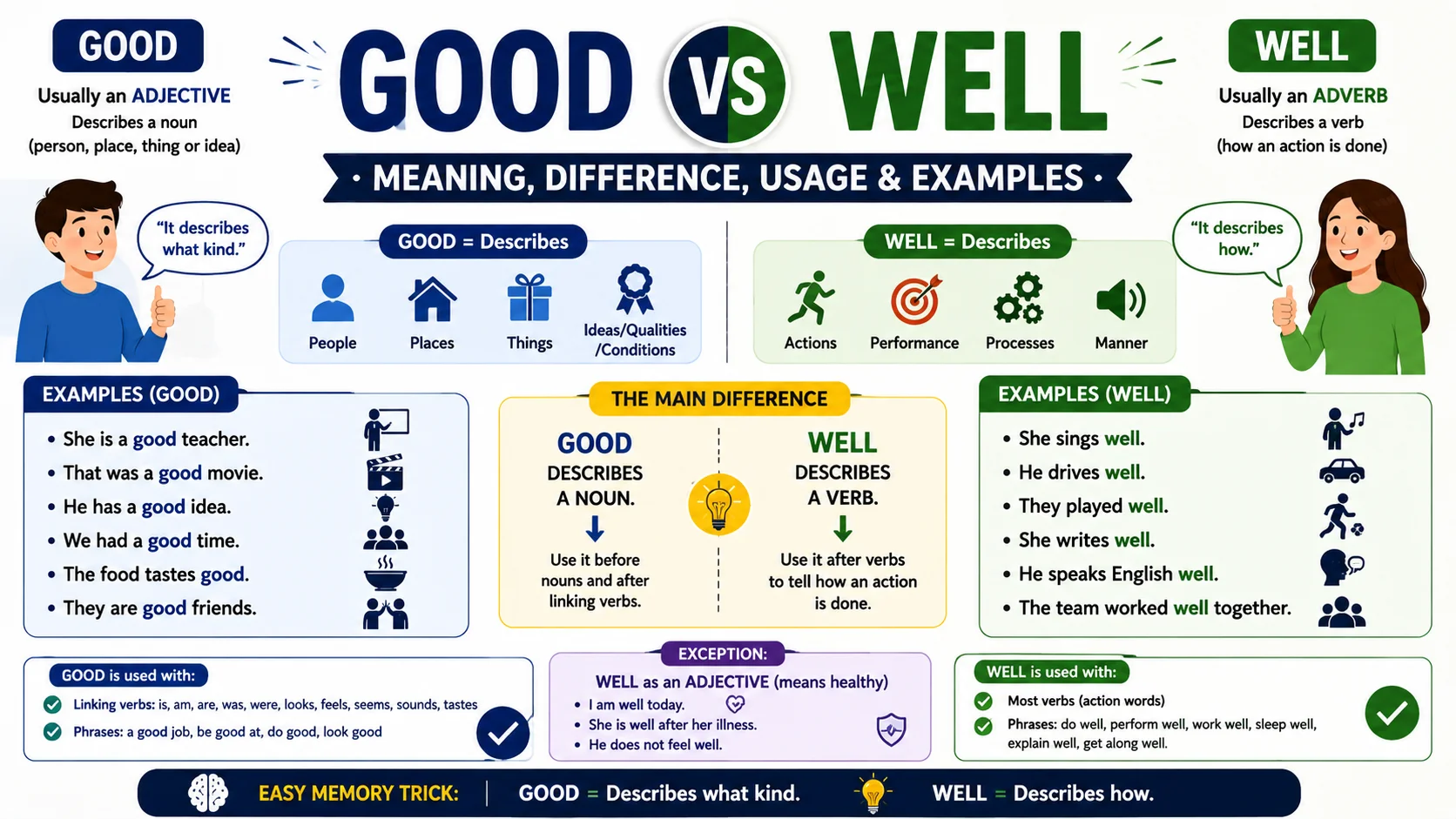
Good vs well is one of the most common grammar questions in English. Both words are used frequently, but they do not always perform the same grammatical job.
The simplest rule is that good is usually an adjective, while well is usually an adverb. An adjective describes a person, place, thing, or idea, while an adverb commonly describes how an action happens.
For example, you can say She is a good singer because good describes the singer. You can also say She sings well because well describes how she sings.
However, the distinction becomes more interesting when talking about health, linking verbs, and everyday expressions. In some sentences, well can function as an adjective, especially when it means healthy.
Understanding when to use good and well can make your English more accurate and natural in both speaking and writing.
Good vs Well: Quick Answer
Good is generally an adjective used to describe a noun or pronoun.
Well is generally an adverb used to describe a verb or action.
Examples
- She is a good student.
- She studies well.
- He is a good driver.
- He drives well.
- They gave a good performance.
- They performed well.
The easiest rule is:
Good = describes a person or thing
Well = describes an action
There are exceptions, especially when well means healthy.
What Does Good Mean?
Good is primarily an adjective. It describes the quality, condition, character, or value of a person or thing.
Examples
- She is a good teacher.
- That was a good movie.
- He has a good idea.
- This is a good book.
- We had a good time.
- They are good friends.
- The food tastes good.
In each example, good describes a noun, pronoun, or subject.
What Does Well Mean?
Well is usually an adverb. It describes how someone performs an action.
Examples
- She sings well.
- He drives well.
- They played well.
- She writes well.
- He speaks English well.
- The team performed well.
- You explained the topic well.
Here, well tells us how the action was performed.
Good vs Well: The Main Difference
The basic distinction is:
Good = adjective
Well = adverb
Compare these sentences:
Good
She is a good dancer.
Here, good describes the person and her ability as a dancer.
Well
She dances well.
Here, well describes the action of dancing.
Another example:
Good
He is a good cook.
Well
He cooks well.
This pattern works in many everyday situations.
Good vs Well Examples
| Good | Well |
|---|---|
| She is a good singer. | She sings well. |
| He is a good driver. | He drives well. |
| She is a good writer. | She writes well. |
| He is a good swimmer. | He swims well. |
| They are good players. | They play well. |
| She is a good speaker. | She speaks well. |
The first column describes a person or thing. The second describes an action.
When to Use Good
Use good when you need an adjective to describe a noun or subject.
1. Describing People
- He is a good friend.
- She is a good student.
- They are good neighbors.
- My brother is a good cook.
- She is a good leader.
2. Describing Things
- This is a good book.
- That was a good movie.
- We found a good restaurant.
- She bought a good computer.
- This is a good opportunity.
3. Describing Experiences
- We had a good time.
- It was a good experience.
- She had a good day.
- They had a good trip.
- It was a good decision.
When to Use Well
Use well when describing how an action is performed.
Examples
- She sings well.
- He writes well.
- They work well together.
- She explains things well.
- He plays the guitar well.
- The machine works well.
- You handled the situation well.
In each sentence, well describes the action.
Good vs Well With the Verb Be
The verb be creates some confusion because people sometimes expect an adverb after every verb.
When describing a person’s condition or quality, use good.
- I am good.
- She is good at mathematics.
- He is a good person.
- They are good students.
When talking about health, however, well can be used as an adjective.
- I am well.
- She is well after her illness.
- He does not feel well today.
In this context, well means healthy or in good health.
Is It I Feel Good or I Feel Well?
Both I feel good and I feel well can be correct, but they can carry slightly different meanings.
I Feel Good
This commonly refers to your general emotional or physical state.
- I feel good about the decision.
- I feel good today.
- She feels good about her progress.
I Feel Well
This traditionally emphasizes health.
- I feel well today.
- She feels well after her treatment.
- He is feeling well again.
In everyday American English, I feel good is extremely common and natural when talking about how you feel generally.
Good vs Well With Look
The verb look is a linking verb when it describes someone’s appearance or condition.
Use good when describing how someone or something appears.
- You look good today.
- She looks good in that dress.
- The room looks good after the renovation.
You would not normally use well when you simply mean attractive or pleasing in appearance.
However, look well can mean appear healthy.
- You look well after your vacation.
So the meaning determines the choice.
Good vs Well With Taste
Use good when describing the quality or flavor of food.
- This cake tastes good.
- The soup tastes good.
- The coffee tastes good.
Here, good describes the subject through the linking verb taste.
You generally would not say:
- The cake tastes well.
That would suggest something different and usually sounds incorrect when talking about flavor.
Good vs Well With Smell
The same pattern applies to smell when it functions as a linking verb.
- The flowers smell good.
- The perfume smells good.
- The food smells good.
Here, good describes the smell or overall quality of the subject.
Good vs Well With Sound
Use good after sound when describing the quality of something.
- That sounds good.
- Your idea sounds good.
- The plan sounds good.
But use well when describing the action of producing sound.
- She sings well.
- He plays the piano well.
Good at vs Well
Another common distinction is good at versus well.
Use good at to describe someone’s ability.
- She is good at math.
- He is good at football.
- They are good at solving problems.
- I am good at cooking.
Use well to describe how the activity is performed.
- She does math well.
- He plays football well.
- They solve problems well.
- I cook well.
Compare:
- She is good at singing.
- She has strong singing ability.
- She sings well.
- She performs the action of singing effectively.
Good vs Well in Questions
Both words appear frequently in questions.
Good
- Is this a good idea?
- Are you a good student?
- Was it a good movie?
- Did you have a good day?
- Is this a good restaurant?
Well
- Did you sleep well?
- Did she perform well?
- Can you see well?
- Did he explain it well?
- Does the computer work well?
Good vs Well in Everyday Conversation
Consider these common expressions:
How Are You?
A natural response is:
- I am good.
- I’m doing well.
- I’m well, thank you.
All can be appropriate depending on the intended meaning and level of formality.
In casual American English, I’m good is extremely common.
It can also mean that you do not need something:
- No thanks, I’m good.
Here, good does not mean healthy or successful. It means that you are fine without the offered item.
Good vs Well in Formal Writing
In formal writing, choosing the correct form can improve clarity.
Correct
- The researcher performed well.
- The study produced good results.
- The team worked well together.
- The report provides good information.
- The experiment was well designed.
Notice that good describes nouns while well often describes actions or processes.
Well-Designed vs Good Design
Both forms are common but work differently.
Good Design
Good describes the noun design.
- The website has a good design.
Well Designed
Well modifies the participle designed.
- The website is well designed.
Both express a positive idea, but their grammatical structures are different.
Other examples include:
- well-written article
- well-organized event
- well-planned project
- well-known author
- well-prepared student
Good vs Well: Common Mistakes
Mistake 1: She Sings Good
In standard English, use well to describe how she sings.
❌ She sings good.
✅ She sings well.
However, good can appear in informal speech or certain dialects, but well is the standard choice in formal English.
Mistake 2: He Is a Well Student
If you mean that he is a student who performs successfully, use good.
❌ He is a well student.
✅ He is a good student.
Mistake 3: She Did Good on the Test
In standard formal English, use well when describing performance.
❌ She did good on the test.
✅ She did well on the test.
However, you can say:
✅ She did a good job on the test.
Here, good describes the noun phrase job.
Mistake 4: The Food Tastes Well
When taste is functioning as a linking verb, use good to describe the food.
❌ The food tastes well.
✅ The food tastes good.
Mistake 5: He Looks Well in That Suit
If you mean the suit makes him look attractive, use good.
❌ He looks well in that suit.
✅ He looks good in that suit.
But if you mean he appears healthy:
✅ He looks well.
Good vs Well With Did
One of the most common questions is whether to say did good or did well.
For standard English, use did well when describing performance.
- She did well on the exam.
- He did well in the interview.
- They did well in the competition.
- You did well on the project.
Use good when it modifies a noun.
- She did a good job.
- He did a good performance.
The second sentence is less natural than gave a good performance, so context matters.
Good vs Well With Feel
The choice depends on meaning.
General Feeling
- I feel good today.
- She feels good about her decision.
- He feels good about his progress.
Health
- I feel well today.
- She feels well after resting.
- He feels well again.
In everyday conversation, the distinction is sometimes flexible, especially in American English.
Good vs Well With Work
Use good to describe a person, system, or quality.
- She is a good worker.
- He is a good employee.
- This is a good system.
Use well to describe how someone works.
- She works well.
- He works well under pressure.
- The team works well together.
- The machine works well.
Good vs Well: Easy Memory Trick
Use this simple formula:
Good → adjective → describes a noun
Well → adverb → describes an action
For example:
Good: He is a good writer.
Well: He writes well.
Another way to remember it:
If you can ask What kind?, good may be the answer.
- What kind of writer? A good writer.
If you can ask How?, well may be the answer.
- How does he write? He writes well.
Good vs Well: Quick Comparison Table
| Situation | Correct Word | Example |
|---|---|---|
| Describing a person | Good | She is a good teacher. |
| Describing a thing | Good | It is a good book. |
| Describing an action | Well | She teaches well. |
| Describing performance | Well | He performed well. |
| Describing health | Well | She is well. |
| Describing food quality | Good | The food tastes good. |
| Describing ability | Good | He is good at math. |
| Describing how an activity happens | Well | He solves problems well. |
Good vs Well Practice
Choose good or well in each sentence.
1. She is a ___ singer.
Answer: good
Good describes the singer.
2. She sings ___.
Answer: well
Well describes the action of singing.
3. He is a ___ driver.
Answer: good
Good describes the driver.
4. He drives ___.
Answer: well
Well describes how he drives.
5. The food tastes ___.
Answer: good
Good describes the food.
6. She performed ___.
Answer: well
Well describes her performance.
7. He is ___ at basketball.
Answer: good
Good describes his ability.
8. He plays basketball ___.
Answer: well
Well describes how he plays.
Frequently Asked Questions
What is the difference between good and well?
Good is generally an adjective used to describe a person or thing. Well is generally an adverb used to describe an action.
Is it I feel good or I feel well?
Both can be correct. I feel good commonly describes your general state or feelings, while I feel well traditionally emphasizes physical health.
Is it I did good or I did well?
For standard English, use I did well when describing your performance.
Is she a good singer or a well singer?
Use She is a good singer. Good describes the noun singer.
Is she sings good or she sings well?
Use She sings well in standard English because well describes the action of singing.
Is it good at or well at?
Use good at when describing someone’s ability.
Example: She is good at mathematics.
Can well be an adjective?
Yes. Well can function as an adjective when it means healthy or in good health.
Example: He is well now.
Can good be an adverb?
In standard English, good is primarily an adjective. In informal speech, some people use good where standard English would use well, but well is generally preferred as the adverb.
Is it looks good or looks well?
Use looks good when describing appearance.
Use looks well when meaning that someone appears healthy.
Is it sounds good or sounds well?
Use sounds good when describing how something seems or sounds.
Example: Your idea sounds good.
Is it tastes good or tastes well?
Use tastes good when describing the flavor or quality of food.
Example: This soup tastes good.
How can I remember good vs well?
Remember:
Good = describes a person or thing
Well = describes an action
Also remember the exception:
Well = healthy
Conclusion
The difference between good vs well becomes much easier when you remember their basic grammatical roles.
Use good as an adjective to describe people, things, experiences, qualities, and abilities.
Use well as an adverb to describe how an action is performed.
For example:
- She is a good writer.
- She writes well.
- He is a good driver.
- He drives well.
There is one important exception: well can work as an adjective when it means healthy. That is why I am well is grammatically correct.
The easiest rule to remember is:
Good = adjective
Well = adverb
Well = healthy when used as an adjective
Once you understand this pattern, you’ll be able to choose between good and well more confidently in everyday conversation, academic writing, professional communication, and formal English.

Olivia Bennett is a writer and language enthusiast at Vocabsteria. She is passionate about exploring word meanings, name origins, and cultural expressions from around the world.