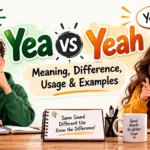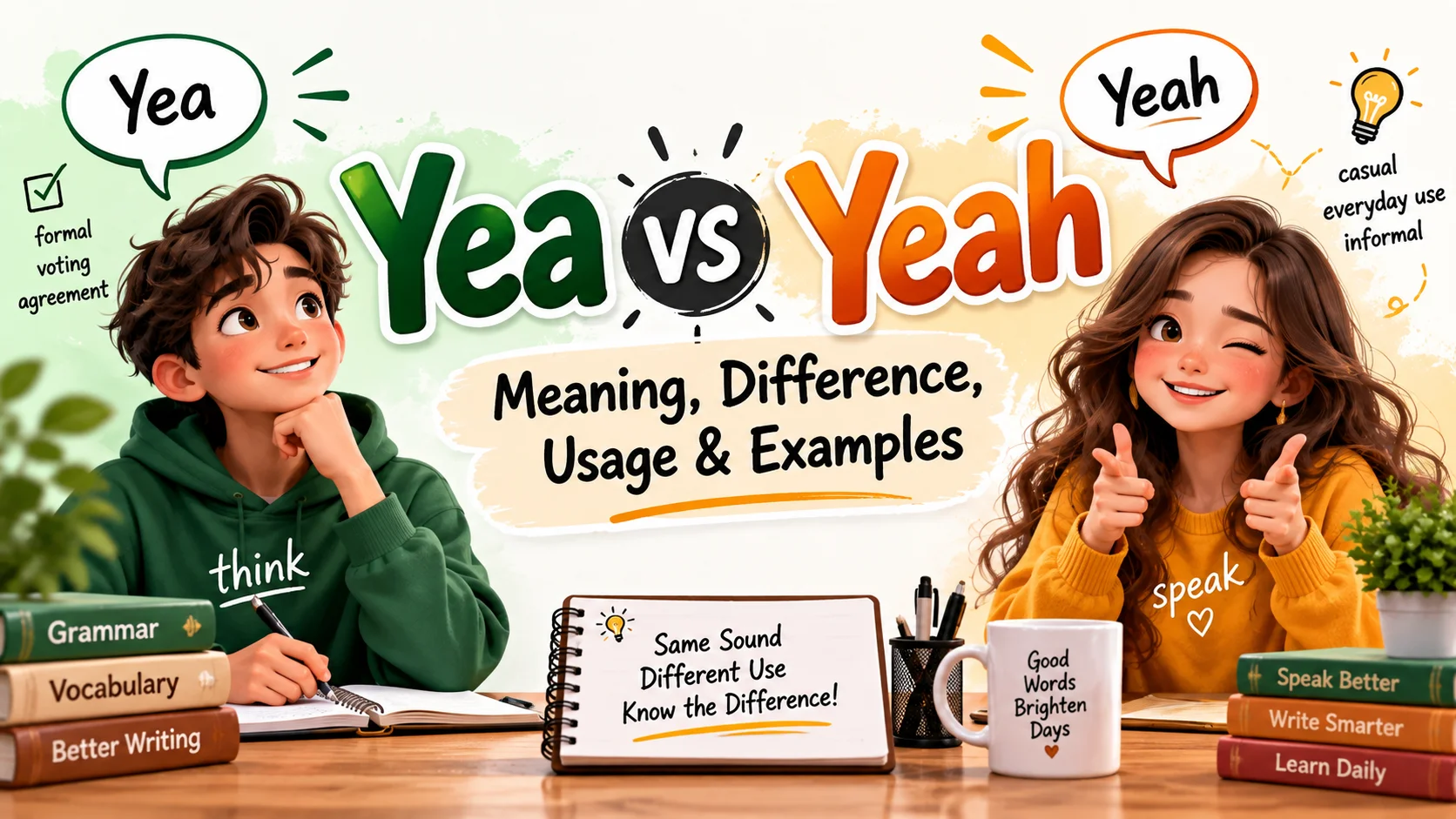
Yea vs Yeah can look almost identical, but these two words have very different meanings and uses. Yea is a formal or old-fashioned word that means yes, while yeah is a casual form of yes that people commonly use in everyday conversations, texts, chats, and social media.
Although both words can express agreement, they do not fit the same situations. You might see yea in voting, historical writing, religious language, or formal contexts, while yeah appears naturally in conversations such as Yeah, that sounds good or Yeah, I understand.
Understanding the difference between yea and yeah helps you choose the right word for the situation. This guide explains their meanings, grammar, pronunciation, examples, common mistakes, texting usage, and the easiest way to remember which one to use.
Yea vs Yeah at a Glance
The quickest way to understand the difference is to look at how each word functions in modern English.
| Word | Main Meaning | Tone | Common Use |
|---|---|---|---|
| Yea | Yes; an affirmative vote | Formal, traditional, old-fashioned | Voting, formal or historical contexts |
| Yeah | Yes | Casual and conversational | Speech, texting, chats, social media |
| Yea | Agreement or affirmation | Formal/traditional | Public decisions and older writing |
| Yeah | Agreement or acknowledgment | Informal | Everyday conversation |
The Simple Rule
Use yeah when you mean casual yes in everyday communication.
Use yea when you are referring to an affirmative vote or using a traditional/formal expression.
Examples:
- Yeah, I can help you.
- The committee voted yea on the proposal.
These sentences use the words correctly because the contexts are different.
What Does Yea Mean?
Yea is an English word that means yes, especially as an affirmative response or vote.
Today, yea is less common in ordinary conversation. You are more likely to encounter it in formal voting situations, historical documents, religious writing, or expressions that use traditional English.
For example:
- The members voted yea on the proposal.
- The final vote was 25 yea and 10 nay.
- The representatives cast their yea votes.
In these examples, yea has a formal or institutional tone.
Yea as an Affirmative Vote
One of the most recognizable modern uses of yea is in voting.
| Expression | Meaning |
|---|---|
| Yea | Yes or affirmative vote |
| Nay | No or negative vote |
| Yea vote | Vote in favor |
| Nay vote | Vote against |
For example:
The motion received 18 yea votes and 7 nay votes.
Here, yea does not simply sound like casual conversation. It identifies an affirmative vote.
What Does Yeah Mean?
Yeah is an informal way to say yes. It is extremely common in spoken English and informal writing.
People use yeah to:
- Agree with someone
- Answer a question
- Confirm information
- Show understanding
- Accept a suggestion
- Respond casually
- Keep a conversation natural
Examples of Yeah
- Yeah, I know what you mean.
- Yeah, that sounds great.
- Yeah, I’ll be there.
- Yeah, you’re right.
- Yeah, I remember her.
- Yeah, let’s do it.
These examples sound natural because yeah fits everyday conversational English.
Yea vs Yeah: The Main Difference
The biggest difference between yea and yeah is their usage and register.
Yea is associated with formal, traditional, historical, or voting language.
Yeah is associated with casual, modern, conversational English.
| Feature | Yea | Yeah |
|---|---|---|
| Means yes | Yes | Yes |
| Casual conversation | Rare | Very common |
| Texting | Uncommon | Very common |
| Social media | Uncommon | Common |
| Formal voting | Common | Uncommon |
| Historical English | Common | Rare |
| Informal speech | Unusual | Natural |
| Modern everyday English | Limited | Very common |
So although both words can relate to yes, they are not interchangeable in every situation.
Yea in Voting and Formal Contexts
The word yea has a particularly important role in voting language.
When people vote on a motion, proposal, or resolution, an affirmative vote may be described as a yea.
For example:
- The motion passed with 40 yea votes.
- Members were asked to vote yea or nay.
- The bill received more yea votes than nay votes.
- She cast a yea vote.
Yea and Nay
You will often see yea paired with nay.
| Affirmative | Negative |
|---|---|
| Yea | Nay |
| Yes | No |
| Vote in favor | Vote against |
This pairing is especially useful because yea and nay belong to a traditional voting vocabulary.
Example
The chair asked members to vote yea or nay.
This sentence sounds formal because the vocabulary belongs to an official voting context.
Yeah in Everyday Conversation
Yeah is one of the most common informal alternatives to yes.
People use it naturally with friends, family members, coworkers, classmates, and online contacts.
Examples
Question: Are you coming tonight?
Answer: Yeah, I’ll be there.
Question: Did you finish the project?
Answer: Yeah, I finished it this morning.
Question: Do you want some coffee?
Answer: Yeah, please.
Question: Is this your phone?
Answer: Yeah, that’s mine.
In each example, yeah feels natural and conversational.
Yeah in Text Messages and Chats
Yeah is especially common in texting and online communication.
People often use it because it is short, relaxed, and conversational.
Common Texting Examples
- Yeah, sure.
- Yeah lol
- Yeah, I agree.
- Yeah, that’s true.
- Yeah, I’ll check.
- Yeah, no problem.
- Yeah, exactly.
- Yeah, I know.
- Yeah, probably.
- Yeah, let’s go.
In informal digital communication, yeah is generally much more natural than yea when the intended meaning is simply yes.
Is Yea the Same as Yeah?
Not exactly.
Both can express agreement, but they belong to different usage patterns.
Yeah is the everyday conversational form of yes.
Yea is traditionally associated with an affirmative response or vote and can also appear in older or literary English.
Consider these examples:
| Sentence | Natural? | Reason |
|---|---|---|
| Yeah, I’ll come with you. | Yes | Casual conversation |
| Yea, I’ll come with you. | Unusual | Sounds archaic or overly formal |
| The vote was yea. | Yes | Formal voting context |
| The vote was yeah. | No | Wrong word for this context |
| Yeah, I understand. | Yes | Everyday speech |
| Yea or nay? | Yes | Traditional voting language |
Yea vs Yeah Pronunciation
Although the spellings differ, yea and yeah are commonly pronounced very similarly in modern English.
Both generally have the vowel sound found in say or day, though actual pronunciation can vary slightly by speaker and dialect.
The spelling difference is therefore more important than the sound difference.
This creates a common problem: someone may know how the word sounds but choose the wrong spelling when writing it.
Easy Pronunciation Reminder
Think of:
Yeah = casual yes
Yea = affirmative vote
The context, rather than pronunciation, usually tells you which spelling you need.
When Should You Use Yeah?
Use yeah when writing or speaking casually.
It works well in:
- Text messages
- Social media
- Casual emails
- Conversations
- Online chats
- Friendly messages
- Informal dialogue
- Everyday speech
Examples
- Yeah, I can do that.
- Yeah, that’s a good idea.
- Yeah, I saw your message.
- Yeah, we’re ready.
- Yeah, I agree with you.
If you would naturally say yes in an informal conversation, yeah will often work as a relaxed alternative.
When Should You Use Yea?
Use yea when the context specifically calls for the traditional or formal term.
Common situations include:
- Formal voting
- Legislative language
- Historical writing
- Traditional expressions
- Religious or literary language
- Formal records
Examples
- The proposal received 30 yea votes.
- Members voted yea or nay.
- The final count included 12 yea votes.
- The representatives recorded their votes as yea or nay.
In ordinary conversation, however, yeah is usually the more natural choice.
Common Mistakes With Yea and Yeah
Because these words sound similar, spelling mistakes are common.
Mistake 1: Using Yea for Casual Yes
Incorrect for modern casual writing:
Yea, I’ll meet you at seven.
This is understandable, but it may sound old-fashioned or overly formal.
Better:
Yeah, I’ll meet you at seven.
Mistake 2: Using Yeah for a Formal Vote
Incorrect:
The bill received 45 yeah votes.
Correct:
The bill received 45 yea votes.
The formal voting term is yea.
Mistake 3: Confusing Yea With Yay
Another common confusion involves yay.
These three words are different:
| Word | Meaning |
|---|---|
| Yea | Yes; affirmative vote |
| Yeah | Informal yes |
| Yay | Expression of excitement or celebration |
For example:
- Yea, I approve the motion.
- Yeah, I understand.
- Yay! We won!
Yea vs Yeah vs Yay
This three-way comparison makes the difference much easier to remember.
Yea
Meaning: Yes or an affirmative vote.
Example:
The members voted yea on the motion.
Yeah
Meaning: Informal yes.
Example:
Yeah, I’ll call you later.
Yay
Meaning: An expression of happiness, excitement, or celebration.
Example:
Yay! We finally finished the project.
| Word | Core Idea | Example |
|---|---|---|
| Yea | Formal/traditional yes | Vote yea |
| Yeah | Casual yes | Yeah, sure |
| Yay | Excitement | Yay, we won! |
How to Remember Yea vs Yeah
A simple memory trick can help.
Think: Yea = Vote
Both yea and vote are associated with formal decisions.
When you see:
yea or nay
think:
yes or no in a vote
Think: Yeah = Chat
If you’re texting a friend and want to say yes, think:
Yeah = everyday chat
For example:
Yeah, I’m coming.
This trick makes the difference easy to remember.
Another Easy Memory Trick
Use the final letters as a clue:
Yea → Yea or Nay
Yeah → Yeah, sure
Yay → Yay, we won!
Each word has a typical phrase associated with it.
| Word | Memory Phrase |
|---|---|
| Yea | Yea or nay |
| Yeah | Yeah, sure |
| Yay | Yay, we won |
Can You Use Yea in Everyday English?
Yes, but it may sound unusual depending on the sentence.
Because yea has a traditional or old-fashioned flavor, using it instead of yeah in casual conversation can make your writing sound intentionally formal, historical, humorous, or theatrical.
For example:
Yea, my friend, I shall join thee.
This sounds deliberately old-fashioned rather than like modern everyday English.
By contrast:
Yeah, I’ll come with you.
sounds completely natural in modern conversation.
Can You Use Yeah in Formal Writing?
You can, but it depends on the type of formal writing.
Yeah is informal, so it usually does not belong in highly formal academic, legal, or professional writing unless you are intentionally reproducing dialogue or a direct conversational style.
Instead, use yes, certainly, indeed, or another appropriate formal expression.
Compare
| Casual | More Formal |
|---|---|
| Yeah, I agree. | Yes, I agree. |
| Yeah, that’s correct. | Yes, that is correct. |
| Yeah, we received it. | Yes, we received it. |
| Yeah, that’s possible. | Yes, that is possible. |
The word yes is usually safer than yeah when you want a neutral or professional tone.
Yeah vs Yes
It is also useful to understand how yeah compares with yes.
| Word | Tone | Typical Situation |
|---|---|---|
| Yes | Neutral/formal | Professional and everyday |
| Yeah | Informal | Conversation and texting |
| Yea | Traditional/formal | Voting and historical contexts |
Examples
Yes, I understand.
Neutral and professional.
Yeah, I understand.
Casual and conversational.
The members voted yea.
Formal voting language.
This distinction helps you select the right word based on tone.
How Yeah Can Change Tone
Although yeah generally means yes, the tone can change depending on punctuation and context.
Yeah.
A short Yeah. can sound neutral, but in some contexts it may also sound distant or uninterested.
Yeah!
This usually shows enthusiasm or excitement.
Yeah, sure.
This often expresses agreement or willingness.
Yeah, I know.
This can be friendly, neutral, or slightly impatient depending on the conversation.
Yeah…
This may suggest hesitation, uncertainty, or reluctance.
So the word itself does not always communicate the complete emotion. Context, punctuation, and surrounding words matter.
Examples of Yea in Sentences
Here are several examples showing the traditional use of yea:
- The committee voted yea on the amendment.
- The proposal received 32 yea votes.
- Members could vote yea or nay.
- The final tally showed 18 yea votes.
- The representative cast a yea vote.
- The resolution passed after a majority voted yea.
- The clerk recorded every yea and nay.
- The motion received more yea votes than nay votes.
These examples demonstrate why yea remains useful even though it is uncommon in casual conversation.
Examples of Yeah in Sentences
Here are natural examples of yeah in everyday English:
- Yeah, I can help you.
- Yeah, that makes sense.
- Yeah, I remember.
- Yeah, you’re right.
- Yeah, let’s go.
- Yeah, I already finished it.
- Yeah, I’ll send it tonight.
- Yeah, that’s what I meant.
- Yeah, I agree.
- Yeah, no problem.
- Yeah, I’m interested.
- Yeah, that sounds good.
Examples in Text Messages
Texting often uses yeah in short responses.
| Message | Possible Reply |
|---|---|
| Are you free tonight? | Yeah, I’m free. |
| Want to grab coffee? | Yeah, sure. |
| Did you see the movie? | Yeah, I watched it. |
| Are we still meeting at six? | Yeah, that’s right. |
| Can you send me the file? | Yeah, I’ll send it. |
| Do you understand? | Yeah, I got it. |
Using yea in these examples would usually make the messages look unusual unless you intentionally want a humorous or old-fashioned effect.
Professional Writing: Which One Should You Choose?
- For professional communication, yes is usually the safest choice.
- For casual communication, yeah is perfectly natural.
- For formal voting language, yea may be the correct term.
Quick Professional Guide
| Situation | Best Choice |
|---|---|
| Business email | Yes |
| Academic writing | Yes |
| Texting a friend | Yeah |
| Social media chat | Yeah |
| Casual conversation | Yeah |
| Formal vote | Yea |
| Historical writing | Yea |
| Traditional phrase | Yea |
This approach prevents most usage mistakes.
Yea vs Yeah in Social Media
Social media communication tends to favor informal language.
You may see:
- Yeah, exactly!
- Yeah, that’s true.
- Yeah, I agree.
- Yeah, same here.
- Yeah, definitely.
- Yeah, that’s hilarious.
Yea is much less common unless someone is discussing voting, using historical language, or deliberately creating a humorous old-fashioned tone.
Yea vs Yeah: Quick Comparison
| Category | Yea | Yeah |
|---|---|---|
| Basic meaning | Yes | Yes |
| Modern everyday use | Limited | Very common |
| Casual conversation | Rare | Common |
| Texting | Rare | Very common |
| Social media | Uncommon | Common |
| Voting | Common | Not standard |
| Historical tone | Common | Rare |
| Formal tone | Possible | Informal |
| Old-fashioned flavor | Yes | No |
| Typical pair | Yea or nay | Yeah, sure |
Frequently Asked Questions
Is yea the same as yeah?
No. Yea traditionally means yes or an affirmative vote, while yeah is the informal form of yes used in everyday conversation.
Is yea or yeah correct?
Both can be correct, but they serve different purposes. Use yeah for casual agreement and yea mainly for affirmative voting or traditional contexts.
Is yeah a slang word?
Yeah is an informal form of yes. It is common in spoken English, texting, online chats, and casual writing.
What does yea mean in voting?
In voting, yea means an affirmative or positive vote in favor of a proposal, motion, or decision.
Is yea formal?
Yea can have a formal, traditional, historical, or old-fashioned tone. It is particularly associated with formal voting language.
Is yeah professional?
Yeah is generally considered informal. In professional writing, yes is usually a better choice when you want a neutral and polished tone.
What is the difference between yea and yay?
Yea means yes or an affirmative vote. Yay expresses excitement, happiness, or celebration.
For example:
- Yea = an affirmative vote
- Yeah = casual yes
- Yay = excitement
Can I use yeah in an email?
You can use yeah in a casual email, especially when writing to someone you know well. In formal business communication, yes usually sounds more professional.
Why do people confuse yea and yeah?
They are commonly pronounced similarly, and both can relate to agreement. Their meanings and typical contexts, however, are different.
Quick Practice
Choose yea, yeah, or yay in each sentence.
- ___, I’ll call you later.
- The members voted ___ on the proposal.
- ___! We finally won.
- ___, I understand what you mean.
- The final count included 28 ___ votes.
Answers
- Yeah
- Yea
- Yay
- Yeah
- Yea
This simple exercise highlights the difference between the three words.
Final Yea vs Yeah Rule
Remember these three words as a simple set:
Yea = affirmative vote
Yeah = casual yes
Yay = excitement
- If you are texting a friend and want to say yes, choose yeah.
- If you are talking about a formal vote, choose yea.
- If you are celebrating something, choose yay.
For professional writing, yes is usually the safest neutral option.
Final Comparison
| Word | Use It When You Mean |
|---|---|
| Yea | Yes in a traditional or voting context |
| Yeah | Casual yes in conversation or texting |
| Yay | Excitement or celebration |
| Yes | Neutral or formal agreement |
Conclusion
The difference between yea and yeah becomes simple once you focus on context. Yea is traditionally used to express an affirmative response and remains especially common in voting language, often alongside nay. Yeah, on the other hand, is the familiar informal form of yes that people use every day in conversations, texts, chats, and social media.
When you need a quick casual response, yeah is usually the natural choice. When you are describing an affirmative vote, yea is the appropriate term. And when you want to express excitement, remember the third word: yay.
A useful memory trick is:
Yea = vote
Yeah = chat
Yay = celebrate
Once you remember that distinction, choosing the correct word becomes much easier.

Olivia Bennett is a writer and language enthusiast at Vocabsteria. She is passionate about exploring word meanings, name origins, and cultural expressions from around the world.