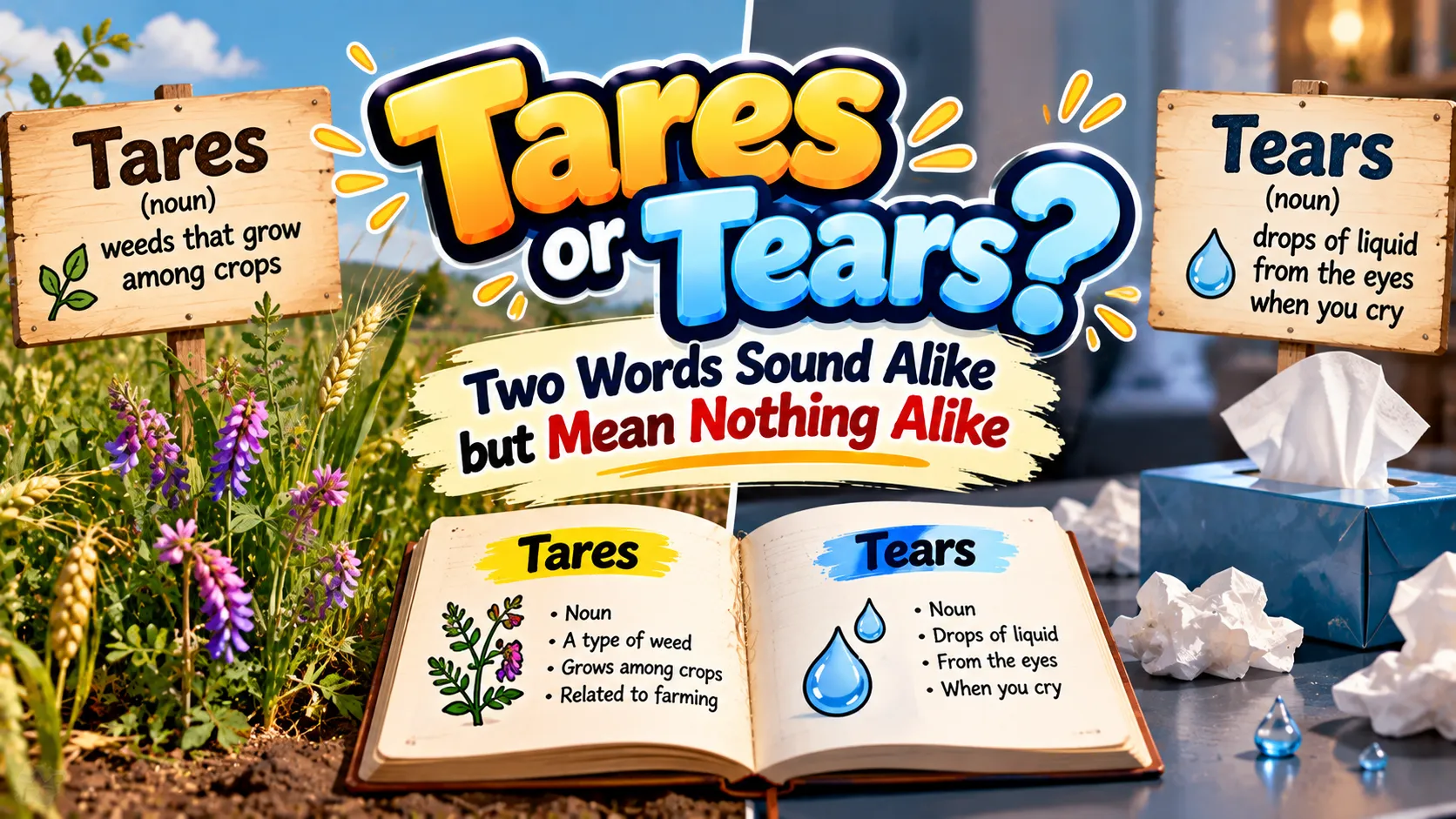
Tares or tears can be confusing because they may sound identical in some contexts, yet their meanings are completely different. One word is connected to agriculture and weighing, while the other can describe crying or something being ripped.
The confusion becomes even greater because tears itself has two different pronunciations and meanings. Tares is a much less common word, but it appears in specific agricultural and technical contexts.
If you’re writing, reading an old text, studying vocabulary, or trying to understand a sentence containing one of these words, context is the key to choosing the right meaning.
🌾 Tares or Tears? The Quick Answer
The words have different meanings and uses.
| Word | Main Meaning | Example |
|---|---|---|
| Tares | Weeds or unwanted plants, especially in agricultural or biblical contexts; also related to tare weight | Farmers removed the tares. |
| Tears | Drops from the eyes or rips in something | She wiped her tears. |
| Tears | Rips or splits, pronounced differently | The fabric tears easily. |
Easy reminder:
Tares = plants/weeds or tare weight 🌱
Tears = crying or ripping 😢
🌱 What Does Tares Mean?
Tares is a specialized plural noun that can refer to certain weeds or unwanted plants growing among crops. The word is particularly familiar from the biblical phrase “wheat and tares.”
In agricultural or historical writing, tares can refer to plants considered undesirable among cultivated crops.
Example:
The farmer separated the wheat from the tares.
The word is relatively uncommon in everyday modern conversation, but it remains recognizable in religious, historical, and agricultural contexts.
⚖️ What Does Tare Mean?
Tare has another important meaning in weighing and measurement.
In commerce, shipping, cooking, and science, tare refers to the weight of a container or packaging that must be subtracted to determine the net weight of its contents.
For example:
The container has a tare weight of two pounds.
The plural or related form can appear in technical contexts involving weights and measurements.
Simple formula:
Gross weight − tare weight = net weight
For example:
Gross weight: 12 lb
Tare weight: 2 lb
Net weight: 10 lb
This meaning is completely different from tears.
😢 What Does Tears Mean?
Tears has more than one meaning.
The first meaning refers to drops of liquid produced by the eyes, often associated with crying.
Example:
Tears filled her eyes.
He wiped away his tears.
The second meaning relates to the verb tear, meaning to rip or pull something apart.
Example:
The paper tears easily.
These two uses of tears are spelled identically but pronounced differently.
🔊 Tears Has Two Pronunciations
This is one of the most interesting parts of the word.
Tears meaning crying:
tears = /tɪrz/
Example:
She was in tears.
Tears meaning rips:
tears = /terz/
Example:
The fabric tears easily.
So the spelling tears can represent two different words with different pronunciations.
⚖️ Tares vs Tears: Full Comparison
| Word | Pronunciation | Meaning | Example |
|---|---|---|---|
| tares | Usually like “tears” in some contexts | Weeds/unwanted plants | Wheat and tares |
| tears | /tɪrz/ | Drops from eyes | Her tears fell. |
| tears | /terz/ | Rips or splits | The cloth tears easily. |
Context tells you which word and meaning is intended.
📖 Tares in the Bible
The word tares is particularly well known because of the biblical Parable of the Weeds, often referred to as the Parable of the Wheat and the Tares.
In this context, tares refers to unwanted plants growing among wheat.
The phrase has become part of English vocabulary and is sometimes used metaphorically to describe something undesirable growing alongside something valuable.
You may encounter expressions such as:
wheat and tares
This is much more common in religious or literary writing than in ordinary everyday conversation.
🌾 Tares in Agriculture
In agricultural contexts, tares may refer to weeds or plants that grow among crops and interfere with cultivation.
For example:
The farmer worked to separate the wheat from the tares.
The exact botanical identity of plants called “tares” can vary by historical or regional context, so modern agricultural writing often uses more specific plant names.
Still, the word remains useful when discussing historical agriculture or biblical terminology.
⚖️ Tare Weight in Measurement
The word tare also appears in technical weighing systems.
If you place a container on a scale, the scale can account for the container’s weight. That weight is called the tare weight.
For example:
The package has a tare weight of 0.5 kg.
Then:
Gross weight = product + container
Net weight = product alone
This is why you may see tare on commercial scales, shipping documents, and packaging equipment.
📦 Tare vs Net vs Gross Weight
These three terms often appear together.
| Term | Meaning |
|---|---|
| Gross weight | Total weight including container |
| Tare weight | Weight of the empty container |
| Net weight | Weight of the contents alone |
Example:
Gross = 25 kg
Tare = 5 kg
Net = 20 kg
This technical meaning of tare has nothing to do with crying or ripping.
😭 Tears as Drops From the Eyes
When tears refers to crying, it is the plural of tear.
Examples:
- tears of joy
- tears of sadness
- tears of happiness
- tears of relief
- tears filled her eyes
- wipe away tears
- burst into tears
- hold back tears
Examples in sentences:
She wiped away her tears.
His eyes filled with tears.
They cried tears of joy.
✂️ Tears as Rips
The word tears can also come from the verb tear, meaning to rip or damage something.
Examples:
This paper tears easily.
The fabric tears when pulled too hard.
Thin material tears quickly.
In these sentences, tears is pronounced differently from the noun meaning crying.
🔍 Tear, Tears, Torn, and Tearing
The verb tear has several forms.
| Form | Example |
|---|---|
| tear | Don’t tear the paper. |
| tears | The paper tears easily. |
| tore | He tore the paper. |
| torn | The paper was torn. |
| tearing | She is tearing the paper. |
The noun has another meaning:
| Form | Meaning |
|---|---|
| tear | A drop from the eye |
| tears | Drops from the eyes |
Context determines which meaning is intended.
🧠 Easy Memory Trick for Tares and Tears
Because tares is less common, connect it with plants.
Tares → fields → plants 🌱
For tears, think:
Tears → eyes → crying 😢
And remember that tare also appears in:
tare weight → container weight ⚖️
These associations make the words easier to separate.
✍️ How to Use Tares in a Sentence
Examples:
- The farmer noticed tares growing among the wheat.
- The field contained wheat and tares.
- The parable describes wheat and tares.
- Historical texts often mention tares among crops.
- The farmer separated the crop from the tares.
These sentences use tares in the agricultural or historical sense.
😢 How to Use Tears in a Sentence
Examples:
- Her tears began to fall.
- He wiped away his tears.
- The movie brought tears to her eyes.
- She cried tears of happiness.
- His eyes filled with tears.
- They struggled to hold back their tears.
Here, tears means drops produced by the eyes.
✂️ How to Use Tears as a Verb
Examples:
- The paper tears easily.
- This fabric tears under pressure.
- The material tears when stretched.
- The old page tears if handled roughly.
- Thin plastic tears quickly.
Here, tears is a verb and means “rips.”
📊 Tares, Tears, and Their Meanings
| Word | Meaning | Example |
|---|---|---|
| tare | Container weight | The tare is 2 kg. |
| tares | Weeds/unwanted plants | The field had tares. |
| tear | Drop from the eye | A tear rolled down her cheek. |
| tears | Drops from the eyes | She wiped her tears. |
| tear | Rip apart | Don’t tear the paper. |
| tears | Rips | The fabric tears easily. |
This table highlights why context matters so much.
🗣️ Why Tares and Tears Can Be Confusing
English contains many words that sound alike but have unrelated meanings. Tares and tears can create this confusion because their pronunciations can overlap depending on the word and dialect.
When reading, you cannot rely on pronunciation alone.
Instead, look at the surrounding words.
For example:
wheat and ___
The answer is probably:
tares
But:
wiped away her ___
clearly calls for:
tears
🚫 Common Mistake: Writing Tears for Tares
Consider:
❌ The farmer removed the tears from the wheat.
If you’re referring to unwanted plants in the agricultural or biblical sense, the intended word is:
✅ The farmer removed the tares from the wheat.
The surrounding context—farmer, wheat, field, plants—makes the distinction clear.
🚫 Common Mistake: Writing Tares for Tears
The reverse mistake can happen too:
❌ She wiped away her tares.
Correct:
✅ She wiped away her tears.
The context involves crying, so tears is required.
📚 Tares in Literary and Religious Writing
You are more likely to encounter tares in:
- biblical studies
- religious writing
- historical texts
- agricultural history
- literary works
- theological discussions
It is relatively uncommon in casual modern conversation.
If you’re writing about ordinary farming today, a more specific term such as weeds may often be clearer.
⚖️ Tare in Shipping and Commerce
The technical meaning of tare is more common in:
- shipping
- packaging
- manufacturing
- logistics
- weighing
- retail
- food production
Examples:
The scale automatically calculates the tare.
The package’s tare weight is listed on the label.
The system records gross, net, and tare weights.
🔤 Pronunciation Guide
Here’s a simple pronunciation comparison.
| Word | Meaning | Approximate Sound |
|---|---|---|
| tares | Weeds | “tairs” |
| tears | Crying | “teerz” |
| tears | Rips | “tairs” |
The pronunciation of tears changes depending on meaning.
This makes the word especially interesting because spelling alone doesn’t tell you how it should sound.
🎯 Quick Practice: Tares or Tears?
Choose the correct word.
- The farmer found ___ growing among the wheat.
Answer: tares - She wiped away her ___.
Answer: tears - The fabric ___ easily.
Answer: tears - The parable mentions wheat and ___.
Answer: tares - His eyes filled with ___.
Answer: tears - The scale measures the ___ weight.
Answer: tare - The old paper ___ when folded.
Answer: tears - The farmer tried to remove the ___.
Answer: tares
🧩 Context Clues That Make the Answer Easy
If you’re unsure which word belongs in a sentence, look for nearby clues.
Agriculture clues:
- wheat
- field
- crop
- farmer
- weeds
- plants
→ tares
Crying clues:
- eyes
- cried
- sadness
- happiness
- wiped
- cheeks
→ tears
Weighing clues:
- scale
- package
- container
- gross
- net
- weight
→ tare
Ripping clues:
- paper
- fabric
- cloth
- damage
- pull
- rip
→ tears
❓ Frequently Asked Questions About Tares vs Tears
What is the difference between tares and tears?
Tares can refer to weeds or unwanted plants, especially in agricultural or biblical contexts. Tears can mean drops from the eyes or rips in material.
Is tares a real word?
Yes. Tares is a legitimate word, although it is relatively uncommon in everyday modern English.
What does tares mean in the Bible?
In the biblical context, tares refers to unwanted plants growing among wheat in the Parable of the Wheat and the Tares.
What does tears mean?
Tears can refer to drops produced by the eyes or to the third-person singular form of the verb tear, meaning to rip.
Are tares and tears pronounced the same?
They can sound the same or very similar depending on the word and dialect. Context is important.
Does tears have two pronunciations?
Yes. Tears meaning drops from the eyes is generally pronounced like “teerz,” while tears meaning rips is generally pronounced like “tairs.”
What is tare weight?
Tare weight is the weight of an empty container or packaging, which is subtracted from gross weight to calculate net weight.
What is the difference between tare and gross weight?
Tare is the weight of the empty container. Gross weight includes both the container and its contents.
What is the difference between tare and net weight?
Tare weight is the container’s weight, while net weight is the weight of the contents alone.
Is “wheat and tears” correct?
No, if you’re referring to the biblical phrase. The expression is “wheat and tares.”
Is “wiped away her tares” correct?
No. If you mean drops from her eyes, the correct word is tears.
How can I remember the difference?
Think tares = plants and tears = eyes or rips. For weighing, remember tare weight = container weight.
🏁 Final Takeaway
The difference between tares and tears becomes much easier when you focus on context.
Tares can refer to unwanted plants, especially in agricultural and biblical contexts. Tare can also refer to the weight of an empty container.
Tears can mean drops from the eyes:
She wiped away her tears.
Or tears can mean rips:
The fabric tears easily.
The easiest memory trick is:
Tares → plants 🌱
Tears → crying 😢
Tare → container weight ⚖️
When these words appear in a sentence, the surrounding context will usually tell you exactly which meaning is intended.

Olivia Bennett is a writer and language enthusiast at Vocabsteria. She is passionate about exploring word meanings, name origins, and cultural expressions from around the world.