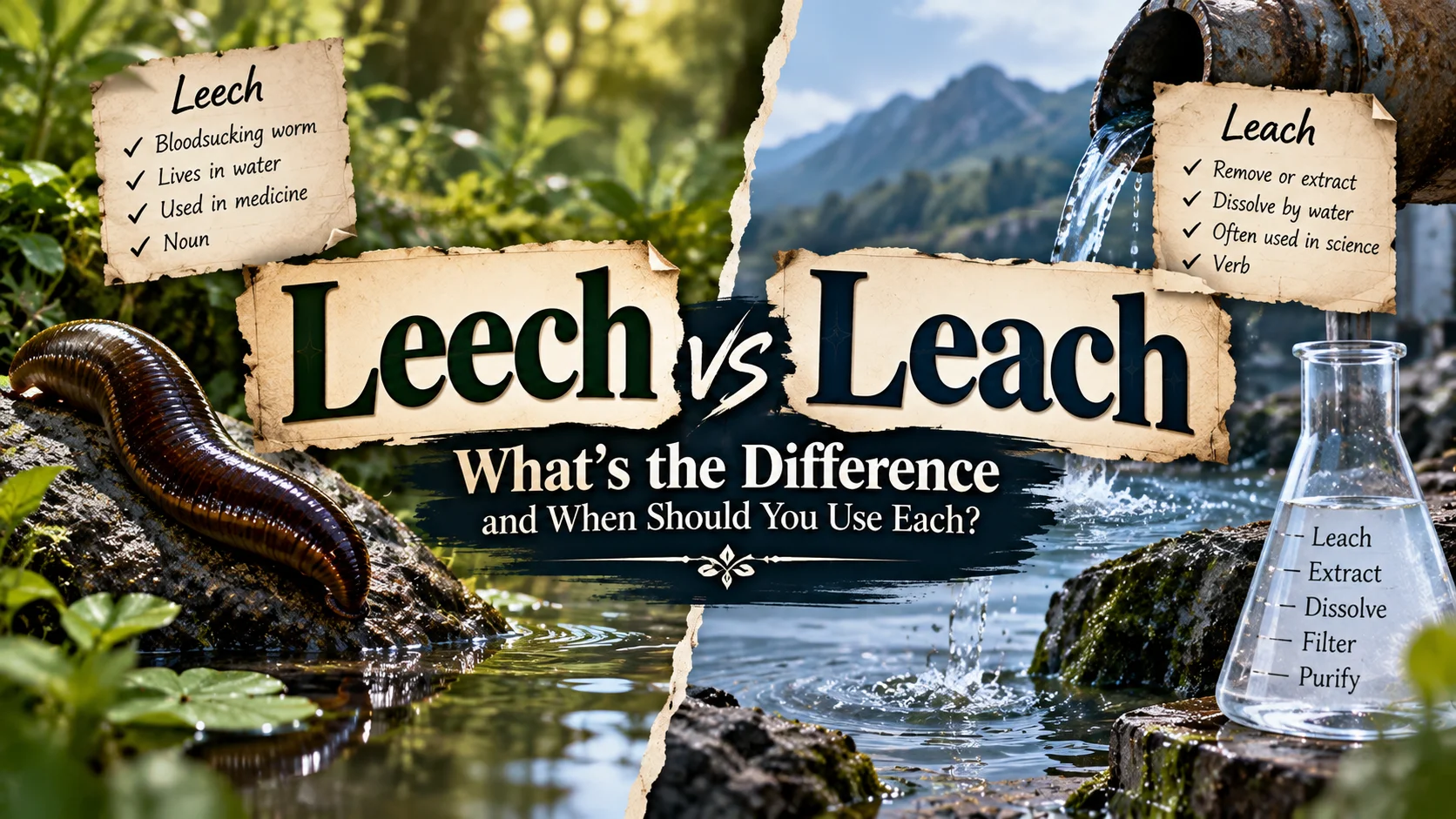
Leech vs leach can be confusing because these two words look and sound almost identical, but they have completely different meanings. Leech usually refers to a blood-feeding worm or a person who takes advantage of others, while leach describes the process of removing or extracting a substance from something, often through liquid.
Although the spelling differs by only one letter, using the wrong word can completely change the meaning of a sentence. Understanding the difference between leech and leach makes your writing clearer and helps you avoid one of the most common spelling and vocabulary mistakes in English.
Leech vs Leach at a Glance 🔎
The easiest way to understand these words is to compare their meanings, parts of speech, and common uses.
| Word | Main Meaning | Common Use | Part of Speech |
|---|---|---|---|
| Leech | A blood-feeding worm | Animals, medicine, figurative descriptions | Noun |
| Leech | A person who takes advantage of others | Relationships and social situations | Noun |
| Leach | To remove or extract a substance | Soil, minerals, chemicals, water | Verb |
| Leach | To be removed from a material | Environmental and scientific contexts | Verb |
The Simple Difference
Leech is usually a living creature or a person who exploits others.
Leach is usually about extracting or removing a substance, especially with liquid.
A simple memory trick is:
Leech = creature or exploiter
Leach = extract or remove
What Does Leech Mean? 🪱
Leech is a noun that traditionally refers to a small, soft-bodied aquatic worm that attaches itself to animals or humans and feeds on blood. Leeches have been used in medicine for centuries, particularly because they can draw blood and release substances that affect blood clotting.
The word also has a figurative meaning. A leech can describe someone who constantly takes money, time, attention, resources, or other benefits from another person without giving much in return.
Leech as an Animal
A leech is a type of segmented worm that often lives in freshwater environments. Some species attach themselves to animals and feed on blood.
For example:
- The doctor used a leech as part of the treatment.
- A leech attached itself to the swimmer’s leg.
- The pond contained several leeches.
- The fisherman noticed a leech on the fish.
Leech as a Person
English also uses leech metaphorically for a person who takes advantage of someone else’s generosity.
For example:
- He acts like a leech and never pays his share.
- She felt that her roommate was becoming a leech.
- Everyone knew the man as a financial leech.
- A person who constantly depends on others without contributing may be called a leech.
This figurative use usually carries a negative meaning.
What Does Leach Mean? 💧
Leach is mainly a verb. It means to remove a substance from a solid material by allowing liquid to pass through it.
The word appears frequently in environmental science, agriculture, chemistry, geology, and everyday discussions about soil and water.
For example:
- Heavy rain can leach nutrients from the soil.
- Chemicals may leach into groundwater.
- Water can leach minerals from rocks.
- The fertilizer may leach away after repeated rainfall.
Leach as a Process
The basic idea behind leach is movement or extraction. A liquid passes through or over a material and carries dissolved substances away.
This process can occur naturally or through human activity.
For example, rainfall can pass through soil and carry nutrients deeper into the ground. Scientists may also deliberately use liquids to extract particular substances from materials.
Leech vs Leach: The Main Difference ⚖️
The biggest difference is simple:
Leech refers to a creature or, figuratively, a person who takes advantage of others.
Leach refers to the removal or extraction of a substance, usually through liquid.
| Feature | Leech | Leach |
|---|---|---|
| Meaning | Worm or exploiter | Extract or remove |
| Typical role | Noun | Verb |
| Common context | Biology, medicine, relationships | Soil, water, chemistry |
| Example | The leech attached to his leg. | Rain can leach nutrients from soil. |
| Figurative use | Yes | Less common |
| Related idea | Taking | Removing |
Examples of Leech in a Sentence ✍️
Here are several examples showing how to use leech correctly.
- The nurse carefully removed the leech.
- A leech was found in the freshwater pond.
- The fisherman discovered a leech on the fish.
- Some medical treatments have historically involved leeches.
- He depends on his friends like a leech.
- Nobody wanted to support the financial leech.
- The children learned about leeches during their biology lesson.
- The wetland provides a habitat for many leeches.
- She called him a leech because he always borrowed money.
- The scientist studied how the leech feeds.
Examples of Leach in a Sentence 🌱
These examples show how leach works as a verb.
- Heavy rain can leach nutrients from farmland.
- Chemicals may leach into nearby groundwater.
- Water can leach minerals from the soil.
- Excessive irrigation can cause nutrients to leach away.
- Acidic water may leach metals from rocks.
- The researchers examined how pollutants leach through soil.
- Rainwater can leach fertilizer into deeper layers.
- Some substances can leach from plastic containers.
- The process allows water to leach unwanted compounds from the material.
- Poor soil management can increase nutrient leaching.
Leech as a Noun 🧠
The most common grammatical role of leech is a noun.
It can identify either the actual animal or a person who exploits another person.
| Type | Example |
|---|---|
| Animal | The leech attached to the frog. |
| Medical use | The doctor used a leech during treatment. |
| Figurative person | He is acting like a leech. |
| Plural | The pond contains many leeches. |
The plural form is leeches.
Common Expressions With Leech
The word often appears in expressions that describe dependence or exploitation.
Examples include:
- a financial leech
- a social leech
- a human leech
- act like a leech
- live like a leech
- cling like a leech
These expressions generally describe someone who takes advantage of another person’s resources or generosity.
Leach as a Verb 💦
Leach functions primarily as a verb.
It describes the movement of a dissolved substance from one material into a liquid and then away from the original material.
For example:
Rainwater can leach nutrients from soil.
The subject rainwater performs the process, while nutrients are the substances being removed.
Common Forms of Leach
| Form | Example |
|---|---|
| Base form | leach |
| Present participle | leaching |
| Past tense | leached |
| Past participle | leached |
| Noun | leaching |
Examples:
- Chemicals are leaching into the groundwater.
- Rain leached nutrients from the soil.
- The process is called leaching.
Leech vs Leach in Science 🔬
The word leach appears frequently in scientific writing.
Environmental scientists use it when discussing the movement of dissolved substances through soil, sediments, waste materials, or other porous materials.
For example, pollutants can leach from contaminated soil into groundwater. Agricultural chemicals can also leach downward after rainfall or irrigation.
Leech, by contrast, usually appears in biology or medicine when discussing the animal.
| Scientific Context | Correct Word |
|---|---|
| Blood-feeding worm | Leech |
| Removing nutrients from soil | Leach |
| Chemicals entering groundwater | Leach |
| Aquatic worm | Leech |
| Minerals removed by water | Leach |
| Medical blood-feeding organism | Leech |
Leech vs Leach in Everyday English 🗣️
You are more likely to encounter leech in everyday conversation when someone talks about an animal or a person who takes advantage of others.
Leach appears more often in technical, environmental, agricultural, and scientific writing.
For example:
- That person is such a leech.
- A leech was found in the pond.
- Rainwater can leach nutrients from the soil.
- Chemicals can leach into groundwater.
This difference in context can help you choose the correct spelling quickly.
Common Mistakes With Leech and Leach ❌
Because these words sound similar, writers sometimes switch them accidentally.
Mistake 1: Using Leech for Chemical Removal
Incorrect:
- Rain can leech nutrients from the soil.
Correct:
- Rain can leach nutrients from the soil.
The sentence describes the removal of nutrients, so leach is correct.
Mistake 2: Using Leach for the Animal
Incorrect:
- A leach attached itself to my leg.
Correct:
- A leech attached itself to my leg.
The sentence refers to the blood-feeding worm, so leech is correct.
Mistake 3: Confusing Figurative Leech
Incorrect:
- He is a financial leach.
Correct:
- He is a financial leech.
When describing a person who takes advantage of others, use leech.
Leech vs Leach Pronunciation 🔊
The two words have the same pronunciation in standard English. They are homophones, meaning they sound alike but have different spellings and meanings.
| Word | Pronunciation | Meaning |
|---|---|---|
| Leech | /liːtʃ/ | Worm or exploiter |
| Leach | /liːtʃ/ | Extract or remove |
Because pronunciation cannot help you distinguish them, you need to rely on context and spelling.
Leech vs Leach: Easy Memory Trick 🧩
A simple trick can make the difference easier to remember.
Think of the extra e in leech as being part of the word for the creature.
Leech = creature or person
Then remember:
Leach = liquid extraction
You can also associate leach with leaching, a scientific process involving the movement of dissolved substances through materials.
| Remember | Meaning |
|---|---|
| Leech | Living creature |
| Leech | Person who exploits others |
| Leach | Remove through liquid |
| Leaching | Extraction process |
Leech vs Leach vs Leaching 📚
The noun leaching comes from the verb leach.
It describes the process in which soluble substances move through a material because of liquid.
For example:
- Soil leaching can reduce nutrient availability.
- Researchers studied chemical leaching.
- Heavy rainfall may increase nutrient leaching.
Do not confuse leaching with leeches. The first relates to extraction, while the second is the plural form of the animal leech.
| Word | Meaning |
|---|---|
| Leech | A worm or exploiter |
| Leeches | More than one leech |
| Leach | To extract or remove |
| Leached | Removed through leaching |
| Leaching | The extraction process |
Quick Comparison Examples ⚡
These pairs make the difference especially clear.
| Sentence | Correct Word | Why |
|---|---|---|
| The ___ attached to my foot. | leech | It is an animal. |
| Rain can ___ nutrients from soil. | leach | It means remove through liquid. |
| He behaves like a ___. | leech | He exploits others. |
| Chemicals can ___ into water. | leach | The chemicals move through liquid. |
| The pond contains several ___. | leeches | More than one animal. |
| Scientists studied metal ___. | leaching | It describes an extraction process. |
When Should You Use Leech? ✅
Use leech when you mean:
- A blood-feeding worm
- A medical leech
- A person who exploits others
- Someone who constantly takes without contributing
For example:
The leech attached itself to the animal.
He is a leech who always depends on his friends.
When Should You Use Leach? ✅
Use leach when you mean:
- Remove a substance using liquid
- Extract dissolved material
- Allow a substance to move through soil or another material
- Describe a scientific or environmental extraction process
For example:
Heavy rain can leach nutrients from the soil.
Toxic substances may leach into groundwater.
Final Difference Between Leech and Leach 🏁
The difference between leech and leach becomes easy once you focus on their meanings rather than their pronunciation.
Leech is a noun that refers to a blood-feeding worm or, figuratively, a person who takes advantage of others. Leach is primarily a verb that describes the removal or extraction of a substance, usually through liquid.
Remember the basic rule:
Leech = worm or exploiter
Leach = extract or remove
Since both words sound the same, context provides the best clue. If you are talking about an animal or a person who takes advantage of others, choose leech. If you are talking about nutrients, chemicals, minerals, soil, water, or extraction, choose leach.
FAQs About Leech vs Leach ❓
Is leech and leach the same word?
No. Leech and leach have different meanings and spellings, even though they have the same pronunciation.
What is the difference between leech and leach?
Leech means a blood-feeding worm or a person who exploits others. Leach means to remove or extract a substance, usually through liquid.
Is leach a noun or a verb?
Leach is primarily used as a verb. It describes the process of extracting or removing a soluble substance.
Is leech a noun or a verb?
Leech is primarily a noun. It refers to the animal or a person who takes advantage of others.
Are leech and leach homophones?
Yes. Leech and leach are homophones because they have the same pronunciation but different spellings and meanings.
How do you remember leech vs leach?
Remember leech for the animal or an exploiter. Remember leach for extraction through liquid, especially in soil, water, and environmental contexts.
Conclusion
Leech vs leach is a classic English spelling confusion because both words sound exactly alike. However, their meanings are easy to separate once you remember their roles. A leech is a blood-feeding worm or someone who takes advantage of others, while leach describes the process of removing or extracting a substance through liquid.
When you see words such as soil, nutrients, minerals, chemicals, water, or groundwater, leach is usually the right choice. When you see an animal, medical treatment, or an exploitative person, choose leech.

Olivia Bennett is a writer and language enthusiast at Vocabsteria. She is passionate about exploring word meanings, name origins, and cultural expressions from around the world.