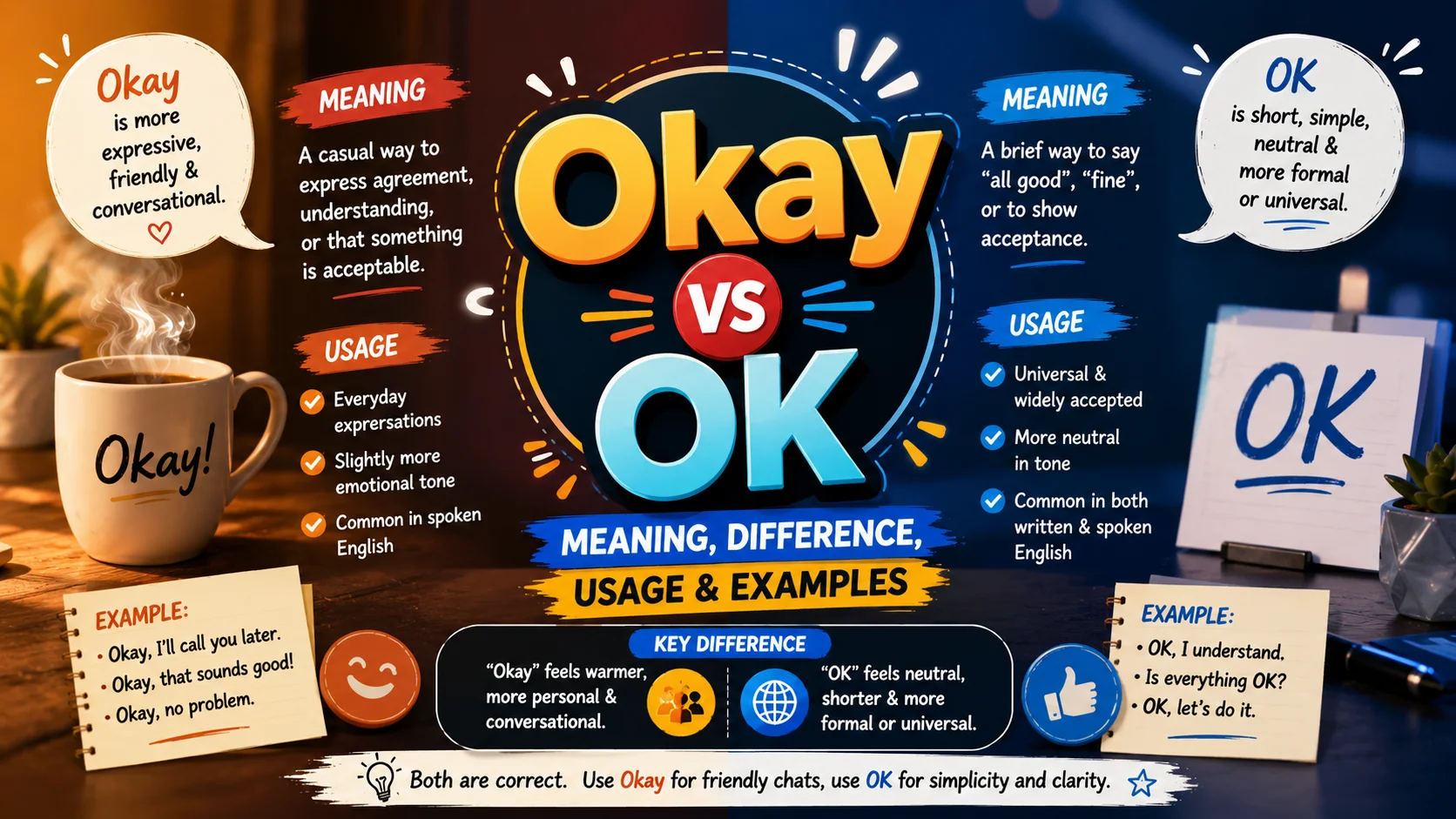
Okay vs OK is one of those English comparisons where the difference is easy to miss. Both forms are used to express agreement, approval, acceptance, understanding, or a satisfactory condition. In most everyday situations, okay and OK can be used interchangeably without changing the meaning of a sentence.
The main distinction is in form and style. Okay is the fully written form, while OK is the shorter form that has become a standard part of modern English. Both are widely recognized and accepted.
For example:
- Okay, I’ll finish it today.
- OK, I’ll finish it today.
Both sentences are correct.
However, the context can influence which form sounds more natural. OK is especially common in quick responses, messages, instructions, and confirmations, while okay can feel slightly more conversational in running prose.
Okay vs OK at a Glance
| Feature | Okay | OK |
|---|---|---|
| Basic meaning | Agreement, acceptance, or satisfactory | Same |
| Pronunciation | Oh-KAY | Oh-KAY |
| Form | Full spelling | Short form |
| Everyday use | Very common | Very common |
| Texting | Common | Extremely common |
| Professional writing | Appropriate | Appropriate |
| Formal prose | Appropriate | Appropriate |
| Main difference | Longer written form | Shorter written form |
What Does Okay Mean?
Okay can have several related meanings depending on how it is used. It can mean that something is acceptable, satisfactory, permitted, or understood.
It can also be used as a response to indicate agreement.
Examples of Okay
- Okay, I’ll call you later.
- The food was okay, but the dessert was excellent.
- Is it okay if I leave early?
- Everything is okay now.
- She said okay to the proposal.
- Okay, I understand the instructions.
| Meaning | Example |
|---|---|
| Agreement | Okay, I’ll join you. |
| Acceptance | Okay, that’s fine. |
| Permission | Is it okay if I sit here? |
| Understanding | Okay, I understand. |
| Reassurance | Everything is okay. |
| Satisfactory quality | The movie was okay. |
What Does OK Mean?
OK has essentially the same meanings as okay. It can express agreement, approval, acceptance, understanding, or a satisfactory condition.
Examples of OK
- OK, let’s begin.
- Are you OK?
- The plan is OK with me.
- OK, I understand.
- Everything is OK now.
- Is it OK if I call you tomorrow?
In these examples, OK can generally be replaced with okay without changing the meaning.
The Main Difference Between Okay and OK
The primary difference between okay and OK is not meaning. It is mainly a matter of spelling, length, and style.
Okay is the full written form.
OK is the shorter form.
| Sentence | Correct? |
|---|---|
| Okay, let’s go. | ✓ |
| OK, let’s go. | ✓ |
| Everything is okay. | ✓ |
| Everything is OK. | ✓ |
| Is this okay? | ✓ |
| Is this OK? | ✓ |
Both forms are standard English.
Is Okay or OK More Correct?
Neither one is inherently more correct.
Both okay and OK are accepted forms. Your choice can depend on the context, publication style, and the tone you want to create.
For example:
Okay, I’ll take care of it.
and
OK, I’ll take care of it.
are both grammatically acceptable.
If you’re writing a formal document, however, you may sometimes want to replace either form with a more precise expression such as:
- I agree.
- That is acceptable.
- I understand.
- Approved.
- We can proceed.
- That works for me.
Okay vs OK in Professional Writing
Both forms can appear in professional communication.
Professional Examples
Okay:
Okay, I will review the report and send my feedback tomorrow.
OK:
OK, I will review the report and send my feedback tomorrow.
Neither sentence is grammatically wrong.
However, when writing a highly formal document, a more specific phrase may sound more polished:
I confirm that the proposed changes are acceptable.
This communicates the intended meaning more precisely than simply saying okay.
| Instead of | More Professional Alternative |
|---|---|
| Okay, that’s fine. | That is acceptable. |
| OK, I’ll do it. | I will take care of it. |
| Okay, I understand. | I understand. |
| OK, approved. | The proposal has been approved. |
| Okay, we can proceed. | We can proceed as planned. |
Okay vs OK in Texting
Both forms are extremely common in text messages, but OK has an advantage because it is shorter.
| Text | Possible Tone |
|---|---|
| OK | Brief and direct |
| Okay | Neutral |
| Okay! | Friendly or positive |
| OK! | Energetic |
| Okay. | Neutral or potentially serious |
| OK. | Brief or businesslike |
The punctuation can sometimes influence how the message is perceived.
For example:
Okay! may sound enthusiastic.
Okay. may sound more serious or reserved.
However, tone always depends on the surrounding conversation.
Is Okay More Friendly Than OK?
Not necessarily.
Some readers may perceive okay as slightly softer or more conversational because it is written out fully. OK can feel shorter and more direct.
Compare:
- OK, I’ll see you tomorrow.
- Okay, I’ll see you tomorrow.
Both are friendly enough in the right context. The difference is subtle.
Punctuation, capitalization, and the rest of the message usually have a greater effect on tone than the choice between okay and OK.
Okay vs OK in Questions
Both forms work naturally in questions.
| Okay | OK |
|---|---|
| Are you okay? | Are you OK? |
| Is this okay? | Is this OK? |
| Is it okay with you? | Is it OK with you? |
| Is everything okay? | Is everything OK? |
| Would that be okay? | Would that be OK? |
Examples
- Are you okay after the trip?
- Is it okay if we reschedule?
- Would it be okay to start tomorrow?
- Is everything OK?
- Is this time OK for you?
Okay as an Adjective
Okay can function as an adjective when it describes something as acceptable, satisfactory, or safe.
Examples
- The results are okay.
- The food was okay.
- Are you okay?
- Everything is okay.
- It’s okay to ask questions.
The same construction works with OK:
- The results are OK.
- The food was OK.
- Are you OK?
- Everything is OK.
Okay as an Interjection
One of the most common uses of okay is as an interjection. It can introduce agreement, acknowledgment, or a change in the conversation.
Examples
- Okay, let’s start.
- Okay, I understand.
- Okay, what should we do next?
- Okay, that’s enough.
- Okay, I’ll think about it.
The shorter form works in the same way:
- OK, let’s start.
- OK, I understand.
- OK, what should we do next?
Okay as a Verb
Okay can also be used as a verb meaning to approve, authorize, or give permission for something.
Examples
- The manager okayed the proposal.
- The supervisor okayed the request.
- The doctor okayed the procedure.
You may also see OK’d, especially in informal writing.
| Form | Example |
|---|---|
| okayed | The manager okayed the plan. |
| OK’d | The manager OK’d the plan. |
| approved | The manager approved the plan. |
In formal writing, approved is often the clearest choice.
Okay vs OK vs O.K.
You may encounter three different forms:
- okay
- OK
- O.K.
They generally represent the same expression, but they are not equally common in modern writing.
| Form | Modern Usage |
|---|---|
| Okay | Common |
| OK | Very common |
| O.K. | Less common and somewhat old-fashioned |
For most modern writing, okay and OK are the preferred forms.
Common Expressions With Okay and OK
Both forms appear in many common expressions.
| Expression | Meaning |
|---|---|
| It’s okay | It is acceptable or fine |
| Are you okay? | Asking whether someone is safe or well |
| That’s okay | That is acceptable |
| Okay with me | I agree |
| Okay then | Acceptance or transition |
| Everything is okay | Everything is fine |
| OK with me | I agree |
| OK then | Acceptance or transition |
| Everything is OK | Everything is fine |
| All OK | Everything is satisfactory |
Examples
- That’s okay with me.
- Are you okay?
- Everything is okay now.
- OK, then we’ll continue.
- That’s OK with me.
Okay vs OK in Different Contexts
| Context | Natural Choice |
|---|---|
| Casual conversation | Okay / OK |
| Text message | OK / okay |
| Professional email | Okay / OK |
| Formal prose | Okay |
| Quick confirmation | OK |
| Written instructions | OK |
| Friendly conversation | Okay |
| Approval | OK / Approved |
| Reassurance | Okay / OK |
There is no universal rule requiring one form in every situation.
Common Mistakes With Okay and OK
Mistake 1: Thinking Only Okay Is Correct
It is incorrect to assume that OK is somehow wrong. It is a standard and widely accepted form.
Correct:
- Okay, I’ll do it.
- OK, I’ll do it.
Mistake 2: Thinking OK Is Always Informal
OK can be used in professional and standard written communication. Its suitability depends on the context.
Mistake 3: Thinking Okay Is Always More Formal
Writing the word in full does not automatically make the sentence formal.
For example:
Okay, buddy, let’s go.
is still informal.
Mistake 4: Using Okay When You Need Precision
In professional or technical writing, okay can sometimes be too vague.
Instead of:
The plan is okay.
you could write:
The plan is acceptable.
or:
The plan has been approved.
The second versions communicate a more specific idea.
Okay vs OK: Which One Should You Use?
The answer depends on what you are writing.
Use Okay When:
- You prefer the full spelling.
- You are writing conversational prose.
- You want a slightly more natural appearance in a sentence.
- Your publication style prefers words written out.
Use OK When:
- You want a shorter form.
- You are writing a quick response.
- You are confirming something.
- You are using a label, note, or short instruction.
- Your style guide prefers OK.
| Goal | Good Choice |
|---|---|
| Full spelling | Okay |
| Short response | OK |
| Casual conversation | Okay / OK |
| Professional communication | Okay / OK |
| Highly formal writing | A more precise phrase |
| Quick confirmation | OK |
Okay vs OK Examples
| Meaning | Example With Okay | Example With OK |
|---|---|---|
| Agreement | Okay, I’ll come. | OK, I’ll come. |
| Permission | Is it okay? | Is it OK? |
| Reassurance | I’m okay. | I’m OK. |
| Understanding | Okay, I understand. | OK, I understand. |
| Acceptance | That’s okay. | That’s OK. |
| Quality | The result is okay. | The result is OK. |
| Approval | The plan is okay. | The plan is OK. |
| Transition | Okay, let’s continue. | OK, let’s continue. |
Quick Memory Tip
You do not need a complicated rule to remember okay vs OK.
Simply remember:
Okay = full form
OK = shorter form
Both usually communicate the same meaning.
If you’re talking about something being satisfactory:
The plan is okay.
or
The plan is OK.
If you’re agreeing with someone:
Okay, I’ll do it.
or
OK, I’ll do it.
Both are correct.
Frequently Asked Questions
Is okay or OK correct?
Both okay and OK are correct forms in modern English. They generally have the same meaning.
Is OK more informal than okay?
Not necessarily. OK is a standard form used in both everyday and professional communication. It is simply shorter.
Is okay more formal than OK?
Not automatically. Okay is the full spelling, but formality depends on the entire context.
Which is better for formal writing: okay or OK?
Okay may fit naturally into formal prose, but in very formal writing, a precise word such as acceptable, approved, or satisfactory may be better.
Can I use OK in a professional email?
Yes. OK is widely accepted in professional communication, although some organizations may have their own style preferences.
Are okay and OK pronounced the same?
Yes. Both are normally pronounced oh-KAY.
Is O.K. correct?
O.K. is an older form that is still understandable, but OK and okay are much more common in modern English.
Can okay be used as a verb?
Yes. Okay can mean to approve or authorize something.
Example: The manager okayed the request.
Is OK better for texting?
OK is particularly convenient for texting because it is short, but okay is also very common.
What is the difference between OK and okay in a text?
Usually very little. OK is shorter, while okay may sometimes feel slightly more conversational. Context and punctuation often matter more.
Final Comparison: Okay vs OK
| Feature | Okay | OK |
|---|---|---|
| Standard form | Yes | Yes |
| Meaning | Same | Same |
| Agreement | ✓ | ✓ |
| Acceptance | ✓ | ✓ |
| Permission | ✓ | ✓ |
| Reassurance | ✓ | ✓ |
| Professional use | ✓ | ✓ |
| Texting | ✓ | ✓ |
| Formal writing | ✓ | ✓ |
| Pronunciation | Oh-KAY | Oh-KAY |
| Length | Longer | Shorter |
| Main distinction | Full spelling | Short form |
Conclusion
The difference between okay vs OK is mainly a matter of form and style rather than meaning. Both are standard English forms and can express agreement, acceptance, approval, understanding, or a satisfactory condition.
Okay is the full spelling, while OK is the shorter form. Both are appropriate in many everyday and professional situations.
If you are writing a sentence such as Okay, I’ll send the report or OK, I’ll send the report, neither version is incorrect. Choose the form that fits your preferred style and the context.
For highly formal or professional writing, consider whether a more precise expression would communicate your meaning better. Words such as acceptable, approved, satisfactory, agreed, or confirmed can sometimes provide more clarity than either okay or OK.
The easiest rule is:
Okay = full form
OK = short form
Both are correct.

Olivia Bennett is a writer and language enthusiast at Vocabsteria. She is passionate about exploring word meanings, name origins, and cultural expressions from around the world.