Have you ever written strait when you meant straight? These two words look remarkably similar and are pronounced alike in many varieties of English, but their meanings are completely different. One can describe a narrow passage of water, while the other can describe direction, shape, honesty, or something direct.
The confusion between strait and straight is especially common because the extra gh in “straight” can be easy to overlook. However, knowing the context makes the correct spelling much easier to identify.
In this guide, you’ll discover exactly when to use strait and straight, how their meanings differ, which phrases commonly use each word, and simple tricks for remembering the correct spelling.
🔤 Strait or Straight? The Difference at a Glance
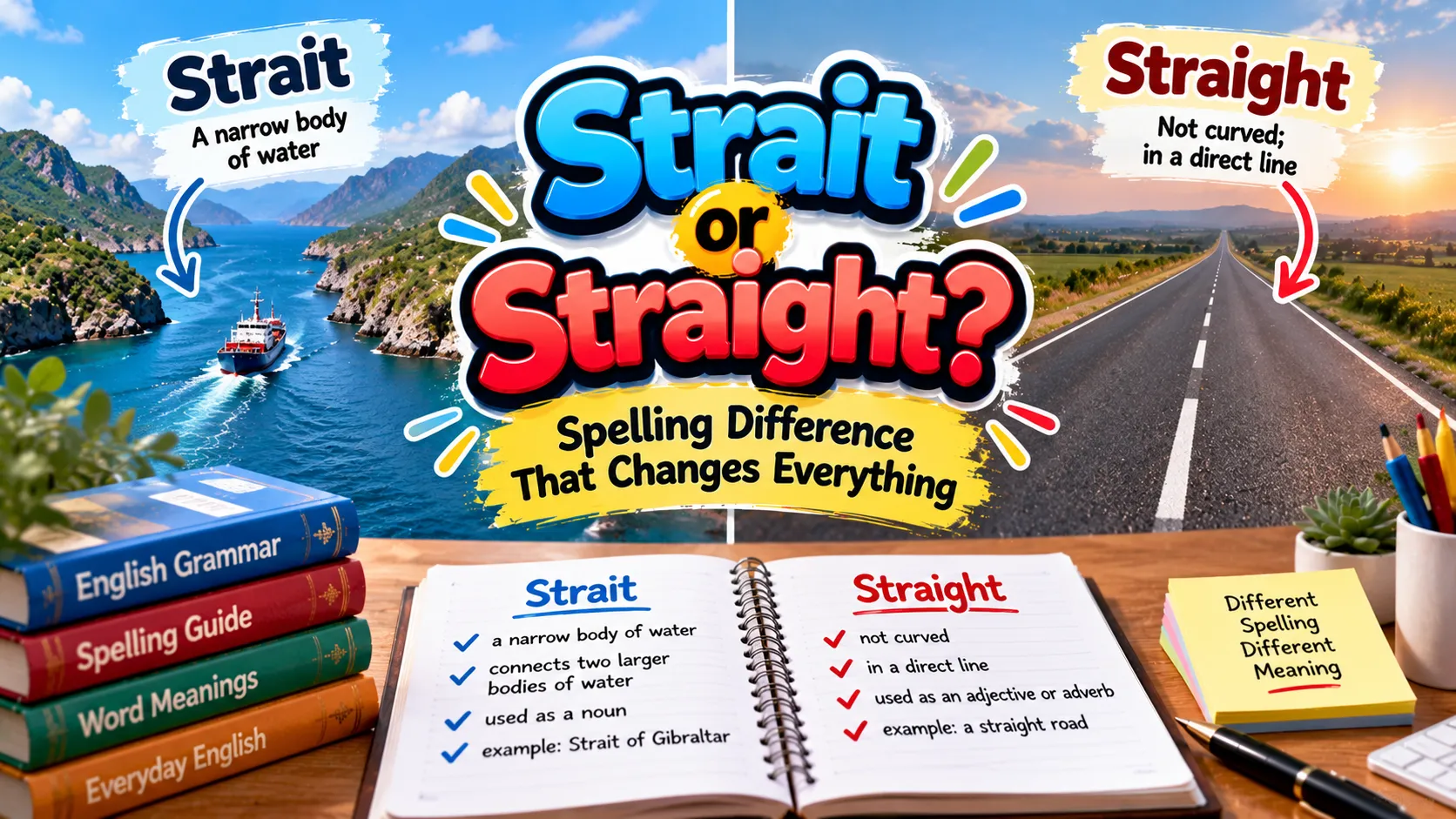
The easiest way to separate strait and straight is to connect each word with its most common meaning. Straight is used for direction, shape, honesty, and directness, while strait is mainly associated with a narrow passage of water or a difficult situation.
| Word | Meaning | Part of Speech | Example |
|---|---|---|---|
| Straight | Not curved or bent; direct; honest | Adjective, Adverb, Noun, Verb | Walk straight ahead. |
| Strait | A narrow passage of water connecting larger bodies of water; a difficult situation | Noun, Adjective | The ship crossed the strait. |
Quick rule:
Straight = direct, level, or not curved
Strait = narrow passage or difficult situation
📖 What Does Straight Mean?
Straight is a highly versatile English word with several meanings. It can describe something that is not curved or bent, a direct direction, an honest statement, or something uncomplicated and direct.
Examples include:
- Draw a straight line.
- Walk straight ahead.
- She has straight hair.
- Give me a straight answer.
- The road is straight for several miles.
- He went straight home.
Because straight has many meanings, it appears frequently in everyday English, academic writing, instructions, and conversation.
🌊 What Does Strait Mean?
A strait is a narrow passage of water that connects two larger bodies of water. It is primarily a geographical term and is usually used as a noun.
For example:
- The ship passed through the strait.
- The Strait of Gibraltar connects the Atlantic Ocean and the Mediterranean Sea.
- The vessel entered the narrow strait.
- Several important trade routes pass through the strait.
The word strait can also appear in the phrase in dire straits, meaning to be in a very difficult or serious situation.
⚖️ Strait vs Straight Comparison Table
Although these words differ by only a few letters, their meanings are far apart. This table shows the main differences so you can quickly choose the correct word.
| Feature | Straight | Strait |
|---|---|---|
| Main meaning | Direct, level, or not curved | Narrow passage of water |
| Common part of speech | Adjective, adverb, noun, verb | Noun, sometimes adjective |
| Common context | Direction, shape, honesty, movement | Geography, waterways |
| Example | The road is straight. | The ship crossed the strait. |
| Common phrase | straight line | Strait of Gibraltar |
| Figurative use | Very common | “In dire straits” |
| Related idea | Directness | Narrowness or difficulty |
| Spelling clue | Contains gh | No gh |
🗣️ Are Strait and Straight Pronounced the Same?
For most English speakers, strait and straight are pronounced the same.
| Word | Common Pronunciation | Syllables |
|---|---|---|
| Strait | /streɪt/ | 1 |
| Straight | /streɪt/ | 1 |
Because they are homophones, pronunciation cannot tell you which spelling to use. You must look at the meaning and context.
For example:
The road is straight.
versus:
The ship entered the strait.
The two words sound alike, but their meanings are completely different.
🛣️ When Should You Use Straight?
Use straight when you are describing something that is not curved, bent, twisted, or angled. It can also describe direct movement or an uncomplicated route.
Examples:
- Draw a straight line.
- Keep your back straight.
- The road runs straight through town.
- She walked straight toward the door.
- Turn straight left after the bridge.
- The arrow flew straight toward the target.
In these examples, straight expresses shape or direction.
🧭 Straight as a Direction
One of the most common uses of straight is to describe movement in a direct line.
Common expressions include:
- Go straight ahead.
- Walk straight forward.
- Drive straight down the road.
- Go straight home.
- Look straight ahead.
- Move straight toward the exit.
- Continue straight.
For example:
After the traffic light, drive straight for two miles.
Here, straight tells someone to continue directly without turning.
📏 Straight as a Shape
Straight can describe lines, objects, roads, hair, posture, or anything that lacks a curve or bend.
Examples:
- a straight line
- a straight road
- straight hair
- a straight stick
- a straight edge
- a straight path
- a straight posture
Example:
The carpenter cut a straight piece of wood.
Here, straight describes the shape of the wood.
💬 Straight Meaning “Direct or Honest”
The word straight also has a figurative meaning connected with directness and honesty.
For example:
- Give me a straight answer.
- I want a straight explanation.
- She gave him a straight response.
- He is known for being straight with his employees.
- Let me be straight with you.
In these sentences, straight means direct, honest, or without unnecessary complications.
🌊 When Should You Use Strait?
Use strait when talking about a narrow waterway connecting two larger bodies of water. This is its most important modern geographical meaning.
Examples:
- The ship crossed the strait.
- The strait separates the two regions.
- The navy controls the strait.
- The vessel entered the narrow strait.
- The strait is an important shipping route.
Famous examples:
- Strait of Gibraltar
- Strait of Hormuz
- Bering Strait
- Bosporus Strait
- Torres Strait
- Taiwan Strait
These geographical names all use strait because they refer to waterways.
🌍 Famous Straits You Should Know
The word strait appears in the names of many important waterways around the world. Learning a few examples can help reinforce the correct spelling.
| Strait | General Location |
|---|---|
| Strait of Gibraltar | Between Spain and Morocco |
| Strait of Hormuz | Between Iran and Oman |
| Bering Strait | Between Russia and Alaska |
| Torres Strait | Between Australia and New Guinea |
| Taiwan Strait | Between Taiwan and mainland China |
| Cook Strait | Between New Zealand’s North and South Islands |
| Bass Strait | Between mainland Australia and Tasmania |
If you are writing about one of these waterways, strait is the correct spelling.
🚢 Strait in Geography and Navigation
In geography, a strait is a naturally occurring narrow water passage that connects larger bodies of water. Straits can be important for transportation, trade, navigation, and regional geography.
For example:
The Strait of Gibraltar is an important maritime passage.
Or:
Commercial ships frequently travel through the Strait of Hormuz.
In these contexts, using straight would be a spelling error.
😟 Strait in “Dire Straits”
There is another important meaning of strait that is not related to geography. In the expression in dire straits, the word means a difficult, dangerous, or troubling situation.
Examples:
- The company is in dire straits.
- After losing his job, the family was in dire straits.
- The organization found itself in dire financial straits.
- The project was in serious straits.
The expression is relatively formal and often describes serious difficulties.
Remember:
Dire straits = serious trouble
🚫 Common Mistake: Straight of Gibraltar
One of the most noticeable spelling mistakes is writing Straight of Gibraltar.
❌ Straight of Gibraltar
✅ Strait of Gibraltar
The correct geographical term is Strait of Gibraltar because it refers to a narrow water passage.
The same rule applies to other geographical names:
- ❌ Straight of Hormuz
- ✅ Strait of Hormuz
- ❌ Bering Straight
- ✅ Bering Strait
- ❌ Taiwan Straight
- ✅ Taiwan Strait
🚫 Common Mistake: Strait Line
Another common mistake is writing strait line when you mean a line without curves.
❌ Draw a strait line.
✅ Draw a straight line.
The word straight is correct because the line is not curved or bent.
More examples:
❌ Walk in a strait line.
✅ Walk in a straight line.
❌ Keep the road strait.
✅ Keep the road straight.
🧠 Easy Trick to Remember Strait and Straight
A simple spelling trick can make these words much easier to remember.
Think:
STRAIGHT has “GH” → Straight lines go forward.
The longer spelling straight is the word you need for lines, roads, directions, and directness.
For strait, think:
STRAIT = narrow waterway
You can associate strait with geographical names such as:
Bering Strait
Hormuz Strait
Taiwan Strait
The simplest memory rule:
Straight = line
Strait = water
🔍 Strait vs Straight in Different Contexts
Context is the fastest way to identify the correct spelling. This table covers common situations where writers may hesitate between the two words.
| Context | Correct Word | Example |
|---|---|---|
| A line without curves | Straight | Draw a straight line. |
| A direct route | Straight | Go straight ahead. |
| Direct answer | Straight | Give me a straight answer. |
| Straight hair | Straight | She has straight hair. |
| Narrow waterway | Strait | The ship crossed the strait. |
| Geographic water passage | Strait | The Bering Strait is important. |
| Serious difficulty | Straits | They are in dire straits. |
| Direct movement | Straight | Walk straight toward the exit. |
🆚 Straight vs Direct
Straight and direct can sometimes be synonyms, especially when describing movement, communication, or routes. However, they are not identical in every context.
| Straight | Direct |
|---|---|
| Walk straight ahead. | Take a direct route. |
| Give me a straight answer. | Give me a direct answer. |
| The road is straight. | The route is direct. |
Direct often emphasizes efficiency or lack of intermediaries, while straight can emphasize a literal line or directness.
🆚 Strait vs Narrow
Strait and narrow are related because a strait is typically a narrow passage. However, they have different grammatical roles and meanings.
Narrow is usually an adjective:
The passage is narrow.
Strait is generally a noun when referring to a waterway:
The ship crossed the strait.
You should not replace strait with narrow when naming a specific geographical waterway.
✍️ Straight in Everyday Expressions
The word straight appears in many common English expressions.
Examples:
- straight ahead
- straight away
- straight home
- straight line
- straight path
- straight answer
- straight talk
- straight face
- straight from the source
- straight to the point
- straight through
- straight out
- straight back
- straight forward
Examples:
Please get straight to the point.
She went straight home after work.
He answered with a straight face.
📚 Strait in Common Expressions
Although strait is less common than straight, it appears in several established expressions.
Examples:
- in dire straits
- financial straits
- narrow straits
- a maritime strait
- a geographical strait
- a navigable strait
The most familiar figurative expression is:
in dire straits
This means being in a very difficult or serious situation.
📝 Strait or Straight in Example Sentences
Seeing the words in complete sentences can help you recognize their meanings immediately.
Straight:
- The road is perfectly straight.
- Walk straight ahead.
- She drew a straight line.
- He gave me a straight answer.
- The arrow flew straight toward the target.
- She has naturally straight hair.
Strait:
- The ship entered the strait.
- The Strait of Gibraltar is strategically important.
- They sailed through the narrow strait.
- The vessel crossed the Bering Strait.
- The company is in dire straits.
📊 Correct Word by Meaning
When you’re unsure about the spelling, identify the intended meaning first.
| If You Mean… | Use | Example |
|---|---|---|
| Not curved | Straight | A straight road |
| Direct | Straight | A straight answer |
| Directly forward | Straight | Go straight ahead |
| Honest | Straight | Be straight with me |
| Narrow waterway | Strait | The Strait of Gibraltar |
| Difficult situation | Straits | In dire straits |
| Water passage | Strait | A busy shipping strait |
🎯 How to Choose the Correct Spelling
Ask yourself one simple question:
Am I talking about a line, direction, directness, or shape?
If yes, use straight.
Walk straight ahead.
Am I talking about a narrow water passage?
If yes, use strait.
The ship crossed the strait.
If you are describing a difficult situation using the established expression, use straits.
The business is in dire straits.
This meaning-first approach is much more reliable than trying to remember the spelling by pronunciation.
🇺🇸 Strait vs Straight in American English
In American English, straight is an extremely common word used for direction, shape, behavior, communication, and many idiomatic expressions. Strait appears less frequently in everyday conversation and is most often encountered in geographical or formal contexts.
American English examples include:
“Go straight ahead.”
“Give me a straight answer.”
“The ship passed through the strait.”
“The company is in dire straits.”
Because both words are pronounced alike, correct spelling remains important in written American English.
🧩 Quick Practice: Strait or Straight?
Test yourself by choosing the correct word in each sentence.
- Walk ___ ahead until you reach the corner.
Answer: straight - The ship crossed the ___ between the two seas.
Answer: strait - Please draw a ___ line.
Answer: straight - The company was in ___ financial straits.
Answer: dire - The vessel entered the narrow ___.
Answer: strait - Give me a ___ answer.
Answer: straight - She has naturally ___ hair.
Answer: straight - The Bering ___ separates Russia and Alaska.
Answer: Strait
❓ Frequently Asked Questions About Strait vs Straight
These questions address the most common spelling, grammar, geography, and usage concerns about strait and straight.
What is the difference between strait and straight?
Straight means not curved, direct, or straightforward. Strait usually means a narrow passage of water connecting larger bodies of water. It can also appear in in dire straits, meaning serious difficulty.
Is Strait of Gibraltar or Straight of Gibraltar correct?
The correct name is Strait of Gibraltar.
Is it Bering Strait or Bering Straight?
The correct geographical name is Bering Strait.
Are strait and straight pronounced the same?
Yes. For most English speakers, both are pronounced /streɪt/.
Is straight an adjective?
Yes. Straight can function as an adjective, adverb, noun, and verb depending on the sentence.
Is strait a noun?
Yes. Strait is commonly a noun when referring to a narrow waterway. It can also have an adjective use in older or formal English.
What does “in dire straits” mean?
In dire straits means being in a very difficult, serious, or troubling situation.
What is an example of straight?
“Please walk straight ahead.” Here, straight describes direct movement.
What is an example of strait?
“The ship sailed through the strait.” Here, strait refers to a narrow water passage.
How do you remember strait vs straight?
Remember straight = line or direction and strait = narrow waterway. The extra letters in straight can remind you of a long, direct line.
Can straight mean honest?
Yes. In expressions such as give me a straight answer or be straight with me, straight can mean honest and direct.
Can strait mean difficult?
Yes, particularly in the plural expression straits, as in in dire straits.
🏁 Conclusion
The difference between strait and straight becomes much easier when you focus on their meanings. Straight is used for things that are not curved, direct movement, direct communication, and many related expressions. Strait usually refers to a narrow passage of water and also appears in the expression in dire straits.
Remember this simple rule:
Straight = line, direction, or directness
Strait = narrow waterway
So write:
“Walk straight ahead.”
But:
“The ship crossed the strait.”
And when talking about serious difficulties:
“The company is in dire straits.”
Once you connect straight with lines and strait with waterways, this commonly confused pair becomes much easier to use correctly.

Olivia Bennett is a writer and language enthusiast at Vocabsteria. She is passionate about exploring word meanings, name origins, and cultural expressions from around the world.