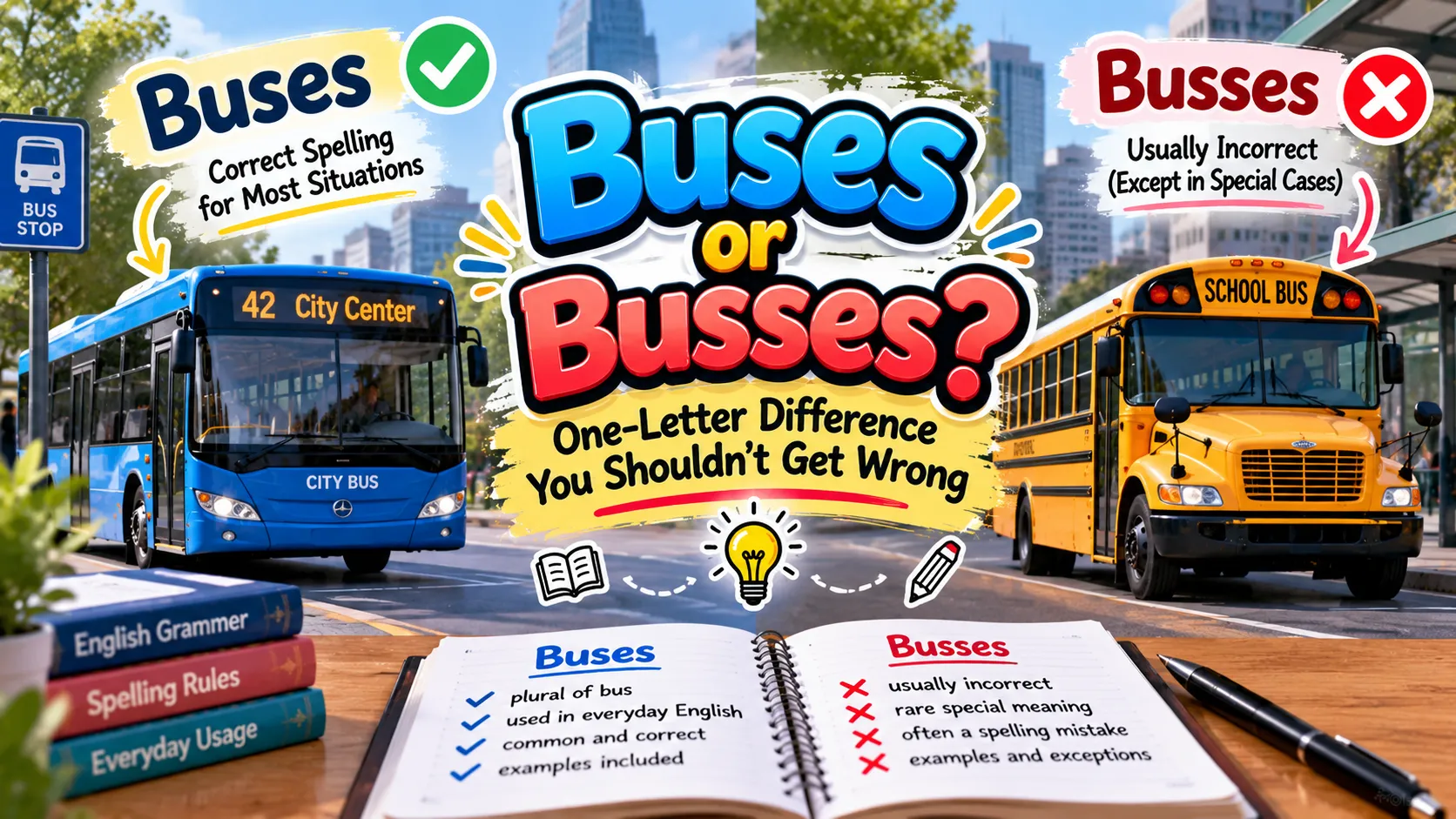
Is the plural of bus spelled buses or busses? You may have seen both forms and wondered whether one is a spelling mistake. The answer is a little more interesting than it first appears.
In modern American English, buses is the standard and overwhelmingly preferred plural of bus. Busses has historically appeared as a variant, but it is much less common and can create confusion because buss is also an old word meaning a kiss.
Understanding buses vs busses is useful for students, writers, editors, and anyone working on professional or academic content. In most ordinary writing, choosing buses is the safest option.
🚌 Buses or Busses? The Quick Answer
If you are talking about more than one vehicle used to transport passengers, use buses.
| Word | Meaning | Standard Plural? | Example |
|---|---|---|---|
| Bus | A vehicle for transporting passengers | Singular | The bus arrived. |
| Buses | More than one bus | ✅ Standard plural | Three buses arrived. |
| Busses | Historical/variant spelling; can also relate to “buss” | ⚠️ Less common | The older spelling is rarely needed. |
Easy rule:
One bus → two buses
For modern American English, buses is the preferred spelling.
📖 Why Is the Plural of Bus Buses?
The noun bus normally forms its plural by adding -es because the word ends in s.
So:
bus → buses
This follows a familiar English spelling pattern:
- bus → buses
- class → classes
- glass → glasses
- box → boxes
- dish → dishes
- church → churches
The ending -es makes the plural easier to pronounce and represents the additional syllable heard in buses.
⚖️ Buses vs Busses Comparison Table
The two spellings are often confused, but modern usage strongly favors buses for the plural of the transportation noun.
| Feature | Buses | Busses |
|---|---|---|
| Meaning | More than one bus | Rare/variant spelling |
| Standard modern plural | ✅ Yes | ⚠️ Less common |
| American English | Preferred | Uncommon |
| Pronunciation | /ˈbʌsɪz/ | Usually similar when intended as plural |
| Common context | Public transportation | Historical or variant usage |
| Example | The buses are late. | Busses is rarely needed. |
🔤 Bus, Buss, Buses, and Busses
One reason this spelling issue is confusing is that bus and buss have both existed as English words.
A bus is a passenger vehicle.
A buss is an old-fashioned word meaning a kiss, and it can also appear as a verb meaning to kiss.
This creates a distinction:
| Word | Meaning |
|---|---|
| Bus | Passenger vehicle |
| Buses | More than one passenger vehicle |
| Buss | A kiss; an old-fashioned word |
| Busses | Plural or verb forms associated with buss in certain uses |
For everyday modern English, however, if you mean passenger vehicles, buses is the word to choose.
🗣️ How Do You Pronounce Buses?
The plural buses is generally pronounced with two syllables:
BUS-iz
Phonetically, it is commonly represented as /ˈbʌsɪz/.
Examples:
- one bus
- two buses
- several buses
The plural ending creates an extra syllable.
🚍 How to Use Buses in a Sentence
Use buses whenever you are referring to more than one passenger bus.
Examples:
- The buses arrived at the station.
- Several buses were waiting outside.
- The city operates hundreds of buses.
- School buses lined up near the entrance.
- The buses were delayed because of traffic.
- Two buses stopped at the same station.
In each sentence, buses is the standard plural spelling.
🚫 Common Mistake: Writing Busses for Vehicles
One of the most common mistakes is adding -es incorrectly as busses.
Incorrect in standard modern usage:
Five busses arrived at the station.
Preferred:
Five buses arrived at the station.
The correct modern plural of the transportation noun bus is buses.
🏫 Buses in Everyday American English
The word buses appears frequently in American English because buses are used for public transportation, school transportation, tourism, and long-distance travel.
Common phrases include:
- school buses
- city buses
- public buses
- transit buses
- tour buses
- shuttle buses
- passenger buses
- electric buses
- buses and trains
- buses at the station
Examples:
The city is adding more electric buses.
Several school buses arrived before 8 a.m.
🚌 School Buses or School Busses?
The standard spelling is:
school buses
Not:
school busses
Examples:
- The school buses arrived early.
- Yellow school buses lined the parking lot.
- The district purchased several new school buses.
- The children waited for their school buses.
This is one of the most common contexts where the spelling question arises.
🚏 City Buses or City Busses?
When talking about public transportation, use city buses.
Examples:
- The city added more city buses.
- City buses run throughout the downtown area.
- The new city buses use electric power.
- Several city buses were delayed.
Again, buses is the standard plural.
📚 Buses in Formal Writing
In academic, business, government, and professional writing, buses is the appropriate modern spelling when referring to multiple passenger vehicles.
Examples:
The transportation department operates 250 buses.
The study examined the efficiency of electric buses.
Several buses were inspected before entering service.
Using busses in these contexts may look outdated or simply like a spelling error to many readers.
🧠 Easy Trick to Remember Buses
A simple memory trick is:
One BUS → many BUSES
Think of the extra E as part of the standard plural spelling.
You can compare it with:
- bus → buses
- class → classes
- glass → glasses
- dress → dresses
- box → boxes
When the noun ends in a sound that typically takes -es, the plural spelling often uses -es.
🔍 Why Not Busses?
You might reasonably wonder why English doesn’t simply use busses, especially because words ending in s often add -es.
The answer is partly historical. English has had different forms of the word over time, and buss existed separately as a word meaning a kiss. Modern English settled primarily on bus for the vehicle, with buses as its standard plural.
So although busses can be found in historical or variant usage, buses is the normal modern form.
🆚 Buses vs Buss
This distinction is important because buss is a separate word.
| Word | Meaning | Example |
|---|---|---|
| Bus | Passenger vehicle | The bus is here. |
| Buses | Multiple passenger vehicles | The buses are here. |
| Buss | Kiss; archaic/literary | He gave her a buss. |
| Busses | Forms related to buss | Rare in modern writing |
Unless you are intentionally using historical or literary vocabulary, buss and busses are unlikely to be the words you need.
📖 Is Busses Ever Correct?
Busses can occur as a legitimate English form in certain contexts, particularly as a form of the separate word buss or as a historical/variant spelling of the plural of bus.
However, if your intended meaning is simply “more than one passenger bus,” modern standard usage strongly favors:
buses
For general writing, there is little reason to choose busses when referring to transportation vehicles.
✍️ Buses in Different Sentences
Here are some natural examples of the standard plural:
- The buses leave every thirty minutes.
- Several buses stopped outside the hotel.
- The school owns twelve buses.
- The new buses are more fuel-efficient.
- We waited for the buses after the concert.
- The buses were crowded during rush hour.
- Electric buses are becoming more common.
- The transit system replaced older buses.
📊 Correct Word by Context
Use this table whenever you’re unsure which spelling belongs in your sentence.
| Meaning | Correct Form | Example |
|---|---|---|
| One passenger vehicle | Bus | The bus arrived. |
| More than one passenger vehicle | Buses | The buses arrived. |
| Public transportation | Buses | City buses are busy. |
| School transportation | Buses | School buses arrived. |
| Multiple shuttle vehicles | Buses | Shuttle buses run every hour. |
| Old word meaning kiss | Buss | A buss is an old-fashioned kiss. |
| Forms related to the word buss | Busses | Rare/literary usage |
🌎 Buses in American English
In modern American English, buses is the standard plural spelling of bus. It is used across newspapers, websites, educational materials, transportation documents, and everyday communication.
Examples:
“The buses will arrive at 7:30.”
“Several buses were delayed.”
“The city purchased new electric buses.”
For ordinary American English writing, buses is the form you should normally use.
🔄 Bus Plural Rules
The plural of bus follows a pattern that can be compared with several other English nouns.
| Singular | Plural |
|---|---|
| Bus | Buses |
| Class | Classes |
| Glass | Glasses |
| Dress | Dresses |
| Kiss | Kisses |
| Box | Boxes |
| Dish | Dishes |
The important point is that bus becomes buses, not normally busses, when forming the modern standard plural.
📝 Buses in Professional and Academic Sentences
When writing formally about transportation, buses is the natural choice.
Examples:
- The agency operates more than 500 buses.
- The study evaluated fuel efficiency in public buses.
- The district plans to replace older buses.
- Electric buses may reduce operating costs.
- The transportation network includes trains and buses.
Using the standard spelling makes your writing look polished and conventional.
🧩 Quick Practice: Buses or Busses?
Test yourself with these sentences.
- The ___ arrived at the station.
Answer: buses - Several school ___ were parked outside.
Answer: buses - The city operates electric ___.
Answer: buses - We waited for the ___ after the game.
Answer: buses - The transportation department purchased new ___.
Answer: buses - The old-fashioned word for a kiss is ___.
Answer: buss - If you mean multiple passenger vehicles, use ___.
Answer: buses
❓ Frequently Asked Questions About Buses vs Busses
These questions cover common spelling and grammar concerns about the plural form of bus.
Is it buses or busses?
For the modern plural of the transportation noun bus, the standard spelling is buses.
Is busses a correct word?
Busses can occur as a historical or variant form and can also relate to the separate word buss, meaning a kiss. However, buses is the normal modern spelling for multiple passenger vehicles.
Why is the plural of bus buses?
The standard plural is formed with -es, giving bus → buses.
Is buses correct in American English?
Yes. Buses is the standard plural form in modern American English.
Should I write school buses or school busses?
Write school buses when referring to multiple school transportation vehicles.
Is it city buses or city busses?
The standard modern form is city buses.
How do you pronounce buses?
Buses is generally pronounced with two syllables, approximately “BUS-iz.”
What is the singular of buses?
The singular is bus.
What is the plural of bus?
The standard plural is buses.
What does buss mean?
Buss is an old-fashioned or literary word meaning a kiss. It can also function as a verb meaning to kiss.
Is busses ever used for buses?
Yes, busses has appeared as a variant spelling, but it is much less common. For modern standard writing, buses is the preferred form for transportation vehicles.
Why do some people spell buses as busses?
The spelling busses has historical support and may also arise by analogy with other nouns ending in s. However, modern usage overwhelmingly favors buses for the plural of bus.
🏁 Conclusion
If you’re wondering whether the plural of bus is buses or busses, the answer for modern standard English is straightforward: buses is the preferred spelling when you mean multiple passenger vehicles.
Although busses can be found in historical or variant usage and is also connected to the separate word buss, it is not the spelling you normally want in everyday American English.
Remember:
One bus → two buses
So write:
“The buses arrived at the station.”
rather than:
“The busses arrived at the station.”
For school buses, city buses, public buses, shuttle buses, and transit buses, buses is the clear modern choice.

Olivia Bennett is a writer and language enthusiast at Vocabsteria. She is passionate about exploring word meanings, name origins, and cultural expressions from around the world.