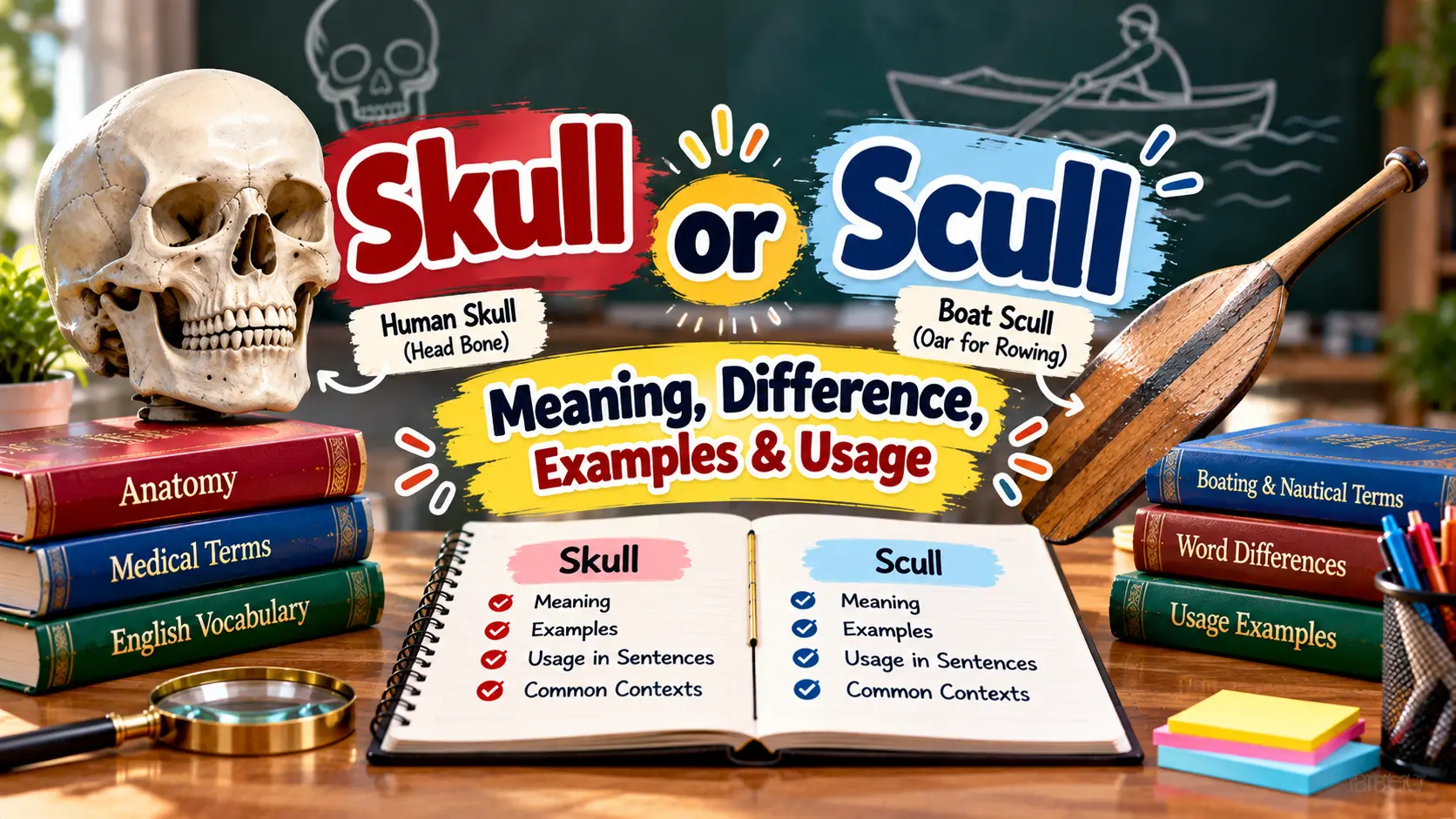
Skull and scull are two English words that look and sound very similar, but they have completely different meanings. Skull refers to the bony structure of the head, while scull can refer to an oar used for rowing or to the action of moving a boat with such an oar.
Understanding skull vs scull is especially useful for students, writers, and English learners because a single letter changes the meaning entirely. If you are talking about anatomy, bones, or the head, skull is the correct word. If you are discussing rowing, boats, or a type of oar, scull is usually the word you need.
This guide explains the difference between skull and scull, including their meanings, pronunciation, grammar, examples, common mistakes, and easy ways to remember which spelling to use.
🔤 Skull vs Scull: Quick Difference
The simplest way to distinguish these words is to connect skull with the human head and scull with rowing. Although they are homophones for many speakers, their meanings are unrelated.
| Word | Meaning | Part of Speech | Example |
|---|---|---|---|
| Skull | The bony structure forming and protecting the head | Noun | The helmet protected his skull. |
| Scull | An oar used for rowing or the act of rowing with one | Noun / Verb | He learned to scull on the lake. |
Easy rule:
Skull = head and bones
Scull = rowing and oar
🦴 What Does Skull Mean?
A skull is the bony framework of the head. It protects the brain and supports structures such as the face, eyes, and jaw. In everyday English, skull is commonly used when discussing anatomy, injuries, fossils, skeletons, or protective equipment.
Examples:
- The helmet protected his skull.
- The X-ray showed a fracture in the skull.
- The human skull contains many individual bones.
- Scientists discovered an ancient animal skull.
- The injury affected the front of the skull.
The word skull is a noun.
🚣 What Does Scull Mean?
Scull has several related meanings connected with rowing. As a noun, a scull can refer to a narrow boat designed for rowing or an oar used to propel a boat.
As a verb, to scull means to propel a boat using one or two oars, depending on the particular rowing technique.
Examples:
- She learned to scull on the river.
- He used a scull to move the boat.
- The athlete practiced sculling every morning.
- They rented a small scull for the afternoon.
- The rower handled the scull with skill.
The meaning is determined by context.
⚖️ Skull vs Scull Comparison Table
This table shows the main differences between the two words. The spelling is similar, but their meanings, contexts, and grammatical uses are different.
| Feature | Skull | Scull |
|---|---|---|
| Main meaning | Bony structure of the head | Oar, rowing boat, or rowing action |
| Part of speech | Noun | Noun / Verb |
| Main context | Anatomy, medicine, skeletons | Rowing, boating, sports |
| Related to body? | Yes | No |
| Related to boats? | No | Yes |
| Example | He injured his skull. | She learned to scull. |
| Plural | Skulls | Sculls |
| Verb form | Not normally used as a rowing verb | Scull, sculls, sculled, sculling |
🗣️ Skull vs Scull Pronunciation
For many English speakers, skull and scull are pronounced exactly the same.
| Word | Pronunciation | Syllables |
|---|---|---|
| Skull | /skʌl/ | 1 |
| Scull | /skʌl/ | 1 |
Because they are pronounced alike, they are homophones in standard pronunciation for many speakers.
This means spelling and context are especially important.
🧠 Why Are Skull and Scull Confused?
The words are confusing because they:
- Have nearly identical spelling
- Have the same pronunciation for many speakers
- Differ by only one letter
- Both function as nouns
- Appear in specialized vocabulary
However, their meanings are easy to separate once you associate each word with its subject.
Skull → anatomy
Scull → rowing
🦴 How to Use Skull in a Sentence
Use skull when talking about the bony structure of a person’s or animal’s head.
Examples:
- The doctor examined the patient’s skull.
- The helmet provides protection for the skull.
- Archaeologists found an ancient skull.
- The animal had a large skull.
- The impact caused a skull fracture.
- The museum displayed a dinosaur skull.
Common phrases with skull:
- skull fracture
- skull bone
- human skull
- animal skull
- skull injury
- skull anatomy
- skull structure
- skull protection
- skull shape
- skull fossil
🚣 How to Use Scull in a Sentence
Use scull when talking about rowing or a rowing-related piece of equipment.
Examples:
- He learned how to scull on the lake.
- The coach taught her proper sculling technique.
- She picked up the scull and prepared to row.
- The team practiced sculling before the race.
- He bought a new pair of sculls for training.
In rowing terminology, sculling generally involves using two oars, one in each hand, while sweep rowing generally uses one oar per rower.
🛶 Scull as a Boat
A scull can also refer to a narrow boat designed for rowing. The exact use can depend on the rowing context and regional terminology.
Examples:
- The athlete trained in a single scull.
- They launched the scull early in the morning.
- The racing scull moved quickly across the water.
- She practiced balance in the scull.
In competitive rowing, terms such as single scull, double scull, and quadruple scull are commonly used for boats with different numbers of rowers.
🏆 Sculling in Rowing
Sculling is a rowing technique in which a rower uses two oars. It is an important term in competitive and recreational rowing.
Common rowing terms include:
| Term | Meaning |
|---|---|
| Scull | A small rowing boat or oar |
| Sculling | Rowing with two oars |
| Single scull | Boat for one rower |
| Double scull | Boat for two rowers |
| Quadruple scull | Boat for four rowers |
| Oar | Equipment used to propel a boat |
| Rowing | Sport or activity involving oars |
This context makes scull much easier to identify.
🚫 Common Mistake: Skull Instead of Scull
Writers sometimes use skull when they are discussing rowing.
Incorrect:
She learned how to skull across the lake.
If the intended meaning is the rowing technique, the standard spelling is:
She learned how to scull across the lake.
The word scull is connected to rowing.
🚫 Common Mistake: Scull Instead of Skull
The opposite mistake occurs when discussing anatomy.
Incorrect:
The helmet protected his scull.
Correct:
The helmet protected his skull.
The bones of the head are the skull, not the scull.
🧠 Easy Trick to Remember Skull and Scull
Use the extra K in skull as a memory clue.
Think:
SKULL → K for “Kranium” / head bones
Although “Kranium” is not the standard English spelling, the visual association can help you remember that skull belongs to anatomy.
For scull, think:
SCULL → SC = sculling
The word sculling contains the same spelling pattern as scull.
Simple memory rule:
Skull = head
Scull = boat
🔍 Skull vs Scull in Different Contexts
The surrounding context usually tells you which word is correct. This table provides quick examples from different subjects.
| Context | Correct Word | Example |
|---|---|---|
| Human anatomy | Skull | The skull protects the brain. |
| Medical injury | Skull | He suffered a skull fracture. |
| Archaeology | Skull | Researchers discovered a human skull. |
| Fossils | Skull | The fossilized skull was carefully examined. |
| Helmet protection | Skull | The helmet protects the skull. |
| Rowing sport | Scull | She practices sculling. |
| Rowing boat | Scull | The athlete entered the single scull. |
| Rowing equipment | Scull | He carried his sculls to the dock. |
| Boat movement | Scull | They sculled across the water. |
🧬 Skull in Medical and Scientific English
The word skull is common in medical, anatomical, biological, and archaeological writing. It may appear in discussions about bones, injuries, fossils, development, and anatomy.
Common expressions include:
- skull fracture
- skull injury
- skull anatomy
- skull bone
- skull base
- skull structure
- skull shape
- human skull
- animal skull
- fossil skull
Example:
The researchers examined the skull structure to identify the species.
Here, skull clearly refers to the anatomical structure.
🏺 Skull in Archaeology and Paleontology
Archaeologists and paleontologists often use skull when describing human or animal remains. Fossilized skulls can provide important information about anatomy and species.
Examples:
- The archaeologists discovered a human skull.
- The fossil skull was carefully preserved.
- Researchers examined the animal’s skull.
- The museum displayed a reconstructed skull.
Again, scull would be incorrect in these contexts.
🏅 Scull in Competitive Rowing
Competitive rowing uses scull and sculling as important technical terms. A single scull generally accommodates one rower, while other sculling boats can accommodate multiple rowers.
Common terms include:
- single scull
- double scull
- quadruple scull
- sculling boat
- sculling oars
- sculling technique
- sculling race
- sculling practice
Examples:
- She competes in single sculling events.
- The team practiced in a quadruple scull.
- He trained with a lightweight sculling boat.
🆚 Skull vs Cranium
If you are studying anatomy, you may also encounter cranium. While skull is a common everyday term, cranium is a more technical anatomical term.
| Word | Meaning |
|---|---|
| Skull | The complete bony framework of the head |
| Cranium | The part of the skull that encloses and protects the brain |
For everyday writing, skull is generally the more familiar word.
🆚 Scull vs Oar
Scull and oar are related but should not always be treated as exact synonyms.
An oar is a broad term for a pole-like implement used to propel a boat through water.
A scull can refer specifically to an oar used in sculling or to a type of rowing boat.
Examples:
He picked up an oar.
She used two sculls for the rowing exercise.
The more specific word depends on the rowing technique and equipment being discussed.
✍️ Skull vs Scull Example Sentences
These examples show how one letter changes the meaning of the sentence.
Skull
- The helmet protected his skull.
- The doctor examined her skull.
- The museum displayed an ancient skull.
- The animal had an unusually large skull.
- The X-ray revealed a skull fracture.
Scull
- She learned to scull on the river.
- He bought new sculls for training.
- The athlete raced in a single scull.
- They practiced sculling every morning.
- The rower carried the scull to the dock.
📚 Skull or Scull for Students
Students can remember these words by connecting them to their subjects.
If your sentence is about bones, anatomy, the head, fossils, or injuries, choose skull.
If your sentence is about rowing, boats, oars, or sculling, choose scull.
Practice
- The helmet protected his ___.
Answer: skull - She learned how to ___ across the lake.
Answer: scull - Scientists discovered an ancient animal ___.
Answer: skull - The athlete competed in a single ___.
Answer: scull - The doctor examined the patient’s ___.
Answer: skull - The team practiced ___ before the competition.
Answer: sculling
🌎 Skull vs Scull in American English
In American English, skull is the standard everyday word for the bones forming the head. Scull is less common in general conversation and is primarily encountered in rowing and boating contexts.
Because both words are pronounced the same for many speakers, American English writers need to rely on spelling and context.
For example:
The helmet protects the skull.
but:
She competes in sculling.
🔤 Plural Forms of Skull and Scull
Both words have regular plural forms, but the meanings remain different.
| Singular | Plural | Meaning |
|---|---|---|
| Skull | Skulls | Bony structures of the head |
| Scull | Sculls | Rowing oars or boats |
Examples:
- The museum contains several animal skulls.
- The athletes carried their sculls to the water.
🎯 How to Choose the Correct Word
The easiest approach is to identify the topic of the sentence.
Choose skull when the topic is:
- Head
- Bones
- Brain protection
- Anatomy
- Fossils
- Medical injuries
- Skeletons
Choose scull when the topic is:
- Rowing
- Boats
- Oars
- Sculling
- Rowing competitions
- Water sports
Remember:
SKULL → BODY
SCULL → BOAT
This simple distinction will help you avoid most spelling mistakes.
❓ Frequently Asked Questions About Skull vs Scull
These common questions cover the spelling, meaning, pronunciation, and usage of skull and scull.
What is the difference between skull and scull?
Skull refers to the bony structure of the head. Scull refers to a rowing oar, a type of rowing boat, or the action of rowing using sculling technique.
Are skull and scull pronounced the same?
Yes, they are pronounced the same in many varieties of English. Both are commonly pronounced /skʌl/.
Is scull a type of boat?
Yes. Scull can refer to a narrow rowing boat, particularly in rowing terminology.
Is skull related to the brain?
Yes. The skull is the bony structure that protects the brain and supports the structures of the head.
What does scull mean as a verb?
As a verb, scull means to propel a boat using sculling oars or to row using a sculling technique.
What is the plural of skull?
The plural is skulls.
What is the plural of scull?
The plural is sculls.
Is a scull an oar?
A scull can refer to an oar used in sculling, although oar is the broader term.
What is a single scull?
A single scull is a rowing boat designed for one rower who uses two oars.
How can I remember skull vs scull?
Remember skull = head and scull = boat. If you are discussing anatomy, use skull. If you are discussing rowing, use scull.
🏁 Conclusion
The difference between skull vs scull comes down to context. Skull is the bony structure of the head, while scull is associated with rowing, oars, and rowing boats.
Although the two words are pronounced the same for many English speakers, their meanings are completely different. A useful memory trick is:
SKULL = head and bones
SCULL = rowing and boats
When writing about anatomy, fossils, injuries, or helmets, choose skull. When writing about rowing, oars, or boats, choose scull.

Olivia Bennett is a writer and language enthusiast at Vocabsteria. She is passionate about exploring word meanings, name origins, and cultural expressions from around the world.