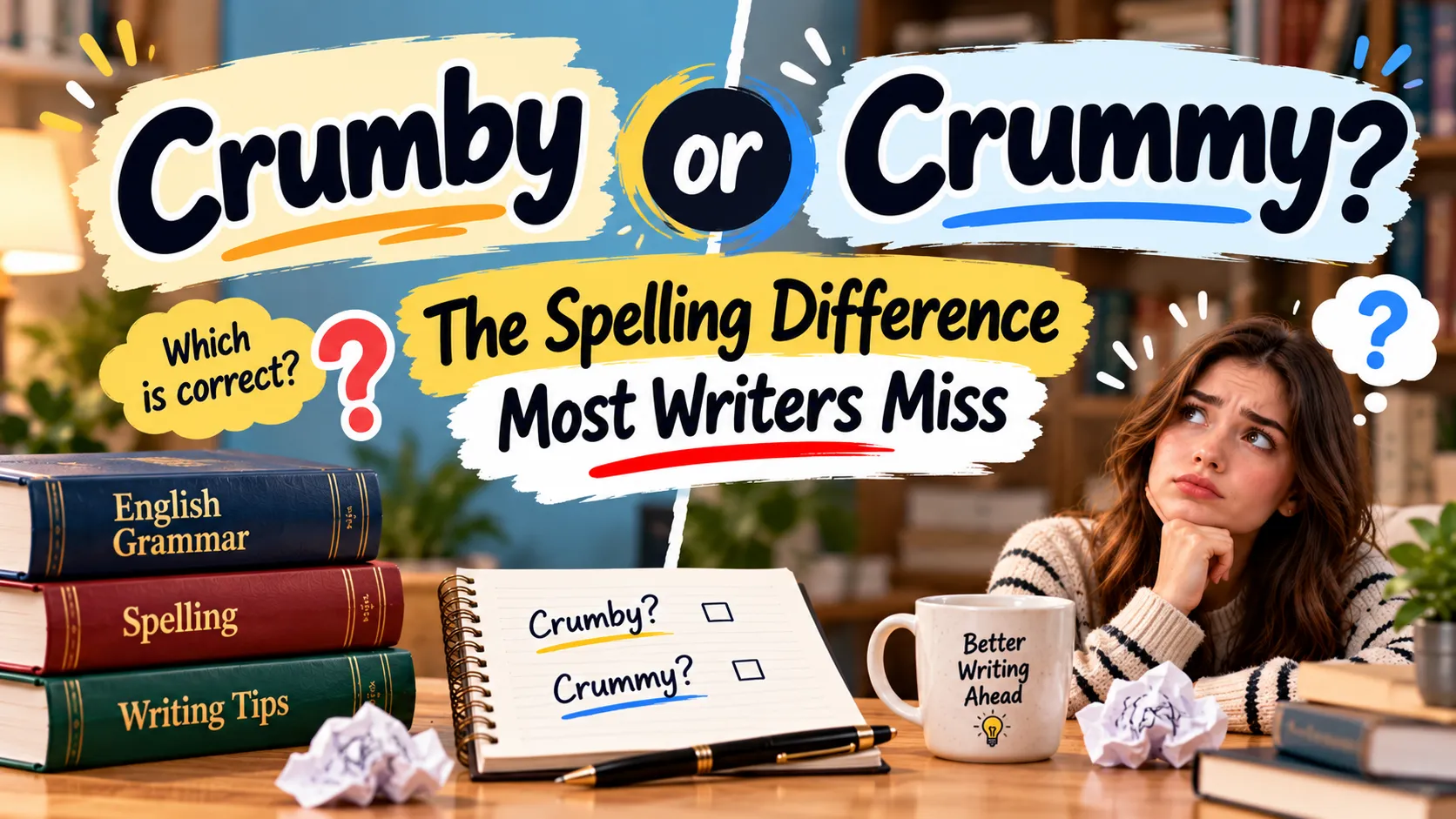
Crumby and crummy look almost identical, and both can appear in English dictionaries, but they are not equally common or interchangeable in every context. The word crummy is the familiar modern spelling when you mean something poor, unpleasant, disappointing, or of low quality.
Crumby has a more specific history and can also mean something covered with or containing crumbs. It may therefore be correct when literally talking about crumbs, while crummy is usually the better choice when describing something as lousy or inferior.
If you have ever wondered whether to write crumby or crummy, this guide explains the difference, pronunciation, meanings, American English usage, examples, common mistakes, and an easy way to remember which spelling fits your sentence.
🔤 Crumby or Crummy? The Quick Answer
The two words are closely related, but context determines which spelling is appropriate. Crummy is the standard everyday choice for something unpleasant or of poor quality, while crumby can literally relate to crumbs.
| Word | Main Meaning | Common Use | Example |
|---|---|---|---|
| Crummy | Bad, unpleasant, poor-quality, or disappointing | Informal descriptions | We had a crummy day. |
| Crumby | Containing or covered with crumbs; sometimes an alternative spelling of crummy | Literal crumbs or less-common usage | The table was crumby after breakfast. |
Easy rule:
Crummy = lousy or poor
Crumby = crumbs or, less commonly, poor
📖 What Does Crummy Mean?
Crummy is an informal adjective meaning bad, unpleasant, disappointing, or of poor quality. It is commonly used in casual American English to describe experiences, situations, objects, conditions, or feelings.
Examples:
- We had a crummy day.
- The hotel room was crummy.
- I feel crummy today.
- That was a crummy excuse.
- The weather has been crummy all week.
- He got a crummy deal.
The tone of crummy is generally informal. It is useful in conversation and casual writing but may not be appropriate for highly formal or academic writing.
🍪 What Does Crumby Mean?
Crumby can be used literally to describe something containing, covered with, or resembling crumbs. For example, a kitchen counter might be described as crumby after someone eats toast or cookies.
Examples:
- The table was crumby after breakfast.
- The kitchen floor became crumby after the children ate crackers.
- I wiped the crumby counter.
- The picnic table was covered in crumby leftovers.
In this literal sense, crumby connects directly with the noun crumb.
However, crumby can also appear as a variant spelling of crummy in some dictionaries and usage contexts. When you mean “bad” or “poor-quality,” crummy is generally the more familiar choice.
⚖️ Crumby vs Crummy Comparison Table
This comparison shows why the two spellings can cause confusion. The biggest distinction is between the literal crumb-related meaning and the informal bad or poor-quality meaning.
| Feature | Crumby | Crummy |
|---|---|---|
| Main meaning | Covered with or containing crumbs | Bad, unpleasant, or poor-quality |
| Commonness | Less common | More common |
| Tone | Literal or informal | Informal |
| Related word | Crumb | Crumb, historically |
| Example | A crumby table | A crummy hotel |
| Can mean “bad”? | Sometimes, as a variant | Yes |
| Best choice for “lousy”? | Usually not | Yes |
| Best choice for literal crumbs? | Yes | No |
🧠 Why Are Crumby and Crummy Confused?
The confusion is understandable because both spellings are closely connected to the word crumb. They also sound very similar, and crummy can be interpreted as something originally associated with crumbs.
There is another reason the spelling can be confusing: English frequently forms adjectives with different endings, such as:
- crumb → crumby
- crumb → crummy
- luck → lucky
- sun → sunny
- fun → funny
However, modern usage has given crummy a strong independent meaning of “bad” or “poor.”
🗣️ Crumby vs Crummy Pronunciation
For most speakers, crumby and crummy are pronounced the same or extremely similarly.
| Word | Common Pronunciation | Syllables |
|---|---|---|
| Crumby | /ˈkrʌm.bi/ | 2 |
| Crummy | /ˈkrʌm.i/ | 2 |
Because the pronunciation is so similar, you cannot reliably determine the spelling from sound alone. Context is the better guide.
🍪 When Should You Use Crumby?
Use crumby when you literally mean that something has crumbs on it or contains crumbs.
For example:
- a crumby table
- a crumby countertop
- a crumby kitchen floor
- a crumby plate
- a crumby surface
Example sentences:
- The counter was crumby after I made toast.
- The children left a crumby mess on the table.
- Please clean the crumby kitchen floor.
- The picnic blanket became crumby after lunch.
Here, crumby has a literal relationship to crumbs.
😕 When Should You Use Crummy?
Use crummy when you mean bad, unpleasant, disappointing, cheap, or low-quality.
Examples:
- It was a crummy movie.
- He had a crummy attitude.
- We stayed at a crummy hotel.
- That’s a crummy excuse.
- She received a crummy deal.
- I feel crummy today.
If you can replace the word with bad, lousy, or poor, crummy is usually the natural choice.
🆚 Crummy vs Bad
Crummy and bad can have similar meanings, but they have different tones.
| Crummy | Bad |
|---|---|
| Informal | Neutral |
| Conversational | Suitable in most contexts |
| Often expresses personal dissatisfaction | Broad and flexible |
| “A crummy hotel” | “A bad hotel” |
For example:
We stayed at a crummy hotel.
sounds more conversational and expressive than:
We stayed at a bad hotel.
🆚 Crummy vs Lousy
Crummy and lousy are close synonyms when describing something poor, unpleasant, or disappointing.
Examples:
- We had a crummy weekend.
- We had a lousy weekend.
Both are informal, although the exact tone can vary depending on the speaker and context.
Other alternatives include:
- Poor
- Bad
- Inferior
- Unpleasant
- Disappointing
- Low-quality
- Mediocre
- Substandard
🍞 Crumby and Literal Crumbs
The clearest use of crumby is when something has crumbs scattered across it. This meaning is easy to understand because it directly connects to the noun crumb.
For example:
The table is crumby.
This means:
The table has crumbs on it.
Similarly:
The kitchen floor is crumby.
means the floor has crumbs on it.
In these contexts, crummy would not communicate the same literal meaning.
🚫 Common Mistake: Crumby for Poor Quality
A common spelling choice is:
We stayed in a crumby hotel.
If you mean that the hotel was bad or low-quality, crummy is the more familiar modern choice:
We stayed in a crummy hotel.
The word crumby could suggest something involving crumbs rather than poor quality.
🚫 Common Mistake: Crummy for Literal Crumbs
The opposite can also cause confusion.
If you mean:
The table is covered with crumbs.
Writing:
The table is crummy.
can be confusing because crummy is normally understood to mean bad or unpleasant.
For a literal crumb-covered surface, crumby is clearer:
The table is crumby.
📚 Crummy in Everyday American English
Crummy is especially useful in informal American English. It can describe situations, objects, experiences, or physical feelings.
Common expressions:
- crummy day
- crummy weather
- crummy job
- crummy hotel
- crummy service
- crummy excuse
- crummy deal
- crummy attitude
- crummy movie
- feel crummy
Examples:
I had a crummy day at work.
The restaurant provided crummy service.
I feel crummy today.
These expressions are conversational rather than highly formal.
🇺🇸 Crumby vs Crummy in American English
In contemporary American English, crummy is the much more recognizable spelling when the intended meaning is bad, unpleasant, or low-quality.
For literal crumbs, crumby can be used as a descriptive adjective.
Therefore:
That was a crummy experience.
but:
The table was crumby after the children ate cookies.
This distinction helps avoid ambiguity.
✍️ Crummy in Different Sentences
Seeing crummy in different contexts makes its meaning easier to recognize.
- We had a crummy vacation.
- The service was crummy.
- He gave me a crummy excuse.
- She works at a crummy job.
- The weather was crummy yesterday.
- I got a crummy deal.
- That old computer is crummy.
- I feel crummy after staying up all night.
- They rented a crummy apartment.
- The movie had a crummy ending.
In every example, crummy expresses a negative evaluation.
🍪 Crumby in Different Sentences
When the meaning involves actual crumbs, crumby can be useful.
- The plate is crumby.
- The counter looks crumby.
- The children left a crumby mess.
- The table became crumby after breakfast.
- The floor was crumby after the party.
- I cleaned the crumby surface.
- The picnic blanket was crumby after lunch.
Here, the word describes the physical presence of crumbs.
🔍 Crumby or Crummy? Context Makes the Difference
When you are unsure between these spellings, look at what the adjective is describing. If it is something that can literally have crumbs on it, crumby may be appropriate. If you are criticizing its quality, crummy is generally the clearer choice.
| Sentence Meaning | Better Choice |
|---|---|
| Covered with crumbs | Crumby |
| Full of crumbs | Crumby |
| Poor-quality hotel | Crummy |
| Bad experience | Crummy |
| Unpleasant weather | Crummy |
| Disappointing service | Crummy |
| Bad excuse | Crummy |
| Low-quality product | Crummy |
| Mess containing crumbs | Crumby |
| Poor treatment | Crummy |
📝 Is Crumby a Correct Word?
Yes, crumby can be a legitimate English word, particularly when it literally means containing or covered with crumbs. It can also appear as a variant spelling related to crummy.
However, spelling conventions and dictionary treatment can vary, and crummy is the far more familiar choice for the meaning “bad” or “poor-quality.”
Therefore, if your sentence is:
“That was a ___ movie.”
Crummy is the natural choice.
If your sentence is:
“The table was ___ after breakfast.”
Crumby can clearly express the idea of being covered with crumbs.
🆚 Crumby vs Crumbly
Crumby and crumbly are also worth distinguishing.
Crumby generally describes something containing or covered with crumbs.
Crumbly means easily breaking into crumbs or small pieces.
| Word | Meaning | Example |
|---|---|---|
| Crumby | Covered with or containing crumbs | The table was crumby. |
| Crumbly | Easily breaking into crumbs | The cookie was crumbly. |
For example:
The counter was crumby.
means it had crumbs on it.
The cookie was crumbly.
means the cookie easily broke into crumbs.
🆚 Crummy vs Crumbly
These words have very different meanings despite their similar spelling.
- Crummy = bad or poor-quality.
- Crumbly = easily breaking into crumbs.
Examples:
The restaurant had crummy service.
The cake was crumbly.
Knowing this distinction can prevent another common vocabulary mistake.
🎯 How to Choose the Correct Spelling
Use this simple question:
Am I talking about actual crumbs?
If yes, crumby may be the intended word.
The table is crumby.
Am I saying that something is bad, unpleasant, or poor-quality?
If yes, use crummy.
The hotel was crummy.
If you can replace the word with lousy, bad, or poor, crummy is probably the right choice.
So If you can replace it with covered in crumbs, crumby is likely the better choice.
🧠 Easy Memory Trick for Crumby and Crummy
A simple memory trick can make the distinction easier.
Think:
CRUMBY → CRUMB
The spelling crumby contains the letters crumb, making it easy to connect with actual crumbs.
Think:
CRUMMY → YUCKY
Both are informal ways to describe something unpleasant or poor.
Remember:
Crumby = crumbs
Crummy = lousy
This is not an absolute rule for every historical use, but it is a useful practical guide for everyday writing.
📊 Correct Word by Context
Use this table as a quick reference when deciding between crumby and crummy.
| If You Mean… | Use | Example |
|---|---|---|
| Covered in crumbs | Crumby | The table is crumby. |
| Full of crumbs | Crumby | The floor became crumby. |
| Bad hotel | Crummy | It was a crummy hotel. |
| Poor service | Crummy | The service was crummy. |
| Bad weather | Crummy | We had crummy weather. |
| Disappointing experience | Crummy | It was a crummy experience. |
| Bad excuse | Crummy | That’s a crummy excuse. |
| Poor-quality product | Crummy | The product feels crummy. |
📖 Formal Alternatives to Crummy
Because crummy is informal, you may want a more professional alternative in academic, business, or formal writing.
Depending on the meaning, you can use:
- Poor
- Inferior
- Substandard
- Unsatisfactory
- Unacceptable
- Low-quality
- Disappointing
- Inadequate
- Deficient
- Unsuitable
For example:
Informal:
The company provided crummy service.
More formal:
The company provided unsatisfactory service.
Or:
The company provided substandard service.
💬 Informal Alternatives to Crummy
In casual conversation, several words can communicate a similar idea.
- Bad
- Lousy
- Awful
- Terrible
- Poor
- Rotten
- Cheap
- Unpleasant
- Disappointing
- Second-rate
The best alternative depends on what exactly you are criticizing.
For example:
a lousy day
a terrible movie
a poor-quality product
an unpleasant experience
🧩 Quick Practice: Crumby or Crummy?
Test yourself with these sentences.
- We stayed at a ___ hotel.
Answer: crummy - The kitchen table was ___ after breakfast.
Answer: crumby - He had a ___ day at work.
Answer: crummy - The floor was ___ after the children ate cookies.
Answer: crumby - That’s a ___ excuse.
Answer: crummy - The counter became ___ after I made toast.
Answer: crumby - The customer complained about the ___ service.
Answer: crummy - The picnic table was covered in a ___ mess.
Answer: crumby
❓ Frequently Asked Questions About Crumby vs Crummy
These questions cover the most common spelling, meaning, and usage concerns surrounding crumby and crummy.
Is it crumby or crummy?
Both spellings can occur, but crummy is the standard and much more familiar choice when you mean bad, unpleasant, or poor-quality. Crumby can be used literally for something covered with or containing crumbs.
Is crumby a real word?
Yes. Crumby can describe something containing or covered with crumbs. It may also occur as a variant related to crummy.
Does crummy mean bad?
Yes. Crummy is an informal adjective meaning bad, unpleasant, disappointing, or poor-quality.
Does crumby mean covered in crumbs?
Yes. In literal usage, crumby can mean containing or covered with crumbs.
Which is more common, crumby or crummy?
Crummy is much more common in modern everyday English when describing something as bad or low-quality.
Is crummy formal?
No. Crummy is generally informal and conversational. More formal alternatives include poor, inferior, substandard, inadequate, and unsatisfactory.
Can I say “a crumby hotel”?
If you mean the hotel is covered with crumbs, the sentence could be interpreted literally. If you mean the hotel is poor or unpleasant, a crummy hotel is the clearer and more familiar choice.
Can crummy mean covered in crumbs?
Although the words are historically related, modern readers generally understand crummy to mean bad or unpleasant. For literal crumbs, crumby is clearer.
What is the difference between crumby and crumbly?
Crumby can mean covered with or containing crumbs, while crumbly means easily breaking into crumbs.
What is another word for crummy?
Depending on context, alternatives include bad, lousy, poor, inferior, substandard, disappointing, unpleasant, and unsatisfactory.
What is another word for crumby?
For the literal meaning, you could say covered in crumbs, full of crumbs, crumb-covered, or messy with crumbs.
Is crummy American English?
Yes. Crummy is well established in American English as an informal word meaning bad, unpleasant, or poor-quality.
🏁 Conclusion
The choice between crumby and crummy depends on what you mean. Crummy is the familiar modern spelling when describing something as bad, unpleasant, disappointing, or low-quality. Crumby is useful when you are literally describing something covered with or containing crumbs.
The easiest memory trick is:
Crumby → crumbs
Crummy → lousy or poor
So you can write:
“The table was crumby after breakfast.”
But:
“We had a crummy experience.”
When you’re writing casually in American English and mean “bad” or “poor-quality,” crummy is generally the safer and more recognizable choice.

Olivia Bennett is a writer and language enthusiast at Vocabsteria. She is passionate about exploring word meanings, name origins, and cultural expressions from around the world.