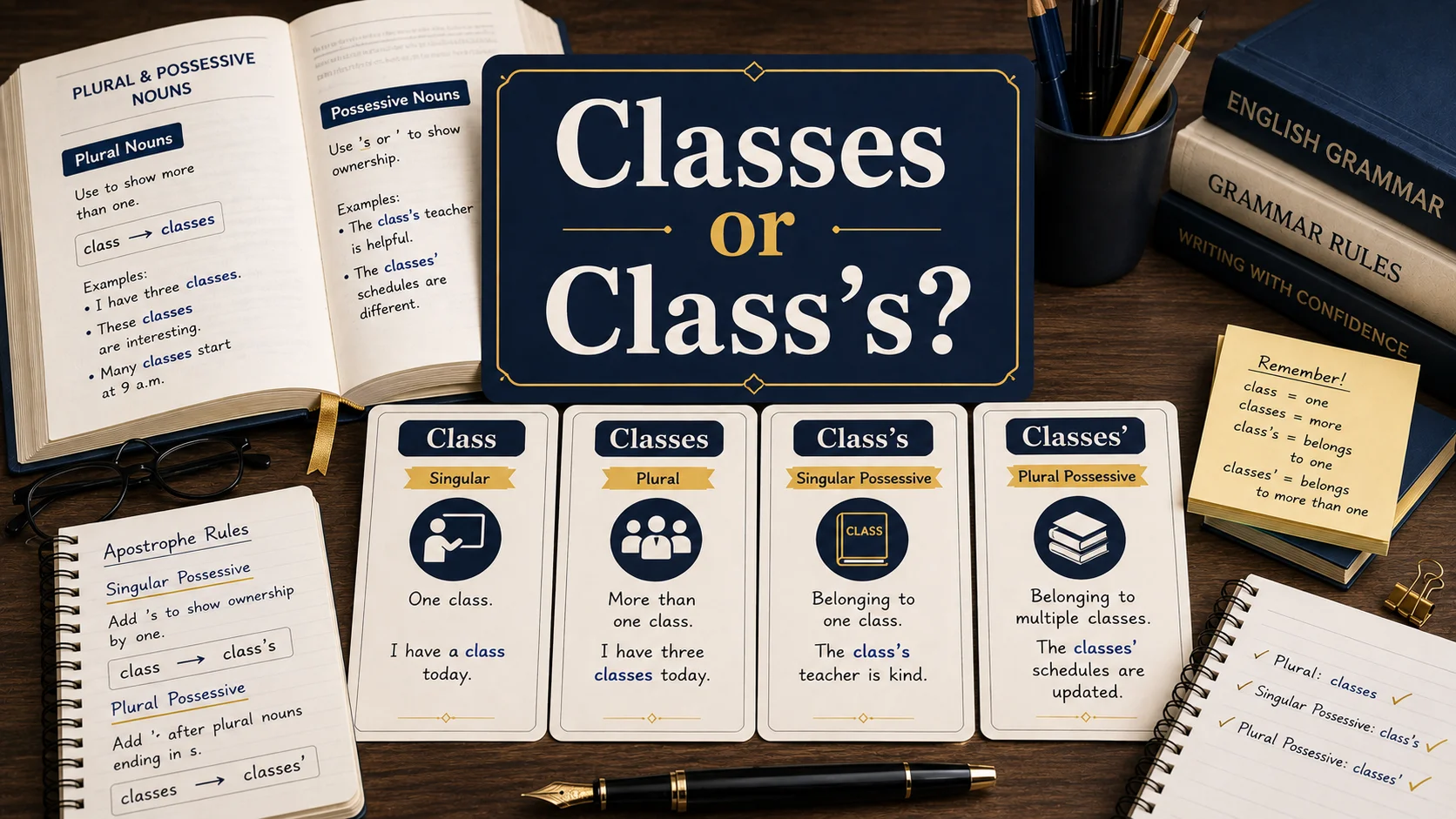
The difference between classes or class’s is mainly a matter of plural and possessive grammar. Although these forms look similar, they have different jobs in a sentence. Classes is the plural form of class, while class’s is the singular possessive form. There is also a third form, classes’, which shows possession by more than one class.
For example, you would say, “I have three classes today” when talking about multiple lessons. But if you mean something belongs to one class, you would write, “The class’s schedule has changed.” When something belongs to several classes, the correct form is classes’, as in “The classes’ schedules were posted online.”
Understanding these small differences can make your writing much clearer. This guide explains when to use classes, class’s, and classes’, with simple rules, comparison tables, and real-life examples.
Quick Answer: Classes or Class’s?
Classes is the correct plural form of class. Use it when you mean more than one class.
Class’s is the singular possessive form. Use it when something belongs to one class.
Classes’ is the plural possessive form. Use it when something belongs to two or more classes.
| Form | Meaning | Example |
|---|---|---|
| Class | One class | I have a class today. |
| Classes | More than one class | I have three classes today. |
| Class’s | Belonging to one class | The class’s teacher arrived early. |
| Classes’ | Belonging to multiple classes | The classes’ schedules were updated. |
Classes: The Plural Form of Class
Classes is the plural form of class. Use it when you’re talking about two or more classes, lessons, groups, or categories.
The word class ends in -ss, so its plural is formed by adding -es, rather than simply adding -s.
Examples
- I have four classes today.
- The school offers evening classes.
- Several classes participated in the competition.
- My morning classes start at eight.
- The university added two new classes this semester.
Why Is It “Classes” Instead of “Classs”?
English nouns ending in -s, -ss, -sh, -ch, -x, and some other sounds commonly form their plurals with -es.
For example:
- class → classes
- bus → buses
- box → boxes
- dish → dishes
- watch → watches
So classs is incorrect.
Class’s: The Singular Possessive Form
Class’s means that something belongs to or is associated with one class.
The apostrophe and s show possession.
Examples
- The class’s schedule changed this week.
- The class’s teacher gave everyone homework.
- The class’s performance was excellent.
- The class’s project won first place.
- The class’s average score improved.
In each sentence, class refers to one specific class, and the apostrophe shows that the following noun belongs to or is connected with that class.
Simple Rule
If you mean:
something belonging to one class
use class’s.
Example:
The class’s classroom was decorated for the event.
Here, one class has a classroom.
Classes’: The Plural Possessive Form
Classes’ is used when something belongs to or is associated with multiple classes.
Because classes is already plural and ends in s, you add only an apostrophe after the final s.
Examples
- The classes’ schedules were posted online.
- The classes’ teachers attended the meeting.
- The classes’ projects were displayed in the hallway.
- The classes’ exam results were released yesterday.
- The classes’ classrooms were cleaned after school.
Compare the Three Forms
Consider these three sentences:
- The class is starting.
- The classes are starting.
- The class’s schedule is posted.
- The classes’ schedules are posted.
Each form has a different grammatical function.
Classes vs. Class’s
The easiest way to understand classes vs. class’s is to ask whether you’re talking about number or ownership.
| Word | Function | Example |
|---|---|---|
| Classes | Plural | I attend three classes. |
| Class’s | Singular possessive | The class’s teacher is absent. |
Use “Classes” for More Than One
Use classes when the noun itself is plural.
I have five classes this semester.
You’re talking about five separate classes, so no apostrophe is needed.
Use “Class’s” for Possession
Use class’s when one class owns, has, or is connected to something.
The class’s project is due Friday.
The project belongs to one class.
Classes or Class’s: A Simple Test
If you’re unsure which form to use, remove the apostrophe and ask yourself what you’re trying to say.
Are You Talking About Multiple Classes?
Use classes.
The school offers several classes.
Does Something Belong to One Class?
Use class’s.
The class’s assignment is due tomorrow.
Does Something Belong to Multiple Classes?
Use classes’.
The classes’ assignments are due tomorrow.
This three-question test solves most classes or class’s grammar problems.
Common Mistakes
Mistake 1: Using Class’s as the Plural
❌ I have three class’s today.
✅ I have three classes today.
The sentence refers to more than one class, so you need the plural form classes, not the possessive class’s.
Mistake 2: Adding an Apostrophe to Every Plural
❌ The class’s are full.
✅ The classes are full.
An apostrophe does not normally make a noun plural. It usually shows possession or contraction.
Mistake 3: Confusing Classes’ With Classes
❌ The classes’ start at 9 a.m.
✅ The classes start at 9 a.m.
There is no possession in this sentence, so the apostrophe is unnecessary.
Mistake 4: Using Classes Instead of Class’s
❌ The classes teacher is absent.
✅ The class’s teacher is absent.
If one class has a teacher, use the singular possessive class’s.
Quick Comparison
| Sentence | Correct? | Why |
|---|---|---|
| I have three classes. | ✅ | Plural |
| The class’s teacher is absent. | ✅ | One class owns/has the teacher relationship |
| The classes’ teachers are meeting. | ✅ | Multiple classes |
| I have three class’s. | ❌ | Incorrect plural |
| The classes teacher is absent. | ❌ | Possessive form needed |
| The class’s are starting. | ❌ | Apostrophe incorrectly used for plural |
Is Class’s Always Possessive?
Usually, yes, when class’s appears as a standalone noun form. It is the possessive form of singular class.
For example:
The class’s room was unusually quiet.
Here, the room is associated with one class.
However, ‘s can also indicate a contraction in English. For example, class’s could theoretically appear in a quoted or unusual contraction, but that use is not relevant to ordinary possessive grammar. In normal writing about classrooms, lessons, or groups, class’s should be understood as the singular possessive form.
How to Remember the Difference
Use this simple pattern:
Class → one
Classes → more than one
Class’s → belonging to one
Classes’ → belonging to more than one
Think of the apostrophe as a sign of possession.
One Class
The class’s project.
Multiple Classes
The classes’ projects.
Multiple Classes Without Possession
The classes meet every afternoon.
This distinction is more useful than simply memorizing where the apostrophe goes.
Classes or Class’s in Everyday Sentences
Here are examples showing how each form works naturally:
- I have two classes this morning.
- The class’s final project is due Friday.
- The classes’ schedules were changed.
- Several classes joined the field trip.
- The class’s teacher announced the results.
- The school added three new classes.
- The classes’ teachers met after school.
- Our class’s presentation went well.
- These classes are required for graduation.
- The class’s average grade improved.
- All the classes were canceled because of the storm.
- The classes’ rooms were prepared for the exam.
- My afternoon classes are difficult.
- The class’s discussion lasted an hour.
- Several classes competed in the event.
Grammar Rule for Apostrophes
Apostrophes have several functions in English, but they are not normally used simply to make a noun plural.
Singular Possessive
For a singular noun, add ’s:
- class → class’s
- teacher → teacher’s
- student → student’s
Examples:
The student’s book is on the desk.
The class’s project is impressive.
Plural Possessive
For a regular plural noun ending in s, add only an apostrophe:
- classes → classes’
- teachers → teachers’
- students → students’
Examples:
The students’ books are on the desk.
The classes’ schedules are different.
Which One Should You Use?
If you’re writing a sentence and you’re unsure whether to use classes or class’s, identify the role of the word.
- Use classes when you mean more than one class.
- Use class’s when you mean something belonging to one class.
- Use classes’ when you mean something belonging to multiple classes.
- The difference is small in appearance but important in meaning.
People Also Ask
Is “classes” or “class’s” correct?
Both can be correct, but they have different meanings. Classes is the plural form of class, while class’s is the possessive form of singular class. Use classes for multiple classes and class’s when something belongs to one class.
What is the plural of class?
The plural of class is classes. Because class ends in -ss, it takes -es in the plural. For example: “The school offers several classes.”
What is the possessive form of class?
The singular possessive form is class’s. For example: “The class’s teacher assigned homework.” The plural possessive form is classes’, as in “The classes’ schedules were updated.”
Is “class’s” grammatically correct?
Yes. Class’s is grammatically correct when you need the singular possessive form of class. For example, “The class’s room was cleaned.” The apostrophe shows that the room is associated with one class.
Is “classes’s” correct?
No. Classes’s is not the standard possessive form. Because classes is already a plural noun ending in s, its possessive form is classes’.
Should classes have an apostrophe?
Not when classes is simply plural. For example, “I attend three classes.” Add an apostrophe only when showing possession: “The classes’ schedules are different.”
What is the difference between classes’ and class’s?
Class’s means something belongs to one class. Classes’ means something belongs to multiple classes. For example, “The class’s project” refers to one class, while “the classes’ projects” refers to several classes.
Why does class become classes?
English uses -es to form the plural of many nouns ending in sounds such as s, ss, sh, ch, x, and z. Therefore, class becomes classes, not classs.
Frequently Asked Questions
Is “I have two class’s” correct?
No. The correct sentence is:
I have two classes.
You’re talking about more than one class, so you need the plural form.
Is “the class’s schedule” correct?
Yes. If you’re referring to the schedule of one class, class’s is correct.
The class’s schedule has changed.
Is “the classes’ schedule” correct?
It can be correct if multiple classes share one schedule or are collectively associated with a single schedule. More commonly, if each class has its own schedule, you would write:
The classes’ schedules were posted.
Is “classes” a plural noun?
Yes. Classes is the plural form of class.
Can an apostrophe make a word plural?
Generally, no. Apostrophes are not normally used to form ordinary plurals. They are mainly used to show possession or certain contractions.
Which is correct: class’s or classes’?
Both can be correct, depending on the number of classes. Use class’s for one class and classes’ for multiple classes.
What is the possessive plural of classes?
The possessive plural is classes’.
The classes’ schedules were posted online.
What is the easiest way to remember these forms?
Remember the four forms:
- class = one
- classes = more than one
- class’s = belonging to one
- classes’ = belonging to more than one
Conclusion
The difference between classes or class’s becomes simple once you understand plural and possessive forms. Classes is the plural of class, so use it when you’re talking about two or more classes. Class’s is the singular possessive form, so use it when something belongs to or is associated with one class. When something belongs to several classes, use classes’.
A quick memory rule is: classes = more than one, class’s = belonging to one, and classes’ = belonging to more than one. Most mistakes happen when an apostrophe is added simply because a word is plural. Remember that plural nouns generally do not need apostrophes unless possession is involved.

Olivia Bennett is a writer and language enthusiast at Vocabsteria. She is passionate about exploring word meanings, name origins, and cultural expressions from around the world.