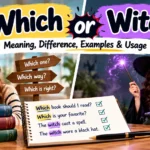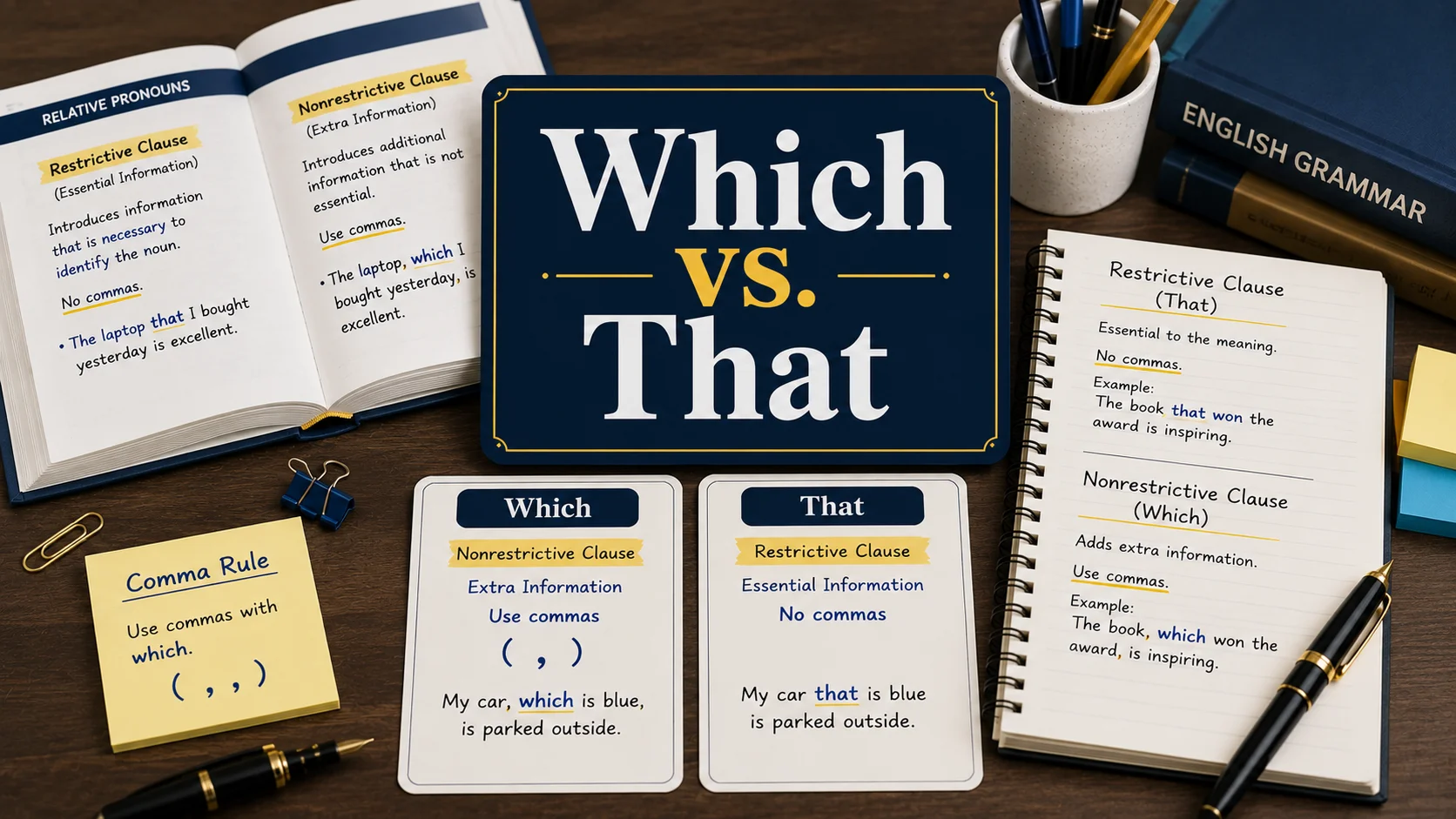
Many English writers struggle with which and that because both words introduce additional information about a noun. Since they often appear in similar sentences, it’s easy to assume they’re interchangeable. However, in formal writing—especially in American English—they serve different grammatical purposes.
The main difference is that that introduces essential (restrictive) information, while which introduces nonessential (nonrestrictive) information that can usually be removed without changing the sentence’s core meaning. Understanding this distinction makes your writing clearer, more precise, and grammatically accurate.
Although everyday conversation often uses these words interchangeably, following the correct rule helps improve academic papers, business writing, blogs, and professional communication.
In this guide, you’ll learn the difference between which and that, discover simple grammar rules, see practical examples, and avoid common mistakes.
Quick Answer
Use that for information that is essential to the meaning of a sentence.
Use which for extra information that can be removed without changing the sentence’s main idea. Nonessential clauses introduced by which are usually set off with commas.
Examples
- The book that I borrowed is excellent.
- The book, which I borrowed yesterday, is excellent.
Word at a Glance
| Word | Part of Speech | Primary Use | Example |
|---|---|---|---|
| That | Pronoun, Determiner, Conjunction | Introduces essential information | The car that broke down is mine. |
| Which | Pronoun, Determiner | Introduces extra information | My car, which is blue, is parked outside. |
Pronunciation
| Word | IPA | Phonetic | Syllables |
|---|---|---|---|
| Which | /wɪtʃ/ | WICH | 1 |
| That | /ðæt/ | THAT | 1 |
Which vs. That at a Glance
| Feature | Which | That |
|---|---|---|
| Introduces extra information | ✅ Yes | ❌ No |
| Introduces essential information | ❌ Usually No | ✅ Yes |
| Usually follows a comma | ✅ Yes | ❌ No |
| Common in formal American English | ✅ Yes | ✅ Ye |
What Does That Mean?
Meaning
That introduces information that is necessary to identify the person, place, thing, or idea you’re talking about. Without this information, the sentence’s meaning changes or becomes unclear.
These are called restrictive clauses because they restrict or define the noun.
Examples
- The laptop that I bought last week is already on sale.
- Students that study consistently usually perform better.
- The restaurant that serves Thai food is my favorite.
- I need the file that you emailed yesterday.
- The shoes that fit me are sold out.
Usage Tip
If removing the clause changes the meaning of the sentence, that is usually the correct choice.
What Does Which Mean?
Meaning
Which introduces information that is additional rather than essential. The sentence still makes sense if this information is removed.
These are called nonrestrictive clauses and are usually separated by commas.
Examples
- My laptop, which is only six months old, suddenly stopped working.
- Paris, which attracts millions of tourists each year, is famous for its landmarks.
- The conference room, which overlooks the city, is available this afternoon.
- Her bicycle, which she bought recently, was stolen.
- The movie, which lasted three hours, received excellent reviews.
Usage Tip
If the information is simply extra detail, use which and place commas around the clause.
Restrictive vs. Nonrestrictive Clauses
Understanding these two clause types is the key to using which and that correctly.
| Type | Use | Word | Example |
|---|---|---|---|
| Restrictive Clause | Essential information | That | The phone that has a cracked screen belongs to Jake. |
| Nonrestrictive Clause | Extra information | Which | My phone, which has a cracked screen, still works perfectly. |
Compare These Sentences
With That (Essential)
- The employee that speaks Spanish will assist you.
(Only one employee speaks Spanish.)
With Which (Extra Information)
- The employee, which… ❌ (Incorrect because “employee” refers to a person.)
Correct:
- The office, which was recently renovated, looks fantastic.
Why Commas Matter
Commas help signal whether the information is essential.
Without Commas (Use That)
- The jacket that has black buttons is mine.
(You’re identifying which jacket.)
With Commas (Use Which)
- My jacket, which has black buttons, is hanging by the door.
(The jacket is already identified. The black buttons are just additional information.)
American vs. British English
| English Variety | Preferred Usage |
|---|---|
| American English | Distinguishes that and which more consistently |
| British English | More flexible; which may appear in restrictive clauses |
Writing Tip: If you’re writing for a U.S. audience or following most American style guides, use that for restrictive clauses and which for nonrestrictive clauses.
When Should You Use That?
Use that when the information is essential to identify the noun. If removing the clause changes the meaning of the sentence, that is the correct choice.
Use That When:
- The information is necessary.
- You’re identifying a specific person or thing.
- The sentence would lose its meaning without the clause.
- No commas are needed.
Examples
- The laptop that I ordered arrived today.
- The student that won the scholarship is my cousin.
- I need the report that you mentioned.
- The restaurant that serves vegan food is nearby.
- Books that inspire people often become classics.
Grammar Tip: If the clause answers “Which one?”, use that.
When Should You Use Which?
Use which when adding extra information that isn’t necessary to identify the noun. This additional detail should be enclosed by commas.
Use Which When:
- The information is optional.
- The sentence still makes sense without it.
- The clause adds extra detail.
- Commas are required.
Examples
- My phone, which is only a year old, stopped working.
- The museum, which opened in 1890, attracts thousands of visitors.
- Their house, which overlooks the lake, is beautiful.
- The meeting, which lasted two hours, was productive.
- Our dog, which loves swimming, jumped into the river.
Usage Comparison Table
| Situation | Correct Word | Example |
|---|---|---|
| Identifying a specific object | That | The car that has a flat tire is mine. |
| Adding extra information | Which | My car, which is blue, is parked outside. |
| Restrictive clause | That | Students that study regularly perform well. |
| Nonrestrictive clause | Which | The library, which closes at 8 p.m., is nearby. |
| No commas | That | The movie that won the award was excellent. |
| With commas | Which | The movie, which won several awards, was excellent. |
Choose the Right Word
Ask yourself these questions before choosing which or that.
Can you remove the clause without changing the main meaning?
✅ Yes → Use which
Example:
- My laptop, which is brand new, runs very fast.
The sentence still works:
- My laptop runs very fast.
Does the clause identify which person or thing you mean?
✅ Yes → Use that
Example:
- The laptop that has a broken screen belongs to me.
Without the clause, you wouldn’t know which laptop is being discussed.
Are commas needed?
If commas naturally belong in the sentence, you’ll usually use which.
If there are no commas, you’ll usually use that.
Common Mistakes
❌ Using Which for Essential Information
Incorrect:
- The student which won the contest received a prize.
Correct:
- The student that won the contest received a prize.
❌ Using That After Commas
Incorrect:
- My bicycle, that I bought last year, is still in great condition.
Correct:
- My bicycle, which I bought last year, is still in great condition.
❌ Forgetting the Commas with Which
Incorrect:
- My laptop which is brand new works perfectly.
Correct:
- My laptop**, which** is brand new**,** works perfectly.
Memory Trick
A simple way to remember the rule:
That = Defines
If the clause defines or identifies the noun, use that.
Example:
- The keys that are on the table belong to me.
Which = Adds Information
If the clause simply adds information, use which.
Example:
- My keys, which are on the table, are silver.
Easy Formula
- That = No commas
- Which = Commas
This simple trick works for most formal American English writing.
Real-Life Example Sentences
- The book that I borrowed is fascinating.
- My book, which I borrowed yesterday, is already finished.
- The teacher that inspired me retired last year.
- The classroom, which was recently renovated, looks amazing.
- I need the documents that you emailed.
- Our office, which is downtown, opens at 9 a.m.
- The restaurant that serves Italian food is always busy.
- The museum, which opened in 1925, welcomes visitors daily.
- The shoes that fit me are sold out.
- Her laptop, which weighs less than a kilogram, is easy to carry.
- The project that won first place impressed the judges.
- My neighbor, which… ❌ (Incorrect because “neighbor” refers to a person.)
- The company that hired me offers excellent benefits.
- The building, which overlooks the river, is a historic landmark.
- The cake that she baked tasted delicious.
- My bicycle, which I ride every weekend, needs new tires.
- The movie that everyone recommended was excellent.
- Our hotel, which includes free breakfast, is near the airport.
- The article that you shared was very informative.
- The conference, which lasted three days, attracted experts from around the world.
Practice Exercise
Choose the correct word: which or that.
- The jacket _____ I bought yesterday fits perfectly.
- My jacket, _____ is waterproof, kept me dry.
- The employee _____ speaks French will help you.
- The conference room, _____ overlooks the garden, is available.
- I need the file _____ you saved yesterday.
- My watch, _____ was a gift, stopped working.
- The restaurant _____ serves sushi is popular.
- Our vacation, _____ lasted two weeks, was unforgettable.
- The report _____ contains the latest data is on your desk.
- The painting, _____ was created in 1880, sold for millions.
Answers
- that
- which
- that
- which
- that
- which
- that
- which
- that
- which
Mini Quiz
1. Which word introduces an essential clause?
A. Which
B. That
✅ Answer: B. That
2. Which word usually follows commas?
A. Which
B. That
✅ Answer: A. Which
3. Which sentence is correct?
A. The car, that is red, belongs to Emma.
B. The car that is red belongs to Emma.
✅ Answer: B
4. Complete the sentence:
“My laptop, _____ is only six months old, works perfectly.”
A. that
B. which
✅ Answer: B. which
5. Which sentence follows standard American English grammar?
A. The book which I borrowed is interesting.
B. The book that I borrowed is interesting.
✅ Answer: B (In formal American English, that is preferred for restrictive clauses.)
Related Words
The words which and that are commonly used as relative pronouns to connect clauses. Although they often perform similar functions, they follow different grammar rules in formal writing. Learning related words can help you understand how English relative clauses work.
| Word | Meaning | Example |
|---|---|---|
| Which | Refers to things or animals; introduces nonessential information | The laptop, which is new, works well. |
| That | Refers to people, animals, or things; introduces essential information | The laptop that I bought works well. |
| Who | Refers to people | The teacher who helped me retired. |
| Whom | Refers to people as an object | The student whom I met was friendly. |
| Whose | Shows possession | The author whose book won the award attended the event. |
| Where | Refers to places | The city where I grew up is beautiful. |
| When | Refers to time | I remember the day when we first met. |
Commonly Confused Words
These relative words often cause confusion because they introduce additional information.
| Words | Difference |
|---|---|
| Which / That | Nonessential vs. Essential clauses |
| Who / Whom | Subject vs. Object |
| Who / That | People vs. People or things |
| Which / What | Specific noun vs. Unknown thing |
| Whose / Who’s | Possession vs. “Who is” |
| Where / Were | Place vs. Past tense of “be” |
| Then / Than | Time vs. Comparison |
| Which / Witch | Relative pronoun vs. Magic practitioner |
Quick Reference Chart
| If You Mean… | Use |
|---|---|
| Essential information | That |
| Extra information | Which |
| Clause without commas | That |
| Clause with commas | Which |
| Formal American English restrictive clause | That |
People Also Ask
What is the difference between which and that?
The main difference is that that introduces essential (restrictive) information, while which introduces nonessential (nonrestrictive) information. In formal American English, which clauses are usually separated by commas.
When should I use that instead of which?
Use that when the information is necessary to identify the noun. If removing the clause changes the meaning of the sentence, that is the correct choice.
Example:
- The laptop that has a broken screen belongs to me.
When should I use which?
Use which when adding extra information that isn’t necessary to identify the noun. These clauses are usually enclosed by commas.
Example:
- My laptop, which is only six months old, runs perfectly.
Does which always need commas?
In formal American English, yes. When which introduces a nonrestrictive clause, commas should appear before and after the clause.
Can that be used after a comma?
Generally, no. Standard American English does not use that to introduce nonrestrictive clauses.
✅ Correct:
- My car, which is electric, is very quiet.
Is this rule the same in British English?
Not always. British English is generally more flexible and sometimes allows which in restrictive clauses. However, using that for essential information remains clear and widely accepted.
Can which refer to people?
Generally, no. Use who or that when referring to people.
✅ Correct:
- The teacher who inspired me retired.
- The teacher that inspired me retired.
❌ Less appropriate:
- The teacher which inspired me retired.
What’s the easiest way to remember the difference?
A simple rule is:
- That = Defines
- Which = Adds extra information
If the clause can be removed without changing the sentence’s core meaning, use which.
Frequently Asked Questions
Is that always used without commas?
Yes. In standard American English, restrictive clauses introduced by that are not separated by commas.
Can I omit that in some sentences?
Yes. In many restrictive clauses, that can be omitted without changing the meaning.
Example:
- The book (that) I borrowed is excellent.
Why do many editors prefer that?
Many American style guides recommend that for restrictive clauses because it makes writing clearer and avoids ambiguity.
Can which replace that?
Sometimes. In casual conversation, people often use which and that interchangeably. However, formal American writing usually distinguishes between them.
Is which more formal than that?
Not necessarily. Both are formal, but they serve different grammatical functions rather than different levels of formality.
What happens if I use the wrong one?
Most readers will still understand your meaning, but using the correct word improves clarity, grammar, and professionalism.
Should I always follow this rule?
If you’re writing for an American audience, academic work, or professional communication, following the which vs. that rule is recommended. For informal conversation, the distinction is often less strict.
Why is this grammar rule important?
Understanding the difference helps you write more precise sentences, avoid ambiguity, and produce polished, professional English.
Conclusion
Although which and that can appear similar, they perform different roles in formal English. That introduces essential information needed to identify a person or thing, while which adds extra details that can usually be removed without changing the sentence’s main meaning. Remember that which clauses are typically set off with commas, whereas that clauses are not.
By focusing on whether the information is essential or optional, you’ll quickly know which word to choose. Applying this simple rule consistently will make your writing clearer, more accurate, and easier for readers to understand.

Olivia Bennett is a writer and language enthusiast at Vocabsteria. She is passionate about exploring word meanings, name origins, and cultural expressions from around the world.