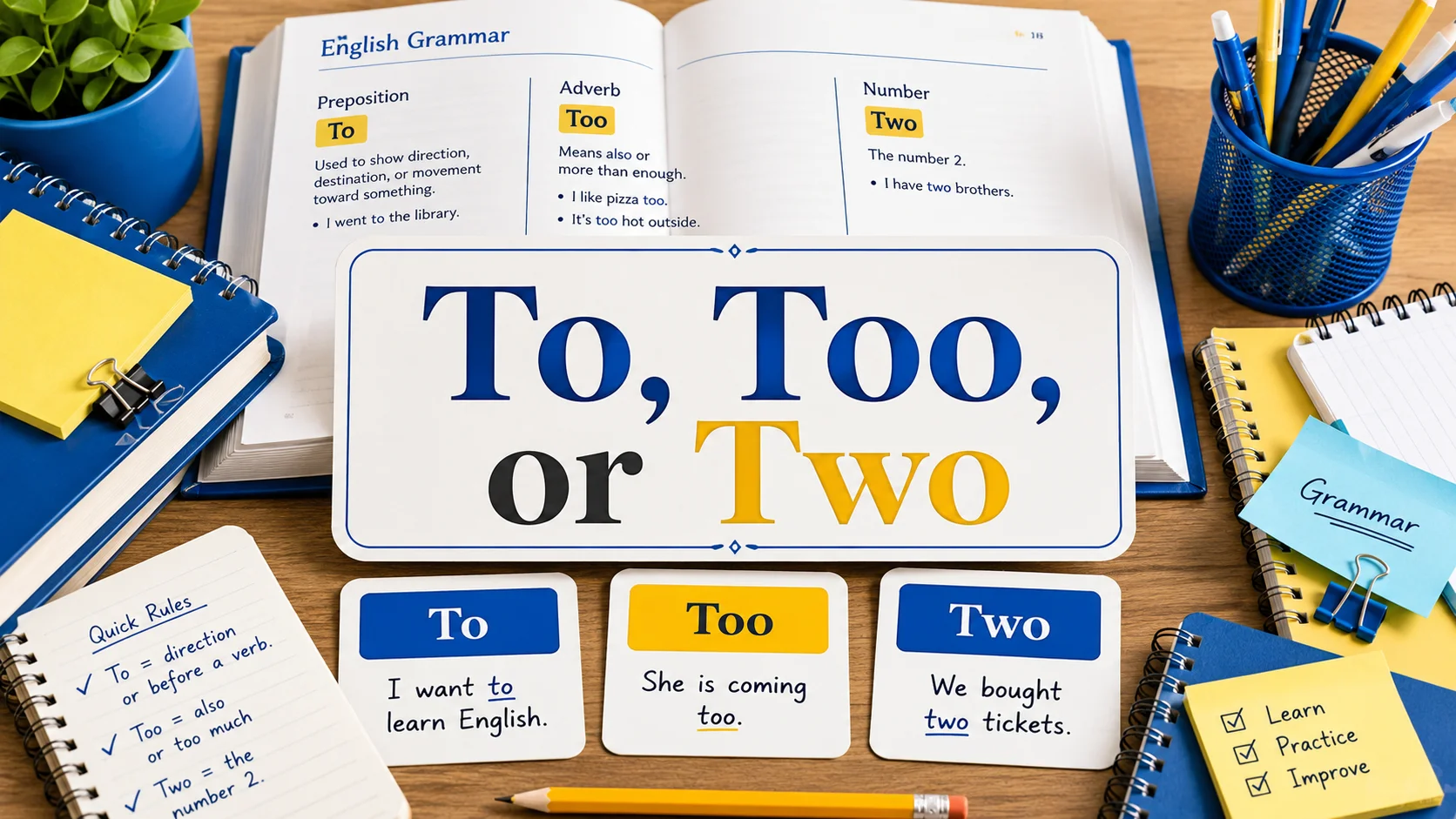
Many English learners confuse to, too, and two because they sound exactly alike. These words are homophones—they share the same pronunciation but have different spellings and meanings. Using the wrong one can change the meaning of a sentence and make your writing look unpolished.
Although they sound identical, each word serves a unique purpose. To is most commonly used as a preposition or as part of an infinitive verb, too means also or excessively, and two refers to the number 2. Learning the differences is easier than it seems once you understand their roles and see them used in real-life examples.
In this guide, you’ll learn the meaning of each word, discover simple grammar rules, compare their differences in an easy-to-read table, and practice with natural examples to help you use to, too, and two correctly every time.
Quick Answer
The difference between to, too, and two is simple:
- To is used as a preposition or before a verb (e.g., go to school, want to learn).
- Too means also or more than enough (e.g., I’m coming too, The coffee is too hot).
- Two is the number 2 (e.g., I have two brothers).
Word at a Glance
| Word | Part of Speech | Meaning | Example |
|---|---|---|---|
| To | Preposition, Infinitive Marker | Shows direction, purpose, or begins a verb | She walked to the park. |
| Too | Adverb | Also, excessively | It’s too cold outside. |
| Two | Number | The number 2 | We bought two tickets. |
Pronunciation
| Word | IPA | Phonetic | Syllables |
|---|---|---|---|
| To | /tuː/ | TOO | 1 |
| Too | /tuː/ | TOO | 1 |
| Two | /tuː/ | TOO | 1 |
Tip: All three words are pronounced the same, so you must rely on the sentence’s meaning to choose the correct spelling.
Understanding To
Meaning
To is one of the most common words in English. It usually shows direction, destination, purpose, or introduces the base form of a verb (called an infinitive).
Common Uses of To
| Use | Example |
|---|---|
| Direction | She walked to the store. |
| Destination | We’re flying to New York. |
| Infinitive Verb | I want to learn Spanish. |
| Time | It’s ten minutes to six. |
| Recipient | I gave the gift to my friend. |
Examples
- I need to finish my homework.
- They drove to the airport.
- She loves to read novels.
- Please send the email to Sarah.
- We went to the beach yesterday.
Understanding Too
Meaning
Too is an adverb that means also or more than enough.
Common Uses of Too
| Meaning | Example |
|---|---|
| Also | I’m going too. |
| Excessively | The soup is too salty. |
Examples
- I’d like to come too.
- You’re working too hard.
- The bag is too heavy.
- She speaks French too.
- It’s too late to cancel.
Tip
If you can replace too with also, it’s probably the correct choice.
Understanding Two
Meaning
Two is the spelling of the number 2.
Common Uses of Two
| Use | Example |
|---|---|
| Counting | I have two cats. |
| Quantity | She ordered two coffees. |
| Pairs | The road splits into two paths. |
Examples
- We bought two movie tickets.
- They have two children.
- I waited for two hours.
- There are two solutions.
- She owns two bicycles.
To vs. Too vs. Two
| Word | Meaning | Easy Memory Trick | Example |
|---|---|---|---|
| To | Direction or verb marker | Think of movement or action | I want to help. |
| Too | Also or excessively | Has an extra O, meaning something extra | She’s coming too. |
| Two | Number 2 | Contains the letter W in the number word | We adopted two puppies. |
Memory Tricks
Remember To
Use to whenever you’re talking about going somewhere or doing something.
Example:
- I need to study.
Remember Too
Too has an extra “O.”
Think of the extra letter as meaning something extra.
Example:
- This backpack is too heavy.
Remember Two
Two always refers to the number 2.
Example:
- I own two laptops.
Common Mistakes
❌ I have too brothers.
✅ I have two brothers.
❌ I want too eat pizza.
✅ I want to eat pizza.
❌ She’s coming to.
✅ She’s coming too.
❌ The coffee is to hot.
✅ The coffee is too hot.
Real-Life Example Sentences
- I walked to the library after class.
- Would you like to join us for dinner?
- My sister is coming too.
- The weather is too cold for swimming.
- We adopted two rescue dogs.
- She bought two new dresses.
- It’s never too late to learn.
- They traveled to Canada last summer.
- I’d love to visit Italy one day.
- The backpack is too heavy for a child.
Grammar Rules for To, Too, and Two
Understanding the grammar behind these three homophones makes it much easier to choose the correct word in every sentence.
Rule 1: Use To for Direction or Destination
Use to when showing movement toward a place, person, or object.
Examples
- We drove to the beach.
- She walked to the office.
- The children ran to their parents.
Rule 2: Use To Before a Verb
The word to introduces the base form of a verb, creating an infinitive.
Examples
- I want to improve my writing.
- They hope to travel next year.
- She plans to start a business.
Rule 3: Use Too to Mean “Also”
If too can be replaced with also, it’s the correct spelling.
Examples
- I’d like some dessert too.
- He’s coming too.
- We enjoyed the movie too.
Rule 4: Use Too to Mean “More Than Enough”
Use too before adjectives or adverbs to show excess.
Examples
- The room is too noisy.
- You’re driving too fast.
- This puzzle is too difficult.
Rule 5: Use Two Only for the Number 2
Whenever you’re counting people, objects, or quantities, use two.
Examples
- I have two sisters.
- We ordered two pizzas.
- They stayed for two nights.
Common Collocations
1. Common Phrases with To
| Phrase | Example |
|---|---|
| Go to | We need to go to school. |
| Talk to | She spoke to her teacher. |
| Listen to | Please listen to the instructions. |
| Want to | I want to help. |
| Try to | Try to stay calm. |
2. Common Phrases with Too
| Phrase | Example |
|---|---|
| Too much | We spent too much money. |
| Too many | There are too many cars. |
| Too late | It was too late to leave. |
| Too fast | You’re walking too fast. |
| Too expensive | That laptop is too expensive. |
3. Common Phrases with Two
| Phrase | Example |
|---|---|
| Two people | Two people volunteered. |
| Two days | We’ll stay for two days. |
| Two hours | The flight lasted two hours. |
| Two choices | You have two choices. |
| Two friends | My two friends arrived early. |
Writing Tips
Read the Sentence for Meaning
Don’t rely on pronunciation because all three words sound identical. Instead, ask what the sentence is trying to say.
Check Whether You’re Counting
If you’re talking about the number 2, always use two.
Example
- We have two meetings today.
Replace Too with “Also”
If the sentence still makes sense, too is probably correct.
Example
- I’m coming too.
- I’m coming also.
Look for an Action
If the next word is a verb, you’ll usually need to.
Example
- I want to learn English.
Commonly Confused Examples
| Incorrect | Correct |
|---|---|
| I have too brothers. | I have two brothers. |
| I want too leave. | I want to leave. |
| She’s going too. | She’s going too. |
| It’s to cold today. | It’s too cold today. |
| We bought to books. | We bought two books. |
Everyday Writing Examples
I’d like to schedule a meeting to discuss the project.
Text Message
I’m coming too. Wait for me!
Shopping List
Buy two bottles of water.
School Assignment
Students should remember to cite their sources correctly.
Travel
We’re flying to Chicago in two weeks.
Practice Exercise
Choose the correct word (to, too, or two).
- I need ___ finish my homework.
- She wants ___ come with us.
- The coffee is ___ hot.
- We have ___ tickets.
- I’m excited ___ see everyone.
- Can I come ___?
- They own ___ cars.
- It’s never ___ late to improve.
- Please send the package ___ my office.
- Only ___ students answered correctly.
Answers
- to
- to
- too
- two
- to
- too
- two
- too
- to
- two
Mini Quiz
1. Which word means “also”?
A. To
B. Too
C. Two
✅ Answer: B. Too
2. Which word is a number?
A. To
B. Too
C. Two
✅ Answer: C. Two
3. Which sentence is correct?
A. I have too dogs.
B. I have to dogs.
C. I have two dogs.
✅ Answer: C. I have two dogs.
4. Which word usually comes before a verb?
A. To
B. Too
C. Two
✅ Answer: A. To
5. Which sentence is correct?
A. She’s coming two.
B. She’s coming too.
C. She’s coming to.
✅ Answer: B. She’s coming too.
Related Words
The words to, too, and two belong to a group of English words called homophones. They sound the same but have different meanings and spellings. Learning related grammar terms can help you understand when to use each word correctly.
| Word | Meaning | Example |
|---|---|---|
| To | Shows direction or introduces a verb | I want to leave. |
| Too | Means also or excessively | She’s coming too. |
| Two | The number 2 | I have two sisters. |
| Tow | To pull something | The truck will tow the car. |
| Toward | In the direction of | She walked toward the station. |
| Together | In one group | We worked together. |
| Also | In addition | I’d like to come also. |
| Pair | A set of two | I bought a pair of shoes. |
Commonly Confused Words
Besides to, too, and two, English has many homophones that learners often confuse.
| Words | Difference |
|---|---|
| Your / You’re | Possession vs. You are |
| Their / There / They’re | Possession, place, they are |
| Its / It’s | Possession vs. It is |
| Then / Than | Time vs. Comparison |
| Affect / Effect | Verb vs. Noun (usually) |
| Accept / Except | Receive vs. Exclude |
| Lose / Loose | Misplace vs. Not tight |
| Here / Hear | Place vs. Listen |
Quick Reference Chart
| If You Mean… | Use |
|---|---|
| Going somewhere | To |
| Doing something | To |
| Also | Too |
| More than enough | Too |
| The number 2 | Two |
People Also Ask
What is the difference between to, too, and two?
To is used for direction or before a verb, too means also or more than enough, and two is the number 2. Although they sound the same, their meanings and grammar functions are completely different.
How do I remember the difference between to, too, and two?
A simple trick is to remember that too has an extra “o,” which represents something extra, such as also or too much. Two always refers to the number 2, while to is used for movement or before verbs.
Why are to, too, and two confusing?
They are confusing because they are homophones. Homophones have identical pronunciation but different spellings and meanings, so choosing the correct one depends entirely on the sentence.
Is too always used at the end of a sentence?
No. Too can appear at the end of a sentence when it means also, but it also comes before adjectives and adverbs to show excess.
Examples
- I’d like to come too.
- It’s too expensive.
Can to be followed by every verb?
Yes. To is commonly used before the base form of a verb to create an infinitive.
Examples include:
- To eat
- To learn
- To write
- To travel
Is two ever used as a verb?
No. Two is always a cardinal number. It never functions as a verb, adjective, or adverb.
Are to, too, and two pronounced differently?
No. In standard English, all three are pronounced /tuː/, making them perfect examples of homophones.
What is the easiest way to avoid mistakes?
Before writing, ask yourself:
- Am I talking about direction or an action? → To
- Do I mean also or more than enough? → Too
- Am I referring to the number 2? → Two
Frequently Asked Questions
Is to a preposition?
Yes. To is commonly used as a preposition, but it also functions as an infinitive marker before verbs.
Can too replace also?
In many cases, yes.
Example:
- I’m coming too.
- I’m coming also.
Both are grammatically correct, although too is more common in everyday English.
Can two replace too?
No. Although they sound identical, they have completely different meanings and cannot replace each other.
Why do spell checkers sometimes miss these mistakes?
Because to, too, and two are all correctly spelled English words. Grammar checkers rely on sentence context to detect errors.
Which word is used before an infinitive verb?
Always use to.
Examples:
- To learn
- To drive
- To improve
- To understand
Is too an adverb?
Yes. Too is an adverb that means also or more than enough.
Which word should I use when counting?
Always use two when referring to the number 2.
Example:
- I have two tickets.
Why is learning these words important?
Using to, too, and two correctly improves grammar, writing accuracy, and communication. Since they’re among the most commonly confused English words, mastering them helps your writing appear more professional and polished.
Conclusion
Although to, too, and two sound exactly alike, each word serves a completely different purpose. To usually shows direction or introduces a verb, too means also or more than enough, and two always refers to the number 2. Understanding these differences makes your writing clearer and helps you avoid one of the most common grammar mistakes in English.
A simple way to remember them is to focus on the meaning of the sentence rather than the pronunciation. With regular practice and real-life examples, choosing the correct word becomes second nature. Whether you’re writing an email, completing schoolwork, or creating professional content, using to, too, and two correctly will make your English more accurate and confident.

Olivia Bennett is a writer and language enthusiast at Vocabsteria. She is passionate about exploring word meanings, name origins, and cultural expressions from around the world.