Satire vs parody can be confusing because both forms of expression can use humor, imitation, exaggeration, and irony. However, they do not have exactly the same purpose.
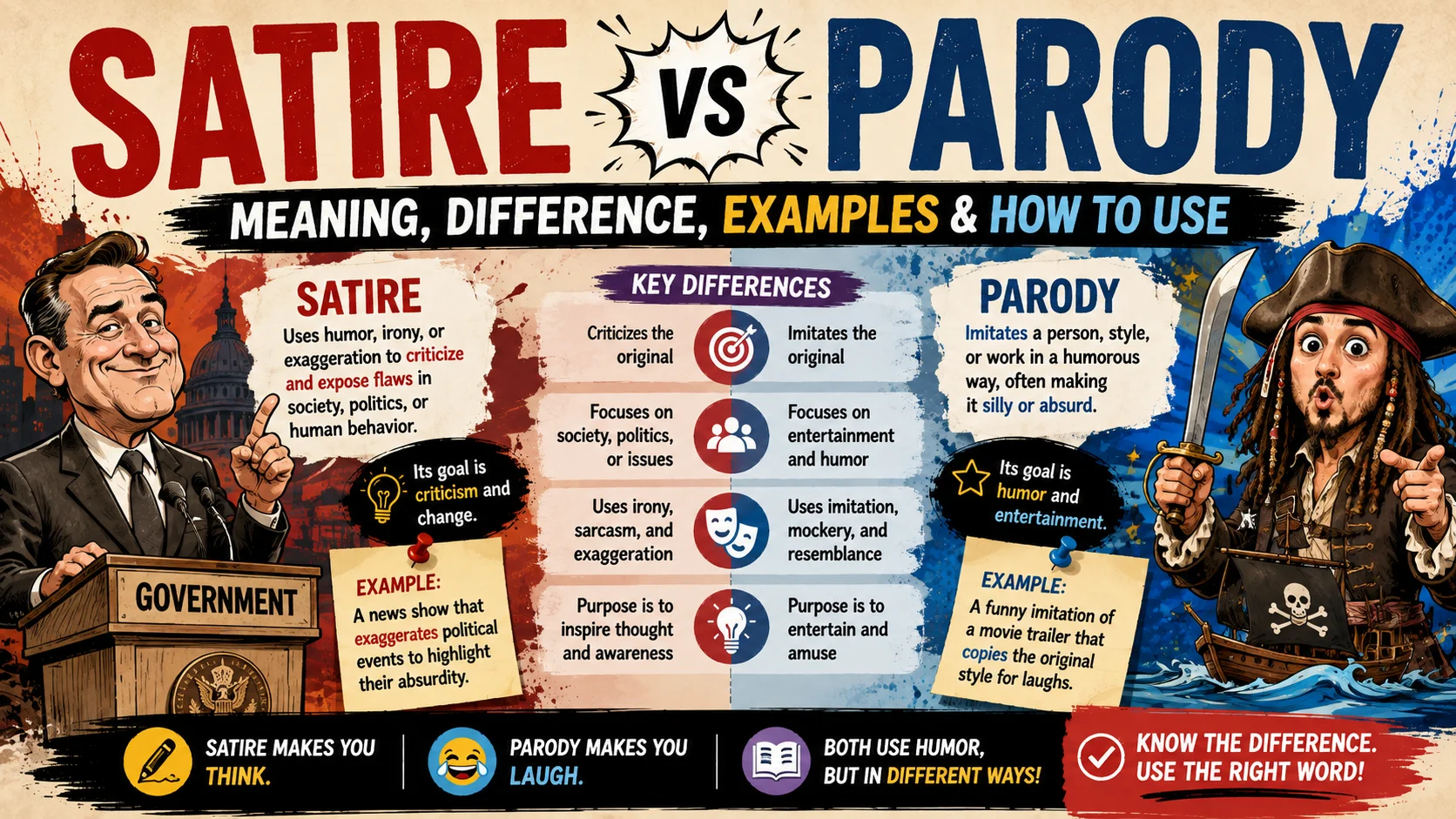
Satire uses humor, irony, exaggeration, or ridicule to criticize human behavior, social problems, institutions, politics, or other issues. Its main goal is often to make people think about a problem while entertaining them.
Parody, on the other hand, imitates a particular person, work, genre, style, or recognizable form in an exaggerated or humorous way. Its main goal is usually to create humor by copying and changing familiar features.
A simple way to remember the difference is:
Satire criticizes an idea, behavior, or problem.
Parody imitates a recognizable work, style, or subject for humorous effect.
Satire vs Parody at a Glance
| Feature | Satire | Parody |
|---|---|---|
| Main purpose | Criticism or social commentary | Humor through imitation |
| Focus | Behavior, society, institutions, ideas | A specific work, person, style, or genre |
| Uses imitation | Sometimes | Usually |
| Uses exaggeration | Often | Often |
| Uses irony | Frequently | Sometimes |
| Requires a specific source? | No | Usually |
| Can be political? | Yes | Yes |
| Can be humorous? | Yes | Yes |
| Main question | What is being criticized? | What is being imitated? |
| Typical effect | Makes people think | Makes people laugh |
What Is Satire?
Satire is a form of expression that uses humor, irony, exaggeration, ridicule, or wit to expose weaknesses and criticize problems.
The target of satire can be almost anything, including:
- Human behavior
- Social customs
- Politics
- Government
- Institutions
- Popular culture
- Workplace culture
- Hypocrisy
- Greed
- Vanity
- Bad habits
- Social trends
Satire does not always make its criticism obvious. Sometimes the humor encourages the audience to recognize the problem for themselves.
Example of Satire
Imagine a fictional advertisement that claims a new product can solve every problem in someone’s life, from missing deadlines to making friends.
The advertisement might exaggerate the product’s abilities so much that the audience recognizes how unrealistic modern advertising can be.
The target is not necessarily one specific advertisement. Instead, the satire may be criticizing overpromising and consumer culture.
What Is Parody?
A parody is a humorous imitation of a recognizable work, person, style, character, genre, or format.
The audience usually recognizes the original source, and the humor comes from changing or exaggerating its familiar characteristics.
A parody might imitate:
- A famous movie
- A television show
- A song
- An advertisement
- A celebrity’s public style
- A news broadcast
- A book
- A genre
- A fictional character
- A recognizable writing style
Example of Parody
Imagine a fictional comedy video that copies the dramatic style of a famous action movie but uses an ordinary household chore as the central mission.
The humor comes from imitating the recognizable action-movie style while applying it to something completely ordinary.
That is parody.
The Main Difference Between Satire and Parody
The biggest difference is what the humor is trying to do.
Satire generally uses humor to criticize or expose something.
Parody generally uses imitation to make fun of or entertain by copying something recognizable.
| Question | Satire | Parody |
|---|---|---|
| What is the focus? | A problem, behavior, or idea | A recognizable source |
| Why use humor? | To criticize or expose | To imitate and entertain |
| Does it need an original work? | No | Usually |
| Can it stand alone? | Yes | Often depends on recognition |
| Is criticism essential? | Usually important | Not necessarily |
| Is imitation essential? | No | Usually |
Satire vs Parody Examples
| Example | Satire or Parody? | Why? |
|---|---|---|
| A comedy article criticizing political corruption | Satire | Criticizes a social issue |
| A video copying a famous movie trailer | Parody | Imitates a recognizable format |
| A fictional campaign advertisement mocking political promises | Satire | Criticizes political behavior |
| A comedy song copying the style of a famous song | Parody | Imitates a recognizable song |
| A cartoon exaggerating workplace bureaucracy | Satire | Criticizes workplace systems |
| A sketch imitating a celebrity’s mannerisms | Parody | Copies a recognizable person |
| A fictional news report mocking sensational journalism | Satire | Criticizes media practices |
| A comedy scene copying a famous TV show | Parody | Imitates a specific show |
Satire Can Use Parody
One reason satire vs parody is confusing is that the two can overlap.
A parody can be used as a satirical tool.
For example, a comedian might imitate a serious political debate and exaggerate the candidates’ behavior. The imitation makes it a parody, while the criticism of political behavior makes it satirical.
So something can contain both parody and satire.
| Element | What It Does |
|---|---|
| Parody | Copies a recognizable style or source |
| Satire | Uses the copied style to criticize something |
| Humor | Makes the message entertaining |
| Exaggeration | Makes the target easier to recognize |
Satire vs Parody in Movies
Movies can contain both forms.
Satirical Movie
A satirical movie may create fictional situations to criticize society, politics, consumerism, inequality, or human behavior.
The story does not necessarily need to imitate one particular movie.
Parody Movie
A parody movie deliberately imitates recognizable movies, characters, scenes, or genres.
For example, a comedy might exaggerate the conventions of horror movies by making familiar horror situations absurd.
| Movie Type | Primary Focus |
|---|---|
| Satire | Social or cultural criticism |
| Parody | Imitation of recognizable material |
| Satirical parody | Imitation used to criticize something |
Satire vs Parody in Literature
Both are common literary techniques.
Satire in Literature
Writers use satire to expose flaws in people, society, institutions, or political systems.
Satirical writing can use:
- Irony
- Sarcasm
- Exaggeration
- Ridicule
- Understatement
- Absurdity
- Humor
Parody in Literature
Parody imitates a recognizable literary style, genre, author, or work.
For example, a writer might imitate the overly dramatic language of a classic romance novel to create a humorous story about an ordinary situation.
Satire vs Parody in Social Media
Social media has made both forms especially common.
| Social Media Content | Likely Form |
|---|---|
| Mocking unrealistic productivity culture | Satire |
| Copying a famous influencer’s video style | Parody |
| Exaggerating political behavior | Satire |
| Recreating a famous advertisement humorously | Parody |
| Mocking unrealistic beauty standards | Satire |
| Imitating a celebrity’s speech style | Parody |
| Criticizing internet culture through humor | Satire |
| Copying a viral format and changing its meaning | Parody |
Satire vs Parody vs Spoof
Spoof is another word that often overlaps with parody.
A spoof is generally a humorous imitation designed to make fun of a recognizable subject.
| Term | Basic Meaning |
|---|---|
| Satire | Humor used to criticize |
| Parody | Humorous imitation |
| Spoof | Humorous imitation or mockery |
| Caricature | Exaggerated representation |
| Sarcasm | Mocking or ironic expression |
Parody and spoof are often used almost interchangeably in everyday conversation, although parody is the more precise literary and artistic term.
Satire vs Parody vs Sarcasm
These concepts are related but different.
Satire
Targets broader problems, behaviors, ideas, or institutions.
Parody
Copies a recognizable source in a humorous way.
Sarcasm
Usually involves saying something that means the opposite of the literal words, often to mock or criticize.
| Term | Main Feature |
|---|---|
| Satire | Criticism |
| Parody | Imitation |
| Sarcasm | Mocking irony |
| Spoof | Humorous imitation |
| Irony | Contrast between expectation and reality |
Satire vs Parody vs Irony
Irony is a broader concept than either satire or parody.
Irony occurs when there is a contrast between what is expected and what actually happens, or between literal wording and intended meaning.
Satire frequently uses irony.
Parody can also use irony.
| Concept | Main Function |
|---|---|
| Irony | Creates contrast |
| Satire | Uses humor to criticize |
| Parody | Uses imitation to create humor |
How to Identify Satire
Ask yourself these questions:
- Is the work criticizing a social problem?
- Is it exposing hypocrisy?
- Is it commenting on politics or institutions?
- Is exaggeration being used to make a criticism clearer?
- Would the message still make sense without copying a particular work?
If the answers are mostly yes, you’re probably looking at satire.
How to Identify Parody
Ask:
- Is a recognizable work being copied?
- Is a particular style being imitated?
- Are familiar features exaggerated?
- Does the humor depend on recognizing the original?
- Is the imitation itself the main source of the joke?
If the answers are mostly yes, it is probably parody.
Easy Way to Remember Satire vs Parody
Here’s the simplest distinction:
Satire = What is being criticized?
Parody = What is being copied?
For example:
A comedian copies the style of a famous news program and uses it to make fun of sensational journalism.
Copying the news program’s style = parody.
Criticizing sensational journalism = satire.
This is why one piece of content can be both a parody and satire.
Common Examples of Satire
Satire can target many areas of life.
| Target | Possible Satirical Approach |
|---|---|
| Politics | Exaggerating campaign promises |
| Advertising | Making product claims absurd |
| Social media | Exaggerating online behavior |
| Education | Mocking excessive bureaucracy |
| Workplace culture | Exaggerating pointless meetings |
| Consumerism | Showing ridiculous shopping habits |
| Celebrity culture | Highlighting obsession with fame |
| Technology | Exaggerating dependence on devices |
| News media | Mocking sensational reporting |
| Human behavior | Exposing hypocrisy |
Common Examples of Parody
Parody often focuses on recognizable sources.
| Source | Possible Parody |
|---|---|
| Action movie | Exaggerated action scenes |
| Horror movie | Turning scary conventions into comedy |
| Romance novel | Overly dramatic romantic language |
| Cooking show | Absurd cooking instructions |
| News broadcast | Imitating the presentation style |
| Advertisement | Exaggerating advertising language |
| Music video | Copying visual and musical conventions |
| Superhero movie | Exaggerating superhero clichés |
| Detective story | Making detective conventions ridiculous |
| Celebrity interview | Imitating recognizable interview habits |
Can Satire Be Serious?
Yes. Satire does not have to be purely comedic.
A satirical work may use humor to discuss serious issues. The humor can make uncomfortable subjects easier to approach while still delivering criticism.
Satire can therefore be:
- Funny
- Serious
- Dark
- Political
- Social
- Educational
- Thought-provoking
The key feature is the critical purpose, not simply whether the audience laughs.
Does Parody Always Criticize?
No.
A parody can simply imitate something because the imitation itself is funny.
For example, someone could create a humorous imitation of a movie genre without making a serious statement about society.
This is why parody does not automatically equal satire.
Frequently Asked Questions
What is the difference between satire and parody?
Satire uses humor, irony, exaggeration, or ridicule to criticize a person, behavior, idea, institution, or social problem. Parody imitates a recognizable work, person, style, or genre to create humor.
Is parody a type of satire?
Not necessarily. Parody and satire are separate techniques, although a parody can be used to create satire.
Can something be both satire and parody?
Yes. A work can imitate a recognizable source while also criticizing an idea, behavior, or institution.
Is satire always funny?
No. Satire often uses humor, but its primary purpose is criticism or social commentary. Some satire can be dark, subtle, or serious.
Is parody always funny?
Parody is generally intended to create humor through imitation, although the exact tone can vary.
What is the easiest way to remember satire vs parody?
Remember satire = criticism and parody = imitation.
What is an example of parody?
A comedy sketch that imitates the style, characters, or conventions of a famous movie is an example of parody.
What is an example of satire?
A fictional advertisement that exaggerates consumer culture to criticize excessive shopping can be an example of satire.
What is the difference between parody and spoof?
The words often overlap. Parody usually refers to humorous imitation of a recognizable work, style, or genre, while spoof is commonly used for humorous imitation or mockery more generally.
What is the difference between satire and sarcasm?
Satire is usually a broader form of criticism aimed at behaviors, ideas, institutions, or social problems. Sarcasm is a particular way of speaking or writing that often uses mocking or ironic language.
Final Comparison
| Feature | Satire | Parody |
|---|---|---|
| Definition | Humor or irony used for criticism | Humorous imitation |
| Primary purpose | Critique | Entertainment or mockery |
| Main target | Ideas, behaviors, society, institutions | Specific works, styles, people, or genres |
| Requires imitation | No | Usually |
| Requires humor | Often | Usually |
| Uses exaggeration | Often | Often |
| Uses irony | Frequently | Sometimes |
| Can be political | Yes | Yes |
| Can be literary | Yes | Yes |
| Can appear in film | Yes | Yes |
| Can appear online | Yes | Yes |
| Can overlap with the other | Yes | Yes |
Conclusion
The difference between satire vs parody becomes much clearer when you focus on their main purposes.
Satire is primarily about criticism. It uses humor, irony, exaggeration, or ridicule to expose problems in society, politics, institutions, human behavior, or popular culture.
Parody is primarily about imitation. It copies a recognizable person, work, genre, style, or format and changes or exaggerates it to create humor.
The two can overlap. A comedian might imitate a famous news program while criticizing sensational journalism. In that case, the imitation makes it a parody, while the criticism makes it satirical.
The easiest rule to remember is:
Satire asks, “What is being criticized?”
Parody asks, “What is being imitated?”
Once you understand that distinction, identifying and using both terms becomes much easier.

Olivia Bennett is a writer and language enthusiast at Vocabsteria. She is passionate about exploring word meanings, name origins, and cultural expressions from around the world.