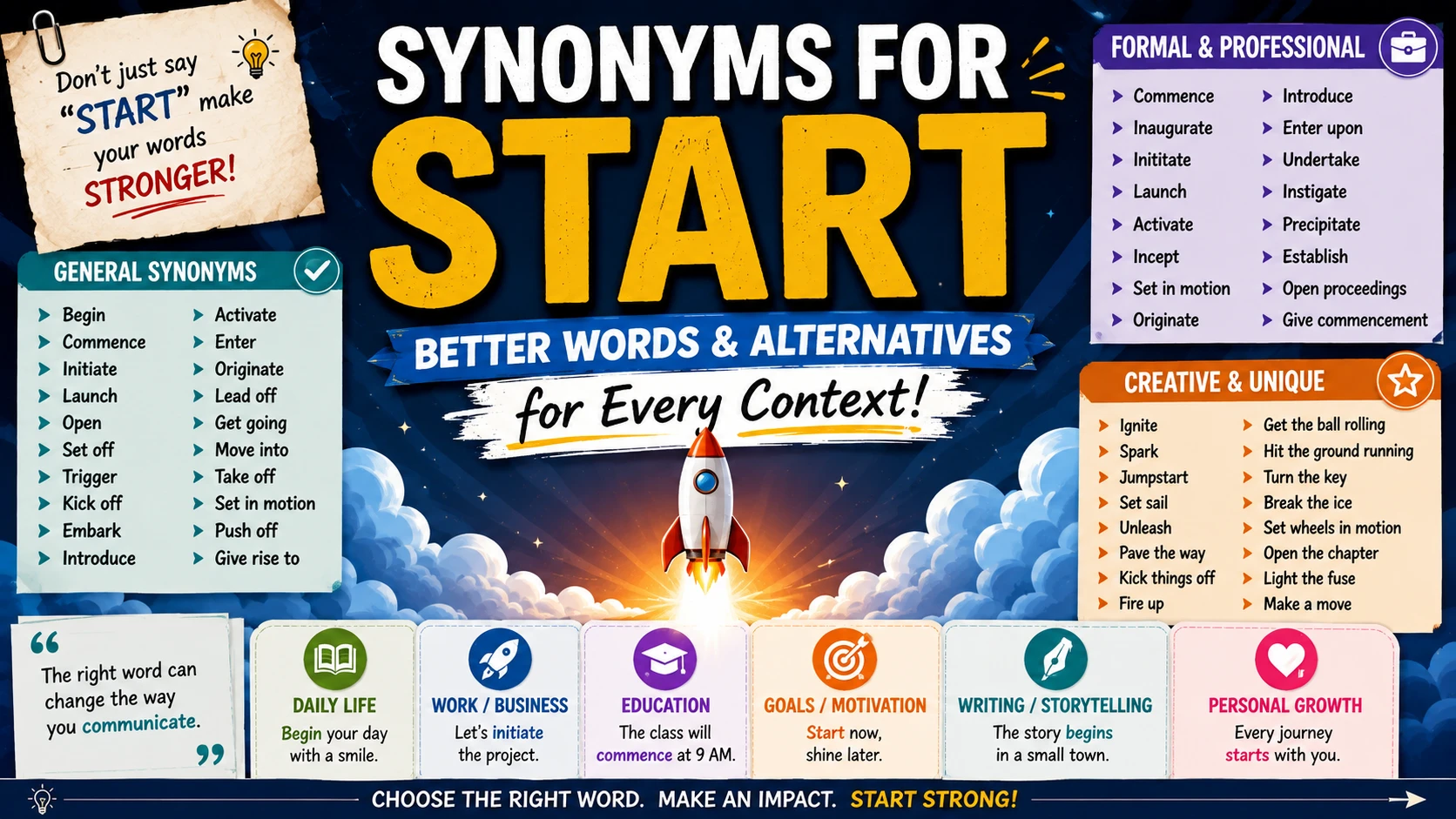
The word start is one of the most useful and frequently used words in English. It can mean beginning an activity, launching a project, creating something, setting an event in motion, or beginning a journey. Because it has so many uses, choosing a more specific synonym can make your writing clearer and more engaging.
Depending on the context, you can replace start with words such as begin, commence, launch, initiate, open, introduce, establish, or kick off. Some alternatives are formal and suitable for professional writing, while others are casual and work better in everyday conversation.
For example, you might begin a lesson, launch a new business, initiate a process, commence a formal ceremony, or kick off a meeting. Although these words share the general idea of starting, each one carries a slightly different meaning.
This guide explores the best synonyms for start, their meanings, examples, differences, and the situations where each word works best.
Quick Answer: What Are Synonyms for Start?
Common synonyms and alternatives for start include:
- Begin
- Commence
- Initiate
- Launch
- Open
- Introduce
- Establish
- Create
- Found
- Activate
- Trigger
- Start off
- Kick off
- Set off
- Get going
- Get underway
- Embark on
- Enter
- Originate
- Arise
- Develop
- Initiate
- Introduce
- Unfold
- Resume
- Restart
- Reopen
- Restart
- Spark
- Ignite
The best choice depends on whether you mean beginning an activity, starting a journey, launching something new, creating something, or making something happen.
Start Synonyms at a Glance
| Synonym | Best Context | Example |
|---|---|---|
| Begin | General use | Let’s begin the lesson. |
| Commence | Formal situations | The ceremony will commence at noon. |
| Initiate | Processes or actions | We initiated the review. |
| Launch | Products, businesses, campaigns | They launched a new app. |
| Open | Events, meetings, discussions | The speaker opened the meeting. |
| Establish | Organizations or systems | They established a new company. |
| Kick off | Casual or energetic situations | Let’s kick off the project. |
| Embark on | Journeys or major projects | She embarked on a new career. |
| Activate | Systems or devices | Press the button to activate the system. |
| Trigger | Events or reactions | The announcement triggered a debate. |
| Spark | Ideas, emotions, movements | The speech sparked a conversation. |
| Resume | Something started again | The meeting resumed after lunch. |
Begin: The Best General Synonym for Start
Begin is one of the closest and most versatile synonyms for start. It works in formal, informal, academic, and everyday English.
Examples:
- Let’s begin the meeting.
- The movie begins at 8 p.m.
- She began writing a new book.
- The class will begin shortly.
Because begin fits so many situations, it is often the safest replacement for start.
Begin vs. Start
These words are usually interchangeable.
Start often sounds slightly more conversational.
Begin can sound a little more polished or formal.
Compare:
Let’s start the meeting.
Let’s begin the meeting.
Both are completely natural.
Commence: A Formal Alternative to Start
Commence means to begin and is generally more formal.
Examples:
- The ceremony will commence at 10 a.m.
- Construction will commence next month.
- The examination commenced at nine o’clock.
- The proceedings will commence shortly.
Commence is common in formal announcements, legal writing, official documents, and professional contexts.
For everyday conversation, start or begin usually sounds more natural.
Initiate: Start a Process or Action
Initiate means to cause something to begin or to take the first step in a process.
Examples:
- The company initiated an investigation.
- We need to initiate the approval process.
- She initiated a conversation with her manager.
- The system automatically initiated the update.
Initiate is especially useful when talking about procedures, processes, actions, or formal steps.
Launch: Start Something New
Launch means to officially introduce or begin something, especially a product, business, campaign, website, or project.
Examples:
- The company launched a new product.
- They launched their website last month.
- The organization launched a fundraising campaign.
- She launched her own business.
Launch is stronger than simply saying start because it often suggests a planned and public beginning.
Open: Start an Event or Discussion
Open can mean to begin a meeting, ceremony, event, discussion, or session.
Examples:
- The chairman opened the meeting.
- She opened the conference with a short speech.
- The host opened the discussion.
- The ceremony was opened by the mayor.
It can also refer to making a place available for business:
The store opens at 9 a.m.
Establish: Start and Build Something
Establish means to create, set up, or bring something into existence.
It is particularly useful for organizations, businesses, systems, traditions, relationships, and institutions.
Examples:
- They established a new company.
- The school was established in 1995.
- She established a successful business.
- The organization established new guidelines.
Establish often suggests that something continues after it is started.
Found: Start an Organization or Institution
Found means to establish an organization, institution, city, or company.
Examples:
- The university was founded in 1890.
- She founded a nonprofit organization.
- The company was founded by two entrepreneurs.
Do not confuse found with find. In this context, found means to establish or create something.
Kick Off: A Casual Way to Say Start
Kick off is an informal expression meaning to begin.
Examples:
- Let’s kick off the meeting.
- The event kicks off at 7 p.m.
- We’re kicking off the campaign next week.
- The team kicked off the season with a victory.
It is common in business conversations, sports, events, and casual speech.
Get Started: Begin Doing Something
Get started is one of the most common everyday expressions for beginning an activity.
Examples:
- Let’s get started.
- I need to get started on my homework.
- When should we get started?
- She got started early this morning.
It is especially natural when encouraging someone to begin an activity.
Get Underway: Begin Progressing
Get underway means to begin and start progressing.
Examples:
- The meeting got underway at 10 a.m.
- Construction is expected to get underway soon.
- The event got underway after a short delay.
This phrase is useful for events, projects, activities, and processes.
Embark On: Start a Journey or Major Project
Embark on means to begin a significant journey, activity, career, project, or experience.
Examples:
- She embarked on a new career.
- They embarked on a long journey.
- The company embarked on an ambitious project.
- He embarked on a new chapter in his life.
This expression often suggests that the activity is important or substantial.
Set Off: Start a Journey
Set off means to begin traveling or leave a place.
Examples:
- We set off early in the morning.
- They set off for the mountains.
- She set off on her journey at sunrise.
It is more specific than start because it commonly refers to travel or movement.
Activate: Start a System or Device
Activate means to make a system, device, service, or process begin working.
Examples:
- Press the button to activate the machine.
- You need to activate your account.
- The sensor activates the alarm.
- The user activated the new feature.
It is especially useful in technical and digital contexts.
Trigger: Cause Something to Start
Trigger means to cause an event, reaction, process, or response to begin.
Examples:
- The news triggered a public debate.
- The alarm was triggered by smoke.
- The announcement triggered a wave of excitement.
- Stress can trigger certain reactions.
Trigger focuses on the cause of something beginning rather than simply the beginning itself.
Spark: Cause an Idea or Reaction to Begin
Spark means to cause something to begin, especially an idea, conversation, interest, movement, or emotional response.
Examples:
- Her question sparked a lively discussion.
- The book sparked my interest in history.
- The event sparked a new movement.
- His speech sparked an important conversation.
Spark is especially effective in descriptive and creative writing.
Ignite: Start Something Powerful or Emotional
Ignite literally means to set something on fire, but it can also mean to cause strong emotions, interest, conflict, or enthusiasm to begin.
Examples:
- The speech ignited public interest.
- The discovery ignited a scientific debate.
- Her performance ignited the crowd.
- The campaign ignited enthusiasm among supporters.
Ignite creates a stronger and more dramatic effect than start.
Introduce: Start a New Topic or Idea
Introduce can mean to bring a new subject, idea, method, or person into a situation.
Examples:
- The teacher introduced a new topic.
- The company introduced a new service.
- She introduced the idea during the meeting.
- The speaker introduced several important concepts.
It is especially useful when starting a discussion or presenting something new.
Create: Start Something New
In some contexts, create can replace start when you mean bringing something into existence.
Examples:
- She started a business.
- She created a business.
However, the meanings are not always identical. Create emphasizes making or producing, while start emphasizes beginning.
Originate: Where Something Begins
Originate means to begin or come from a particular place, person, source, or point.
Examples:
- The tradition originated in Europe.
- The idea originated with a small group of students.
- The river originates in the mountains.
It is useful when discussing the source or beginning of something.
Resume: Start Again
Resume means to begin again after an interruption.
Examples:
- The meeting resumed after lunch.
- Work resumed after the storm.
- She resumed her studies after a short break.
- The game resumed after the delay.
If something has never started before, resume is usually not the correct word.
Restart: Start Again From the Beginning
Restart means to start something again.
Examples:
- Please restart the computer.
- We had to restart the project.
- The machine restarted automatically.
- Let’s restart the discussion.
Restart is especially common with computers, machines, games, processes, and activities.
Reopen: Start Operating Again
Reopen means to open something again after it has been closed.
Examples:
- The store will reopen next week.
- The museum reopened after renovations.
- The restaurant reopened after the holiday.
Reopen is more specific than restart because it commonly refers to places, businesses, cases, or discussions that have been closed.
Start Synonyms for Different Situations
| Situation | Best Alternatives |
|---|---|
| Begin an activity | Begin, get started |
| Formal event | Commence, open |
| Start a project | Initiate, launch, kick off |
| Start a business | Launch, establish, found |
| Start a journey | Set off, embark on |
| Start a conversation | Initiate, open |
| Start a machine | Activate, switch on |
| Cause something to happen | Trigger, spark, ignite |
| Start again | Restart, resume |
| Start a discussion | Open, initiate |
| Start a tradition | Establish, introduce |
| Start from a source | Originate |
Formal Synonyms for Start
If you are writing an academic paper, professional report, formal email, or official document, these alternatives can work well:
- Commence
- Initiate
- Establish
- Launch
- Introduce
- Implement
- Undertake
- Originate
- Initiate
- Embark on
For example:
Casual:
We started the project in June.
More formal:
We commenced the project in June.
Or:
We initiated the project in June.
The best choice depends on the exact meaning.
Casual Synonyms for Start
For everyday conversations, these expressions sound natural:
- Begin
- Get started
- Kick off
- Get going
- Set off
- Start off
- Get underway
Examples:
- Let’s get started.
- When should we kick off?
- It’s time to get going.
- We set off before sunrise.
Synonyms for Start a Business
When talking about creating a business, you can use:
- Launch
- Establish
- Found
- Set up
- Create
- Open
- Build
- Start
Examples:
- She started a small business.
- She launched a small business.
- She founded a small business.
- She established a small business.
- She set up a small business.
Launch emphasizes the introduction of the business, while found and establish emphasize its creation.
Synonyms for Start a Career
Useful alternatives include:
- Begin
- Launch
- Embark on
- Enter
- Pursue
- Establish
Examples:
- She started her career in marketing.
- She began her career in marketing.
- She launched her career in marketing.
- She embarked on a career in marketing.
Embark on gives the sentence a more formal or literary tone.
Synonyms for Start a Conversation
Try:
- Begin
- Initiate
- Open
- Introduce
- Broach
Examples:
- He started a conversation with his neighbor.
- He initiated a conversation with his neighbor.
- She opened a discussion about the issue.
- He broached the subject carefully.
Broach is particularly useful when introducing a difficult or sensitive topic.
Synonyms for Start a Meeting
Natural alternatives include:
- Begin
- Open
- Commence
- Kick off
- Get underway
Examples:
- Let’s start the meeting.
- Let’s begin the meeting.
- Let’s open the meeting.
- Let’s kick off the meeting.
For casual business communication, kick off is common. For formal settings, commence or begin may be better.
Synonyms for Start a Project
Some useful choices are:
- Initiate
- Launch
- Begin
- Commence
- Kick off
- Undertake
- Get underway
Examples:
- We will start the project next month.
- We will launch the project next month.
- We will initiate the project next month.
- We will kick off the project next month.
Synonyms for Start Working
Depending on the context, you can say:
- Begin working
- Get to work
- Get started
- Commence work
- Begin the task
- Set to work
Examples:
- Let’s start working.
- Let’s get to work.
- Let’s get started.
- We began working on the report.
50+ Synonyms and Alternatives for Start
Here is a useful collection of alternatives:
- Begin
- Commence
- Initiate
- Launch
- Open
- Establish
- Found
- Introduce
- Activate
- Trigger
- Spark
- Ignite
- Create
- Originate
- Embark
- Undertake
- Kick off
- Get started
- Get going
- Get underway
- Set off
- Set out
- Enter
- Arise
- Emerge
- Develop
- Evolve
- Unfold
- Initiate
- Implement
- Introduce
- Establish
- Resume
- Restart
- Reopen
- Recommence
- Renew
- Reactivate
- Reignite
- Begin again
- Set in motion
- Put into action
- Put in place
- Get moving
- Get rolling
- Set about
- Take up
- Undertake
- Broach
- Inaugurate
- Incept
- Commence
- Initiate
- Institute
- Establish
Some of these are context-specific rather than exact replacements for start, so always consider the meaning of the sentence before choosing one.
Start vs. Begin
Start and begin are very close in meaning and are often interchangeable.
Examples:
The class starts at nine.
The class begins at nine.
Both are correct.
However, start is often more common in casual conversation, while begin can sound slightly more formal.
Start vs. Commence
Commence is more formal than start.
Compare:
The meeting starts at 10 a.m.
The meeting commences at 10 a.m.
The second sentence sounds more official.
Use commence when writing formal notices, reports, announcements, or official documents. In ordinary conversation, start or begin usually sounds more natural.
Start vs. Initiate
Start simply means to begin. Initiate often suggests deliberately causing a process or action to begin.
Compare:
The meeting started.
The manager initiated the review process.
Initiate is especially useful for procedures, investigations, projects, and formal actions.
Start vs. Launch
Launch usually suggests introducing something new to the public or beginning an important project.
Compare:
We started a new website.
We launched a new website.
Launch gives the idea of an official introduction.
Start vs. Establish
Start focuses on the beginning, while establish often suggests creating something that is intended to continue.
Compare:
They started a company.
They established a company.
Both can be correct, but establish sounds more formal and emphasizes creating a lasting organization.
Start vs. Resume
These words should not always be substituted for each other.
Start means to begin.
Resume means to begin again after an interruption.
Example:
The meeting started at 9 a.m.
The meeting resumed after lunch.
If the meeting had already begun and then stopped, resume is the appropriate choice.
How to Choose the Right Synonym for Start
The best alternative depends on what is actually beginning.
- Use begin for general situations.
- Use commence for formal situations.
- Use initiate for processes and deliberate actions.
- Use launch for products, businesses, campaigns, and major projects.
- Use establish for organizations and systems.
- Use kick off for casual events and projects.
- Use embark on for journeys, careers, and major experiences.
- Use activate for machines and systems.
- Use trigger when something causes an event or reaction.
- Use spark for ideas, conversations, interest, or movements.
- Use resume when something starts again after an interruption.
- Use restart when something is started again, often from the beginning.
People Also Ask
What is another word for start?
Common alternatives include begin, commence, initiate, launch, open, establish, kick off, get started, and get underway.
What is a formal synonym for start?
Commence and initiate are common formal alternatives. Establish and launch may also work depending on the context.
What is a stronger word for start?
Words such as launch, initiate, ignite, spark, and embark on can provide more specific or powerful meanings than start.
What is a synonym for start a business?
Useful alternatives include launch, establish, found, create, and set up.
What is a synonym for start a journey?
Use set off, set out, embark on, or begin.
What is a synonym for start a conversation?
Use initiate, open, begin, introduce, or broach.
What is a synonym for start again?
Use restart, resume, recommence, reopen, or begin again, depending on the context.
What is the opposite of start?
Common opposites include finish, end, stop, conclude, terminate, and complete, depending on the context.
Frequently Asked Questions
Is begin the same as start?
In most situations, yes. Start and begin are often interchangeable, although start is sometimes more conversational and begin can sound slightly more formal.
Is commence a good synonym for start?
Yes. Commence means begin, but it has a more formal tone and is commonly used in official, academic, and professional contexts.
What is the difference between start and launch?
Start simply means to begin. Launch usually suggests officially introducing or beginning something new, such as a product, business, campaign, or project.
What is the difference between start and initiate?
Start means to begin, while initiate often means deliberately causing a process, action, or procedure to begin.
Can kick off mean start?
Yes. Kick off is an informal expression meaning to begin, especially for meetings, events, projects, campaigns, and sports activities.
What is the best synonym for start in an essay?
Begin is usually a safe choice. Depending on the context, commence, initiate, establish, undertake, or embark on may be more precise.
What is a synonym for start in professional writing?
Useful options include initiate, commence, launch, establish, implement, and undertake, depending on the sentence.
Conclusion
There are many useful synonyms for start, but no single alternative works perfectly in every sentence. Begin is the closest general replacement, while commence provides a more formal tone. Initiate works well for processes and deliberate actions, and launch is especially useful for products, businesses, campaigns, and major projects.
For casual writing, phrases such as get started, kick off, and get underway sound natural. When describing journeys or important life changes, set off and embark on can add more meaning. If something causes another event to begin, trigger, spark, or ignite may be better choices. For something that begins again after a pause, resume or restart is more precise.
The key is to choose a word based on the exact situation rather than simply replacing start with the first synonym you find. A precise alternative can make your writing clearer, more natural, and more engaging.

Olivia Bennett is a writer and language enthusiast at Vocabsteria. She is passionate about exploring word meanings, name origins, and cultural expressions from around the world.