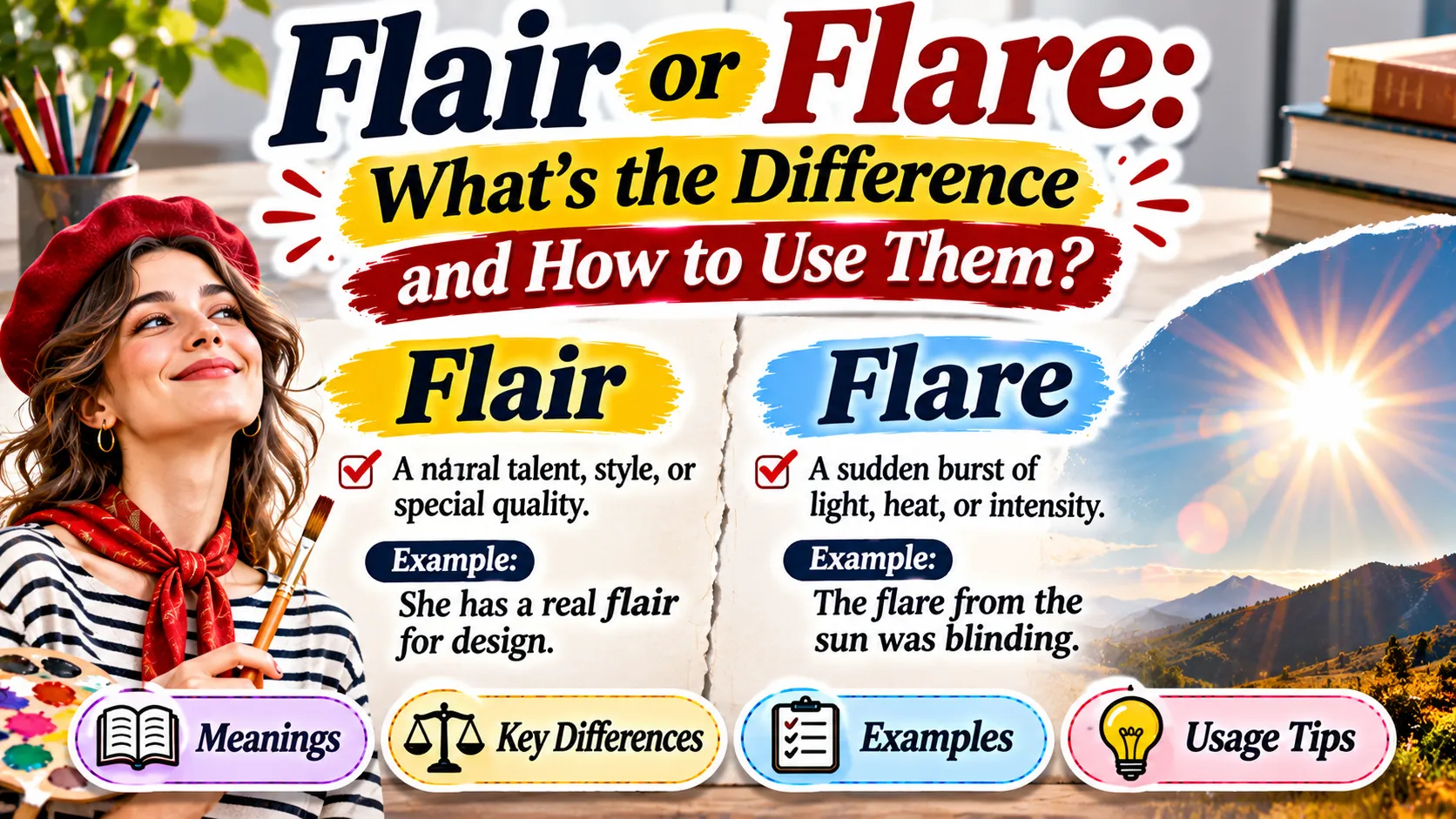
Flair or flare? These two words sound exactly alike, but they have different meanings and uses. Flair refers to a natural talent, distinctive style, or special ability, while flare describes a sudden burst of light, fire, or emotion. Although they are homophones, confusing them can change the meaning of your sentence.
For example, someone might have a flair for writing, meaning they have a natural talent for expressing ideas. However, a flare of light describes a sudden burst of brightness. Both spellings are correct, but each belongs in a different context.
Understanding the difference between flair and flare can improve your spelling, writing, and everyday communication. In this guide, you will learn their definitions, grammatical uses, examples, pronunciation, common expressions, and simple tricks for remembering which word to choose.
⚡ Flair vs. Flare: Quick Answer
The main difference between flair and flare is their meaning. Flair is a noun that describes a natural talent, creative ability, or distinctive style. Flare can be a noun or a verb and refers to a sudden burst of light, fire, emotion, or an increase in intensity.
| Word | Part of Speech | Meaning | Example |
|---|---|---|---|
| Flair | Noun | Natural talent or distinctive style | She has a flair for fashion. |
| Flare | Noun | A sudden burst of light or fire | We saw a flare in the sky. |
| Flare | Verb | To burn brightly or become more intense | The flames began to flare. |
Easy way to remember:
- Flair = Talent and style.
- Flare = Fire, light, or sudden intensity.
Both words are pronounced the same way: /flɛər/.
🎨 What Does Flair Mean?
Flair is a noun that describes a natural talent, special ability, or distinctive way of doing something. It often refers to creativity, elegance, originality, or an impressive personal style.
When someone has flair, they perform a task with confidence, skill, or an attractive personal touch. The word commonly appears in conversations about fashion, art, writing, cooking, design, and communication.
Examples of flair in sentences:
- She has a natural flair for painting.
- The designer added flair to the traditional outfit.
- He writes with creativity and flair.
- My sister has a flair for decorating rooms.
- The chef prepares ordinary dishes with a special flair.
- Her presentation showed a remarkable flair for storytelling.
Common Meanings of Flair
Flair can describe different qualities depending on the context.
1. Natural Talent
Flair often refers to an ability that someone seems naturally good at.
Example: He has a flair for learning new languages.
2. Distinctive Style
It can describe an original or attractive way of presenting something.
Example: The artist decorated the room with artistic flair.
3. Creativity and Originality
Flair can also suggest imagination and the ability to make something interesting.
Example: She approaches every project with creativity and flair.
4. Confidence and Skill
Sometimes flair describes the impressive way someone performs an activity.
Example: The dancer performed with remarkable flair.
🔥 What Does Flare Mean?
Flare can function as both a noun and a verb. As a noun, it commonly describes a sudden burst of light, fire, or brightness. It can also refer to a sudden increase in an emotion, problem, or physical condition.
As a verb, flare means to burn brightly, spread outward, or suddenly become more noticeable or intense.
Examples of flare in sentences:
- A bright flare appeared above the mountains.
- The fire began to flare in the strong wind.
- His anger started to flare during the argument.
- The pilot released a flare to signal for help.
- The argument caused tensions to flare again.
- The candle flame began to flare when the window opened.
Common Meanings of Flare
Flare has several meanings in everyday English.
1. A Sudden Burst of Light
A flare can describe a bright light that appears suddenly.
Example: A red flare lit up the dark sky.
2. A Burst of Fire
It can refer to a sudden increase in flames or brightness.
Example: The flames flared when the wood caught fire.
3. A Sudden Increase in Emotion
Flare can describe anger, excitement, or tension becoming stronger.
Example: Tempers flared during the heated discussion.
4. A Sudden Worsening of a Problem
The word can describe a situation that becomes more serious or noticeable.
Example: Violence flared after the announcement.
5. A Shape That Spreads Outward
Flare can also describe something that gradually becomes wider toward its end.
Example: The dress has a flared skirt.
📊 Flair vs. Flare: Key Differences
Although flair and flare sound identical, their meanings and grammatical functions are different. Understanding these differences will help you avoid common spelling mistakes.
| Feature | Flair | Flare |
|---|---|---|
| Pronunciation | /flɛər/ | /flɛər/ |
| Part of speech | Noun | Noun and verb |
| Main meaning | Natural talent or style | Burst of light, fire, or intensity |
| Common context | Creativity and ability | Light, flames, emotions, and shape |
| Related expression | A flair for writing | A flare-up of anger |
| Example | She has a flair for design. | The flames began to flare. |
The easiest distinction is to remember that flair relates to personal ability, while flare relates to something that bursts, brightens, spreads, or intensifies.
✍️ When to Use Flair in a Sentence
Use flair when describing someone’s natural ability, creativity, or distinctive style. It is particularly useful when discussing artistic work, professional skills, fashion, communication, and personal expression.
Here are some common situations where flair is the correct choice.
1. Flair for Writing
Use this expression when someone has a natural ability to write creatively or communicate ideas effectively.
Examples:
- She has a flair for writing interesting stories.
- His flair for storytelling makes his articles engaging.
- The student demonstrated a flair for creative writing.
2. Flair for Fashion
This expression describes someone’s ability to choose stylish clothing or create attractive outfits.
Examples:
- My friend has a flair for fashion.
- She combines traditional clothing with modern flair.
- The designer is known for her unique fashion flair.
3. Flair for Business
Use this expression when someone has a natural ability to manage, organize, or develop business ideas.
Examples:
- He has a flair for business management.
- Her flair for negotiation helped the company succeed.
- The entrepreneur showed remarkable business flair.
4. Flair for Creativity
This expression describes imagination and the ability to produce original ideas.
Examples:
- The artist has a flair for creative design.
- She decorated the office with artistic flair.
- His projects always show originality and flair.
🔥 When to Use Flare in a Sentence
Use flare when describing a sudden burst of light, fire, emotion, or intensity. It is also correct when describing something that spreads outward or becomes wider.
Here are common situations where flare is the correct spelling.
1. Flare of Light
Use this expression when describing a sudden bright light or signal.
Examples:
- A flare appeared over the ocean.
- The emergency flare helped rescuers locate the boat.
- We noticed a bright flare in the distance.
2. Flare of Fire
Use flare when flames suddenly become brighter or more intense.
Examples:
- The fire began to flare in the wind.
- A small flame flared when the fuel caught fire.
- The candles flared briefly before going out.
3. Flare of Anger
Use this expression when someone’s anger suddenly becomes stronger.
Examples:
- A flare of anger crossed his face.
- Her temper began to flare during the meeting.
- The disagreement caused tempers to flare.
4. Flare-Up of a Problem
A flare-up describes a sudden increase or return of a problem, conflict, or unpleasant situation.
Examples:
- The argument led to a flare-up between the neighbors.
- Political tensions flared after the announcement.
- The conflict experienced another flare-up.
5. Flared Clothing
Use flare when describing clothing that becomes wider toward the bottom.
Examples:
- She wore a pair of flared jeans.
- The dress has a beautiful flared skirt.
- Bell-bottom trousers flare outward from the knees.
🧠 Flair vs. Flare Examples in Everyday English
The following examples show how each word works in different situations. Comparing similar sentences can help you recognize the correct spelling more easily.
| Flair Example | Flare Example |
|---|---|
| She has a flair for cooking. | The flames began to flare. |
| He writes with remarkable flair. | A flare appeared in the night sky. |
| The designer added flair to the outfit. | The emergency flare sent a bright signal. |
| My brother has a flair for music. | His anger started to flare. |
| The restaurant serves food with artistic flair. | The argument caused tempers to flare. |
| She has a natural flair for leadership. | The dress has a flared bottom. |
| The presentation showed creative flair. | The fire flared up suddenly. |
| His flair for storytelling impressed everyone. | The conflict began to flare again. |
| The artist works with impressive flair. | A bright flare illuminated the area. |
| Her flair for design is impressive. | The flames flared in the fireplace. |
🔤 Common Phrases With Flair and Flare
Both words appear in familiar English expressions. Learning these phrases can help you understand their meanings and use them naturally.
Common Expressions With Flair
| Expression | Meaning |
|---|---|
| A flair for writing | Natural writing ability |
| A flair for fashion | A natural sense of style |
| Creative flair | Originality and imagination |
| Artistic flair | Natural artistic ability |
| Dramatic flair | An expressive or theatrical style |
| Business flair | Natural business ability |
| Personal flair | A distinctive individual style |
| A flair for languages | Natural ability to learn languages |
| A flair for design | Natural design ability |
| With great flair | In an impressive or stylish way |
Common Expressions With Flare
| Expression | Meaning |
|---|---|
| Flare up | Suddenly become stronger or more intense |
| Flare of anger | A sudden expression of anger |
| Solar flare | A sudden release of energy from the Sun |
| Emergency flare | A bright signal used in emergencies |
| Flare gun | A device that launches signaling flares |
| Flare skirt | A skirt that widens toward the bottom |
| Flared trousers | Trousers that widen toward the bottom |
| Flare stack | A structure used to burn excess gas |
| Lens flare | Bright light artifacts in photography |
| Flare out | Spread or widen outward |
🌟 What Is the Difference Between Flair and Flare in Fashion?
Fashion is one area where both words can appear, but they describe different things.
Flair refers to someone’s distinctive sense of style, creativity, or ability to combine clothing attractively. Flare describes a garment’s shape when it becomes wider toward the bottom.
| Word | Fashion Meaning | Example |
|---|---|---|
| Flair | Personal style or creativity | She has a flair for fashion. |
| Flare | A shape that widens outward | He bought a pair of flared jeans. |
For example:
- Her fashion flair makes every outfit look elegant.
- The trousers have a flared design.
- The stylist added a creative flair to the collection.
- Bell-bottom jeans flare outward below the knees.
Remember that flair describes how someone styles clothing, while flare describes the shape of the clothing itself.
🌞 What Is a Solar Flare?
A solar flare is a sudden, intense release of energy from the Sun’s atmosphere. It produces electromagnetic radiation across different wavelengths and can affect radio communications, navigation systems, and satellites.
Solar flares are connected with magnetic activity in the Sun’s atmosphere. Scientists study them to better understand space weather and its possible effects on Earth.
Examples:
- Scientists observed a powerful solar flare.
- A solar flare can interfere with some radio communications.
- Researchers monitor solar flares to understand space weather.
The spelling solar flair is incorrect because the term refers to a burst of solar energy, not a person’s talent or style.
📝 Common Mistakes When Using Flair and Flare
Because these words have identical pronunciations, writers sometimes use the wrong spelling. Recognizing common mistakes can help you choose the correct word.
| Incorrect Sentence | Correct Sentence | Explanation |
|---|---|---|
| She has a flare for painting. | She has a flair for painting. | Natural artistic ability means flair. |
| He added some flair to the fire. | He added some fuel, and the fire began to flare. | Flare describes increasing flames. |
| The designer has a flare for fashion. | The designer has a flair for fashion. | A natural sense of style is flair. |
| A bright flair appeared in the sky. | A bright flare appeared in the sky. | A burst of light is a flare. |
| His temper began to flair. | His temper began to flare. | Increasing anger is described by flare. |
| She wore flair jeans. | She wore flared jeans. | Clothing that widens outward is flared. |
Remember: If your sentence describes a person’s talent or style, use flair. If it describes light, flames, emotions, or something spreading outward, use flare.
🧩 Easy Tricks to Remember Flair vs. Flare
If you often confuse these words, a few simple memory tricks can make the difference easier to remember.
1. Flair Starts With F Like Fashion
Think of the expression “fashion flair.” Both words connect with personal style and creativity.
2. Flare Connects With Fire
The word flare is associated with flames, bright lights, and sudden bursts of energy. Think of a fire flaring up.
3. Remember Talent vs. Burst
- Flair = Talent, creativity, and style.
- Flare = Light, fire, and sudden intensity.
4. Use the Sentence Test
Ask yourself what your sentence describes:
- Are you talking about someone’s natural ability? Choose flair.
- Are you describing a bright light or sudden increase? Choose flare.
These simple associations can help you remember the correct spelling without memorizing complicated grammar rules.
❓ Frequently Asked Questions About Flair or Flare
Is it flair or flare for talent?
Use flair when referring to natural talent or ability. For example, “She has a flair for music” means she has a natural ability or special interest in music.
Is it flair or flare for fashion?
Use flair when describing someone’s personal style or creative sense of fashion. Use flare when describing clothing that widens toward the bottom, such as flared jeans.
What does flair mean?
Flair is a noun that means natural talent, distinctive style, or creative ability. For example, “He has a flair for storytelling.”
What does flare mean?
Flare can be a noun or a verb. It describes a sudden burst of light or fire, an increase in emotion or intensity, or something that spreads outward.
Are flair and flare pronounced the same?
Yes. Flair and flare are homophones, meaning they have the same pronunciation but different spellings and meanings.
What is the plural of flair?
The plural of flair is flairs, although the word is commonly used as an uncountable noun when describing natural talent or style.
Example: Her creative flair impressed the audience.
What is the plural of flare?
The plural of flare is flares.
Example: The rescue team carried several emergency flares.
Is it a flair-up or a flare-up?
The correct expression is flare-up. It describes a sudden increase or worsening of something, such as anger, conflict, or a medical condition.
Example: Tensions caused another flare-up between the two groups.
What is a flare in photography?
A lens flare is an effect caused when bright light enters a camera lens and creates visible reflections, streaks, or bright spots in an image.
What is another word for flair?
Depending on the context, synonyms for flair include talent, ability, aptitude, creativity, style, originality, and skill.
What is another word for flare?
Depending on the meaning, alternatives include burst, flash, blaze, outburst, eruption, or expansion.
🎯 Conclusion
Although flair and flare sound exactly alike, they have different meanings and grammatical uses. Flair refers to natural talent, creativity, or a distinctive personal style, while flare describes a sudden burst of light, fire, emotion, or intensity.
Remember the simple distinction: flair is associated with talent and fashion, while flare connects with fire, brightness, and sudden changes. Once you understand this difference, choosing the correct spelling becomes much easier.
Whether you are writing about someone’s creative abilities, describing a bright signal, or discussing flared clothing, using the right word will make your sentences clearer and more accurate.

Olivia Bennett is a writer and language enthusiast at Vocabsteria. She is passionate about exploring word meanings, name origins, and cultural expressions from around the world.