Have you ever wondered whether to write purposely or purposefully? These two words look almost identical, and both describe actions connected to intention. However, they can carry slightly different meanings depending on the context. Choosing the right word can make your writing more precise and help you communicate your ideas clearly.
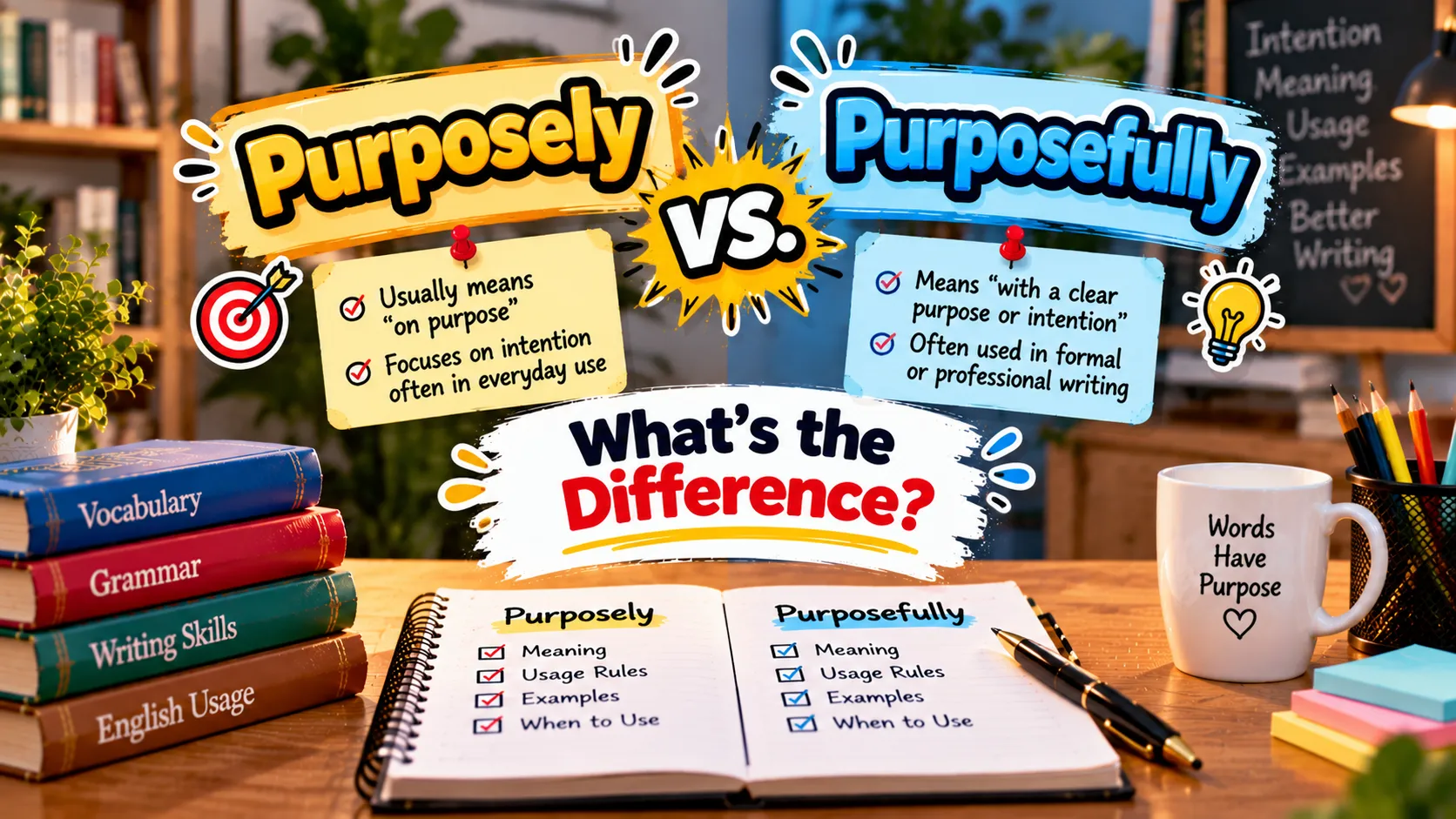
The main difference is that purposely usually means doing something intentionally or deliberately, while purposefully often emphasizes acting with a clear goal, determination, or sense of direction. Although the words overlap, each has its own shades of meaning.
For example, you might say, “She purposely left the door open” to explain that she did it intentionally. On the other hand, “She walked purposefully toward the stage” suggests that she moved with confidence and a clear destination in mind.
In this guide, you’ll learn the meanings of purposely and purposefully, explore their differences, review practical examples, and discover which word works best in everyday conversation and formal writing.
📚 What Does Purposely Mean?
Purposely is an adverb that means intentionally, deliberately, or with a specific intention. It describes an action that someone performs on purpose rather than by accident.
When you use purposely, you generally want to emphasize that the person meant to do something. The word is especially useful when explaining decisions, behavior, mistakes, or actions that might otherwise appear accidental.
Here are some examples:
- She purposely arrived early to get a good seat.
- He purposely ignored the message because he needed more time to think.
- I purposely left a space at the top of the page for the title.
- They purposely changed the meeting time to accommodate everyone.
- The student purposely chose a simpler topic for the presentation.
- He purposely avoided discussing the disagreement during dinner.
- She purposely kept the surprise party a secret.
In each sentence, purposely explains that the action was intentional.
For instance, “She purposely arrived early” means she planned to arrive early. Her early arrival was not an accident or an unexpected result.
Quick tip: Use purposely when you want to emphasize that someone did something intentionally or deliberately.
🎯 What Does Purposefully Mean?
Purposefully is an adverb that often means with purpose, determination, or a clear objective. It can describe an action that someone performs with a particular goal in mind or in a deliberate, focused manner.
The word frequently emphasizes a person’s attitude, direction, or sense of intention. It can describe both the reason behind an action and the way the action is performed.
Consider these examples:
- She walked purposefully toward the entrance.
- He spoke purposefully during the meeting.
- The team worked purposefully to complete the project.
- She moved purposefully through the crowded hallway.
- The organization acted purposefully to improve its services.
- He approached the problem purposefully and confidently.
- The speaker delivered the message purposefully.
In these examples, purposefully often conveys a sense of direction, confidence, or focused effort.
For example, “She walked purposefully toward the entrance” suggests that she knew where she was going and moved with intention. The sentence emphasizes the manner of her movement, not merely the fact that she chose to walk.
Quick tip: Use purposefully when you want to emphasize a clear goal, determined effort, or an intentional manner of acting.
🔍 Purposely vs. Purposefully: Key Differences
The main distinction lies in the emphasis each word creates. Purposely generally focuses on intention, while purposefully often highlights goal-directed or determined action.
| Feature | Purposely | Purposefully |
|---|---|---|
| Main meaning | Intentionally or deliberately | With purpose, determination, or a clear goal |
| Main emphasis | The intention behind an action | The goal or manner of an action |
| Common context | Planned decisions and deliberate actions | Focused movement, speech, work, and effort |
| Example | She purposely left early. | She walked purposefully toward the exit. |
| Opposite idea | Accidentally or unintentionally | Aimlessly or without direction |
| Typical use | Explaining why something happened | Describing focused, goal-directed behavior |
The distinction is useful, but it is not absolute. Both words can mean intentionally, and many sentences can naturally use either one.
For example, “He purposely completed the task” and “He purposefully completed the task” are both possible. The first emphasizes his intention, while the second may suggest focused, goal-oriented effort.
The best choice depends on what you want the reader to notice.
💡 An Easy Trick to Remember the Difference
If you struggle to decide between these words, ask yourself what you want to emphasize.
- Purposely: Did the person do it intentionally rather than by accident?
- Purposefully: Did the person act with a clear goal, direction, or determination?
Consider these examples.
Example One: Purposely
“She purposely deleted the file.”
This sentence means she intentionally deleted it. The deletion was not accidental.
Example Two: Purposefully
“She worked purposefully toward her career goals.”
This sentence emphasizes her focused effort and commitment to achieving those goals.
Example Three: Both Can Work
“He purposely changed his schedule.”
This highlights his deliberate decision.
“He purposefully changed his schedule.”
This can suggest that the change was made with a particular objective in mind.
The meanings overlap, so context matters more than a strict rule that one word is always correct and the other is not.
✍️ When to Use Purposely
Use purposely when you want to show that an action was intentional, planned, or deliberate. It is especially suitable when distinguishing a deliberate action from an accident or misunderstanding.
When Someone Makes a Deliberate Choice
- She purposely selected the blue folder.
- He purposely chose a quiet place to study.
- They purposely scheduled the event for Saturday.
- I purposely included an extra example in the report.
- The designer purposely used simple colors.
These sentences emphasize conscious decisions.
When Someone Avoids or Ignores Something
- He purposely avoided answering the question.
- She purposely ignored the notification.
- They purposely stayed away from the crowded area.
- I purposely avoided mentioning the surprise.
- The manager purposely left that detail out of the announcement.
Here, purposely explains that the person chose not to do something or intentionally avoided an action.
When an Action Is Not an Accident
- She purposely spilled the water to get attention.
- He purposely left his phone at home.
- The player purposely passed the ball to a teammate.
- They purposely delayed the announcement.
- I purposely left the last question unanswered.
In these examples, the word highlights intention rather than coincidence.
Remember that purposely does not automatically mean an action was wrong or harmful. Someone can purposely help a friend, purposely arrive early, or purposely make a thoughtful decision.
🌿 When to Use Purposefully
Use purposefully when you want to emphasize a clear objective, determined effort, or a deliberate manner of acting.
When Describing Movement
- She walked purposefully into the office.
- He strode purposefully across the room.
- The athlete moved purposefully toward the finish line.
- She headed purposefully toward the stage.
- The guide walked purposefully through the museum.
These examples suggest that the person is moving with direction or confidence.
When Describing Work and Effort
- The team worked purposefully toward its deadline.
- She studied purposefully for the final examination.
- The organization acted purposefully to address the problem.
- He approached the project purposefully.
- They continued purposefully despite several challenges.
In these sentences, purposefully emphasizes focused effort and a clear objective.
When Describing Communication
- The speaker addressed the audience purposefully.
- She spoke purposefully about the proposed changes.
- He delivered his message purposefully.
- The manager explained the plan purposefully.
- The presenter answered each question purposefully.
These examples suggest that the person is communicating with intention, focus, or a particular objective.
⚖️ Can Purposely and Purposefully Be Used Interchangeably?
Yes, sometimes. Both words can describe intentional actions, and there is considerable overlap in their meanings.
For example:
- She purposely chose that route.
- She purposefully chose that route.
Both sentences can be correct. The first highlights her deliberate choice, while the second can emphasize that she chose the route to achieve a particular objective.
Another example:
- He purposely spoke slowly.
- He purposefully spoke slowly.
The first emphasizes that he deliberately controlled his speaking speed. The second can suggest that he spoke slowly to achieve a goal, such as helping the audience understand him.
However, the words are not always equally natural.
Consider this sentence:
“She walked purposefully toward the door.”
Purposefully sounds especially natural because it describes directed movement. Purposely is also possible, but it more strongly emphasizes the fact that the movement was intentional.
The best approach is to choose the word that communicates your intended meaning most clearly.
📝 Purposely vs. Purposefully in Example Sentences
Seeing both words in similar situations can make the difference easier to understand.
- Purposely: She purposely arrived late to avoid the opening speech.
- Purposefully: She walked purposefully to the conference room.
- Purposely: He purposely left the question unanswered.
- Purposefully: He worked purposefully to find a solution.
- Purposely: They purposely changed the design.
- Purposefully: They developed the design purposefully to meet the client’s needs.
- Purposely: I purposely saved the final document in a separate folder.
- Purposefully: I organized my files purposefully to make them easier to find.
- Purposely: The child purposely hid the toy.
- Purposefully: The child moved purposefully toward the playground.
In the purposely examples, the main emphasis is on intentional behavior. In the purposefully examples, the emphasis often falls on direction, planning, or focused effort.
🚫 Common Mistakes to Avoid
Although purposely and purposefully are both correct words, writers sometimes choose one without considering the meaning they want to convey.
Assuming Purposefully Is Always More Correct
Incorrect assumption: “Purposefully is the correct word whenever someone intends to do something.”
Actually, purposely is also correct for intentional actions. You can say, “She purposely called her friend,” or “She purposefully called her friend.” The best choice depends on whether you want to emphasize deliberate intention or a specific goal.
Using Purposely When You Mean Aimlessly
Consider this sentence:
“She walked purposely around the park.”
This can mean she walked intentionally, but it may not communicate the idea of moving with direction as clearly as:
“She walked purposefully around the park.”
If you mean that she wandered without a clear destination, use aimlessly instead.
Treating Purposefully as a Synonym for Carefully in Every Situation
Purposefully can imply focused action, but it does not automatically mean carefully.
For example, “He purposefully moved the chair” indicates intention, but it does not necessarily mean he moved it gently or cautiously.
If you want to emphasize caution, carefully or cautiously may be more accurate.
Forgetting That Context Determines Meaning
A word can have different shades of meaning depending on the sentence. Rather than memorizing a rigid rule, consider the situation you are describing.
If your point is that an action was not accidental, purposely may be ideal. If your point is that someone acted with determination or direction, purposefully may be the stronger choice.
🔄 Purposely vs. Purposefully vs. Intentionally vs. Deliberately
Purposely and purposefully are not the only words that describe intention. Intentionally and deliberately are also common alternatives.
| Word | Meaning | Example |
|---|---|---|
| Purposely | Intentionally or on purpose | She purposely left the window open. |
| Purposefully | With a goal, determination, or intention | She walked purposefully toward the stage. |
| Intentionally | As a conscious choice rather than an accident | He intentionally changed the wording. |
| Deliberately | Intentionally, often after thought or consideration | She deliberately avoided the topic. |
| Aimlessly | Without a clear purpose or direction | He wandered aimlessly through the streets. |
| Accidentally | By chance or without intending to | She accidentally deleted the message. |
These words are related, but they are not identical.
Intentionally is a useful general alternative when you want to emphasize a conscious choice. Deliberately can suggest careful consideration or a particularly conscious decision. Aimlessly and accidentally express different ideas and may work as opposites in certain contexts.
🎓 Purposely or Purposefully in Formal Writing
Both words are acceptable in formal writing. The choice depends on the sentence’s meaning, not on whether the writing is academic or professional.
Use purposely when describing a deliberate decision or action.
For example:
“The researchers purposely selected participants with different backgrounds.”
This means the researchers intentionally chose those participants.
Use purposefully when emphasizing a clear objective or goal-directed effort.
For example:
“The research team worked purposefully to identify the factors affecting the results.”
This highlights the team’s focused efforts toward a goal.
In essays, reports, and professional documents, clarity is more important than choosing the longer word. If intentionally communicates your meaning more precisely, there is no need to replace it with purposefully.
💬 Purposely or Purposefully in Everyday Conversation
In everyday conversation, both words are common, but they often appear in slightly different contexts.
People might say:
- “I purposely left my keys on the table.”
- “She purposefully walked away from the argument.”
- “He purposely chose not to respond.”
- “They purposefully worked together to solve the problem.”
- “I purposely made extra food for everyone.”
- “She moved purposefully through the crowd.”
These sentences sound natural because each word suits the intended meaning.
Purposely is particularly common when explaining why someone did something. Purposefully is often used when describing determined behavior, movement, or work.
Still, there is no need to force a distinction where the context does not require one. If both words express your intended meaning clearly, either may be suitable.
🧠 Practice Quiz: Purposely or Purposefully?
Test your understanding by choosing the word that best fits each sentence. In some situations, both words may be possible, but one will better match the intended meaning.
1. She _____ left the light on so her family could find the house.
A. Purposely
B. Purposefully
Answer: Purposely. The sentence emphasizes that she intentionally left the light on.
2. The athlete moved _____ toward the finish line.
A. Purposely
B. Purposefully
Answer: Purposefully. The word emphasizes directed movement and determination.
3. He _____ ignored the message because he was upset.
A. Purposely
B. Purposefully
Answer: Purposely. The sentence highlights a deliberate decision to ignore the message.
4. The team worked _____ to achieve its goals.
A. Purposely
B. Purposefully
Answer: Purposefully. The sentence emphasizes focused effort toward a goal.
5. I _____ included an extra example to clarify the explanation.
A. Purposely
B. Purposefully
Answer: Purposely. The emphasis is on the intentional decision to include the example. Purposefully could also work if the sentence were intended to emphasize goal-directed effort.
6. She walked _____ toward the microphone and began speaking.
A. Purposely
B. Purposefully
Answer: Purposefully. The word describes movement with direction and intention.
7. He _____ changed the schedule to avoid a conflict.
A. Purposely
B. Purposefully
Answer: Purposely. The sentence highlights a deliberate change. Purposefully would also be possible if the emphasis were on achieving the goal.
8. The volunteers worked _____ to improve conditions in their community.
A. Purposely
B. Purposefully
Answer: Purposefully. The word emphasizes coordinated, goal-directed effort.
❓ Frequently Asked Questions
Is purposely or purposefully correct?
Both are correct English words. Purposely usually means intentionally or deliberately, while purposefully often emphasizes acting with a clear goal, direction, or determination.
What is the main difference between purposely and purposefully?
Purposely generally emphasizes that an action was intentional rather than accidental. Purposefully often emphasizes the goal behind an action or the determined manner in which it is performed.
Are purposely and purposefully interchangeable?
Sometimes. Both words can describe intentional actions, but purposefully is often more natural when describing focused movement or goal-directed effort. Purposely is especially useful when explaining that someone deliberately did something.
Is purposely a real word?
Yes. Purposely is a standard English adverb meaning intentionally or deliberately. It is not incorrect or less grammatical than purposefully.
What is another word for purposely?
Common alternatives include intentionally, deliberately, knowingly, consciously, and on purpose. The best alternative depends on the sentence.
What is another word for purposefully?
Depending on the context, alternatives include intentionally, deliberately, determinedly, resolutely, and with a clear goal. For movement, directly or with determination may also work.
Is purposefully more formal than purposely?
Not necessarily. Both words are acceptable in formal and informal writing. The difference is primarily about meaning and emphasis rather than formality.
What is the opposite of purposely?
Depending on the context, opposites include accidentally, unintentionally, inadvertently, and unintentionally on purpose. Accidentally is often the simplest choice when describing an action that was not intended.
What is the opposite of purposefully?
If purposefully means acting with direction or determination, possible opposites include aimlessly, randomly, hesitantly, or without direction. The best choice depends on what the original sentence means.
🌟 Final Thoughts
The difference between purposely and purposefully is subtle, but understanding it can make your writing more precise.
Purposely generally means doing something intentionally or deliberately. Purposefully often describes acting with a clear goal, determination, or direction. Since their meanings overlap, context is the best guide when choosing between them.
If you want to emphasize that something was not an accident, purposely is usually a strong choice. If you want to describe someone moving, working, or speaking with focus and determination, purposefully may communicate your meaning more effectively.
Both words are correct, so focus on the message you want your reader to understand rather than assuming one is always better than the other.

Olivia Bennett is a writer and language enthusiast at Vocabsteria. She is passionate about exploring word meanings, name origins, and cultural expressions from around the world.