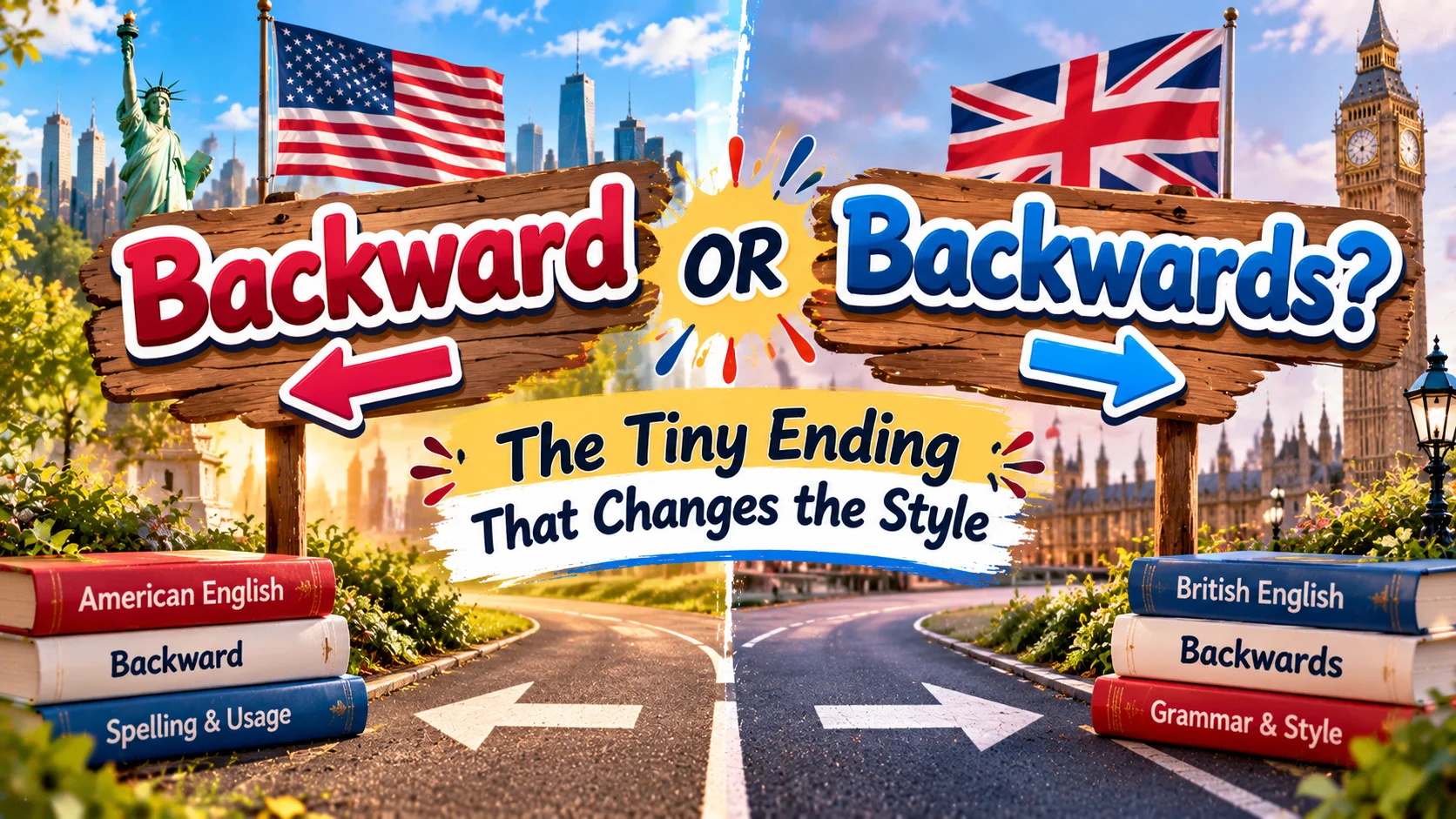
Backward or backwards—which one should you use? If you’ve ever written a sentence such as “step backward” or “look backwards,” you may have wondered whether one spelling is grammatically correct and the other is a mistake.
The interesting part is that both backward and backwards are correct English words. The main difference is regional and stylistic. In American English, backward is generally more common, especially when the word functions as an adverb. Backwards is also understood and used, particularly in British English.
For a US-focused website, article, essay, or professional document, backward is usually the preferred form.
↩️ Backward or Backwards? The Quick Answer
Both forms can be correct, but backward is generally preferred in American English.
| Word | Common Usage | Example |
|---|---|---|
| Backward | Preferred in American English | He took a step backward. |
| Backwards | Common in British English; also used in American English | He looked backwards. |
Simple rule:
US English → backward is generally preferred
British English → backwards is very common
Neither spelling changes the basic meaning.
📖 What Does Backward Mean?
Backward generally describes movement, direction, position, or progress toward the rear or away from the front.
Examples:
- step backward
- move backward
- lean backward
- look backward
- walk backward
- fall backward
- move backward in time
For example:
She took a step backward.
The word tells us that her movement was toward the rear.
🔄 What Does Backwards Mean?
Backwards has essentially the same core meaning as backward. It can describe movement toward the rear or something arranged in the opposite direction.
Examples:
He walked backwards toward the door.
The word was written backwards.
She looked backwards over her shoulder.
The main difference is not usually meaning. It is more about regional preference and style.
⚖️ Backward vs Backwards at a Glance
| Feature | Backward | Backwards |
|---|---|---|
| Meaning | Toward the back/rear | Toward the back/rear |
| American English | Very common | Also possible |
| British English | Used | Very common |
| Adverb | Yes | Yes |
| Adjective | Yes | Generally no |
| Professional US writing | Preferred | Less typical |
One particularly useful distinction is that backward can function as both an adjective and an adverb, while backwards is primarily used as an adverb.
🇺🇸 Backward in American English
American English generally favors backward without the final s.
Examples:
- move backward
- step backward
- walk backward
- glance backward
- look backward
- backward movement
- backward compatibility
- backward thinking
For a website targeting US readers, backward is usually the more consistent choice.
🇬🇧 Backwards in British English
British English frequently uses backwards, especially as an adverb.
Examples:
He walked backwards down the hill.
She glanced backwards.
The child fell backwards.
This does not mean British English considers backward incorrect. Both forms can occur, but backwards is particularly common.
🧠 Easy Memory Trick for Backward vs Backwards
If you’re writing for an American audience, remember:
American English often drops the S: backward.
Compare:
backward movement
move backward
The word stays the same.
You can also remember that backward works especially well when describing a direction:
Step backward.
🚶 How to Use Backward in a Sentence
Here are some natural examples:
- He took one step backward.
- She leaned backward.
- The car rolled backward.
- They moved backward slowly.
- He walked backward toward the door.
- The child fell backward.
- She glanced backward.
- The machine moved backward.
All of these are natural in American English.
🔙 How to Use Backwards in a Sentence
Backwards can also be used as an adverb.
Examples:
- He walked backwards.
- She leaned backwards.
- The child fell backwards.
- They moved backwards.
- He looked backwards.
- The text appeared backwards.
These sentences are grammatically understandable and commonly found, especially in British English.
📊 Backward vs Backwards by Context
| Context | Preferred US Form |
|---|---|
| Take a step ___ | backward |
| Move ___ | backward |
| Walk ___ | backward |
| Look ___ | backward |
| Lean ___ | backward |
| ___ compatibility | backward |
| ___ thinking | backward |
| ___ movement | backward |
| British adverbial usage | backwards is common |
💻 Backward Compatibility
One of the most important fixed phrases using backward is backward compatibility.
It describes the ability of a newer system, device, or software version to work with older systems or technologies.
Examples:
The new console offers backward compatibility.
The software maintains backward compatibility with older versions.
Developers focused on backward compatibility.
In this phrase, backward is the standard form.
You would not normally write:
❌ backwards compatibility
in polished American technical writing.
🧠 Backward Thinking
The phrase backward thinking describes thinking that is considered old-fashioned or resistant to newer ideas.
Examples:
The company needs to move beyond backward thinking.
Some people criticized the policy as backward thinking.
Here, backward functions as an adjective describing thinking.
This is another situation where backwards would not normally be substituted.
📚 Backward as an Adjective
Backward can function as an adjective when it describes a noun.
Examples:
- backward movement
- backward step
- backward glance
- backward motion
- backward compatibility
- backward reasoning
For example:
The machine made a backward movement.
Because backward modifies a noun, backwards is generally not appropriate.
🔎 Backward as an Adverb
Backward can also function as an adverb.
Examples:
He stepped backward.
She looked backward.
The car rolled backward.
This is where you may also encounter backwards.
Both can function adverbially, but backward is particularly common in American English.
⚠️ Common Mistake: Assuming Backwards Is Wrong
It would be inaccurate to say that backwards is always incorrect.
For example:
He walked backwards.
This is a perfectly understandable English sentence and is especially common in British English.
The better rule is:
Backwards is not wrong; backward is generally preferred in American English.
⚠️ Common Mistake: Using Backwards as an Adjective
Consider:
❌ a backwards movement
For standard American English, the more natural form is:
✅ a backward movement
Because backward is functioning as an adjective before the noun movement.
Similarly:
backward compatibility
backward glance
backward step
📝 Backward or Backwards in Formal Writing
If your audience is American, backward is generally the safest choice in formal writing.
Examples:
The device supports backward compatibility.
The vehicle moved backward.
The analysis examines backward movement.
Using one style consistently also makes your writing feel more polished.
🌎 American vs British English
The difference between backward and backwards is part of a broader pattern in English where American and British usage sometimes prefer different forms.
Compare:
| American English | British English |
|---|---|
| toward | towards |
| backward | backwards |
| forward | forwards |
| upward | upwards |
| downward | downwards |
These are tendencies rather than absolute rules. British English can use the shorter forms, and American English can use the forms ending in -s.
➡️ Forward or Forwards?
The same question appears with forward and forwards.
American English commonly prefers:
Move forward.
British English frequently uses:
Move forwards.
The pattern is similar to:
backward / backwards
This can help you remember that American English often favors the shorter form.
⬆️ Upward or Upwards?
Another similar pair is:
upward / upwards
American English commonly uses upward:
The prices are moving upward.
British English may also use upwards:
The prices are moving upwards.
Again, neither form is inherently meaningless or impossible.
⬇️ Downward or Downwards?
The same pattern applies here:
The temperature is moving downward.
or:
The temperature is moving downwards.
For US-focused content, downward is generally the cleaner choice.
📖 Backward in Expressions
Several common expressions use backward without the final s.
Backward compatibility
The device supports backward compatibility.
Backward glance
She gave a quick backward glance.
Movement of Backward
The machine made a backward movement.
Backward step
He took a backward step.
Backward thinking
The idea was criticized as backward thinking.
These phrases are particularly useful to remember because the shorter form is standard.
🔤 Backward vs Backwards and Word Function
One of the best ways to choose between the two forms is to identify how the word functions.
Before a noun:
Use backward.
backward movement
backward glance
backward motion
Describing an action:
In American English, backward is generally preferred.
Move backward.
Step backward.
Look backward.
In British English, backwards is very common in the second type of construction.
🧩 Correct and Incorrect Examples
American English
✅ He took a step backward.
⚠️ He took a step backwards.
The second is understandable, but the first is generally more typical in American English.
Adjective:
✅ Backward movement
❌ Backwards movement
Technical:
✅ Backward compatibility
❌ Backwards compatibility in standard US technical usage
🎯 Quick Practice: Backward or Backwards?
Choose the form that best fits standard American English.
- She took a step ___.
Answer: backward - The software provides ___ compatibility.
Answer: backward - He walked ___ toward the door.
Answer: backward - The machine moved ___.
Answer: backward - The company needs to avoid ___ thinking.
Answer: backward - The car rolled ___.
Answer: backward - Which form is more common in American English?
Answer: backward - Which form is especially common in British English as an adverb?
Answer: backwards
🧠 A Simple Editing Test
When you’re proofreading backward or backwards, ask yourself two questions.
Question 1:
Am I writing for an American audience?
If yes, backward is generally the preferred form.
Question 2:
Is the word describing a noun?
If yes, use backward.
Examples:
backward movement
backward compatibility
backward glance
If you’re using it as an adverb, both forms can occur, but backward is usually the safer US-English choice.
❓ Frequently Asked Questions About Backward vs Backwards
Is backward or backwards correct?
Both are correct English forms. Backward is generally preferred in American English, while backwards is especially common in British English.
Is backwards wrong in American English?
No. Backwards is used in American English, although backward is generally more common and often preferred in edited US writing.
Which is better for American English?
Backward is generally the preferred form for American English.
Which is more common in British English?
Backwards is very common, especially when used as an adverb.
Is “step backward” correct?
Yes. Step backward is standard American English.
Is “step backwards” correct?
Yes. It is also grammatical, especially in British English, and can occur in American English as well.
Is backward an adjective?
Yes. Examples include backward movement, backward glance, and backward compatibility.
Is backwards an adjective?
Generally, backwards is used as an adverb rather than an adjective.
Is backward compatibility correct?
Yes. Backward compatibility is the standard technical expression.
Is it backward thinking or backwards thinking?
Backward thinking is the standard form, particularly in American English.
What is the difference between backward and backwards?
The core meaning is the same. The main distinction is regional and stylistic, with backward favored in American English and backwards especially common in British English.
Should I use backward or backwards on a US website?
For a US-focused website, backward is generally the preferred and more consistent choice.
🏁 Final Takeaway
The choice between backward or backwards is easier once you understand that both forms are legitimate.
For American English, backward is generally preferred:
She stepped backward.
For British English, backwards is especially common as an adverb:
She stepped backwards.
When the word functions as an adjective, backward is the normal choice:
backward compatibility
backward movement
backward glance
So if you’re writing for a US audience, the simplest rule is:
Choose “backward” unless your style guide or context calls for something else.

Olivia Bennett is a writer and language enthusiast at Vocabsteria. She is passionate about exploring word meanings, name origins, and cultural expressions from around the world.