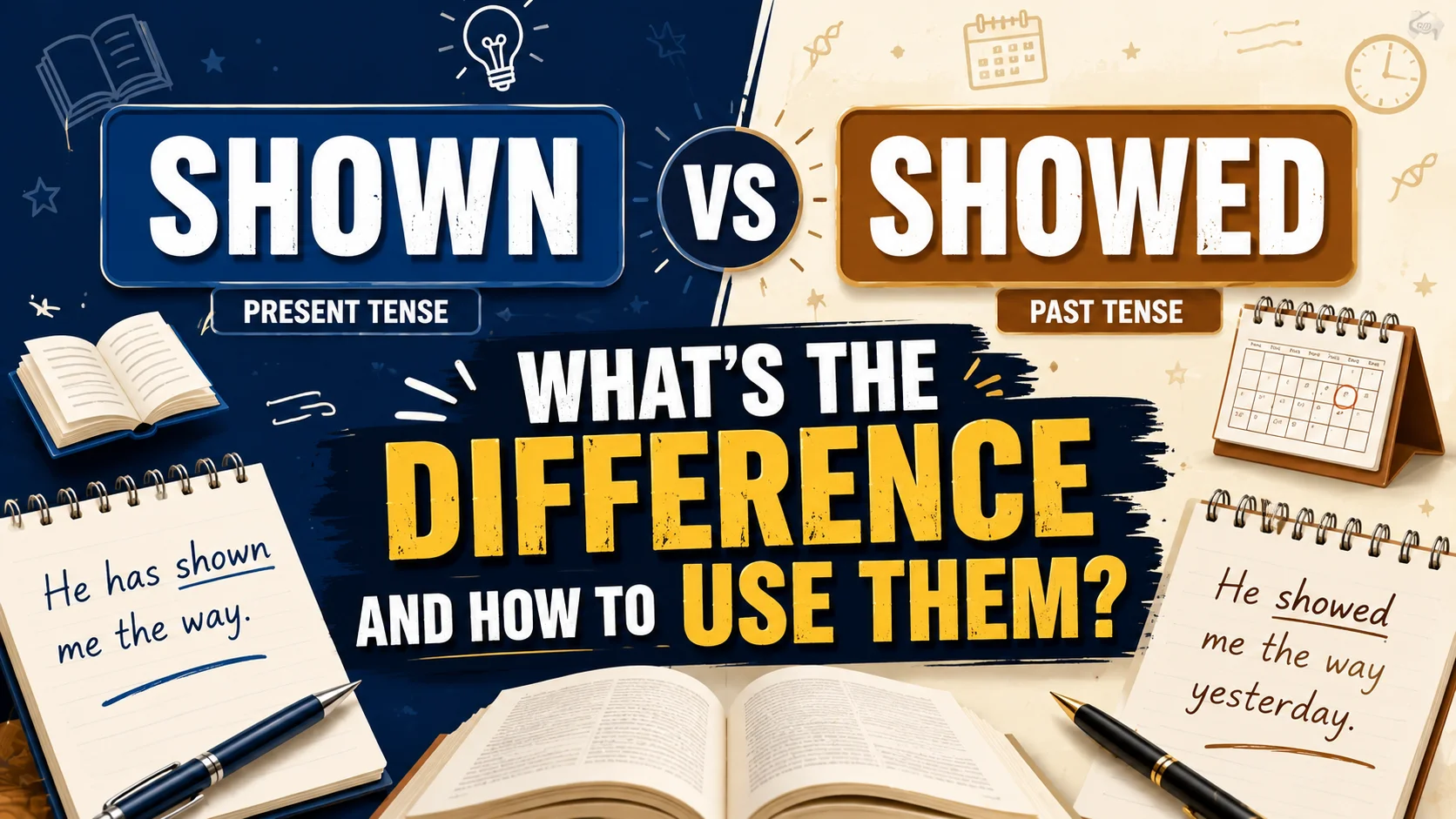
Shown and showed both come from the verb show, but English grammar gives them different jobs. Showed works as the simple past tense, while shown works as the past participle.
You can say She showed me the picture yesterday, because the sentence describes a completed action in the past. You can also say She has shown me the picture, because the auxiliary verb has requires the past participle shown.
Many English learners confuse these forms because both describe actions related to showing something. The key lies in the sentence structure. Once you understand when English uses the simple past and when it uses the past participle, choosing between shown vs. showed becomes much easier.
Quick Answer: Shown or Showed?
Use showed for the simple past tense of show.
Use shown as the past participle, usually after has, have, had, or a form of be.
- Show = present or base form
- Showed = simple past
- Shown = past participle
Examples:
- She showed me the report yesterday.
- She has shown me the report.
- The teacher showed the class a video.
| Word | Verb Form | Main Use | Example |
|---|---|---|---|
| Show | Base form | Present / infinitive | I want to show you something. |
| Showed | Simple past | Completed past action | She showed me the photo. |
| Shown | Past participle | Perfect and passive structures | She has shown me the photo. |
What Does “Showed” Mean?
Showed is the simple past form of show. Use it when someone performed the action at a previous time.
For example:
- She showed me her new car.
- The teacher showed us an example.
- He showed great courage.
- The report showed a significant increase.
- They showed us around the office.
You can use showed with a specific past-time expression:
- yesterday
- last week
- last year
- two hours ago
- earlier
- this morning, when referring to a completed event
Examples With Past-Time Expressions
- She showed me the photos yesterday.
- The study showed different results last year.
- He showed us the document two hours ago.
- The teacher showed the class the experiment earlier.
In each example, showed tells the reader that the action happened in the past.
What Does “Shown” Mean?
Shown serves as the past participle of show. English normally uses it with an auxiliary verb.
Common combinations include:
- has shown
- have shown
- had shown
- was shown
- were shown
- has been shown
- have been shown
- had been shown
Examples:
- She has shown great improvement.
- The researchers have shown strong evidence.
- He had shown considerable interest.
- The teacher was shown the results.
- The documentary was shown at the festival.
The word shown usually cannot replace showed when you simply describe a completed past action.
Shown vs. Showed: The Main Difference
The main difference comes from verb tense and function.
Showed = Simple Past
Use showed when the action happened in the past.
Example:
The teacher showed us the experiment yesterday.
Shown = Past Participle
Use shown with an auxiliary verb.
Example:
The teacher has shown us the experiment.
Compare the two:
| Sentence | Why It Works |
|---|---|
| She showed me the picture. | Simple past |
| She has shown me the picture. | Present perfect |
| She had shown me the picture. | Past perfect |
| The picture was shown to us. | Passive construction |
Show, Showed, and Shown
Understanding all three forms makes the difference much clearer.
Show
Show is the base form.
Examples:
- I want to show you something.
- They show their work to the teacher.
- Can you show me the way?
Showed
Showed is the simple past.
Examples:
- I showed you the answer yesterday.
- They showed their work to the teacher.
- She showed me the way.
Shown
Shown is the past participle.
Examples:
- I have shown you the answer.
- They have shown their work.
- She has shown me the way.
Easy Pattern
Show → Showed → Shown
You can remember it like this:
Present: I show.
Past: I showed.
Perfect: I have shown.
When Should You Use “Showed”?
Use showed when the sentence uses the simple past tense.
Completed Past Action
- She showed me her new apartment.
- He showed us the correct answer.
- The company showed strong growth last year.
- The teacher showed the students a video.
Past Events
Use showed when you describe what someone did during a completed event.
- She showed me the photographs at dinner.
- He showed everyone his new phone.
- The guide showed us around the museum.
Historical or Past Information
- The report showed a major increase in sales.
- The survey showed that customers preferred the new design.
- The experiment showed an unexpected result.
When Should You Use “Shown”?
Use shown when the grammar requires a past participle.
1. With Has
- She has shown great patience.
- The company has shown strong growth.
- The research has shown a clear connection.
With Have
- They have shown excellent progress.
- The results have shown a consistent pattern.
- Researchers have shown that the method works.
2. With Had
- He had shown enough evidence.
- The study had shown similar results.
- She had shown considerable interest.
3. With Forms of “Be”
English also uses shown in passive constructions.
- The results were shown on the screen.
- The video was shown to the students.
- The chart was shown during the presentation.
Is “Has Showed” Correct?
In standard English, has showed is not the correct form when has introduces the present perfect tense.
Use:
has shown
Examples:
- She has shown remarkable improvement.
- The study has shown promising results.
- He has shown great leadership.
Avoid:
- She has showed remarkable improvement.
- The study has showed promising results.
- He has showed great leadership.
The same rule applies to have and had.
Is “Had Showed” Correct?
When had introduces the past perfect tense, use shown.
Correct:
- She had shown great interest in the project.
- The report had shown similar results.
- They had shown enough evidence.
Incorrect:
- She had showed great interest.
- The report had showed similar results.
- They had showed enough evidence.
The pattern remains:
had + shown
Is “Was Showed” Correct?
When you use was to create a passive construction, use shown.
Correct:
- The video was shown to the class.
- The report was shown to the manager.
- The documentary was shown on television.
Incorrect:
- The video was showed to the class.
- The report was showed to the manager.
- The documentary was showed on television.
However, English can use was showing in an active progressive construction:
- The teacher was showing the students a video.
Here, showing functions as the present participle, not shown.
Showed vs. Shown in Active and Passive Voice
Active and passive constructions often make the difference easier to see.
Active Voice
The subject performs the action.
- The teacher showed the students the results.
- The researcher has shown the results to the team.
Passive Voice
The subject receives the action.
- The results were shown to the students.
- The results have been shown to the team.
For your writing, prefer active constructions when they communicate the idea clearly.
Compare:
Passive: The results were shown by the researcher.
Active: The researcher showed the results.
The active version identifies the person responsible for the action and usually sounds more direct.
Showed vs. Shown in Different Tenses
| Tense | Correct Form | Example |
|---|---|---|
| Simple Present | Show | She shows her work. |
| Simple Past | Showed | She showed her work. |
| Present Perfect | Has/Have Shown | She has shown her work. |
| Past Perfect | Had Shown | She had shown her work. |
| Future Perfect | Will Have Shown | She will have shown her work. |
| Passive Past | Was/Were Shown | The work was shown to us. |
This table gives you a quick way to identify the correct form.
Common Mistakes With Shown and Showed
Mistake 1: Using “Showed” After “Has”
Incorrect:
She has showed me the results.
Correct:
She has shown me the results.
Mistake 2: Using “Showed” After “Had”
Incorrect:
He had showed us the evidence.
Correct:
He had shown us the evidence.
Mistake 3: Using “Shown” as Simple Past
Incorrect:
Yesterday, she shown me the photos.
Correct:
Yesterday, she showed me the photos.
Mistake 4: Using “Showed” in a Passive Sentence
Incorrect:
The video was showed during the meeting.
Correct:
The video was shown during the meeting.
Mistake 5: Using “Showed” After “Did”
After did, use the base form show, not showed.
Incorrect:
Did she showed you the report?
Correct:
Did she show you the report?
The pattern is:
Did + show
not:
Did + showed
Shown vs. Showed Pronunciation
The words have different final sounds.
Showed
IPA: /ʃoʊd/
Approximate pronunciation: shohd
Examples of similar endings include:
- road
- code
- mode
Shown
IPA: /ʃoʊn/
Approximate pronunciation: shohn
Examples of similar endings include:
- known
- grown
- thrown
| Word | IPA | Approximate Sound |
|---|---|---|
| Showed | /ʃoʊd/ | shohd |
| Shown | /ʃoʊn/ | shohn |
20 Examples Using “Showed”
- She showed me her new car.
- He showed us the correct answer.
- The teacher showed the class a video.
- They showed great patience.
- The report showed a significant increase.
- She showed me how to use the app.
- He showed his parents the results.
- The map showed the location clearly.
- The experiment showed an unexpected result.
- She showed real determination.
- The movie showed the effects of climate change.
- He showed me his new phone.
- The test showed that the system worked.
- They showed strong support for the proposal.
- The photograph showed the entire building.
- She showed kindness to everyone.
- The survey showed a change in public opinion.
- He showed us around the office.
- The data showed a clear trend.
- The student showed excellent progress.
20 Examples Using “Shown”
- She has shown great courage.
- He has shown considerable improvement.
- They have shown strong interest in the project.
- The study has shown promising results.
- The results have shown a clear pattern.
- She had shown excellent judgment.
- The evidence had shown a different outcome.
- The video was shown to the students.
- The results were shown on the screen.
- The chart was shown during the presentation.
- The documentary was shown at the festival.
- He has shown that he can handle the responsibility.
- The research has shown a strong connection.
- She has shown remarkable patience.
- The report has shown significant progress.
- The image was shown to the audience.
- The data has shown a steady increase.
- The experiment has shown unexpected results.
- His actions have shown his commitment.
- The presentation had shown the main differences.
Showed vs. Shown in Everyday English
Talking About Yesterday
Use showed:
- She showed me her photos yesterday.
- He showed us the new restaurant last night.
Talking About Experience or Results
Use shown with has or have:
- She has shown great improvement.
- The results have shown a clear trend.
Talking About Something Another Person Presented
Use shown in a passive construction:
- The video was shown to the audience.
- The photographs were shown during the meeting.
A Simple Trick to Remember Shown vs. Showed
Use this three-step pattern:
Show → Showed → Shown
Then remember:
Yesterday = showed
Has / Have / Had = shown
Examples:
- Yesterday, she showed me the report.
- She has shown me the report.
- She had shown me the report.
One more useful rule:
Did + show
Example:
- Did she show you the report?
Never use did showed in standard English.
People Also Ask
What is the difference between showed and shown?
Showed is the simple past tense of show, while shown is the past participle. Use showed for completed past actions and shown with auxiliary verbs such as has, have, had, or forms of be.
Is it “has showed” or “has shown”?
The correct standard form is has shown.
Example: She has shown me the results.
Is it “was showed” or “was shown”?
Use was shown in a passive construction.
Example: The video was shown to the class.
Example: She showed me the photograph.
What is the past participle of show?
The standard past participle is shown.
Example: She has shown me the photograph.
Can I say “I showed him”?
Yes. I showed him correctly uses the simple past tense.
Can I say “I have shown him”?
Yes. I have shown him correctly uses the past participle after have.
Frequently Asked Questions
Can I say “I have showed”?
No. Use I have shown in standard English.
Can I say “She showed me”?
Yes. She showed me correctly uses the simple past form.
Can I say “She has showed me”?
No. Use She has shown me.
Is showed more informal than shown?
No. They serve different grammatical functions. Showed is the simple past, while shown is the past participle.
Is shown a verb?
Yes. Shown is a verb form, specifically the past participle of show.
Can I use showed after did?
No. After did, use the base form show.
Correct: Did he show you the picture?
Incorrect: Did he showed you the picture?
What is the easiest way to remember showed and shown?
Remember:
Showed = simple past
Shown = past participle
Then use the shortcut:
Yesterday → showed
Has/Have/Had → shown
Which form should I use in academic writing?
Use the form that matches the grammar of your sentence. Academic writing commonly uses both forms:
- The study showed a significant difference.
- Previous research has shown a similar pattern.
Conclusion
The difference between shown vs. showed comes down to verb form. Showed acts as the simple past tense, while shown acts as the past participle.
Use showed when you describe a completed action in the past:
The teacher showed us the results yesterday.
Use shown after auxiliary verbs such as has, have, or had:
The teacher has shown us the results.
You can also use shown in passive constructions:
The results were shown to the students.
The easiest pattern to remember is:
Show → Showed → Shown
Simple past → showed
Past participle → shown
Once you understand that pattern, you can confidently choose between showed and shown in everyday conversations, academic writing, professional documents, and formal English.

Olivia Bennett is a writer and language enthusiast at Vocabsteria. She is passionate about exploring word meanings, name origins, and cultural expressions from around the world.