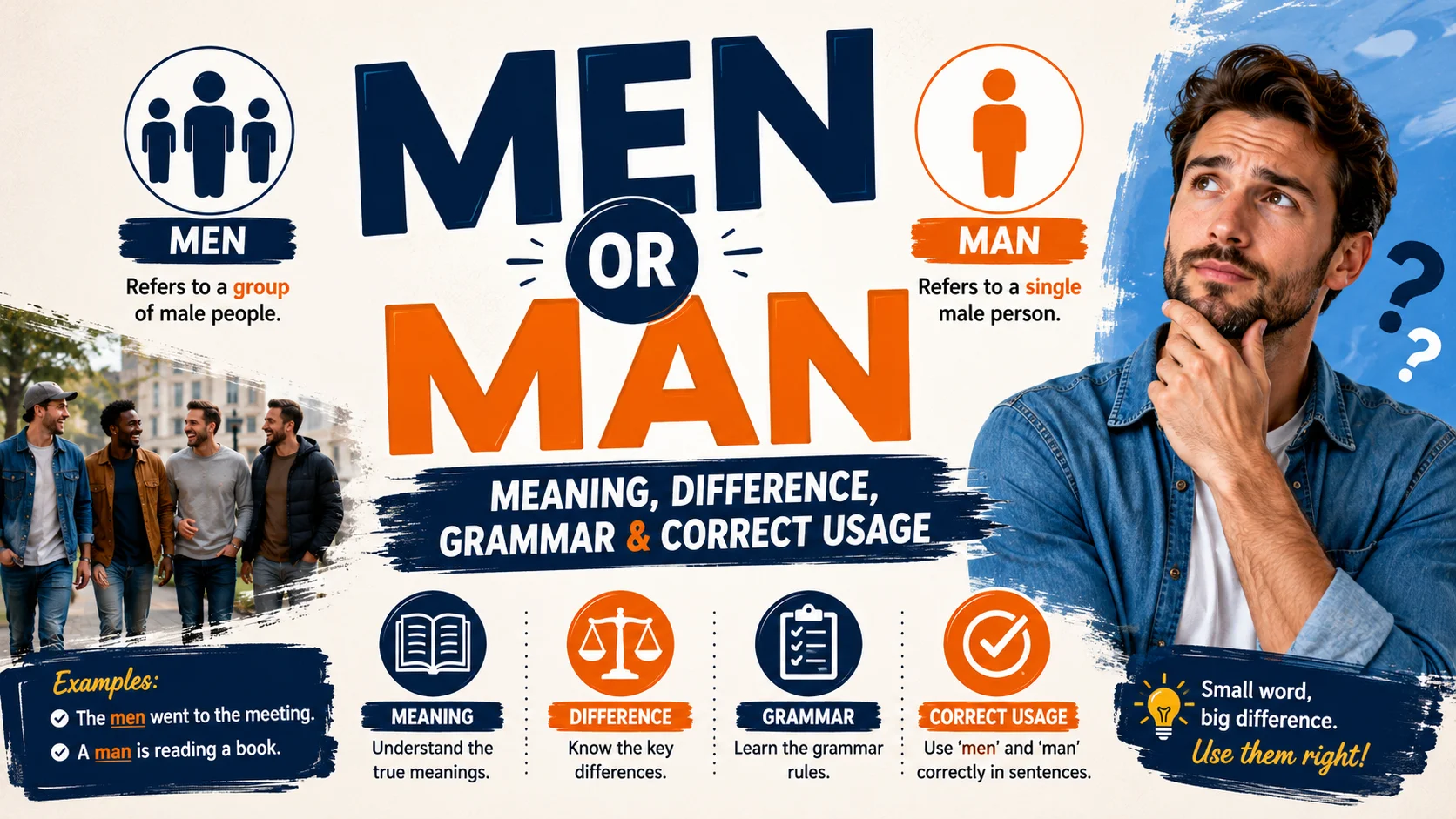
Men or man is a common English-language question because the two words are closely related but have different grammatical roles. Man is the singular form, while men is the plural form. In simple terms, you use man when talking about one adult male and men when talking about two or more adult males.
For example, you would say, “That man is my teacher,” but “Those men are my teachers.”
The difference seems simple, but choosing between man and men can become confusing when they appear in compound nouns, possessive forms, phrases, titles, or sentences with unusual structures. Understanding the difference also helps with related forms such as man’s, men’s, manhood, mankind, and expressions containing man or men.
This guide explains men or man, including their meanings, singular and plural forms, pronunciation, possessives, common mistakes, examples, related words, and practical rules for everyday English.
What Is the Difference Between Man and Men?
The main difference is number.
- Man = singular
- Men = plural
Use man when referring to one adult male:
That man is wearing a black jacket.
Use men when referring to more than one adult male:
Those men are waiting outside.
The word changes spelling rather than simply adding -s.
This is an example of an irregular plural noun. In English, many nouns form plurals by adding -s or -es, such as car → cars or box → boxes. However, man changes to men.
Quick comparison
| Singular | Plural |
|---|---|
| man | men |
| one man | two men |
| a man | several men |
| this man | these men |
| that man | those men |
The same basic pattern applies whether you’re talking about people in general, a specific person, professions, groups, or characters.
What Does Man Mean?
Man is a singular noun that traditionally refers to one adult male human.
For example:
- A man is standing near the door.
- That man is my neighbor.
- I spoke with a man yesterday.
- The man helped carry the boxes.
- He is a kind man.
The word can also appear in broader or historical expressions where man has been used to mean humanity or humankind. However, modern English often uses more inclusive alternatives such as humanity, humankind, people, or human beings when referring to everyone.
The context determines the intended meaning.
In contemporary everyday English, when man is used as a countable noun to describe a person, it normally means one adult male.
Examples
Singular:
The man is reading a newspaper.
Not:
The men is reading a newspaper.
When the subject is one male person, man is the appropriate noun.
What Does Men Mean?
Men is the plural form of man.
It refers to two or more adult males.
Examples include:
- The men are talking.
- Three men entered the building.
- Those men work together.
- Several men attended the meeting.
- The men were waiting outside.
Because men is plural, it normally takes plural verbs.
Correct
The men are working.
Incorrect
The men is working.
This is an important grammar rule.
When men is the subject, use plural forms such as:
- are
- were
- have
- do
For example:
The men have arrived.
The men were discussing the problem.
The men do their work carefully.
Man vs. Men: Simple Grammar Rule
The easiest way to remember the difference is:
One = man
More than one = men
Think of these examples:
- 1 man
- 2 men
- 5 men
- 20 men
- many men
You would never normally say “two mans” when referring to multiple adult males.
Likewise, you wouldn’t use men for one person.
Examples
One person:
A man called me.
More than one:
Two men called me.
One person:
The man is my brother.
More than one:
The men are my brothers.
This rule applies regardless of whether the people are strangers, family members, workers, students, athletes, or characters.
Why Is the Plural of Man Men?
The plural men is an example of an irregular plural.
English has many irregular plural forms that developed from older stages of the language.
Examples include:
- man → men
- woman → women
- child → children
- tooth → teeth
- foot → feet
- mouse → mice
These words don’t follow the regular -s plural pattern.
Historically, the vowel change in man → men developed through changes in Old English and later English pronunciation. The modern spelling reflects this long linguistic history.
This is why learners should memorize man → men rather than trying to form the plural by adding s.
How Do You Pronounce Man and Men?
Although man and men look similar, their vowel sounds are different.
Man
Man is pronounced approximately:
/mæn/
The vowel sounds similar to the vowel in words such as:
- cat
- hat
- map
- black
Men
Men is pronounced approximately:
/men/
The vowel is similar to the sound in:
- bed
- pen
- ten
- red
So the words have different vowel sounds:
man → /mæn/
men → /men/
This distinction is important in spoken English because the spelling difference is small.
Man or Men in a Sentence
The correct choice depends on whether you’re referring to one or multiple people.
Use Man
The man is a doctor.
I saw a man at the store.
That man lives next door.
Every man deserves respect.
The man opened the door.
Use Men
The men are doctors.
I saw several men at the store.
Those men live next door.
The men deserve respect.
The men opened the door.
Notice that other words often change too.
Singular
That man is working.
Plural
Those men are working.
The demonstrative, noun, and verb all need to agree.
Man or Men With Articles
Articles can help you identify whether the noun is singular or plural.
A man
Use a man for one unspecified male.
I saw a man outside.
The man
Use the man when referring to a particular male.
The man outside is my neighbor.
Men
You generally don’t use a directly before the plural noun men.
Correct:
I saw men outside.
Correct:
I saw some men outside.
Incorrect:
I saw a men outside.
If you mean one person, use a man.
If you mean more than one, use men or some men.
Man’s or Men’s: What’s the Difference?
This is where the men or man question becomes slightly more complicated.
Both man’s and men’s are correct, but they have different meanings.
Man’s
Man’s is the possessive form of singular man.
It means something belongs to or is associated with one man.
Example:
The man’s car is outside.
Here, one man owns or uses the car.
Another example:
I borrowed the man’s phone.
Men’s
Men’s is the possessive form of plural men.
It means something belongs to or is associated with multiple men.
Example:
The men’s room is on the left.
Here, men’s refers to men generally or a group of men.
Another example:
The men’s team won the championship.
The team consists of multiple men.
Quick comparison
| Form | Meaning | Example |
|---|---|---|
| man’s | belonging to one man | The man’s coat |
| men’s | belonging to or for men | The men’s coats |
The apostrophe placement is important.
Men or Man in Compound Words
Both forms can appear in compound expressions, but their meanings differ.
Examples with man include:
- man-made
- manpower
- manhood
- manservant
- businessman
- policeman
- fisherman
Examples with men include:
- men’s clothing
- men’s shoes
- men’s health
- men’s fashion
- men’s sports
- men’s room
- men’s team
The choice depends on grammar and meaning.
For example:
men’s clothing
means clothing designed for or associated with men.
But:
man-made
is a compound adjective with a historical meaning related to something produced by humans.
Modern English increasingly uses alternatives such as human-made or artificial, depending on context.
Man or Men in Job Titles
The words can also appear in occupations and job-related expressions.
Traditional examples include:
- businessman
- policeman
- fireman
- fisherman
- chairman
However, modern English frequently uses gender-neutral alternatives where appropriate:
- businessperson
- police officer
- firefighter
- fisher
- chairperson
This doesn’t mean traditional forms are always grammatically wrong. It simply reflects changes in modern usage and efforts to use more inclusive terminology.
For example:
The police officer arrived quickly.
is often preferred to:
The policeman arrived quickly.
when the person’s gender isn’t relevant.
Likewise:
The chairperson opened the meeting.
can be used instead of chairman.
Men or Man in Common Expressions
English contains many expressions using man and men.
Expressions with Man
- a man of honor
- a man of his word
- man of the hour
- one-man show
- man-made
- man enough
- every man for himself
- no man is an island
Expressions with Men
- men and women
- men in uniform
- men at work
- men’s rights
- men’s health
- men’s fashion
- the best of men
- men of courage
The exact form is determined by the phrase’s established usage.
Man or Men in Questions
When asking about one male person, use man.
Who is that man?
Is that man your brother?
Which man called you?
When asking about multiple males, use men.
Who are those men?
Are those men your coworkers?
Which men were invited?
Notice the verb changes as well.
Singular
Who is that man?
Plural
Who are those men?
This is a useful pattern for English learners.
Man or Men With This and These
Demonstrative words also show whether you’re talking about one or more people.
Singular
Use this or that with man.
This man is my uncle.
That man is a teacher.
Plural
Use these or those with men.
These men are my friends.
Those men are our neighbors.
A common mistake is combining a singular demonstrative with the plural noun.
Incorrect:
This men are waiting.
Correct:
These men are waiting.
Similarly:
Incorrect:
Those man are working.
Correct:
Those men are working.
Man or Men With Numbers
Numbers make the difference especially easy to see.
One
one man
Two
two men
Three
three men
Ten
ten men
One hundred
one hundred men
The noun remains men regardless of the exact number, as long as the number is greater than one.
Examples:
There are four men outside.
Five men joined the group.
Twenty men attended the event.
But:
There is one man outside.
The singular/plural distinction also affects the verb.
Common Mistakes With Man and Men
Because man and men are irregular forms, learners sometimes make predictable mistakes.
Mistake 1: Using Mans
Incorrect:
There are three mans outside.
Correct:
There are three men outside.
Mistake 2: Using Men for One Person
Incorrect:
One men came to the office.
Correct:
One man came to the office.
Mistake 3: Using a With Men
Incorrect:
I saw a men.
Correct:
I saw a man.
or:
I saw some men.
Mistake 4: Singular Verb With Men
Incorrect:
The men is waiting.
Correct:
The men are waiting.
Mistake 5: Confusing Men’s and Man’s
Incorrect:
The men car is outside.
Correct:
The man’s car is outside.
If one man owns the car, use man’s.
If multiple men own or are associated with something, use men’s.
Man, Men, Woman and Women
The pattern becomes easier to understand when compared with the corresponding female terms.
| Singular | Plural |
|---|---|
| man | men |
| woman | women |
Examples:
One man and one woman arrived.
Three men and four women arrived.
Both pairs have irregular plural forms.
The pronunciation also changes:
- man → men
- woman → women
Learning these as pairs can make the difference easier to remember.
Man vs. Human
Another important point is that man and human are not always interchangeable.
In modern everyday English, man generally refers to an adult male.
Human refers to a person regardless of sex or gender.
For example:
The man is a doctor.
This identifies the person as male.
But:
Humans need oxygen.
This refers to people generally.
Historically, man was sometimes used in a broader sense meaning humanity, but modern writing often prefers humanity or humankind when referring to all people.
This helps make the intended meaning clearer.
Is Man Always a Noun?
No. Man can also function as a verb or an interjection in certain contexts.
Man as a Verb
As a verb, man can mean to operate, staff, or work at a particular position.
For example:
Two workers man the control desk.
However, alternatives such as staff, operate, or work may sound more natural and inclusive depending on context.
Man as an Interjection
In informal speech, man can also be used as an expression of emotion or as a form of address.
Examples:
Man, that was amazing!
Come on, man!
Here, man doesn’t necessarily mean an adult male in the literal noun sense.
Its meaning comes from context and conversational style.
Is Men Ever Singular?
In standard modern English, men is the plural form of man.
It normally refers to more than one adult male.
However, some historical, literary, or specialized expressions can make English learners encounter unusual constructions. In ordinary contemporary English, the rule is straightforward:
man = one
men = more than one
If you’re writing everyday English, this rule will cover almost every situation you’ll encounter.
When Should You Use Man?
Use man when:
- You mean one adult male.
- The noun follows a.
- A singular demonstrative modifies it.
- A singular possessive form is needed.
- The verb agrees with a singular subject.
Examples:
A man called earlier.
This man is my teacher.
That man owns the store.
The man’s phone is ringing.
The man was waiting.
These sentences all refer to one male person.
When Should You Use Men?
Use men when:
- You mean two or more adult males.
- You are talking about a group.
- A plural demonstrative modifies the noun.
- A plural verb is required.
- You are referring to something intended for or associated with men.
Examples:
Several men arrived.
These men are firefighters.
Those men were laughing.
The men’s team won.
The men’s clothing section is upstairs.
The plural form is men, not mans.
Easy Trick to Remember Man or Men
If you’re unsure, ask yourself:
“Am I talking about one or more than one?”
If the answer is one, choose:
man
If the answer is more than one, choose:
men
Try this quick test:
1 adult male → man
2 adult males → men
10 adult males → men
100 adult males → men
The spelling may be irregular, but the basic concept is simple.
Another useful memory trick is to connect the words with the pair:
woman → women
man → men
Both pairs change their vowel when they become plural.
Frequently Asked Questions About Men or Man
Is men the plural of man?
Yes. Men is the irregular plural form of man.
Is it one man or one men?
The correct expression is one man.
Is it two man or two men?
The standard expression is two men.
Is “mans” a word?
Mans can appear in specialized contexts, such as certain verb forms or proper names, but it is not the standard plural of man. The normal plural noun is men.
What is the difference between man’s and men’s?
Man’s is the possessive form of singular man. Men’s is the possessive form of plural men.
For example:
The man’s hat.
means one man’s hat.
The men’s hats.
means hats belonging to or associated with multiple men.
Is “men” singular or plural?
Men is plural. The singular form is man.
Should I say “a man” or “a men”?
The correct expression is a man because a is used with a singular countable noun.
Which is correct: “men are” or “men is”?
The standard form is men are because men is plural.
What is the difference between man and human?
Man usually means one adult male, while human can refer to any person regardless of sex or gender.
What is the plural of man?
The plural of man is men.
What is the feminine equivalent of man?
The traditional corresponding term is woman, with women as its plural.
Can man refer to humanity?
Historically and in some established expressions, man has been used to refer broadly to humanity. In modern inclusive writing, humanity, humankind, or people is often clearer when referring to everyone.
Is “men’s” possessive?
Yes. Men’s is the possessive form of plural men.
Is “man’s” possessive?
Yes. Man’s is the possessive form of singular man.
What are some examples of man and men?
Examples include:
One man is waiting.
Two men are waiting.
That man is my friend.
Those men are my friends.
The man’s car is red.
The men’s cars are parked outside.
Man or Men: Quick Reference
| Situation | Correct Form | Example |
|---|---|---|
| One adult male | man | He is a man. |
| More than one adult male | men | They are men. |
| One with article | a man | I saw a man. |
| Several | men | I saw several men. |
| Singular possessive | man’s | The man’s coat. |
| Plural possessive | men’s | The men’s coats. |
| Singular demonstrative | this/that man | That man is tall. |
| Plural demonstrative | these/those men | Those men are tall. |
| Singular verb | man is/was | The man is here. |
| Plural verb | men are/were | The men are here. |
Conclusion
Understanding men or man becomes easy once you remember the basic distinction: man is singular, while men is plural. One adult male is a man, while two or more adult males are men.
The same distinction affects surrounding grammar. You say “a man,” “this man,” and “the man is,” but “men,” “these men,” and “the men are.” The possessive forms are also different: man’s refers to one man, while men’s refers to multiple men or something intended for men.
Because man → men is an irregular plural, it cannot normally be formed by simply adding -s. Remembering it alongside woman → women can make the pattern easier.
The words also appear in many expressions and compound terms, although modern English increasingly uses gender-neutral alternatives in professional and general contexts when gender isn’t relevant.
The simplest rule remains the most useful:
One man. Two men.
Once that pattern becomes familiar, choosing between man and men in everyday English becomes much more straightforward.

Olivia Bennett is a writer and language enthusiast at Vocabsteria. She is passionate about exploring word meanings, name origins, and cultural expressions from around the world.