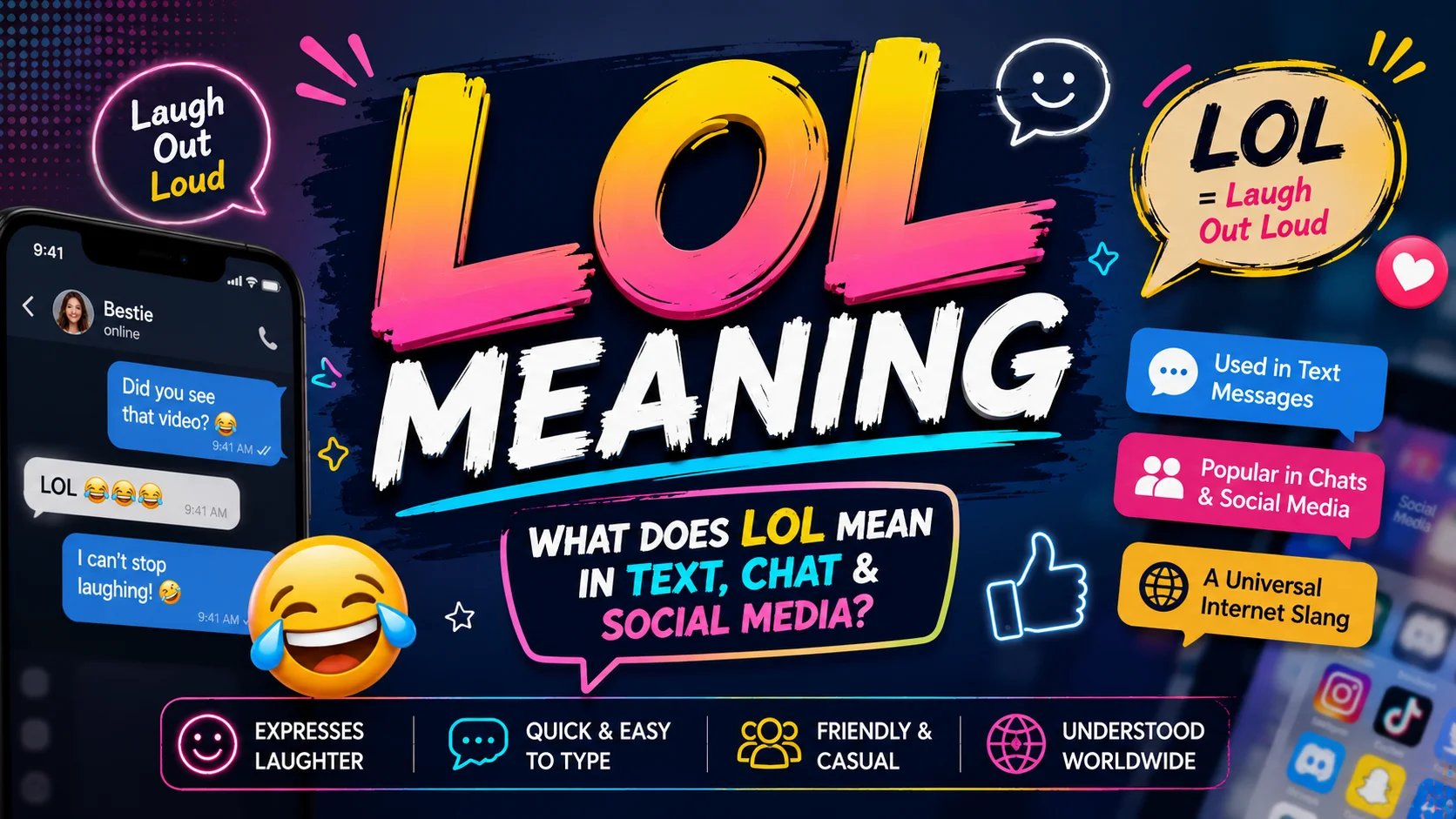
The internet has introduced countless abbreviations into everyday communication, and LOL remains one of the most recognizable. If you have ever received “LOL” in a text, comment, or social media message, you have probably wondered exactly what it means and how people use it. LOL stands for “laughing out loud.” People use it to show that something is funny, amusing, or entertaining.
Although LOL originally described an actual reaction to something humorous, modern internet users often use it more casually. Someone might write “LOL” after a joke, an embarrassing story, an unexpected situation, or even a statement that is only mildly amusing. In some conversations, people also use LOL to make a message sound friendlier or less serious.
The abbreviation became popular through early internet chat rooms, forums, instant messaging, and texting before spreading into mainstream digital communication. Today, LOL appears in texts, social media posts, comments, gaming chats, and casual conversations.
This guide explains the LOL meaning, origin, pronunciation, texting usage, examples, related abbreviations, and common mistakes so you can use it naturally.
Quick Answer: What Does LOL Mean?
| Term | Meaning | Usage | Category |
|---|---|---|---|
| LOL | Laughing out loud | Showing amusement | Internet slang |
| LOL in texting | Laughing out loud | Casual messages | Text abbreviation |
| LOL on social media | Laughing out loud | Comments and posts | Social media slang |
| LOL in chat | Laughing out loud | Instant messaging | Online communication |
| LOL 😂 | Strong amusement | Casual/friendly | Digital expression |
LOL means “laughing out loud.” People commonly use it in texts, chats, comments, and social media to indicate that they find something funny or amusing.
What Does LOL Stand For?
LOL stands for “laughing out loud.”
The abbreviation uses the first letters of the three words:
L = Laughing
O = Out
L = Loud
Unlike some slang terms that have several unrelated meanings, LOL most commonly refers to laughter in modern texting and online communication.
For example:
“That video was hilarious LOL.”
Here, LOL tells the reader that the sender found the video funny.
LOL Meaning in Texting
In texting, LOL usually means “laughing out loud.”
People use it to react to jokes, funny comments, awkward moments, memes, stories, or unexpected situations.
Examples
| Text | What LOL Communicates |
|---|---|
| “You really forgot your keys again LOL.” | Amusement |
| “LOL that was so funny.” | Genuine laughter |
| “I just spilled coffee everywhere LOL.” | Finding the situation amusing |
| “LOL I can’t believe you said that.” | Surprise and amusement |
| “That movie was ridiculous LOL.” | Lighthearted reaction |
The exact strength of the reaction depends on the conversation. LOL does not always mean that the person is literally laughing out loud.
LOL Meaning in Chat
In online chats, people often use LOL as a quick reaction rather than a complete statement.
For example:
Person A: “I walked into the wrong classroom today.”
Person B: “LOL 😂”
Here, Person B uses LOL to show amusement.
People may also combine LOL with other expressions:
- LOL 😂
- LOL!
- LOL omg
- LOL seriously?
- LOL I can’t
- LOL that’s crazy
- lol okay
- lol no
The lowercase lol often feels more casual than uppercase LOL, although the meaning usually stays the same.
LOL Meaning on Social Media
On social media, people commonly use LOL in:
- Comments
- Captions
- Replies
- Direct messages
- Memes
- Group conversations
- Reaction posts
For example:
“LOL this is exactly what happened to me.”
A user may also comment:
“LOL 😂”
to show that they found a meme or video funny.
On platforms such as TikTok, Instagram, Facebook, X, Reddit, and messaging apps, LOL remains a familiar informal expression.
Does LOL Always Mean Laughing Out Loud?
Not necessarily.
Although “laughing out loud” is the standard meaning, people use LOL in several ways.
1. Genuine Laughter
Sometimes LOL indicates that someone genuinely laughed.
“LOL, that joke was actually hilarious.”
2. Mild Amusement
Someone may use LOL even when something only makes them smile.
“I forgot to charge my phone again lol.”
3. Friendly Tone
People sometimes add LOL to make a statement feel less harsh.
“You still owe me that pizza lol.”
Without LOL, the message might sound more serious. Adding it can make the sentence feel lighter.
4. Awkwardness
LOL can sometimes soften an awkward statement.
“I totally forgot your birthday lol.”
5. Surprise
People can also use LOL after an unexpected situation.
“LOL, I did not see that coming.”
Is LOL Slang?
Yes. LOL is internet slang and a common texting abbreviation.
It belongs to a large group of digital expressions that developed as people began communicating through chat rooms, instant messaging, forums, and mobile phones.
Other examples include:
- BRB — Be right back
- IDK — I don’t know
- OMG — Oh my God
- BTW — By the way
- TBH — To be honest
- IMO — In my opinion
- TTYL — Talk to you later
- FYI — For your information
LOL remains one of the most widely recognized examples of internet shorthand.
History and Origin of LOL
LOL developed as part of early online communication, particularly in chat rooms, bulletin boards, forums, and instant messaging.
The abbreviation became popular because online communication lacked the facial expressions, gestures, and vocal tone that people naturally use during face-to-face conversations. Short expressions such as LOL helped users communicate emotional reactions quickly.
As internet culture expanded, LOL moved beyond niche online communities and became common in everyday texting and social media.
Its widespread use helped turn LOL into one of the best-known internet abbreviations in the English language.
How Do You Pronounce LOL?
People commonly pronounce LOL in two ways:
As Individual Letters
L-O-L
This is common when people say the abbreviation aloud.
As a Word
Some people pronounce it as “lol,” usually sounding like “loll.”
However, pronunciation varies by speaker and context. In writing, the abbreviation remains much more common than spoken usage.
LOL vs. LMAO
Both expressions communicate laughter, but they differ in intensity and tone.
| Expression | Meaning | Typical Tone |
|---|---|---|
| LOL | Laughing out loud | Mild to strong amusement |
| LMAO | Laughing my ass off | Stronger, more informal |
| LMFAO | Laughing my fucking ass off | Very informal/strong |
| ROFL | Rolling on the floor laughing | Exaggerated amusement |
| HAHA | Laughter | Casual |
| 😂 | Face with tears of joy | Laughter/amusement |
LOL works in a wider range of casual situations because it usually feels less intense than LMAO or LMFAO.
LOL vs Haha
Here LOL and haha both express amusement, but they can create slightly different impressions.
LOL
“LOL, that’s funny.”
And LOL feels like a quick digital reaction.
Haha
“Haha, that’s funny.”
Haha often feels more like written laughter.
People frequently combine them:
“Haha LOL, I can’t believe you did that.”
The difference depends heavily on the person’s communication style.
Uppercase LOL vs. Lowercase lol
The meaning remains essentially the same, but capitalization can affect the tone.
| Form | Common Impression |
|---|---|
| LOL | Stronger or more noticeable reaction |
| lol | Casual, relaxed reaction |
| Lol | Neutral or conversational |
| LOL 😂 | Strong amusement |
| lol… | Awkward or uncomfortable reaction |
These aren’t strict grammatical rules. People choose capitalization based on personal texting habits.
LOL Meaning in Different Contexts
Everyday Conversation
People use LOL casually to react to funny situations.
“You seriously ate the whole cake LOL.”
Text Messages
LOL helps people communicate laughter without typing a full sentence.
“LOL I just saw that.”
Social Media
Users often add LOL to comments and replies.
“LOL this is too accurate.”
Gaming
Gamers use LOL when reacting to funny gameplay, mistakes, or unexpected events.
“LOL you just walked into the trap.”
Group Chats
LOL works as a quick reaction when several people are talking.
“LOL everyone saw that.”
Dating and Flirting
People sometimes use LOL to make playful messages feel less serious.
“You think you’re funnier than me lol?”
In this context, LOL can soften the statement and create a relaxed tone.
Can LOL Be Used in Formal Writing?
Generally, no.
LOL belongs to informal digital communication. Avoid it in:
- Academic essays
- Business reports
- Formal emails
- Resumes
- Professional proposals
- Legal documents
- Research papers
Instead, use formal language such as:
- amusing
- humorous
- entertaining
- funny
- enjoyable
For example:
Informal:
“LOL, that was funny.”
Formal:
“That was an amusing observation.”
Common Mistakes When Using LOL
| Mistake | Better Usage |
|---|---|
| Using LOL in a formal essay | Use formal language |
| Assuming LOL always means intense laughter | Consider the context |
| Using LOL in every sentence | Use it naturally |
| Treating LOL as formal vocabulary | Recognize it as internet slang |
| Assuming uppercase and lowercase always differ | Both generally mean the same thing |
| Using LOL when someone is discussing serious grief | Consider whether laughter is appropriate |
| Assuming LOL always indicates genuine laughter | It can soften or lighten a message |
| Writing “LOLing” in formal English | Avoid informal derivatives |
| Using LOL without considering tone | Check how the message may sound |
| Assuming everyone interprets LOL identically | Context and age can affect interpretation |
Is LOL Rude?
LOL is not inherently rude. In most casual conversations, it simply expresses amusement.
However, context matters.
For example:
“LOL, that’s hilarious.”
usually sounds friendly.
But:
“LOL, you failed again.”
could sound mocking or insensitive depending on the situation.
When discussing serious subjects, adding LOL may appear dismissive or disrespectful.
The safest approach is to consider the topic, relationship, and emotional context before using it.
Can LOL Be Sarcastic?
Yes. People sometimes use LOL sarcastically.
For example:
“Great, my computer crashed again LOL.”
The person may not actually find the situation funny. Instead, LOL can communicate frustration through humor or irony.
Similarly:
“Sure, because that worked so well last time lol.”
Here, lol can signal sarcasm.
Therefore, the meaning of LOL depends heavily on surrounding words and tone.
LOL in Modern Internet Culture
LOL has become much more than a simple abbreviation.
Internet users now use different versions to communicate subtle emotions:
- lol — casual amusement
- LOL — stronger reaction
- lolol — extended amusement
- LOL!!! — excitement or strong laughter
- lol… — awkwardness or disbelief
- lmao — stronger laughter
- rofl — exaggerated laughter
These variations demonstrate how digital language continues to develop.
Related Internet Slang
| Term | Full Form | Meaning |
|---|---|---|
| LOL | Laughing out loud | Amusement |
| LMAO | Laughing my ass off | Strong laughter |
| LMFAO | Laughing my fucking ass off | Very strong laughter |
| ROFL | Rolling on the floor laughing | Extreme amusement |
| BRB | Be right back | Temporary absence |
| IDK | I don’t know | Uncertainty |
| OMG | Oh my God | Surprise |
| TBH | To be honest | Honest opinion |
| BTW | By the way | Topic transition |
| IMO | In my opinion | Personal opinion |
| IMHO | In my humble opinion | Personal opinion |
| FYI | For your information | Sharing information |
Examples of LOL in Sentences
Here are some natural ways to use LOL:
- “LOL, I completely forgot about that.”
- “That meme was hilarious LOL.”
- “LOL, you actually did it!”
- “I can’t believe you said that lol.”
- “LOL this is so funny.”
- “I just dropped my phone lol.”
- “LOL, that’s exactly what I was thinking.”
- “You really thought that would work? LOL.”
- “LOL, what just happened?”
- “I watched that video three times LOL.”
Related Questions About LOL
What does LOL mean in texting?
LOL means “laughing out loud.” People use it in texting to show amusement, laughter, or a lighthearted reaction.
What does LOL mean on social media?
On social media, LOL generally means “laughing out loud.” Users add it to comments, captions, replies, and messages when they find something funny or amusing.
What does LOL mean from a girl?
LOL has the same basic meaning regardless of gender: “laughing out loud.” The exact tone depends on the conversation. A girl may use LOL to express genuine amusement, friendliness, awkwardness, or sarcasm.
What does LOL mean from a guy?
It generally means “laughing out loud.” A guy might use it to react to a joke, soften a message, or show amusement.
Does LOL mean laughing out loud?
Yes. “Laughing out loud” is the standard and most widely accepted meaning of LOL.
Frequently Asked Questions
1. What is the full form of LOL?
The full form of LOL is “laughing out loud.”
2. Is LOL a slang word?
Yes. LOL is an internet slang abbreviation commonly used in texting, chats, social media, and other informal digital communication.
3. Is LOL still used?
Yes. LOL remains widely recognizable and continues to appear in texting, social media, online chats, gaming, and casual conversations.
4. Does LOL always mean someone is laughing?
No. People often use LOL to show mild amusement, soften a statement, express awkwardness, or add a playful tone. It does not necessarily mean the person is literally laughing.
5. Is LOL appropriate in professional emails?
Usually not. Because LOL is informal internet slang, avoid it in professional and academic writing unless you are discussing the term itself.
6. What is stronger than LOL?
Expressions such as LMAO, LMFAO, and ROFL generally communicate stronger or more exaggerated laughter than LOL.
7. Can LOL be sarcastic?
Yes. Someone can use LOL sarcastically to make frustration, disbelief, irony, or an awkward situation sound lighter.
8. What is the difference between LOL and haha?
Both can express laughter. LOL is an abbreviation meaning “laughing out loud,” while haha represents written laughter. The difference is mostly stylistic and depends on context.
Conclusion
The LOL meaning is “laughing out loud,” making it one of the most recognizable abbreviations in internet and texting culture. People use LOL to show amusement, react to jokes, soften messages, or make conversations feel more casual. Although the abbreviation originally suggested genuine laughter, modern users often use it more broadly to express mild amusement, awkwardness, surprise, or even sarcasm.
LOL works naturally in texts, social media comments, gaming chats, group messages, and other informal settings. However, you should generally avoid it in academic, professional, or formal writing. Its capitalization can also affect the perceived tone, with LOL sometimes feeling stronger and lol often feeling more relaxed.
Understanding these subtle differences can help you use LOL naturally and recognize what someone means when they include it in a message.

Olivia Bennett is a writer and language enthusiast at Vocabsteria. She is passionate about exploring word meanings, name origins, and cultural expressions from around the world.