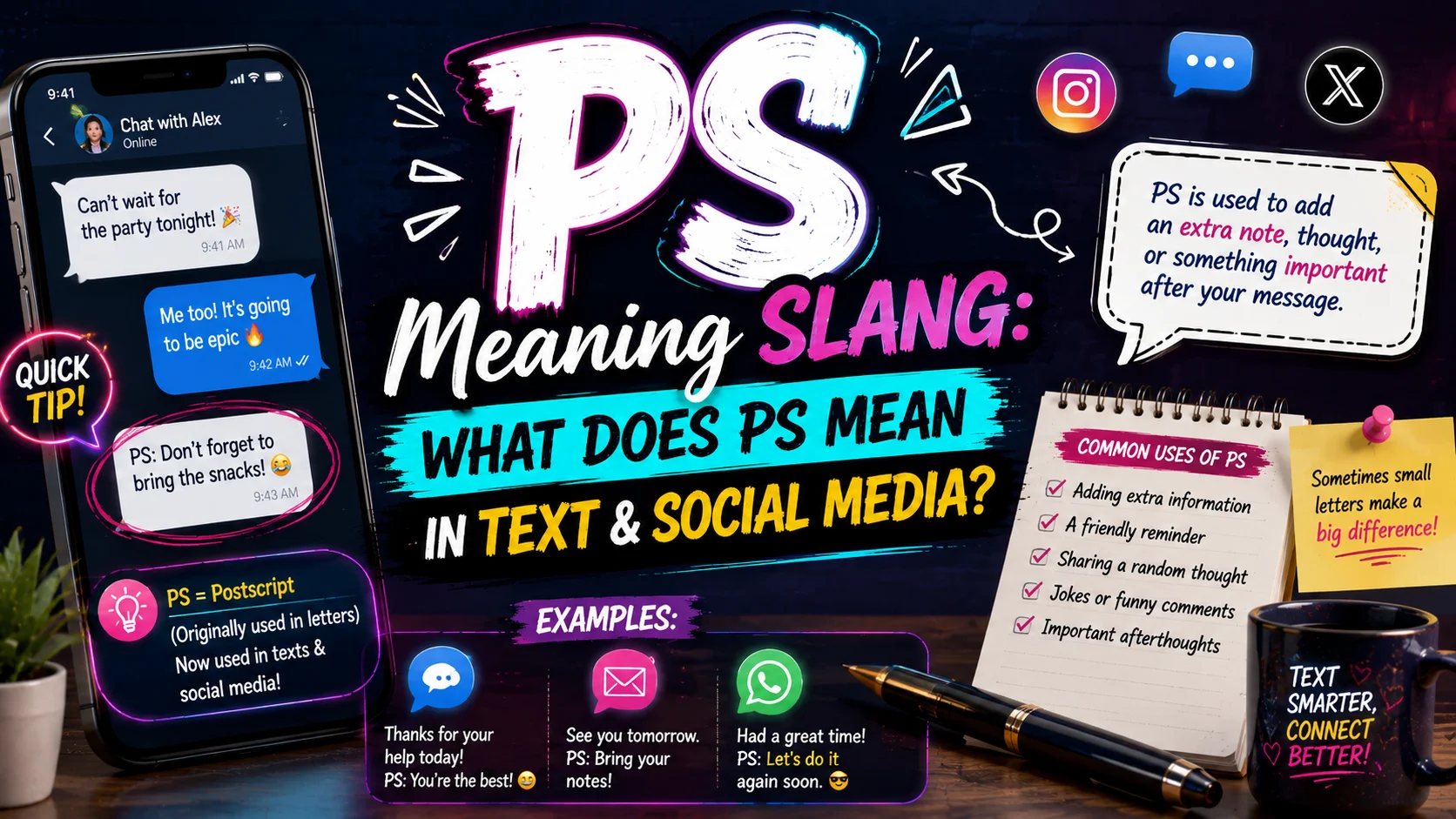
If someone ends a text, email, or social media message with “PS,” you may wonder what those two letters mean. In most everyday messages, PS means “postscript,” an extra thought, reminder, joke, or detail added after the main message. The abbreviation comes from the Latin postscriptum, meaning “written after.”
Although people often search for PS meaning slang, PS is technically better described as an abbreviation than traditional slang. It has existed since the days of handwritten letters and remains useful in modern digital communication. People now use it in texts, emails, captions, DMs, and online conversations when they remember one more thing they want to say.
Context can change the meaning, however. In gaming conversations, PS may refer to PlayStation, while P’s can sometimes mean money in certain slang contexts.
This guide explains the PS meaning slang, its origin, texting usage, examples, related meanings, and common questions.
Quick Answer: PS Meaning Slang
| Term | Meaning | Common Use | Category |
|---|---|---|---|
| PS | Postscript | Adding an extra thought | Abbreviation |
| P.S. | Postscript | Letters and emails | Written abbreviation |
| ps | Postscript | Texting and casual chat | Informal abbreviation |
| PS | PlayStation | Gaming conversations | Gaming abbreviation |
| P’s | Money | Some slang contexts | Slang |
The most common meaning of PS in texting and messages is “postscript,” meaning an extra note added after the main message.
What Does PS Stand For?
PS stands for “postscript.”
The word comes from the Latin postscriptum, meaning “written after.” Traditionally, people added a P.S. at the end of a letter when they remembered something after finishing the main message.
For example:
“See you tomorrow.
P.S. Don’t forget your jacket!”
The writer has finished the main message and then adds one final reminder.
PS Meaning in Texting
In texting, PS usually means “postscript.”
People use it to add something they remembered after writing the main message.
Examples
| Text Message | Meaning of PS |
|---|---|
| “See you at 7. PS: Bring snacks!” | Extra reminder |
| “I had a great time today. PS: Thanks again!” | Additional thought |
| “Good luck tomorrow! PS: Don’t forget your notes.” | Final reminder |
| “I’m heading home now. PS: I love your new haircut.” | Extra comment |
| “Talk to you later. PS: Call me when you arrive.” | Additional request |
Unlike abbreviations such as LOL or BRB, PS isn’t primarily internet slang. It is an older written abbreviation that people continue to use in digital communication.
PS Meaning in Chat
In online chat, PS works as a quick way to say “one more thing.”
For example:
Person A: “Thanks for helping me with my project today!”
Person B: “No problem! PS: Your presentation looked great.”
The second sentence adds information after the main conversation.
People may use PS to add:
- A reminder
- A joke
- A compliment
- An extra detail
- A correction
- A personal comment
- A final thought
PS Meaning on Social Media
People also use PS in social media captions, comments, and direct messages.
For example:
“Finally finished the trip I’ve been planning for months! ✈️
PS: I already want to go back.”
Here, PS adds a personal afterthought without changing the main message.
You may see this style on platforms such as:
- TikTok
- Snapchat
- X
- Messaging apps
The use is essentially the same: PS introduces something extra after the main thought.
Is PS Slang?
Not exactly.
PS is more accurately called an abbreviation or written shorthand.
Unlike newer internet slang such as LOL, LMAO, or BRB, PS existed long before smartphones and social media. People originally used it in handwritten letters because they could not easily go back and insert something they had forgotten.
Today, people have carried the expression into digital communication.
So:
PS = abbreviation
LOL = internet slang/abbreviation
BRB = texting abbreviation
This distinction can help you understand why PS can appear in both casual and relatively formal communication.
PS Meaning in Emails
PS can also appear at the end of emails.
For example:
“Thanks for your help with the project.
PS: Please send me the final document when you get a chance.”
The writer uses PS to add something that wasn’t included in the main body.
PS can work in informal or friendly professional emails, but you should avoid relying on it for important information. If a detail is essential, place it directly in the main body of the email.
PS Meaning in Gaming
Context becomes especially important in gaming.
When someone says:
“I bought it on PS.”
they may mean PlayStation, not postscript.
Similarly:
“Do you play on PS5?”
Here, PS clearly refers to PlayStation.
| Example | Meaning |
|---|---|
| “PS: Don’t forget your charger.” | Postscript |
| “I play on PS5.” | PlayStation |
| “Which PS game are you playing?” | PlayStation |
| “PS: See you tomorrow!” | Postscript |
The surrounding conversation usually makes the intended meaning obvious.
PS Meaning in Slang: P’s
A different expression appears as “P’s” or “p’s.”
In some slang contexts, P’s can mean money or cash. For example:
“He’s trying to make P’s.”
This is different from PS = postscript. Some slang references describe P’s as money-related slang, while the exact origin and usage can vary by community and region.
The punctuation helps distinguish the two:
- PS → usually postscript
- P’s → can mean money
- PS5 → PlayStation 5
PS vs. BTW
PS and BTW can both introduce additional information, but they work differently.
| Term | Meaning | Typical Position |
|---|---|---|
| PS | Postscript | Usually at the end |
| BTW | By the way | Usually within a message |
Example:
BTW:
“BTW, don’t forget to call Sarah.”
PS:
“Have a great night! PS: Don’t forget to call Sarah.”
BTW introduces a side point during the message, while PS usually adds something after the main message has already finished.
PS vs. PPS
You may occasionally see PPS after a PS.
PPS traditionally means “post-postscript.”
It introduces another additional note after the original postscript.
Example:
“P.S. Don’t forget your keys.
P.P.S. Bring an umbrella too.”
PPS is much less common today because digital messages make editing easy.
How Do You Pronounce PS?
People normally pronounce PS as:
“pee ess”
The letters are pronounced separately.
For example:
“P.S. Don’t forget the tickets.”
You would normally say “pee ess” rather than treating PS as a single spoken word.
Examples of PS in Everyday Messages
Here are some natural examples:
- “See you tomorrow! PS: Don’t be late.”
- “Thanks for dinner. PS: The dessert was amazing.”
- “Goodnight! PS: I had so much fun today.”
- “I’m leaving now. PS: Lock the door.”
- “Happy birthday! PS: Your gift is coming tomorrow.”
- “I’ll call you later. PS: Don’t forget your appointment.”
- “Have a great weekend! PS: Send me those pictures.”
- “I finished the book. PS: You were right about the ending.”
- “Thanks again! PS: Let me know when you get home.”
- “I’m going to bed. PS: Love you.”
What Tone Does PS Create?
PS can change the tone of a message depending on what follows it.
Friendly
“PS: Have a great weekend!”
Funny
“PS: I definitely didn’t eat the last cookie.”
Romantic
“PS: I miss you already.”
Helpful
“PS: Don’t forget your passport.”
Playful
“PS: You still owe me coffee!”
This flexibility explains why PS has remained useful even as communication moved from handwritten letters to smartphones.
Common Mistakes With PS
| Mistake | Correct Usage |
|---|---|
| Treating PS as a formal sentence | Use it as an additional note |
| Assuming PS always means PlayStation | Check the context |
| Assuming PS is always slang | It is primarily an abbreviation |
| Using PS for essential information | Put important details in the main message |
| Confusing PS with P’s | P’s can have a different slang meaning |
| Writing PS in every message | Use it only when an afterthought fits |
| Assuming PS has a romantic meaning | The following text determines the tone |
| Thinking PS is only for letters | It also appears in texts and emails |
| Confusing PS with PPS | PPS means an additional note after PS |
| Assuming PS has one meaning everywhere | Context determines the meaning |
When Should You Use PS?
PS works best when you genuinely want to add a final thought.
Use it for:
- Reminders
- Small details
- Personal comments
- Jokes
- Compliments
- Friendly messages
- Casual emails
- Social media captions
For example:
“Thanks for coming to my party! PS: I’ll send you the photos tomorrow.”
The main message is complete, but the PS adds one more useful detail.
When Should You Avoid PS?
You should generally avoid PS when the information belongs naturally in the main message.
For example, instead of:
“Your appointment is tomorrow at 9 a.m. PS: Bring your ID.”
you could simply write:
“Your appointment is tomorrow at 9 a.m. Please bring your ID.”
This makes important information easier to notice.
Frequently Asked Questions
1. What does PS mean in slang?
PS usually means “postscript,” an additional thought or note added after the main message. Although people often call it slang, PS is more accurately an abbreviation that originated in traditional writing.
2. What does PS mean in texting?
In texting, PS usually means postscript. People use it to add a reminder, joke, detail, or final thought after the main message.
3. What does PS mean on social media?
On social media, PS usually introduces an extra comment or afterthought in a caption, reply, or message.
4. Does PS mean PlayStation?
Sometimes. In a gaming context, PS can mean PlayStation. For example, “I play on PS5” clearly refers to PlayStation.
5. What does P’s mean in slang?
In some slang contexts, P’s means money or cash. This is different from PS meaning postscript.
6. Is PS considered slang?
Not technically. PS is primarily an abbreviation for postscript. It can appear in casual online communication, but the term itself predates internet slang.
7. What does PS mean from a girl or guy?
There is no special meaning based on gender. Whether a girl or guy writes PS, it usually means postscript. The message following PS determines whether the tone is funny, romantic, friendly, or serious.
8. What does PPS mean?
PPS means “post-postscript.” People use it to introduce another additional thought after an original PS, although it is relatively uncommon today.
Conclusion
The most common PS meaning slang is “postscript,” an extra note added after the main message. Although many people associate PS with modern texting and social media, the abbreviation actually comes from the much older tradition of letter writing. The Latin postscriptum means “written after,” which explains exactly why people place PS at the end of a message.
Today, people use PS in texts, emails, captions, comments, and DMs to add reminders, jokes, personal thoughts, or extra information. Context matters, though. In gaming conversations, PS can mean PlayStation, while P’s may refer to money in certain slang contexts.
So, when you see “PS” at the end of an ordinary message, the safest interpretation is simple: the sender has one more thing to say.

Olivia Bennett is a writer and language enthusiast at Vocabsteria. She is passionate about exploring word meanings, name origins, and cultural expressions from around the world.