Past vs passed is a common English grammar confusion because both words sound alike but have different meanings and grammatical roles. Although they share the same pronunciation in many varieties of English, you cannot use them interchangeably.
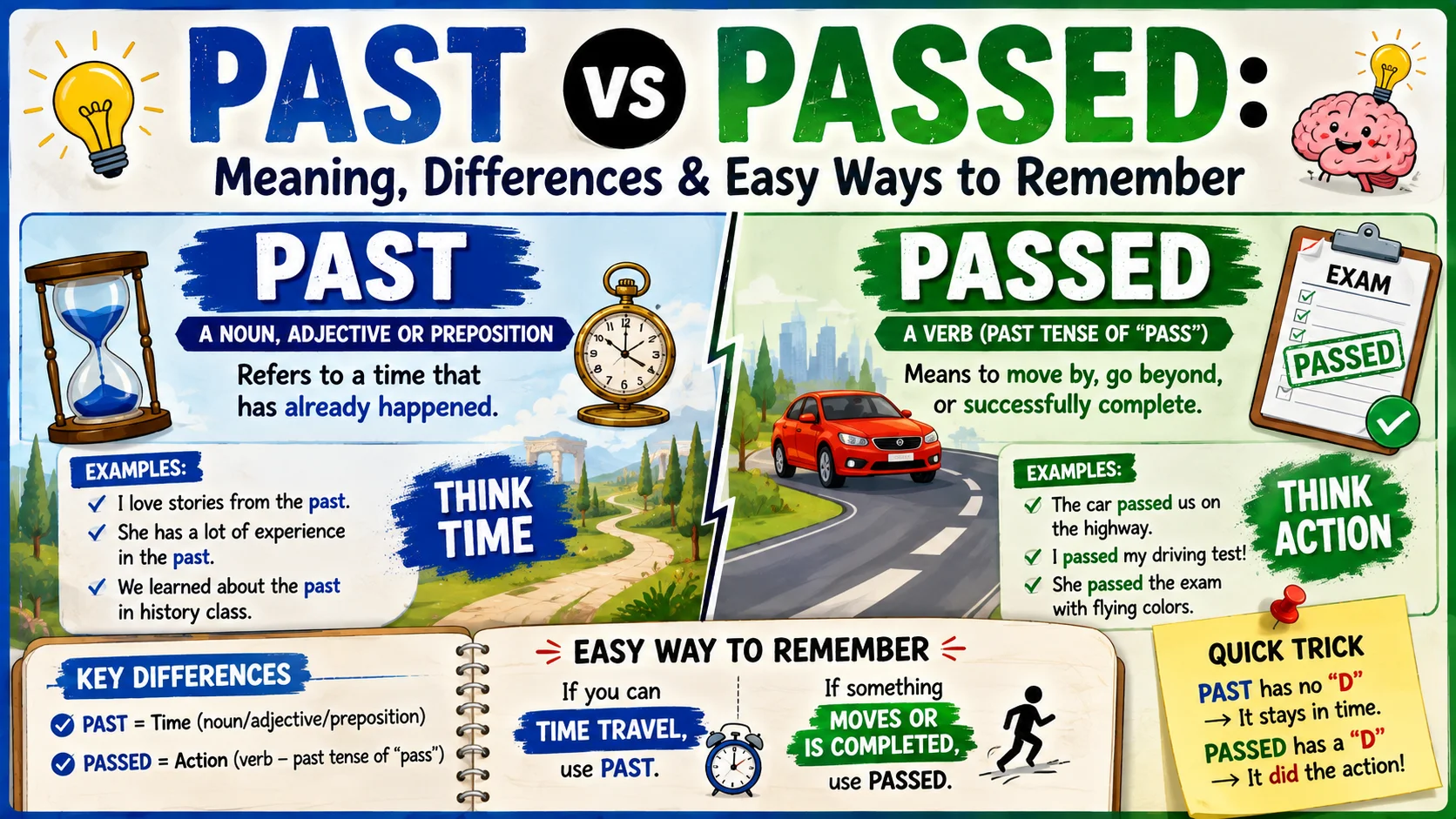
Past usually refers to a time that has already happened, a previous period, or movement beyond a particular point. Passed is the past tense and past participle of the verb pass, which can mean to move by, succeed, hand something over, or go through a particular stage.
For example:
- I lived there in the past.
- She passed the exam.
- We walked past the store.
- The car passed us quickly.
The easiest way to understand past vs passed is to remember that past usually functions as a noun, adjective, adverb, or preposition, while passed functions as a verb.
Past vs Passed: Quick Answer
Past refers to a time, period, place, or position that is already behind you. Passed is the past form of the verb pass and describes an action that someone or something completed.
Easy trick: If you can replace the word with “went by,” “succeeded,” “handed,” or another form of pass, use passed. If you mean previous time or beyond a point, use past.
| Word | Main Function | Meaning | Example |
|---|---|---|---|
| Past | Noun, adjective, adverb, preposition | Previous time or beyond a point | We walked past the house. |
| Passed | Verb | Completed the action of passing | She passed the house. |
What Does Past Mean?
Past usually refers to something that happened before the present moment.
For example:
I learned a lot from my past.
Here, past refers to previous experiences or time.
You can also use past to describe movement beyond something:
We drove past the school.
In this sentence, past acts as a preposition and means beyond or alongside the school.
Common Meanings of Past
The word past can refer to:
- A previous time
- Previous events
- A former period
- Something completed
- A location beyond another point
- Movement beyond something
Examples With Past
- I don’t like talking about my past.
- She has learned from her past mistakes.
- We walked past the restaurant.
- It was past midnight when we arrived.
- The train went past the station.
- His past experiences shaped his decisions.
- Look past the obvious answer.
- The deadline is past.
- She moved past her fears.
- We drove past the old building.
What Does Passed Mean?
Passed is the past tense and past participle of the verb pass.
It describes an action that already happened.
For example:
She passed the exam.
Here, passed tells us what she did. She successfully completed the exam.
Common Meanings of Passed
Passed can mean:
- Moved beyond something
- Succeeded in a test
- Handed something to someone
- Transferred something
- Spent or went through time
- Approved something
- Moved from one person or place to another
Examples With Passed
- She passed her driving test.
- The car passed us on the highway.
- He passed the ball to his teammate.
- I passed the message to Sarah.
- The teacher passed the papers around.
- Time passed quickly.
- Congress passed the bill.
- He passed through security.
- She passed the bookstore without stopping.
- The doctor said the patient had passed peacefully.
Past vs Passed: The Main Difference
The simplest distinction is grammatical:
Past is usually not the main verb in a sentence.
Passed is a form of the verb pass.
Compare these examples:
We walked past the house.
We passed the house.
Both sentences can describe movement beyond the house, but their grammar differs.
In the first sentence, walked is the verb, while past tells us where the action happened.
In the second sentence, passed is the verb.
This distinction makes many confusing sentences easier to understand.
Past as a Noun
Past can function as a noun when it refers to previous events or someone’s earlier life.
Examples:
- We should learn from the past.
- She doesn’t like discussing her past.
- His past remains a mystery.
- The past cannot be changed.
- They have finally moved beyond the past.
Here, past refers to an earlier period or previous experiences.
Past as an Adjective
Past can describe something connected with an earlier time.
Examples:
- My past experiences taught me patience.
- She contacted a past employer.
- The past president attended the event.
- We discussed past mistakes.
- He compared his current results with past results.
In these examples, past describes another noun.
Past as a Preposition
You can use past as a preposition when you mean beyond or alongside something.
Examples:
- We walked past the library.
- She drove past my house.
- He ran past the finish line.
- I looked past the window.
- They went past the old bridge.
A useful clue is that past often appears directly before a noun or noun phrase.
Past as an Adverb
Past can also function as an adverb.
Examples:
- The car drove past.
- She walked past without saying anything.
- The runner moved past quickly.
- He glanced at me and went past.
Here, past describes the direction or movement of an action.
Passed as a Verb
Passed always represents an action because it comes from the verb pass.
For example:
The ball passed through the window.
She passed the test.
He passed the salt.
The train passed the station.
The meaning changes depending on the context, but the word always functions as a verb.
Past vs Passed in Time Expressions
This is one of the areas where people often confuse these words.
Past
Use past when talking about a previous period.
- In the past, people wrote letters more often.
- She has changed a lot since the past year.
- We discussed what happened in the past.
- His past experiences influence his decisions.
Passed
Use passed when something happens or moves through time.
- Two hours passed before she arrived.
- Several years passed quickly.
- The deadline passed without a response.
- Time passed while we waited.
Compare:
In the past, I lived in New York.
Five years passed before I returned.
The first sentence refers to a previous period. The second describes time moving forward.
Past vs Passed With “Time”
A useful way to remember the difference is this:
Time passed.
Not:
Time past.
Examples:
- Time passed quickly.
- Several months passed before they met again.
- As the years passed, things changed.
- The afternoon passed peacefully.
But:
- In the past, I worked there.
- We often think about the past.
- She wants to forget the past.
Past vs Passed With “By”
The phrase “past” and the verb “passed” can both appear with movement, which makes this comparison especially confusing.
Walk Past
We walked past the store.
Here, walked is the verb and past indicates movement beyond the store.
Passed
We passed the store.
Here, passed itself is the verb.
Both sentences are grammatically correct.
Common Mistakes With Past and Passed
Mistake 1: “I past the exam.”
❌ I past the exam.
✅ I passed the exam.
Because passed means successfully completed the exam.
Mistake 2: “We walked passed the house.”
❌ We walked passed the house.
✅ We walked past the house.
The verb is walked, so you need past to show movement beyond the house.
Mistake 3: “Time past quickly.”
❌ Time past quickly.
✅ Time passed quickly.
Because passed is the verb describing what time did.
Mistake 4: “In the passed, I lived there.”
❌ In the passed, I lived there.
✅ In the past, I lived there.
Here, you are referring to an earlier period, so use past.
Mistake 5: “She drove passed me.”
❌ She drove passed me.
✅ She drove past me.
The verb is drove, while past describes movement beyond you.
Past or Passed: Which One Should You Use?
Ask yourself what role the word plays.
Use “Past” When:
- You mean an earlier time.
- You refer to previous events.
- You mean beyond something.
- You describe movement with another verb.
- You describe something from an earlier period.
Examples:
- In the past
- Past mistakes
- Walked past
- Drove past
- Past experience
Use “Passed” When:
- You need the past tense of pass.
- Someone succeeded at something.
- Something moved beyond another thing as the main action.
- Someone handed something over.
- Time moved forward.
- Something received official approval.
Examples:
- Passed the test
- Passed the car
- Passed the ball
- Passed the message
- Time passed
- Passed the law
Easy Trick to Remember Past vs Passed
Here’s a simple memory trick:
Past = Time or Place
Think:
Past = previous time or beyond a place.
Examples:
- The past year
- In the past
- Walk past the store
Passed = Action
Think:
Passed = something happened.
Examples:
- She passed the exam.
- He passed the ball.
- Time passed quickly.
Another useful trick is to replace passed with pass.
If the sentence still makes sense as an action, you probably need passed.
She passed the test.
→ She passes the test.
That works because passed is a verb.
But:
We walked past the store.
You cannot say:
We walked passes the store.
So past is correct.
Past vs Passed Examples
Here are more examples to make the distinction clear.
Correct Uses of Past
- I remember my past.
- She has a difficult past.
- We walked past the bank.
- He drove past our house.
- The time is past noon.
- Let’s leave the past behind.
- She learned from her past mistakes.
- We went past the museum.
- His past experiences helped him.
- They live past the bridge.
Correct Uses of Passed
- She passed the exam.
- He passed me on the road.
- The ball passed over the fence.
- Time passed quickly.
- She passed the salt.
- The bill passed in Congress.
- He passed through the gate.
- The opportunity passed him by.
- They passed the information to us.
- The car passed the truck.
Past vs Passed in Sentences
Consider these pairs:
I walked past the school.
The verb is walked.
I passed the school.
The verb is passed.
In the past, I lived there.
Past refers to an earlier time.
Three years passed before I returned.
Passed describes time moving forward.
- She walked past me.
- She moved beyond me.
- She passed me.
- She moved ahead of me.
These examples show why context matters.
“Passed Away” vs “Past Away”
One important expression is passed away, which is a polite way to say that someone died.
Correct:
Her grandfather passed away last year.
Incorrect:
Her grandfather past away last year.
Because passed is the verb.
“Past Due” vs “Passed Due”
Another common expression is past due.
Correct:
The payment is past due.
Here, past means the deadline has already gone by.
Do not write:
The payment is passed due.
The phrase past due is the standard expression.
“Past Tense” vs “Passed Tense”
The correct phrase is:
past tense
Not:
passed tense
Past tense refers to a verb form that describes an action or state that happened before now.
For example:
“Walked” is the past tense of “walk.”
“Past Experience” vs “Passed Experience”
The correct phrase is:
past experience
Example:
Her past experience helped her succeed.
Passed experience is not normally correct in this meaning.
“Past Mistakes” vs “Passed Mistakes”
The standard phrase is:
past mistakes
Example:
We should learn from our past mistakes.
You use past because you mean mistakes that happened previously.
“Passed the Point” vs “Past the Point”
Both can be correct, but they work differently.
Past the Point
We are past the point of arguing.
Here, past acts as a preposition and means beyond.
Passed the Point
The train passed the point where the road ends.
Here, passed is the verb describing the train’s movement.
Why Are Past and Passed So Easy to Confuse?
The main reason is pronunciation.
In standard English, past and passed are usually pronounced the same way:
/pæst/
Because they sound identical, you cannot always determine the spelling by listening.
You need to consider the meaning and grammatical role.
For example:
I passed the store.
and
I walked past the store.
They can sound similar when spoken quickly, but their grammatical structures differ.
This is why English learners often confuse these words in writing.
Past vs Passed: Quick Comparison
| Feature | Past | Passed |
|---|---|---|
| Part of speech | Noun, adjective, adverb, preposition | Verb |
| Refers to previous time | Yes | No |
| Can mean beyond | Yes | Yes, as an action |
| Comes from “pass” | No | Yes |
| Example | In the past | She passed the test |
| Example | Walk past the house | He passed the house |
| Common phrase | Past due | Passed away |
Frequently Asked Questions
Is it “past” or “passed”?
Both words are correct, but they have different meanings. Use past for previous time or something beyond a point. Use passed as the past tense of pass.
Is it “walk past” or “walk passed”?
The correct phrase is walk past.
Example:
We walked past the store.
The verb is walked, so you use past to describe the movement.
Is it “passed the house” or “past the house”?
Both can be correct depending on the sentence.
We walked past the house.
We passed the house.
In the first sentence, past works with the verb walked. In the second, passed is the main verb.
Is it “past the test” or “passed the test”?
The correct phrase is passed the test when you mean someone succeeded.
She passed the test.
Is it “time past” or “time passed”?
The correct phrase is time passed when describing time moving forward.
Time passed quickly.
Is “past” a verb?
Usually, no. Past can function as a noun, adjective, adverb, or preposition, but passed functions as a verb.
Is “passed” always a verb?
Passed is the past tense and past participle of pass, so it functions as a verb.
How do I remember past vs passed?
Remember: Past = time or place. Passed = action.
If you mean an earlier time or movement beyond something with another verb, use past. If pass describes the action, use passed.
Why do past and passed sound the same?
They are homophones in standard English. They have the same or nearly the same pronunciation but different spellings and meanings.
Is it “past due” or “passed due”?
The correct expression is past due.
Example:
My payment is past due.
Is it “past away” or “passed away”?
The correct expression is passed away.
Example:
Her grandfather passed away peacefully.
Conclusion
Understanding past vs passed becomes much easier when you focus on their grammatical roles rather than their pronunciation. Although both words sound alike, they serve different purposes in a sentence.
Use past when you talk about a previous time, earlier events, or something located beyond a particular point. You can see it in phrases such as “in the past,” “past mistakes,” “past the house,” and “past due.”
Use passed when you describe an action connected to the verb pass. Common examples include “passed the exam,” “passed the ball,” “passed the house,” “passed the message,” and “time passed.”
The easiest rule to remember is:
Past = time or place.
Passed = action.
Once you understand this simple distinction, choosing between the two words becomes much easier.

Olivia Bennett is a writer and language enthusiast at Vocabsteria. She is passionate about exploring word meanings, name origins, and cultural expressions from around the world.