Lose vs loose is one of the most common confusing word pairs in English. The two words look and sound similar, but they have completely different meanings and grammatical functions. Using the wrong one can change the meaning of a sentence and create an obvious spelling or grammar mistake.
Lose is mainly a verb. It means to no longer have something, fail to win, or become unable to find something. For example, you can lose your keys, lose a game, lose money, or lose interest.
Loose is usually an adjective. It describes something that is not tight, firmly attached, or closely controlled. You can have a loose shirt, a loose tooth, loose clothing, or a loose connection.
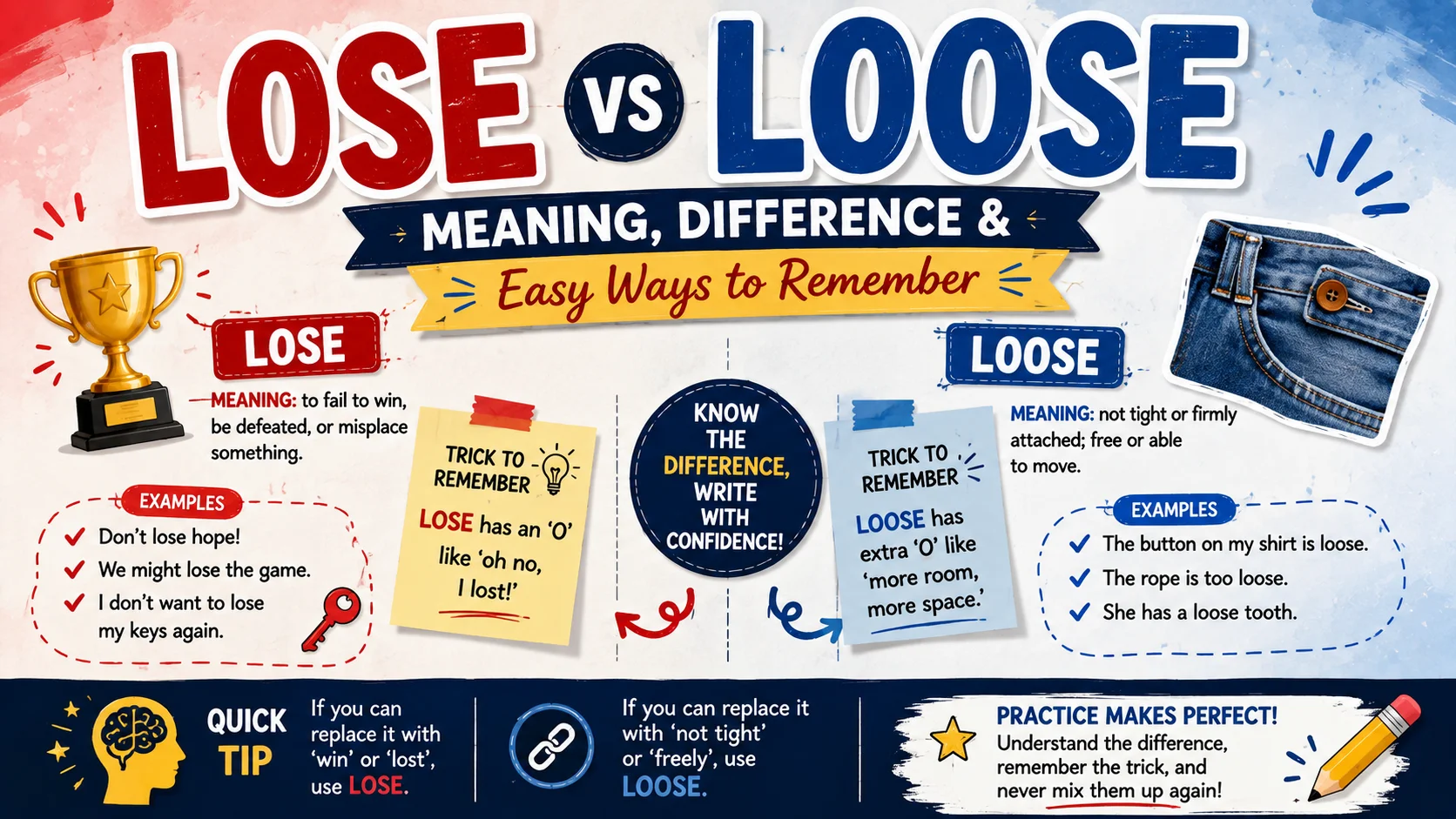
The easiest way to remember the difference is to associate lose with losing something and loose with something that is not tight.
This guide explains the lose vs loose meaning, pronunciation, grammar, common mistakes, sentence examples, memory tricks, and related words so you can use both correctly.
Quick Answer: Lose vs Loose
| Word | Part of Speech | Main Meaning | Example |
|---|---|---|---|
| Lose | Verb | Misplace, fail to win, or no longer have | I don’t want to lose my phone. |
| Loose | Adjective | Not tight or securely attached | My shoes feel loose. |
Simple Rule
Lose = misplace, fail, or no longer have something
Loose = not tight or firmly attached
What Does Lose Mean?
Lose is primarily a verb with several related meanings.
It can mean:
- To misplace something
- To stop having something
- To fail to win
- To miss an opportunity
- To experience a reduction
- To become unable to find someone or something
- To no longer understand or follow something
Examples
- I don’t want to lose my wallet.
- Our team could lose the game.
- She may lose her job.
- I don’t want to lose touch with my friends.
- He began to lose interest in the project.
- I lost my keys yesterday.
The past tense of lose is lost, not loosed.
What Does Loose Mean?
Loose is primarily an adjective that describes something that is not tight, fixed, or securely attached.
Examples
- These pants are too loose.
- The dog got loose from its leash.
- I have a loose tooth.
- The screw is loose.
- Her hair was loose.
- The connection is loose.
Loose can also describe something that is relaxed, unrestricted, or not closely organized.
For example:
- The rules are loose.
- The group has a loose structure.
- They formed a loose alliance.
Lose vs Loose Meaning
The main difference is simple:
Lose describes an action or result.
Loose describes a condition.
Compare these examples:
- I might lose my ring.
- My ring is loose.
In the first sentence, lose describes the possibility of no longer having the ring.
In the second sentence, loose describes the ring’s condition or fit.
Lose vs Loose Pronunciation
Pronunciation provides another useful way to distinguish these words.
Lose
Lose is pronounced like looz.
IPA: /luːz/
The final sound is a z sound.
Loose
Loose is pronounced like loos.
IPA: /luːs/
The final sound is an s sound.
Easy Pronunciation Trick
Think:
Lose → zoo
Loose → goose
Lose rhymes with words such as:
- Choose
- Shoes
- Blues
- Cruise
Loose rhymes with:
- Goose
- Moose
- Juice
- Noose
The pronunciation difference is small but important.
Lose vs Loose Examples
Here are some common examples that show the difference clearly.
Example 1
Correct: I don’t want to lose my phone.
You are talking about no longer having or finding your phone.
Incorrect: I don’t want to loose my phone.
Example 2
Correct: My shirt is too loose.
The shirt is not tight enough.
Incorrect: My shirt is too lose.
Example 3
Correct: Our team might lose the match.
Lose means fail to win.
Incorrect: Our team might loose the match.
Example 4
Correct: The door handle is loose.
The handle is not firmly attached.
Example 5
Correct: Don’t lose your keys.
You are talking about misplacing something.
Example 6
Correct: The screw is loose.
The screw is not tight or secure.
Lose as a Verb
Lose has several important meanings.
1. Misplace Something
You cannot find something because you do not know where you put it.
Example:
I always lose my headphones.
2. Fail to Win
You do not win a competition, game, or contest.
Example:
Our team may lose the final.
3. No Longer Have Something
You stop possessing something.
Example:
He could lose his job.
4. Experience a Reduction
Something decreases.
Example:
The company may lose money this year.
5. Stop Understanding
You no longer follow an explanation or argument.
Example:
I lost track of the conversation.
6. Lose Someone
You can no longer find or stay with someone.
Example:
We lost our guide in the crowd.
Loose as an Adjective
Loose can describe many different conditions.
1. Not Tight
Example:
These shoes are too loose.
2. Not Firmly Attached
Example:
The handle is loose.
3. Not Closely Controlled
Example:
The organization has a loose structure.
4. Not Closely Connected
Example:
The two ideas have a loose connection.
5. Free or Unrestrained
Example:
The horse broke loose from the fence.
6. Not Closely Packed
Example:
The soil has a loose texture.
Is Loose Ever a Verb?
Yes, although loose is much more commonly used as an adjective.
As a verb, to loose means to release, set free, or let something go.
Example:
The soldiers loosed the dogs.
Another example:
The hunter loosed an arrow.
This use is relatively uncommon in everyday modern English.
Do not confuse loose as a verb with lose.
Lose vs Loose Grammar
Understanding the parts of speech makes the difference easier.
Lose
Usually a verb.
Examples:
- I might lose.
- She lost her phone.
- They could lose the game.
- Don’t lose hope.
Loose
Usually an adjective.
Examples:
- The shirt is loose.
- The screw is loose.
- His grip was loose.
- The rules are loose.
Loose can also function as a verb in less common contexts.
Common Mistakes With Lose and Loose
One of the most common errors is using loose when the writer means lose.
Incorrect
I don’t want to loose my wallet.
Correct
I don’t want to lose my wallet.
Another common mistake happens in descriptions of clothing.
Incorrect
My jeans are too lose.
Correct
My jeans are too loose.
Incorrect
Don’t loose your ticket.
Correct
Don’t lose your ticket.
Incorrect
The door handle might lose.
Correct
The door handle might be loose.
Lose vs Loose in Texting
People often confuse these words in texting because they sound similar.
Common texting mistakes include:
- I don’t want to loose you.
- Don’t loose your keys.
- My shirt is lose.
- We are going to loose.
- I always loose my phone.
Correct versions:
- I don’t want to lose you.
- Don’t lose your keys.
- My shirt is loose.
- We are going to lose.
- I always lose my phone.
Even though texting is informal, choosing the correct word makes your writing clearer.
Lose vs Loose in a Relationship
This is a particularly common search because people often write phrases such as I don’t want to lose you.
The correct expression is:
I don’t want to lose you.
Here, lose means you do not want the relationship to end or the person to leave your life.
Loose would be incorrect in this context.
More Examples
- I don’t want to lose you.
- I’m afraid I might lose her.
- He doesn’t want to lose his best friend.
- They don’t want to lose their connection.
Lose vs Loose in Clothing
When describing clothing, use loose.
Examples:
- These jeans are too loose.
- I prefer loose clothing.
- The dress has a loose fit.
- His jacket feels loose around the shoulders.
Do not use lose when describing something that does not fit tightly.
Lose vs Loose in Sports
When discussing the result of a game or competition, use lose.
Examples:
- We might lose the game.
- They lost the match.
- Nobody wants to lose the championship.
- Our team cannot afford to lose today.
The adjective loose can still appear in sports, but it describes something different.
Example:
- The player had a loose grip on the ball.
Lose vs Loose in Business
Use lose when describing a loss of money, customers, employees, opportunities, or business.
Examples:
- The company could lose customers.
- We might lose money.
- The business may lose market share.
- They don’t want to lose the contract.
Use loose when describing something that is not strict, fixed, or tightly organized.
Example:
- The company has a loose management structure.
Lose vs Loose: Easy Memory Tricks
Memory Trick 1: One O Means Lose
Remember:
Lose = one O
Think about losing something and it disappearing from your possession.
Memory Trick 2: Loose Has Extra Space
Loose has two O’s.
You can imagine the two O’s as having extra space between them, just like something loose has extra room.
Memory Trick 3: Lose Rhymes With Choose
Lose sounds like:
choose
Loose sounds like:
goose
Memory Trick 4: Think Tight vs. Loose
If something is the opposite of tight, choose loose.
If something is no longer yours or you fail to win, choose lose.
Lose vs Loose vs Lost
These three words are related but different.
| Word | Function | Meaning |
|---|---|---|
| Lose | Verb | Misplace or fail to win |
| Lost | Past tense of lose | Misplaced or failed |
| Loose | Adjective | Not tight or secure |
Examples:
Present:
I don’t want to lose my wallet.
Past:
I lost my wallet yesterday.
Adjective:
My wallet strap is loose.
Lose vs Loose vs Loosen
There is another related word that often causes confusion.
Lose
Means to misplace, fail, or no longer have something.
Example:
Don’t lose your keys.
Loose
Means not tight.
Example:
The screw is loose.
Loosen
Means to make something less tight.
Example:
Please loosen the screw.
This three-word comparison is useful:
Lose = no longer have
Loose = not tight
Loosen = make less tight
Common Phrases With Lose
Here are some common expressions using lose:
- Lose weight
- Lose money
- Lose time
- Lose interest
- Lose hope
- Lose control
- Lose focus
- Lose sleep
- Lose touch
- Lose confidence
- Lose patience
- Lose a game
- Lose a job
- Lose an opportunity
- Lose your mind
- Lose your way
- Lose track
- Lose someone
- Lose something
- Lose faith
Common Phrases With Loose
Common expressions include:
- Loose clothing
- Loose fit
- Loose connection
- Loose screw
- Loose tooth
- Loose grip
- Loose hair
- Loose change
- Loose structure
- Loose rules
- Loose agreement
- Break loose
- Set loose
- Let loose
Difference Between Loose and Lose in a Table
| Feature | Lose | Loose |
|---|---|---|
| Main role | Verb | Adjective |
| Pronunciation | /luːz/ | /luːs/ |
| Main idea | Misplace or fail | Not tight |
| Past tense | Lost | Loosed, rarely used |
| Example | Don’t lose your phone. | My phone case is loose. |
| Opposite | Find, win, gain | Tight, secure |
| Common phrase | Lose weight | Loose clothing |
How to Remember Lose and Loose
The easiest method is to focus on the meaning rather than the spelling.
Ask yourself:
Am I talking about misplacing something, failing, or no longer having something?
Use lose.
Am I describing something that is not tight or secure?
Use loose.
For example:
I don’t want to lose my ring.
My ring feels loose.
This simple question can prevent most mistakes.
Frequently Asked Questions
Is it lose or loose?
Both words are correct, but they have different meanings. Lose means to misplace something, fail to win, or no longer have something. Loose means not tight or firmly attached.
What is the difference between lose and loose?
Lose is mainly a verb, while loose is mainly an adjective. Lose relates to misplacing, failing, or no longer having something. Loose describes something that is not tight or secure.
Is it lose weight or loose weight?
The correct phrase is lose weight. Lose is the verb used when talking about reducing body weight.
Is it lose or loose clothing?
Use loose clothing because loose means clothing that is not tight.
Is it lose someone or loose someone?
The correct expression is lose someone when you mean that someone leaves, disappears, or is no longer in your life.
Is it lose hope or loose hope?
The correct phrase is lose hope.
Is it lose interest or loose interest?
The correct phrase is lose interest.
Is it loose or lose a game?
The correct expression is lose a game because lose means fail to win.
Is a shirt lose or loose?
A shirt that is not tight is loose.
Is it loose change or lose change?
The correct expression is loose change, meaning small coins carried separately rather than bills or money kept in a fixed form.
What is the past tense of lose?
The past tense of lose is lost.
Example:
I lost my keys yesterday.
What is the opposite of loose?
The most common opposite of loose is tight.
What is the opposite of lose?
Depending on the context, the opposite of lose can be find, win, keep, gain, or retain.
Conclusion
Understanding lose vs loose becomes much easier when you focus on their meanings. Lose is primarily a verb that means to misplace something, fail to win, or no longer have something. Loose is mainly an adjective that describes something that is not tight, firmly attached, or closely controlled.
Remember the basic rule:
Lose = misplace, fail, or no longer have
Loose = not tight or secure
You can also remember the pronunciation difference. Lose ends with a z sound, while loose ends with an s sound. If you are describing clothing, a screw, a tooth, or something that is not tight, use loose. If you are talking about losing a game, losing money, losing weight, or losing something you own, use lose.
Once you learn this simple distinction, one of the most common English word-choice mistakes becomes much easier to avoid.

Olivia Bennett is a writer and language enthusiast at Vocabsteria. She is passionate about exploring word meanings, name origins, and cultural expressions from around the world.