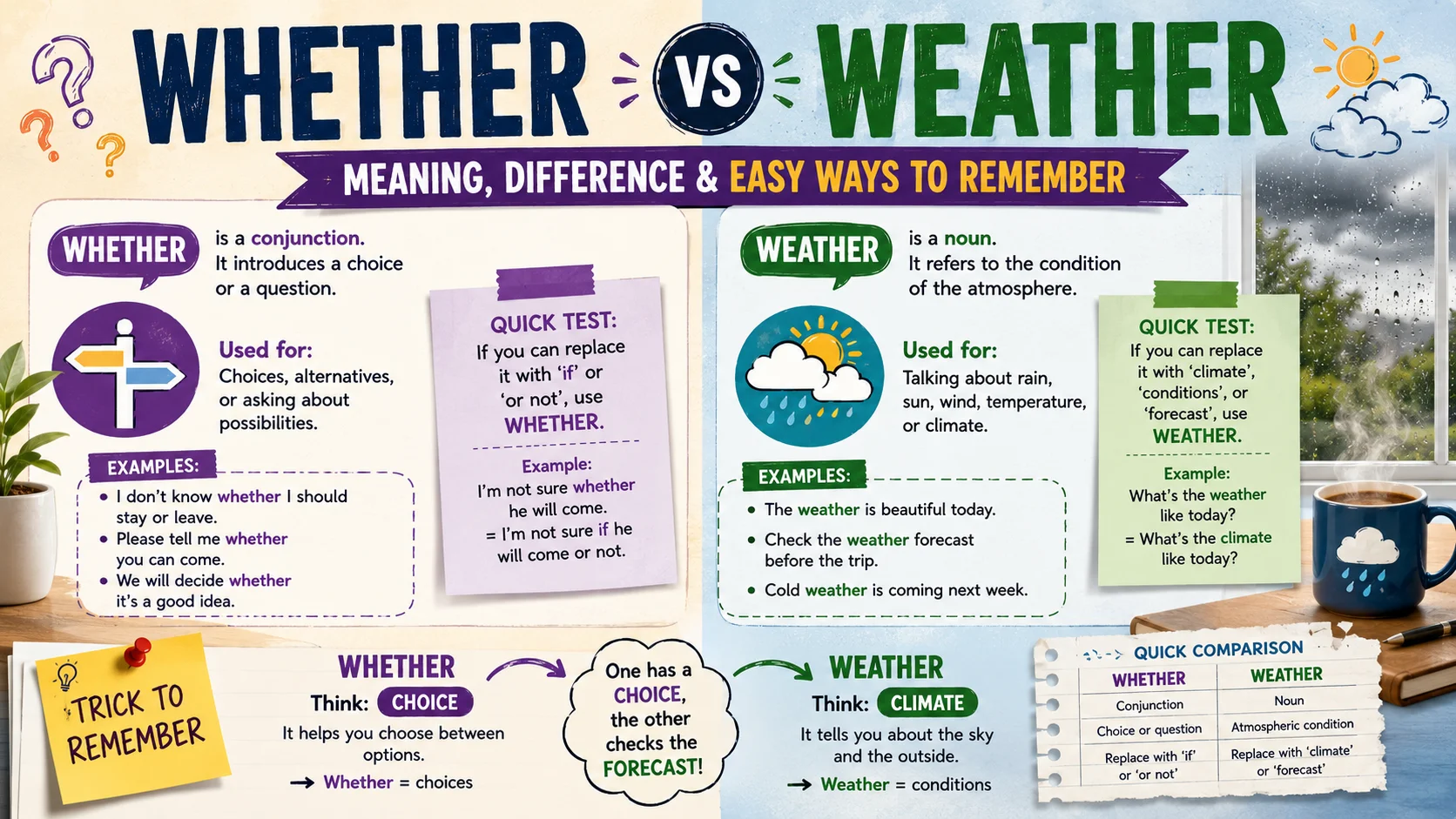
Whether vs weather is a common English word confusion because the two words sound very similar, especially in everyday speech. Despite their similar pronunciation, they have completely different meanings and functions.
Whether is used when talking about alternatives, possibilities, choices, or uncertainty. It often appears when someone is considering two or more possibilities, such as whether to stay or leave.
Weather, on the other hand, refers to the conditions of the atmosphere, including temperature, rain, wind, clouds, sunshine, and storms. It can also function as a verb in less common contexts.
The easiest way to remember the difference is simple: whether is about choices or possibilities, while weather is about the conditions outside.
This guide explains the whether vs weather meaning, pronunciation, grammar, common mistakes, sentence examples, differences, memory tricks, and everyday usage.
Quick Answer: Whether vs Weather
| Word | Meaning | Part of Speech | Example |
|---|---|---|---|
| Whether | Used for alternatives, choices, or possibilities | Conjunction | I don’t know whether she will come. |
| Weather | Atmospheric conditions | Noun | The weather is beautiful today. |
Simple Rule
Whether = choice or possibility
Weather = rain, sunshine, temperature, wind, etc.
What Does Whether Mean?
Whether is a conjunction used to introduce alternatives or express uncertainty between possibilities.
It commonly appears when someone is deciding between two options or is uncertain about an outcome.
Examples
- I don’t know whether he will come.
- She asked whether I needed help.
- We need to decide whether to stay.
- I’m not sure whether this is correct.
- Tell me whether you agree.
In each example, whether introduces a question, choice, or possibility.
What Does Weather Mean?
Weather refers to the condition of the atmosphere at a particular place and time.
Weather can include:
- Rain
- Snow
- Wind
- Sunshine
- Clouds
- Temperature
- Humidity
- Storms
- Fog
- Thunder
Examples
- The weather is warm today.
- We stayed home because of the bad weather.
- The weather forecast predicts rain.
- I love cold weather.
- The weather changed suddenly.
Whether vs Weather Meaning
The core difference is very easy:
Whether = a choice or possibility
Weather = atmospheric conditions
Compare:
I don’t know whether it will rain.
Here, whether introduces uncertainty.
I don’t like rainy weather.
Here, weather refers to atmospheric conditions.
Whether as a Conjunction
Whether is most commonly used as a conjunction.
It can introduce alternatives:
- whether you stay or leave
- whether we go today or tomorrow
- whether she agrees or disagrees
- whether it is true or false
Examples
- We need to decide whether we should go.
- I don’t know whether he is available.
- She asked whether I wanted coffee.
- They are discussing whether to change the plan.
Whether With Or
One of the most recognizable structures is:
whether … or …
This construction presents two or more possibilities.
Examples
- I don’t know whether to stay or leave.
- We need to decide whether to drive or take the train.
- Tell me whether you agree or disagree.
- She couldn’t decide whether to laugh or cry.
The word whether signals that the sentence involves alternatives.
Whether Without Or
Whether does not always need to appear with or.
Examples:
- I don’t know whether he is coming.
- She asked whether we were ready.
- I’m unsure whether this is the right choice.
- We need to determine whether the plan will work.
Even without or, whether can still introduce uncertainty.
Whether vs If
Whether and if can sometimes be used in similar sentences, but they are not always interchangeable.
Whether
Whether is particularly useful when there are alternatives.
Example:
I don’t know whether she will come.
If
If often introduces a condition.
Example:
I will call you if she comes.
This distinction is important.
Compare:
I don’t know whether he will come.
This expresses uncertainty.
I will call you if he comes.
This expresses a condition.
Whether to Do Something
Whether commonly appears before an infinitive with to.
Structure:
whether + to + verb
Examples:
- I don’t know whether to go.
- She couldn’t decide whether to stay.
- We need to determine whether to continue.
- He is unsure whether to accept the offer.
- They discussed whether to cancel the event.
This construction is very common in everyday and professional English.
Whether or Not
The phrase whether or not emphasizes two possible outcomes.
Examples:
- I will go whether or not you come.
- We need to decide whether or not to continue.
- She doesn’t know whether or not he is serious.
- The decision will happen whether or not everyone agrees.
In many sentences, whether alone is enough, but whether or not can add emphasis.
What Does Weather Mean in a Sentence?
Weather describes atmospheric conditions.
Good Weather
- The weather is sunny.
- We had beautiful weather during our vacation.
- The weather is perfect for a picnic.
Bad Weather
- The flight was delayed because of bad weather.
- Heavy weather caused problems on the roads.
- The storm brought dangerous weather conditions.
Changing Weather
- The weather changed quickly.
- The weather became colder overnight.
- We are expecting warmer weather tomorrow.
Weather as a Noun
Weather is primarily a noun.
It describes atmospheric conditions over a particular time or location.
Examples:
- The weather is cold.
- The weather forecast looks promising.
- Bad weather canceled the event.
- We enjoyed warm weather during our trip.
Weather as a Verb
Weather can also function as a verb, although this use is different from the everyday meaning of atmospheric conditions.
As a verb, weather can mean to survive or endure a difficult situation.
Examples:
- The company weathered the financial crisis.
- She weathered the difficult period successfully.
- The building weathered several major storms.
It can also describe how something changes because of exposure to the elements.
Example:
The wooden fence has weathered over time.
Whether vs Weather Pronunciation
The pronunciation of these words is one reason they are often confused.
Whether
Whether is commonly pronounced:
WEH-thər
IPA: /ˈwɛðər/
The middle consonant is the voiced th sound.
Weather
Weather is commonly pronounced:
WEH-thər
IPA: /ˈwɛðər/
In most varieties of standard English, the two words are pronounced the same or almost exactly the same.
This makes them homophones.
Their spelling and meaning are different even though their pronunciation is essentially identical.
Whether and Weather Are Homophones
A homophone is a word that sounds the same as another word but has a different spelling and meaning.
Whether and weather are a classic example.
Other common homophone pairs include:
- Their / there
- They’re / their
- To / too
- Two / too
- Your / you’re
- Hear / here
- See / sea
Because whether and weather sound alike, you need to use the meaning of the sentence to choose the correct spelling.
Whether vs Weather Examples
Example 1
Correct: I don’t know whether she will come.
The sentence expresses uncertainty.
Example 2
Correct: The weather is cold today.
The sentence describes atmospheric conditions.
Example 3
Correct: We need to decide whether to leave.
The sentence describes a choice.
Example 4
Correct: The bad weather delayed our flight.
The sentence describes atmospheric conditions.
Example 5
Correct: Tell me whether you agree.
The sentence involves a possibility or choice.
Example 6
Correct: The weather forecast says it will rain.
The sentence concerns atmospheric conditions.
Common Mistakes With Whether and Weather
Mistake 1: Using Weather for a Choice
Incorrect:
I don’t know weather I should go.
Correct:
I don’t know whether I should go.
Mistake 2: Using Whether for Atmospheric Conditions
Incorrect:
The whether is beautiful today.
Correct:
The weather is beautiful today.
Mistake 3: Confusing Weather Forecast With Whether
Incorrect:
Check the whether forecast.
Correct:
Check the weather forecast.
Mistake 4: Confusing Whether or Not
Incorrect:
I don’t know weather or not he will come.
Correct:
I don’t know whether or not he will come.
Whether vs Weather in Texting
These words are frequently confused in texting because autocorrect may not always identify the intended meaning.
Common mistakes include:
- I don’t know weather I should go.
- Let me know weather you agree.
- The whether is terrible today.
- Check the whether before leaving.
Correct versions:
- I don’t know whether I should go.
- Let me know whether you agree.
- The weather is terrible today.
- Check the weather before leaving.
Even though both words sound alike, their meanings are completely different.
Whether vs Weather in Formal Writing
Correct usage becomes especially important in professional and academic writing.
Whether
Use whether when discussing:
- Alternatives
- Decisions
- Possibilities
- Uncertainty
- Choices
Example:
The committee must determine whether the proposal meets the requirements.
Weather
Use weather when discussing:
- Atmospheric conditions
- Climate-related events
- Outdoor conditions
- Storms
- Temperature
- Rain or snow
Example:
The event may be postponed because of severe weather.
Whether vs Weather in Questions
Whether can introduce an indirect question.
Examples:
- I wonder whether he knows.
- She asked whether we were ready.
- Do you know whether they are coming?
- We need to find out whether the store is open.
Weather can appear in direct questions about atmospheric conditions.
Examples:
- How is the weather today?
- What will the weather be like tomorrow?
- Is the weather getting colder?
- Did the weather cause the delay?
Whether vs If: Important Difference
This is another common English question.
Use Whether for Alternatives
I don’t know whether to choose tea or coffee.
Use If for Conditions
I will call you if I have time.
However, in some indirect-question structures, whether and if can both work:
I don’t know whether he is coming.
I don’t know if he is coming.
Both can be acceptable, although whether is often preferred in formal writing.
Easy Memory Tricks
Memory Trick 1: Whether = Which Choice?
Think of whether whenever you are deciding between possibilities.
Ask yourself:
Which option?
If the sentence involves a choice or uncertainty, use whether.
Memory Trick 2: Weather = Outside
Think of weather whenever you are talking about what is happening outside.
Rain, snow, wind, sunshine, clouds, and temperature all relate to weather.
Memory Trick 3: Weather Has Weather Forecast
Remember the phrase:
weather forecast
You never write whether forecast when talking about rain or sunshine.
Memory Trick 4: Whether Has Alternatives
Think:
whether A or B
Examples:
- whether to stay or leave
- whether to accept or reject
- whether to go or stay
Whether vs Weather vs Wether
There is actually a third word that looks and sounds similar: wether.
Wether
A wether is a castrated male sheep or goat.
This word is uncommon outside agricultural or livestock contexts.
| Word | Meaning |
|---|---|
| Whether | Choice or possibility |
| Weather | Atmospheric conditions |
| Wether | Castrated male sheep or goat |
These three words can sound very similar, making them easy to confuse when writing.
Common Phrases With Whether
- Whether or not
- Whether to go
- Whether to stay
- Whether you agree
- Whether it is true
- Whether it works
- Whether he comes
- Whether she knows
- Whether we should continue
- Whether they are ready
Common Phrases With Weather
- Good weather
- Bad weather
- Cold weather
- Warm weather
- Hot weather
- Severe weather
- Stormy weather
- Weather forecast
- Weather conditions
- Weather report
- Weather warning
- Weather changes
- Extreme weather
- Wet weather
- Dry weather
Whether vs Weather Comparison
| Feature | Whether | Weather |
|---|---|---|
| Main meaning | Choice or possibility | Atmospheric conditions |
| Part of speech | Conjunction | Noun, sometimes verb |
| Pronunciation | /ˈwɛðər/ | /ˈwɛðər/ |
| Sounds like | Weather | Whether |
| Common structure | Whether … or … | The weather is … |
| Example | I wonder whether he knows. | The weather is cold. |
| Related idea | Choice | Rain, wind, temperature |
| Common phrase | Whether or not | Weather forecast |
How to Choose Between Whether and Weather
When you are unsure which spelling to use, look at the meaning.
Step 1: Is the sentence about a choice?
Use whether.
Example:
I can’t decide whether to go.
Step 2: Is the sentence about conditions outside?
Use weather.
Example:
The weather is beautiful.
Step 3: Does the sentence contain or suggest alternatives?
Use whether.
Example:
We need to decide whether to stay or leave.
Step 4: Could you talk about rain, wind, temperature, or sunshine?
Use weather.
Example:
The weather may change tomorrow.
Frequently Asked Questions
What is the difference between whether and weather?
Whether introduces a choice, possibility, or uncertainty. Weather refers to atmospheric conditions such as rain, wind, sunshine, and temperature.
Are whether and weather pronounced the same?
In standard English, whether and weather are generally pronounced the same or very similarly. This makes them homophones.
Is it whether or weather I should go?
The correct form is whether I should go because the sentence expresses uncertainty about a choice.
Is it good whether or good weather?
The correct phrase is good weather when describing pleasant atmospheric conditions.
Is it whether or weather forecast?
The correct phrase is weather forecast because a forecast predicts atmospheric conditions.
Is it whether or not or weather or not?
The correct phrase is whether or not when expressing alternatives or uncertainty.
Can whether and if mean the same thing?
Sometimes. In sentences expressing uncertainty, both can be possible, although whether is often preferred when presenting alternatives or in more formal writing.
What is the easiest way to remember whether and weather?
Remember whether = choice and weather = conditions outside.
Is weather always a noun?
Weather is primarily a noun, but it can also function as a verb meaning to endure, survive, or change through exposure.
What is the difference between whether, weather, and wether?
Whether refers to alternatives, weather refers to atmospheric conditions, and wether refers to a castrated male sheep or goat.
Conclusion
Understanding whether vs weather becomes much easier once you focus on their meanings rather than their pronunciation. Although the two words sound the same in standard English, they serve completely different purposes.
Use whether when discussing a choice, possibility, or uncertainty. It commonly appears in structures such as whether to go, whether or not, and whether this is true.
Use weather when talking about atmospheric conditions such as rain, sunshine, wind, temperature, snow, or storms. Remember phrases such as weather forecast, bad weather, and severe weather.
The simplest rule is:
Whether = choice or possibility
Weather = conditions outside
Once you connect each spelling with its meaning, this common homophone confusion becomes much easier to avoid in everyday, academic, and professional writing.

Olivia Bennett is a writer and language enthusiast at Vocabsteria. She is passionate about exploring word meanings, name origins, and cultural expressions from around the world.