Compliment vs complement is one of the most common spelling and vocabulary confusions in English. The two words sound exactly alike in most varieties of English, but they have completely different meanings.
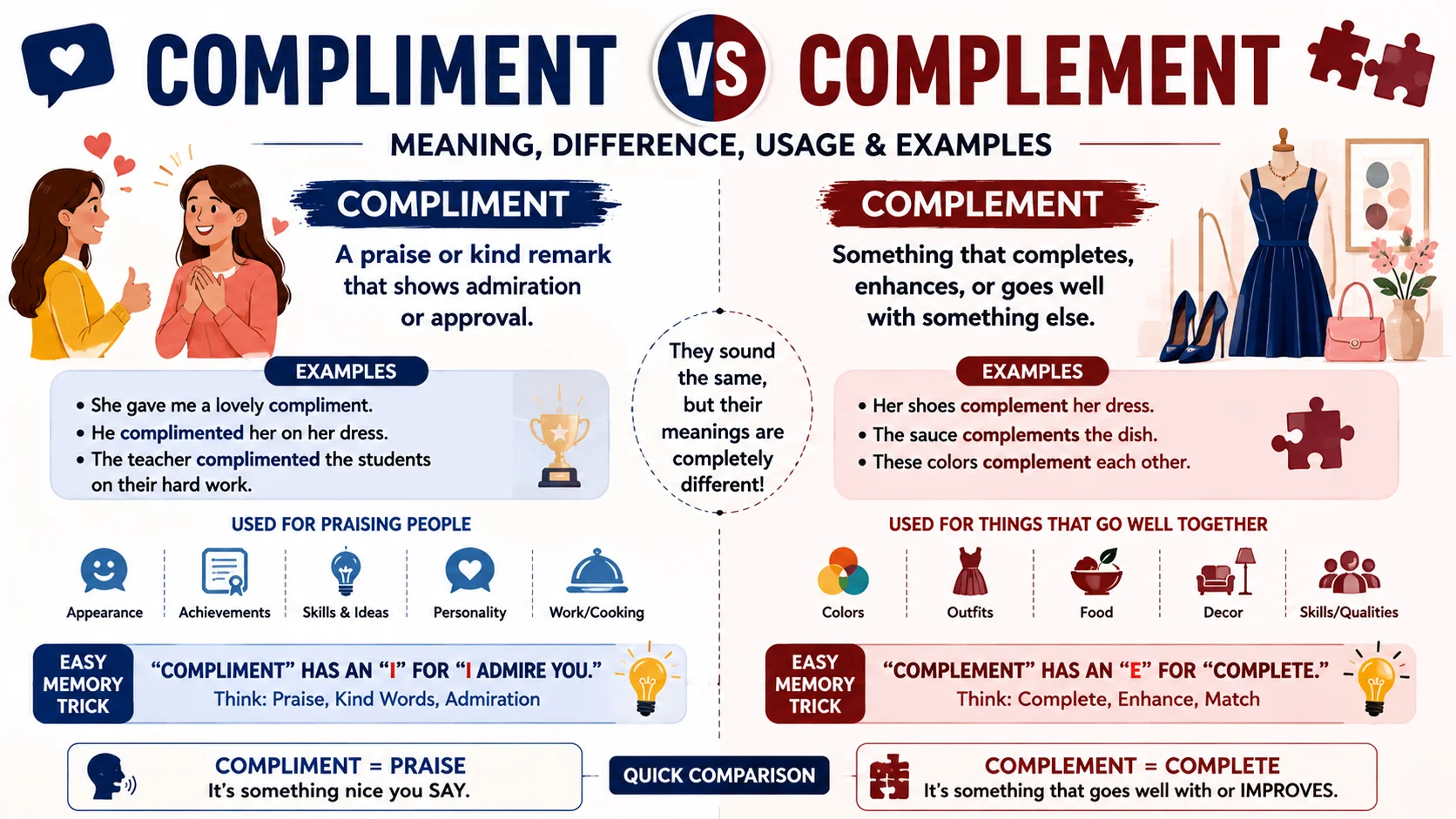
Compliment refers to praise, admiration, or a polite expression of approval. Complement refers to something that completes, improves, or goes well with something else.
For example, if you tell someone that their outfit looks beautiful, you are giving them a compliment. If you say that a blue shirt complements their eyes, you mean the shirt enhances or goes well with their eyes.
The easiest way to remember the difference is to connect compliment with praise and complement with complete. Once you understand this simple distinction, choosing the correct spelling becomes much easier.
Compliment vs Complement: Quick Answer
Compliment means praise or an expression of admiration.
Complement means something that completes, enhances, or works well with something else.
| Word | Meaning | Example |
|---|---|---|
| Compliment | Praise or admiration | She gave me a nice compliment. |
| Complement | Something that completes or enhances | The shoes complement her dress. |
Easy Memory Trick
Think:
Compliment = praise
Complement = complete
The extra e in complement can remind you of complete.
What Does Compliment Mean?
A compliment is a positive remark that expresses admiration, approval, or appreciation.
You can compliment someone on their:
- Appearance
- Clothing
- Work
- Skills
- Personality
- Performance
- Achievements
- Cooking
- Creativity
- Ideas
Examples of Compliment
- She gave me a lovely compliment.
- He complimented her on her new hairstyle.
- The teacher complimented the students on their hard work.
- I received several compliments about my presentation.
- He paid her a sincere compliment.
- She complimented me on my cooking.
In all these examples, the word relates to praise or appreciation.
What Does Complement Mean?
A complement is something that completes, enhances, balances, or works well with something else.
For example:
The red curtains complement the furniture.
This means the curtains look good with the furniture and enhance its overall appearance.
Complement can also refer to something that completes a whole.
Examples:
- The sauce complements the dish perfectly.
- Her shoes complement her outfit.
- The lighting complements the room’s design.
- The two colors complement each other.
- Fresh herbs are the perfect complement to the meal.
Compliment vs Complement: The Main Difference
The easiest distinction is:
Compliment = something nice you say.
Complement = something that goes well with or completes something else.
Compare these sentences:
She gave me a compliment about my dress.
She praised your dress.
Her shoes complement her dress.
The shoes look good with the dress.
The first sentence involves praise. The second describes how two things work well together.
Compliment as a Noun
As a noun, compliment means a statement of praise or admiration.
Examples:
- That was a wonderful compliment.
- She received a lot of compliments on her artwork.
- He gave me a sincere compliment.
- Your kind compliment made my day.
- She smiled after hearing the compliment.
Common Compliment Phrases
- Give someone a compliment
- Receive a compliment
- Pay someone a compliment
- Accept a compliment
- Return a compliment
- Take a compliment
Compliment as a Verb
As a verb, compliment means to praise someone or something.
Examples:
- I complimented her on her dress.
- He complimented my cooking.
- The manager complimented the team on its performance.
- She complimented him on his excellent presentation.
- They complimented the chef on the meal.
The verb forms are:
- Compliment
- Compliments
- Complimented
- Complimenting
Complement as a Noun
As a noun, complement refers to something that completes, improves, or goes well with something else.
Examples:
- The wine was a perfect complement to the meal.
- The scarf is a nice complement to her outfit.
- The new furniture is a great complement to the room.
- Her skills are an excellent complement to the team.
- The sauce makes a perfect complement to the dish.
In these sentences, complement describes something that adds to or enhances another thing.
Complement as a Verb
As a verb, complement means to improve, enhance, or complete something.
Examples:
- The blue curtains complement the walls.
- Her shoes complement her dress.
- The music complements the atmosphere.
- These colors complement each other.
- The new software complements our existing system.
The verb forms are:
- Complement
- Complements
- Complemented
- Complementing
Compliment vs Complement in Sentences
Seeing the words side by side makes the difference easier to understand.
Compliment
She complimented me on my presentation.
She praised your presentation.
Complement
The visuals complemented the presentation.
The visuals improved or worked well with the presentation.
Compliment
He gave her a compliment.
He said something positive about her.
Complement
Her necklace was a perfect complement to her dress.
The necklace enhanced the appearance of the dress.
Common Mistakes With Compliment and Complement
Mistake 1: Complementing Someone
❌ I want to complement your new haircut.
If you mean praise, this spelling is incorrect.
✅ I want to compliment your new haircut.
Mistake 2: Complimenting an Outfit
❌ The shoes compliment your dress.
If you mean the shoes look good with the dress, use complement.
✅ The shoes complement your dress.
Mistake 3: Compliment to a Meal
❌ The sauce is a perfect compliment to the meal.
If the sauce enhances or completes the meal, use complement.
✅ The sauce is a perfect complement to the meal.
Mistake 4: Complementing Someone’s Work
❌ She complemented him on his excellent work.
If she praised his work, use complimented.
✅ She complimented him on his excellent work.
Compliment vs Complement: Easy Memory Trick
The easiest trick is:
Compliment = Praise
If you are saying something nice about someone, use compliment.
Think:
Compliment = kindness and praise
Examples:
- Give a compliment
- Receive a compliment
- Compliment someone’s appearance
- Compliment someone’s work
Complement = Complete
If one thing improves, completes, or works well with another, use complement.
Think:
Complement = complete
Examples:
- Colors complement each other.
- Shoes complement an outfit.
- Sauce complements a meal.
- Skills complement a team.
Compliment vs Complement in Fashion
Fashion provides some of the clearest examples.
Compliment
She complimented me on my dress.
She praised the dress.
Complement
The shoes complement my dress.
The shoes match or enhance the dress.
Both words can appear in the same situation but describe different ideas.
For example:
Sarah complimented Emma on her outfit because the colors complemented each other perfectly.
Here:
- Complimented = praised
- Complemented = matched or enhanced
Compliment vs Complement in Food
The same distinction applies to food.
Compliment
The chef received many compliments about the dessert.
People praised the dessert.
Complement
The fresh berries complement the cheesecake.
The berries enhance the cheesecake.
This distinction is especially useful in restaurant reviews and food writing.
Compliment vs Complement in Relationships
You can also use both words when discussing relationships.
Compliment
She complimented her partner on his new haircut.
She praised his haircut.
Complement
Their personalities complement each other.
Their personalities work well together.
Notice how the meanings remain different even though the words sound the same.
Compliment vs Complement in the Workplace
These words frequently appear in professional writing.
Compliment
The manager complimented the employee on her excellent performance.
The manager praised her.
Complement
His technical skills complement the team’s creative abilities.
His skills add value to the team and work well with the other abilities.
Compliment vs Complement in Grammar
Both words can function as nouns and verbs, but their meanings remain distinct.
| Word | Noun Meaning | Verb Meaning |
|---|---|---|
| Compliment | Praise | To praise |
| Complement | Something that completes or enhances | To complete or enhance |
Compliment
Noun: She gave me a compliment.
Verb: She complimented me.
Complement
Noun: The sauce is a perfect complement to the meal.
Verb: The sauce complements the meal.
Complementary vs Complimentary
The confusion becomes even greater when you encounter complementary and complimentary.
Complementary
Complementary means things that work well together or enhance each other.
Examples:
- The two colors are complementary.
- Their skills are complementary.
- The flavors are complementary.
This word comes from complement.
Complimentary
Complimentary can mean expressing praise or provided free of charge.
Examples:
- She made complimentary remarks about his work.
- The hotel offers complimentary breakfast.
- Guests received complimentary tickets.
This word comes from compliment.
Easy Comparison
Complementary = works well together
Complimentary = praise or free
Compliment vs Complement: Common Phrases
Compliment
Common expressions include:
- Give a compliment
- Pay a compliment
- Receive a compliment
- Accept a compliment
- Compliment someone
- Compliment someone on something
- Take a compliment
Examples:
- She gave me a compliment.
- He complimented her on her dress.
- I received several compliments.
Complement
Common expressions include:
- Complement each other
- Complement an outfit
- Complement a meal
- Complement a design
- Complement someone’s skills
- A perfect complement
- A natural complement
Examples:
- The colors complement each other.
- The sauce complements the dish.
- Her skills complement the team.
Compliment vs Complement: Quick Comparison Table
| Feature | Compliment | Complement |
|---|---|---|
| Main meaning | Praise | Complete or enhance |
| Related word | Praise | Complete |
| Noun | A kind remark | Something that enhances |
| Verb | To praise | To enhance or complete |
| Example | She gave me a compliment. | The shoes complement the outfit. |
| Related adjective | Complimentary | Complementary |
How to Choose the Correct Word
Ask yourself one simple question:
Am I praising someone?
If yes, choose compliment.
I want to compliment you on your work.
Am I describing how two things work together?
If yes, choose complement.
The colors complement each other.
Am I talking about something free?
Use complimentary.
The hotel provides complimentary breakfast.
Am I describing things that work well together?
Use complementary.
The two flavors are complementary.
Examples to Test Yourself
Choose the correct word in each sentence.
1. She gave me a nice ______ on my hairstyle.
Answer: compliment
She praised your hairstyle.
2. The blue curtains ______ the gray walls.
Answer: complement
The curtains enhance the walls.
3. He ______ me on my presentation.
Answer: complimented
He praised your presentation.
4. The sauce is a perfect ______ to the dish.
Answer: complement
The sauce enhances the dish.
5. The hotel offers ______ breakfast.
Answer: complimentary
The breakfast is provided free.
6. Their skills are ______.
Answer: complementary
Their skills work well together.
Frequently Asked Questions
What is the difference between compliment and complement?
Compliment means praise or admiration, while complement means something that completes, improves, or works well with something else.
Is it compliment or complement someone?
Use compliment when you mean praise someone.
Correct: She complimented me on my dress.
Is it complement or compliment an outfit?
Use complement when you mean that something looks good with or enhances an outfit.
Correct: The shoes complement the dress.
How do I remember compliment vs complement?
Remember compliment = praise and complement = complete. If you are saying something nice, use compliment. If something enhances or completes another thing, use complement.
Are compliment and complement pronounced the same?
Yes. In standard English, they are generally pronounced the same, making them homophones.
What is the noun form of compliment?
The noun is compliment, meaning a statement of praise or admiration.
Example: She gave me a compliment.
What is the noun form of complement?
The noun is complement, meaning something that completes, enhances, or works well with another thing.
Example: The sauce is a perfect complement to the meal.
What is the difference between complimentary and complementary?
Complimentary can mean expressing praise or provided free of charge. Complementary means things that work well together or enhance each other.
Is complimentary breakfast related to compliment?
Yes. Complimentary can mean something provided free of charge, such as complimentary breakfast or complimentary tickets. It is spelled with an i because it comes from the word compliment.
Can a sentence use both compliment and complement?
Yes.
Example:
She complimented me on my outfit because the colors complemented each other.
Here, complimented means praised, while complemented means worked well together.
Conclusion
The difference between compliment vs complement becomes simple when you connect each word with its core meaning.
Use compliment when you mean praise, admiration, or a kind remark. You can give someone a compliment, receive a compliment, or compliment someone on their appearance, work, skills, or personality.
Use complement when you mean complete, enhance, or work well with something else. Colors can complement each other, shoes can complement an outfit, and ingredients can complement a meal.
The easiest memory trick is:
Compliment = praise
Complement = complete
Also remember the related adjectives: complimentary can mean praise or something provided free of charge, while complementary describes things that work well together.
Once you connect compliment with praise and complement with completion, you’ll have a much easier time choosing the correct spelling.

Olivia Bennett is a writer and language enthusiast at Vocabsteria. She is passionate about exploring word meanings, name origins, and cultural expressions from around the world.